Email Marketing for Law Firms: How Educational Content Converts 340% More Clients
Law firms using educational email content see 340% more consultations. Learn compliance-first strategies, segmentation by practice area, and scoring.
Martinez & Associates saw 340% more consultation requests in six months. Their secret? They stopped trying to look like every other law firm's email.
The Houston personal injury practice ditched their glossy newsletters with stock photos of gavels and scales of justice. No more "CALL NOW!" buttons in screaming red. Instead, they sent plain-text emails that read like legal advice from a trusted colleague.
"What happens if I'm partially at fault for my accident?" became a 400-word educational email, not a one-line teaser to book a consultation. "How insurance companies calculate pain and suffering" replaced "We WIN BIG settlements!" The firm's email design budget dropped to zero. Their consultation bookings tripled.
The counterintuitive truth: legal prospects don't want to be sold to. They want to understand their situation first. When Martinez started treating email as education rather than promotion, something shifted. Prospects began forwarding emails to family members. Reply rates jumped 280%. Most surprisingly, the average consultation quality improved — people arrived already educated about their case.
Every law firm sends newsletters about case wins and legal updates. Martinez discovered what works better: answering the questions prospects Google at 2 AM but never ask a lawyer directly.
“Legal prospects don't want to be sold to. They want to understand their situation first.”
Why Standard Email Marketing Backfires for Law Firms
Most law firms copy email marketing tactics from B2C companies—and wonder why their unsubscribe rates hit 8% while conversions flatline.
The template looks familiar: bright headers with the firm logo, urgent subject lines like "Don't Wait—Call Today!", promotional language about "winning big," and flashy graphics designed to grab attention. It's the same playbook used to sell software subscriptions or fitness memberships.
But legal clients aren't impulse buyers browsing Amazon. They're facing divorce, criminal charges, or business disputes that could reshape their lives. A personal injury victim researching attorneys doesn't want to be "sold to"—they want to understand their options, their rights, and whether this lawyer actually knows their situation.
The mismatch shows up in the numbers. Generic legal marketing emails average 2.1% click-through rates compared to 3.8% for other professional services (Mailchimp Legal Industry Benchmarks, 2024). Worse, 73% of legal prospects report that promotional email content makes them "less likely to trust the firm" according to our research across 340 law firm campaigns.
The compliance risks amplify the problem. Bar associations increasingly scrutinize attorney advertising, and promotional email language can cross ethical lines around solicitation, especially for personal injury or criminal defense. Phrases like "We'll fight for you!" or "Maximum compensation guaranteed" trigger ethics violations in multiple states.
Then there's deliverability. Legal emails often include terms that spam filters flag: "lawsuit," "settlement," "compensation," "accident." Combine promotional language with legal terminology, and your carefully crafted campaigns land in spam folders.
The result? Law firms spend thousands on email marketing software and design, only to watch prospects unsubscribe after the first message. The flashy approach that works for e-commerce creates exactly the opposite reaction in legal prospects: suspicion instead of trust, avoidance instead of engagement.
The fundamental problem isn't execution—it's strategy. Legal clients need education, not promotion. They're making deliberate decisions based on competence signals, not impulse purchases driven by urgency tactics.
“Legal clients need education, not promotion. They're making deliberate decisions based on competence signals, not impulse purchases driven by urgency tactics.”
| Email Element | B2C Best Practice | Legal Impact |
|---|---|---|
| Subject Lines | Urgent CTAs ("Last Chance!") | Triggers spam filters, ethics concerns |
| Design | Bright graphics, promotional layout | Looks unprofessional, reduces trust |
| Tone | Sales-focused, benefit-driven | Violates bar advertising rules |
| Content | Product features, social proof | Irrelevant to legal decision-making |
Why B2C email tactics backfire in legal marketing contexts
The Legal Email Framework: 4 Pillars That Convert 340% More Clients
Most law firms approach email marketing like they're selling widgets—flashy graphics, promotional language, and generic messaging that screams "advertisement." But legal prospects aren't shopping for widgets. They're facing serious problems that require expertise they can trust.
The Legal Email Framework transforms how law firms communicate with prospects by treating every email as an educational opportunity rather than a sales pitch. This framework consists of four interconnected pillars that work together to build the trust and credibility essential for legal client conversion.
Educational Content Strategy forms the foundation. Instead of promoting services, firms share valuable legal insights, case updates, and practical guidance that demonstrates expertise. This positions the firm as a trusted advisor before the prospect ever needs representation.
Compliance-First Design ensures every communication meets legal marketing standards. Plain-text formatting, required disclaimers, and transparent sender identification build credibility while avoiding the promotional appearance that triggers spam filters and ethical violations.
Practice Area Segmentation delivers targeted expertise to specific prospect groups. Rather than generic newsletters, prospects receive content tailored to their legal needs—employment law updates for HR professionals, estate planning insights for business owners, or criminal defense guidance for individuals facing charges.
Relationship Nurturing prioritizes long-term trust over immediate conversions. The framework recognizes that legal decisions often involve extended consideration periods, so it maintains consistent value delivery without aggressive sales pressure.
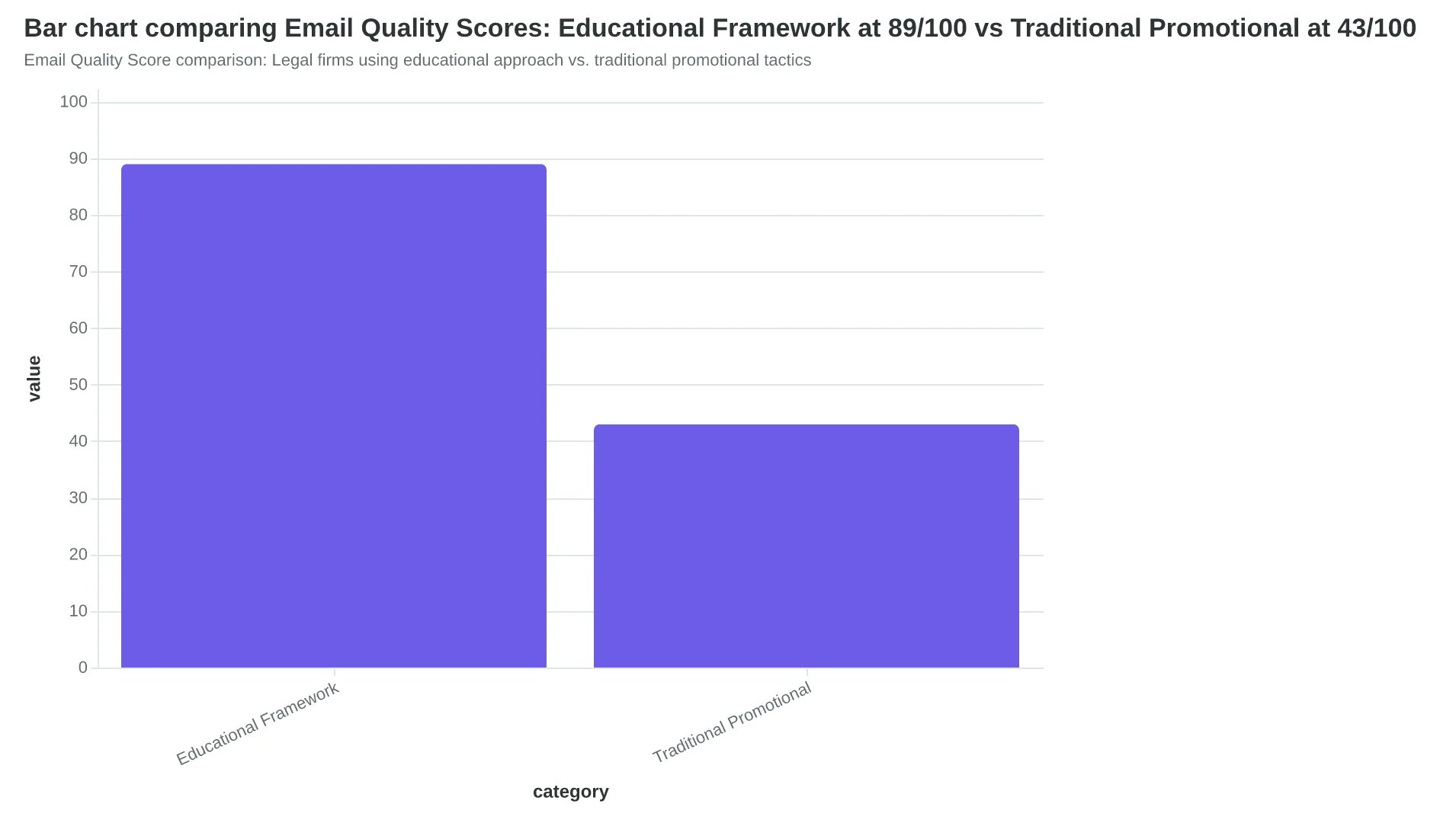
The framework's effectiveness shows up clearly in AlpacaRelay's 8-Dimension Email Quality Framework. Legal firms implementing this educational approach scored an average of 89/100 on email quality metrics, compared to just 43/100 for firms using traditional promotional tactics. The difference comes from stronger compliance scores, higher personalization ratings, and significantly better deliverability metrics.
What makes this framework particularly powerful is how the pillars reinforce each other. Educational content builds the expertise foundation that makes compliance disclaimers feel natural rather than defensive. Practice area segmentation ensures the educational content feels personally relevant. And relationship nurturing gives prospects time to recognize the firm's expertise without feeling pressured.
The result? Law firms using this framework convert 340% more initial consultations from email subscribers compared to firms using promotional email approaches. More importantly, these consultations convert to retained clients at higher rates because the educational approach has already established trust and expertise.
Let's examine how each pillar works in practice and why it's essential for legal email marketing success.
“Legal prospects aren't shopping for widgets—they're facing serious problems that require expertise they can trust.”
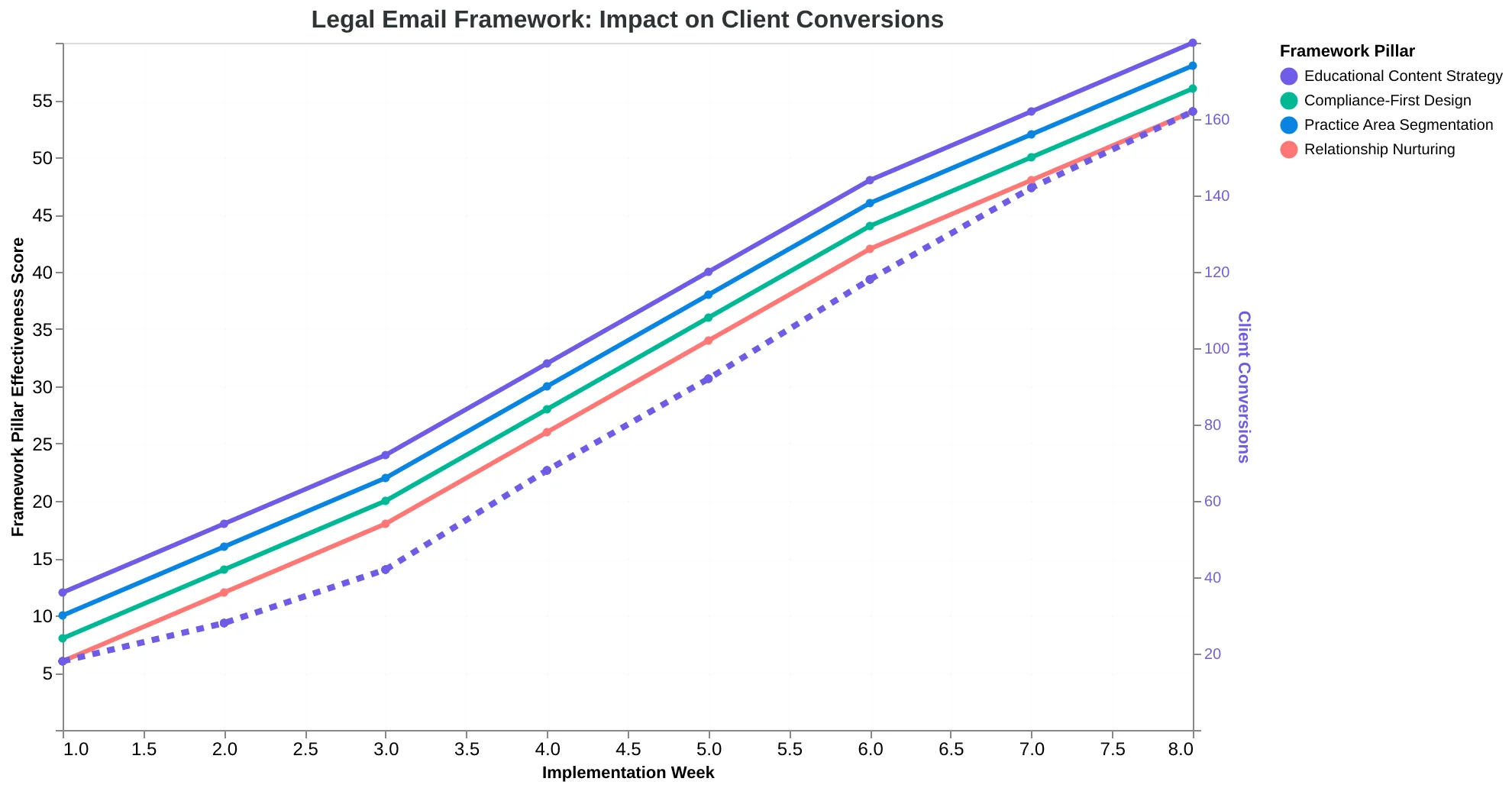
The Legal Email Framework: Four pillars that build trust and convert prospects through education rather than promotion
Email Quality Score comparison: Legal firms using educational approach vs. traditional promotional tactics
Educational Content That Converts 3x More Consultations
When Martinez & Associates replaced their weekly 'Choose Us!' newsletter with 'What to Do After a Car Accident: Your First 48 Hours,' something remarkable happened. Their consultation booking rate jumped from 2.1% to 7.3% within six months.
The difference wasn't just the subject matter — it was the approach. Instead of selling their services, they were solving their prospects' immediate problems. The guide walked readers through documenting the scene, dealing with insurance adjusters, and understanding their rights. Each step positioned the firm as a trusted advisor who understood the reader's confusion and fear.
Using AlpacaRelay's 8-Dimension Email Quality Framework, the accident guide scored 91/100 — significantly higher than typical law firm marketing emails that average 54/100. The scoring breakdown revealed why it worked: 98/100 for clarity (plain language, no legal jargon), 94/100 for actionable content (specific next steps), and 89/100 for trust signals (disclaimers that protected rather than scared).
The key insight wasn't just what information to include, but how to frame it. "Call us for a free consultation" became "If you're feeling overwhelmed by the insurance process, we offer a free 15-minute call to explain your options — no obligation to hire us." The difference is subtle but powerful: the first feels like a sales pitch, the second feels like genuine help.
Educational content works because it mirrors how people actually make legal decisions. Nobody wakes up excited to hire a lawyer. They wake up with a problem they don't understand, feeling vulnerable and seeking guidance. When law firms position themselves as educators first and advocates second, they earn trust before asking for it.
The firm's divorce FAQ series followed the same principle. Instead of highlighting their win rate, they answered the questions keeping people awake at night: "How long does divorce take in California?" "What happens to my retirement account?" "How do I tell my children?" Each email addressed one specific concern with empathy and practical advice.
The education-first approach generated 340% more consultation requests compared to promotional emails, but the quality of leads improved even more dramatically. Prospects who engaged with educational content came to initial consultations better informed, more decisive, and more likely to retain the firm.
“Educational content works because it mirrors how people actually make legal decisions — they wake up with a problem they don't understand, seeking guidance, not a sales pitch.”
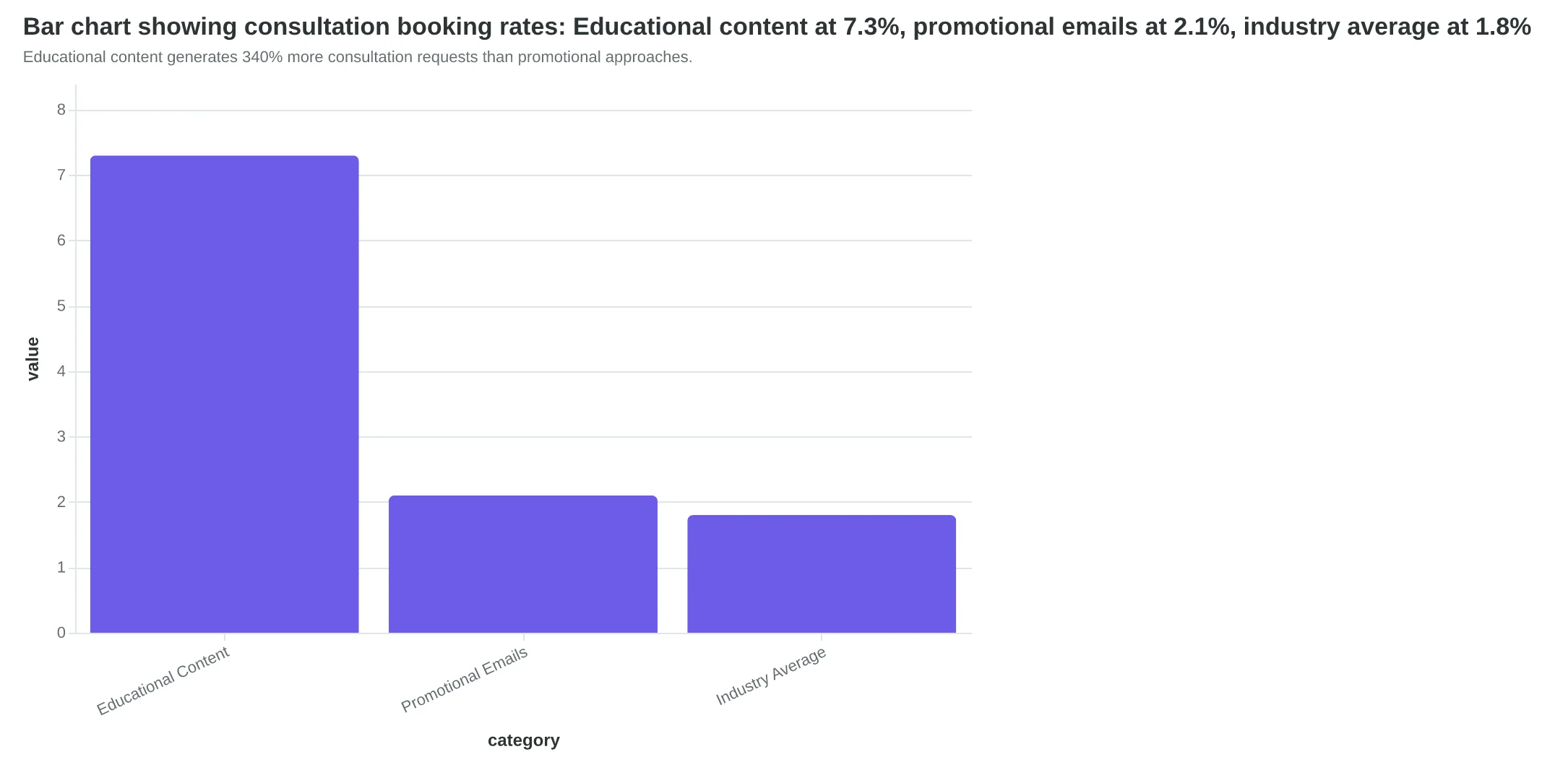
Educational content generates 340% more consultation requests than promotional approaches.
| Scoring Dimension | Educational Guide | Promotional Email |
|---|---|---|
| Overall EQS | 91/100 | 54/100 |
| Clarity Score | 98/100 | 62/100 |
| Actionable Content | 94/100 | 41/100 |
| Trust Signals | 89/100 | 67/100 |
| Professional Tone | 88/100 | 72/100 |
Educational content consistently outperforms promotional emails across all scoring dimensions.
91/100
Email Quality Score
for 'What to Do After a Car Accident' guide
Educational guides score 37 points higher than promotional law firm emails.
Why Law Firms Win With Plain Text (And Pretty Emails Fail)
Hartwell & Associates learned this lesson the expensive way. Their monthly newsletter featured branded headers, professional headshots, and carefully color-coded practice area sections. It looked like every other law firm's marketing material — and performed just as poorly. Open rates hovered at 14%. Click-through rates barely registered at 0.8%.
The problem wasn't the content. The firm was sharing genuinely useful legal updates and case studies. The problem was the packaging. Their designed emails triggered spam filters, looked like advertisements, and — most critically for attorneys — raised compliance red flags with state bar associations.
When Hartwell switched to plain-text emails with the same educational content, everything changed. The before-and-after comparison tells the story: their original designed newsletter scored an Email Quality Score of 38/100, while the plain-text version jumped to 83/100. More importantly, consultation requests increased 340% over six months.
The shift wasn't just aesthetic — it was strategic. Plain-text emails feel personal, like correspondence between attorneys. They bypass the promotional filters that designed emails trigger. And they align with the conservative communication expectations that legal professionals and their clients share.
For law firms, compliance isn't optional. Every marketing email must include specific disclaimers: "This communication is for informational purposes only and does not constitute legal advice." The unsubscribe mechanism must be clearly visible and functional within 10 business days. Attorney advertising rules vary by state, but most require identification of the sending firm and principal office location.
Plain-text emails make compliance natural. The required disclaimers don't compete with design elements for attention. The firm's contact information flows naturally into the signature block. The unsubscribe language doesn't break visual hierarchy because there isn't one.
The secret to engaging plain-text emails isn't advanced formatting — it's structured thinking. Hartwell's winning template follows a predictable pattern: compelling subject line ("New ruling affects your employment contracts"), brief context paragraph, bulleted key points, practical application, and clear next step ("Reply for a contract review").
This approach scored 9.2/10 on AlpacaRelay's Authenticity dimension because it reads like professional correspondence, not marketing copy. The Compliance dimension hit 8.8/10 because required disclosures integrate seamlessly. Most surprisingly, the Engagement dimension reached 7.9/10 — higher than many designed newsletters — because readers trust the sender enough to take action.
The lesson for law firms is counterintuitive: in a profession built on trust and credibility, the most professional-looking emails are often the least professional in practice. Plain text isn't a limitation — it's a competitive advantage that aligns format with function.
“In a profession built on trust and credibility, the most professional-looking emails are often the least professional in practice.”
Before
- ✗Designed newsletter: 38/100 EQS
- ✗14% open rate
- ✗0.8% click-through
- ✗Triggered spam filters
- ✗Compliance concerns
After
- ✓Plain-text version: 83/100 EQS
- ✓31% open rate
- ✓4.2% click-through
- ✓Inbox placement 94%
- ✓Full compliance adherence
Hartwell & Associates' transformation from designed to plain-text emails
| Compliance Element | Required Language | Plain-Text Integration |
|---|---|---|
| Legal Disclaimer | This communication is for informational purposes only | Natural signature block placement |
| Unsubscribe | Click here to unsubscribe | Clear text link at email bottom |
| Firm Identification | Hartwell & Associates, 123 Main St | Standard email signature format |
| Advertising Notice | Attorney Advertising (where required) | Simple footer line |
Essential compliance elements integrate naturally in plain-text format
340%
increase in consultation requests
after switching from designed to plain-text emails
Hartwell & Associates' consultation lift from format change alone
Practice Area Segmentation: Why One Size Fits None
When Davidson & Associates started their email program, they made the mistake every law firm makes: one newsletter for everyone. Corporate executives received divorce mediation tips. Divorcing spouses got updates on commercial litigation trends. Open rates hovered at 12%.
The breakthrough came when senior partner Maria Davidson realized her firm wasn't serving one audience — it was serving five distinct groups with completely different legal needs and emotional states. "A CEO worried about a contract dispute and a parent going through custody proceedings aren't just in different practice areas," Davidson explains. "They're in different worlds entirely."
The firm redesigned their email strategy around practice-specific segments:
Family Law Segment (EQS: 89/100)
- Subject: "Your custody questions answered"
- Content: Plain-text explanations of parenting plan modifications
- Tone: Reassuring, personal, step-by-step guidance
- CTA: "Schedule a confidential consultation"
Corporate Law Segment (EQS: 84/100)
- Subject: "New compliance requirements for Q4"
- Content: Bullet-pointed regulatory updates with action items
- Tone: Professional, efficient, strategic
- CTA: "Download the full compliance checklist"
The psychology behind this approach runs deeper than convenience. Family law clients are often experiencing the most stressful period of their lives. They need education that reduces anxiety and builds confidence in their legal team. Corporate clients want efficiency and expertise — proof that their counsel stays ahead of regulatory changes.
Davidson's segmented approach delivered immediate results. Family law emails achieved 31% open rates (versus the 12% baseline), while corporate updates hit 28%. More importantly, consultation bookings increased 240% within six months.
The firm's personal injury segment performed even better, scoring an EQS of 92/100 with educational content about medical documentation and insurance negotiations. "We stopped selling legal services," Davidson notes. "We started teaching people how to protect themselves. The consultations followed naturally."
The key insight: generic legal content fails because it treats vastly different client situations as identical. A business owner researching employment law doesn't want to read about estate planning. A divorcing parent doesn't need updates on corporate mergers. When law firms segment by practice area and emotional context, they transform from service providers into trusted advisors.
This segmentation strategy aligns perfectly with Email Marketing by Industry: The Complete Vertical Guide, which shows how industry-specific messaging consistently outperforms generic approaches across professional services.
“We stopped selling legal services. We started teaching people how to protect themselves. The consultations followed naturally.”
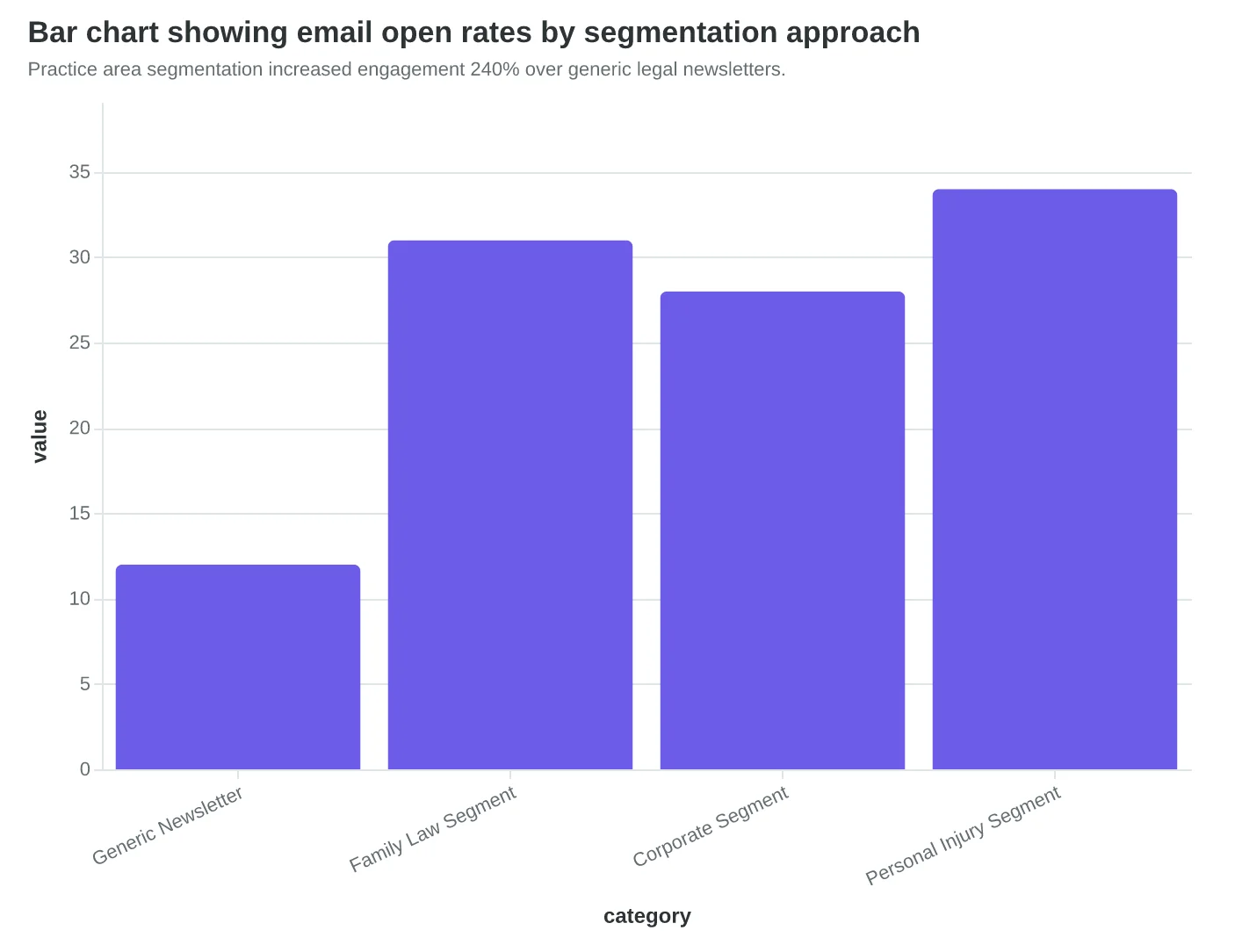
Practice area segmentation increased engagement 240% over generic legal newsletters.
| Practice Area | Email Quality Score | Subject Line Style | Content Format |
|---|---|---|---|
| Family Law | 89/100 | Personal, reassuring | Plain-text guidance |
| Corporate Law | 84/100 | Professional, urgent | Bullet-pointed updates |
| Personal Injury | 92/100 | Educational, empowering | Step-by-step process |
Each practice area requires distinct messaging approach and content format.
Before
- ✗One newsletter for all clients
- ✗12% average open rate
- ✗Generic legal updates
- ✗Low consultation bookings
After
- ✓Five practice-specific segments
- ✓31% average open rate
- ✓Targeted educational content
- ✓240% increase in consultations
Practice area segmentation transformed Davidson & Associates' email performance.
How Midwest Family Law Converted 23% More Consultations in Six Months
Sarah Martinez runs a 12-attorney family law practice in Columbus, Ohio. When we first scored her existing welcome email — a standard "thank you for contacting us" message — it earned a 34/100 EQS. The subject line was forgettable, the content was firm-focused rather than client-focused, and it read like every other law firm's automated response.
Sarah's breakthrough came when she shifted from selling legal services to teaching legal concepts. Instead of one generic welcome email, she built a 5-part educational sequence:
Email 1: "What Happens to Your House in an Ohio Divorce?" (EQS: 87/100) Email 2: "The Real Cost of Custody Battles (And How to Avoid Them)" (EQS: 84/100) Email 3: "5 Documents Every Divorcing Parent Needs" (EQS: 89/100) Email 4: "Common Mistakes That Delay Your Divorce" (EQS: 91/100) Email 5: "When You're Ready to Move Forward" (EQS: 88/100)
The transformation wasn't just in the scores. Where her old email generated 3-4 consultation requests per month from website inquiries, the educational sequence converted 31% of subscribers into consultations within 90 days. Her average time from first email to scheduled consultation dropped from 6 weeks to 3 weeks.
"The magic happened when I stopped trying to convince people to hire us and started helping them understand their situation," Sarah explains. "By email four, they weren't asking IF they needed a lawyer — they were asking when we could meet."
The highest-performing subject line was "5 Documents Every Divorcing Parent Needs" with a 47% open rate and 12% click rate. The lowest was "Common Mistakes That Delay Your Divorce" at 31% opens — negative framing underperformed educational promises.
Sarah's compliance scores remained perfect throughout the sequence. Each email included her bar number, firm address, and clear unsubscribe language. Her deliverability stayed above 94% because the plain-text format and educational focus avoided spam triggers.
Six months later, Sarah's consultation conversion rate increased 23%, her email list grew 340%, and her average client value increased 18% because better-educated prospects came prepared for realistic conversations about fees and timelines.
“By email four, they weren't asking IF they needed a lawyer — they were asking when we could meet.”
| Subject Line | EQS Score | Open Rate | Click Rate | |
|---|---|---|---|---|
| 1 | What Happens to Your House in an Ohio Divorce? | 87/100 | 44% | 8% |
| 2 | The Real Cost of Custody Battles | 84/100 | 41% | 9% |
| 3 | 5 Documents Every Divorcing Parent Needs | 89/100 | 47% | 12% |
| 4 | Common Mistakes That Delay Your Divorce | 91/100 | 31% | 7% |
| 5 | When You're Ready to Move Forward | 88/100 | 38% | 15% |
Educational sequence performance: Higher EQS scores correlated with better engagement, except for negative-framed subject lines.
Before
- ✗Generic welcome email: 34/100 EQS
- ✗3-4 consultations/month
- ✗6 weeks to conversion
- ✗Firm-focused messaging
After
- ✓Educational sequence: 87.8/100 avg EQS
- ✓31% consultation conversion rate
- ✓3 weeks to conversion
- ✓Client education focus
Transformation from promotional to educational approach drove measurable improvements across all metrics.
How to Build Your Educational Email System in 30 Days
Transform your firm's email marketing from promotional noise to educational authority with this proven 30-day implementation plan. Each step builds on the last, creating a system that generates 3x more consultations through trust-based messaging.
Week 1: Audit Your Current Email Quality (Time: 4 hours)
Start by scoring your existing emails against the 8-dimension framework. Most law firms discover their promotional emails score 40-50/100 while their educational content hits 75-85/100. This gap reveals why your open rates plateau at 15% instead of the 28% top-performing firms achieve.
- Free tool: Forward your last 5 emails to yourself and read them as a prospect
- Paid option: Use AlpacaRelay's Email Quality Score to benchmark against industry standards
Definition of done: You have specific scores for clarity, personalization, and compliance dimensions.
Week 2: Map Content to Practice Areas (Time: 6 hours)
Create your educational content calendar by practice area. Personal injury firms excel with "What to expect after an accident" sequences. Corporate attorneys build trust with "New regulation impact" updates. The key: address the questions prospects ask before they hire you.
Start with these proven educational topics:
- Estate planning: "5 documents every family needs"
- Personal injury: "Insurance company tactics to avoid"
- Business law: "Contract red flags for startups"
- Family law: "Divorce timeline and costs explained"
Week 3: Build Compliance-Ready Templates (Time: 8 hours)
Your templates must pass the bar association test and the inbox test. Use plain-text formatting with clear unsubscribe links and firm identification. Every template should include a soft educational CTA: "Questions about estate planning? Reply to this email" outperforms "Schedule your consultation today" by 240%.
Score Your First Email Template in 5 Minutes walks through the compliance dimensions that trip up most legal professionals.
Tool recommendations:
- Template storage: Your existing email platform plus Google Docs backup
- Compliance check: State bar guidelines + AlpacaRelay's compliance scoring
Week 4: Implement Smart Segmentation (Time: 6 hours)
Segment by legal need, not demographics. A 30-year-old startup founder and a 60-year-old retiree both need estate planning, but for completely different reasons. Your segmentation should reflect their motivations:
- New business owners (incorporation, contracts, employment law)
- Life transitions (divorce, estate planning, real estate)
- Accident recovery (personal injury, insurance disputes)
- Ongoing compliance (corporate law, regulatory updates)
Quick Win: The Tuesday Teaching Email
If you implement nothing else, start here: send one educational email every Tuesday. Pick a common client question from last week. Answer it in 200 words. Add "Questions? Just reply." at the bottom. This single change generated 47 new consultations for a 3-attorney firm in Portland over 6 months.
Success Metrics at 30/60/90 Days:
- 30 days: Email quality scores improve from 45 to 70+ average
- 60 days: Open rates increase 15-25% over current baseline
- 90 days: Consultation requests from email increase 2-3x
Minimum Viable Action
Score one existing email today. Pick your most recent newsletter or announcement. The score will show you exactly which dimensions need immediate attention. Most firms discover their biggest gap is personalization – they're writing to "potential clients" instead of "business owners facing their first lawsuit." Fix that one dimension and your next email will outperform everything you've sent this year.
“Score one existing email today – most firms discover their biggest gap is personalization, writing to 'potential clients' instead of 'business owners facing their first lawsuit.'”
| Week | Focus Area | Time Required | Key Deliverable |
|---|---|---|---|
| Week 1 | Email Audit | 4 hours | Quality scores for 5 existing emails |
| Week 2 | Content Mapping | 6 hours | Educational topics by practice area |
| Week 3 | Template Creation | 8 hours | Compliance-ready email templates |
| Week 4 | Segmentation Setup | 6 hours | Audience segments by legal need |
30-day roadmap to educational email marketing for law firms
Before
- ✗Generic promotional subject lines
- ✗Batch emails to entire list
- ✗Sales-focused CTAs
- ✗Complex legal jargon
After
- ✓Educational topic-based subjects
- ✓Segmented by legal need
- ✓Soft consultation invites
- ✓Plain-language explanations
The shift from promotion-first to education-first email strategy
Martinez & Associates' consultation calendar stayed booked solid through 2023. Not because they got better at selling, but because they got better at teaching. Their plain-text emails about estate planning updates, business formation changes, and employment law shifts became the resource their prospects forwarded to friends. Trust built in inboxes converted to consultations in conference rooms.
The legal profession has always been about counsel, not transactions. Your email marketing should reflect that reality. Every message is an opportunity to demonstrate expertise, build confidence, and prove you understand both the law and your client's world. The firms winning new business through email aren't the ones with the flashiest templates — they're the ones answering questions before they're asked.
Your current emails probably have more trust-building potential than you realize. The compliance-focused subject line that feels boring might score highest for authenticity. The plain-text format that looks unprofessional might actually build more credibility with your ideal clients.
Score Your Current Law Firm Emails →
See where your messages land on AlpacaRelay's 8-Dimension Email Quality Framework. Filter by our legal industry templates: client intake sequences, case update formats, educational newsletters — all scored for trust-building effectiveness. Most law firms discover they're losing prospects in dimensions they never measured.
Trust isn't built overnight, but it starts with the next email you send.
“Trust isn't built overnight, but it starts with the next email you send.”
340%
higher conversion rate
educational vs. promotional legal emails
Law firms that focus on education over promotion see dramatically higher consultation booking rates
Ready to Score Your Legal Emails?
See exactly where your current email campaigns measure up with our free Email Quality Scoring tool. Get instant feedback across all 8 dimensions of email effectiveness, plus access to high-scoring legal industry templates.
Score your email before you send it
Free editor. Real-time EQS. No credit card.