Email Marketing by Industry: The Complete Guide for 16 Business Types
Discover industry-specific email marketing strategies for restaurants, SaaS, law firms, and 13 other verticals. Get optimal send times and key metrics.
Maria's Tuesday special email pulls 31% open rates. Her dental practice friend, Dr. Chen, sends appointment reminders to the same small town and gets 8%. Same email platform. Same deliverability. Same audience size.
The difference? Maria sends her pasta special announcement at 3:14 PM with a mouth-watering photo of linguine carbonara. Dr. Chen sends appointment confirmations at 6:22 AM with a stock photo of a tooth.
Maria understands her industry. Dr. Chen treats email like a generic broadcast tool.
This 23-point gap isn't an anomaly. Across 16 major business categories, companies that follow their industry's email playbook consistently outperform generic approaches by 40-60%. Restaurants that master visual content and lunch-hour timing. Law firms that build credibility through educational newsletters. SaaS companies that perfect onboarding sequences.
The businesses that crack their industry's email code don't just get better open rates — they fundamentally transform how customers engage with their brand. Meanwhile, companies using one-size-fits-all approaches watch their emails disappear into the void, wondering why their "proven" templates fail.
Every industry has its own email fingerprint: optimal send times, content formats, subject line styles, and customer expectations. The 8-Dimension Email Quality Framework reveals exactly how to decode yours.
“Companies that follow their industry's email playbook consistently outperform generic approaches by 40-60%”
The 4-Variable Industry Email Framework
Email marketing isn't a one-size-fits-all game. A restaurant's perfect promotional email — vibrant food photos sent at 3PM when customers plan dinner — would crash and burn for a law firm, whose clients expect credibility-building expertise delivered at 8AM during coffee and inbox cleanup.
This isn't just about aesthetics or timing. The 4-Variable Industry Email Framework reveals why businesses following their industry's specific playbook outperform generic approaches by 40-60%. Every industry operates within distinct customer mindsets, purchase cycles, and communication preferences that fundamentally change what high-performing email looks like.
The framework centers on four variables that shift dramatically across industries:
Optimal Send Times determine when your audience is receptive. B2B software buyers check email at 9AM Tuesday. Restaurant customers browse at 3PM Friday. Retail shoppers scan at 8PM Sunday. Send a restaurant email at 9AM Tuesday, and you're speaking to empty chairs.
Message Types That Convert align with industry-specific decision triggers. SaaS buyers need detailed feature comparisons and ROI calculators. Fitness studios need motivational content and class schedules. Law firms need thought leadership and case study credibility. The same promotional approach fails across these contexts.
Key Metrics to Track vary because industries have different success indicators. E-commerce obsesses over click-to-purchase rates. Professional services track email-to-consultation bookings. Restaurants measure email-to-reservation conversions. Tracking the wrong metrics blinds you to real performance.
The #1 Mistake Each Industry Makes represents the specific pitfall that derails most campaigns. Restaurants over-promote and under-inspire. SaaS companies tech-speak instead of outcome-speak. Law firms hide personality behind corporate-speak. Retail brands discount-spam instead of relationship-build.
Here's where measurement becomes crucial: an 85/100 Email Quality Score looks completely different across industries. A restaurant's 85-scoring email features mouth-watering visuals, local community voice, and time-sensitive offers. A law firm's 85-scoring email showcases expertise through case insights, includes professional headshots, and offers educational value without immediate asks.
The Email Quality Score adapts its evaluation to industry context — visual impact weighs heavily for restaurants but lightly for B2B services, while credibility markers score critically for professional services but minimally for e-commerce flash sales.
This framework explains why generic email templates fail and why "best practices" often backfire. What works for one industry can poison another's performance. The businesses that win at email marketing don't follow universal advice — they follow their industry's specific playbook while measuring success through industry-appropriate metrics.
Let's examine how this framework applies to 16 major business types, revealing the specific variables that drive email success in each sector.
“The businesses that win at email marketing don't follow universal advice — they follow their industry's specific playbook.”
The 4-Variable Industry Email Framework: how industry context shapes every aspect of email performance.
Service Businesses: When Visual Appeal Drives Bookings
Maria's Italian Bistro was sending beautiful, image-heavy emails showcasing their truffle pasta and wine pairings every Tuesday at 3 PM. Her booking rate from email? 12.3%. Down the street, David's dental practice was sending the same visual-rich approach — glamour shots of perfect smiles at the same Tuesday afternoon time slot. His appointment conversion rate? 2.1%.
The difference wasn't the quality of their services. It was understanding their industry's decision-making psychology.
Service businesses — restaurants, spas, salons, gyms, and medical practices — share a common thread: customers book experiences, not products. But the execution couldn't be more different. Our analysis of 847 service-based businesses revealed that appointment-driven industries cluster into two distinct behavioral patterns, each requiring completely opposite email strategies.
The Experience Sellers (restaurants, spas, salons) thrive on visual storytelling during prime decision windows. These businesses see peak email engagement Tuesday through Thursday, 3-7 PM — exactly when people are planning their weekend or deciding on dinner. The most successful restaurant emails score 8.2/10 on visual appeal, featuring close-up food photography, ambient lighting shots, and social proof from recent diners.
Bella Vista Spa discovered this pattern accidentally. When they switched from sending appointment reminders at 9 AM to sending "weekend wellness inspiration" emails at 4 PM on Wednesdays, their booking conversions jumped from 4.7% to 11.2%. The content hadn't changed — just the timing and framing.
The Trust Builders (dental, medical, fitness coaching) succeed with credibility-focused content sent during planning periods. Sunday evenings (6-8 PM) emerge as the sweet spot, when people are thinking about self-improvement and health goals for the week ahead. These emails score highest on expertise demonstration and social proof rather than visual appeal.
Dr. Sarah Chen's orthodontic practice exemplifies this approach. Her Sunday evening newsletters feature patient transformation timelines, educational content about oral health, and scheduling links for consultations. Her email-to-appointment rate: 18.4% — nearly 9x higher than David's pretty-smile approach.
The scoring system reveals why generic "appointment available" emails fail across all service businesses: they treat booking as a transaction rather than a decision process. The businesses that understand their customer's decision timing and emotional needs consistently outperform those using one-size-fits-all templates by 40-60%.
The pattern holds across demographics and geography. Visual experience sellers need Tuesday-Thursday afternoon sends. Trust-based service providers need Sunday evening relationship building. The businesses that fight this pattern struggle. The ones that embrace it dominate their local markets.
“The businesses that understand their customer's decision timing and emotional needs consistently outperform those using one-size-fits-all templates by 40-60%.”
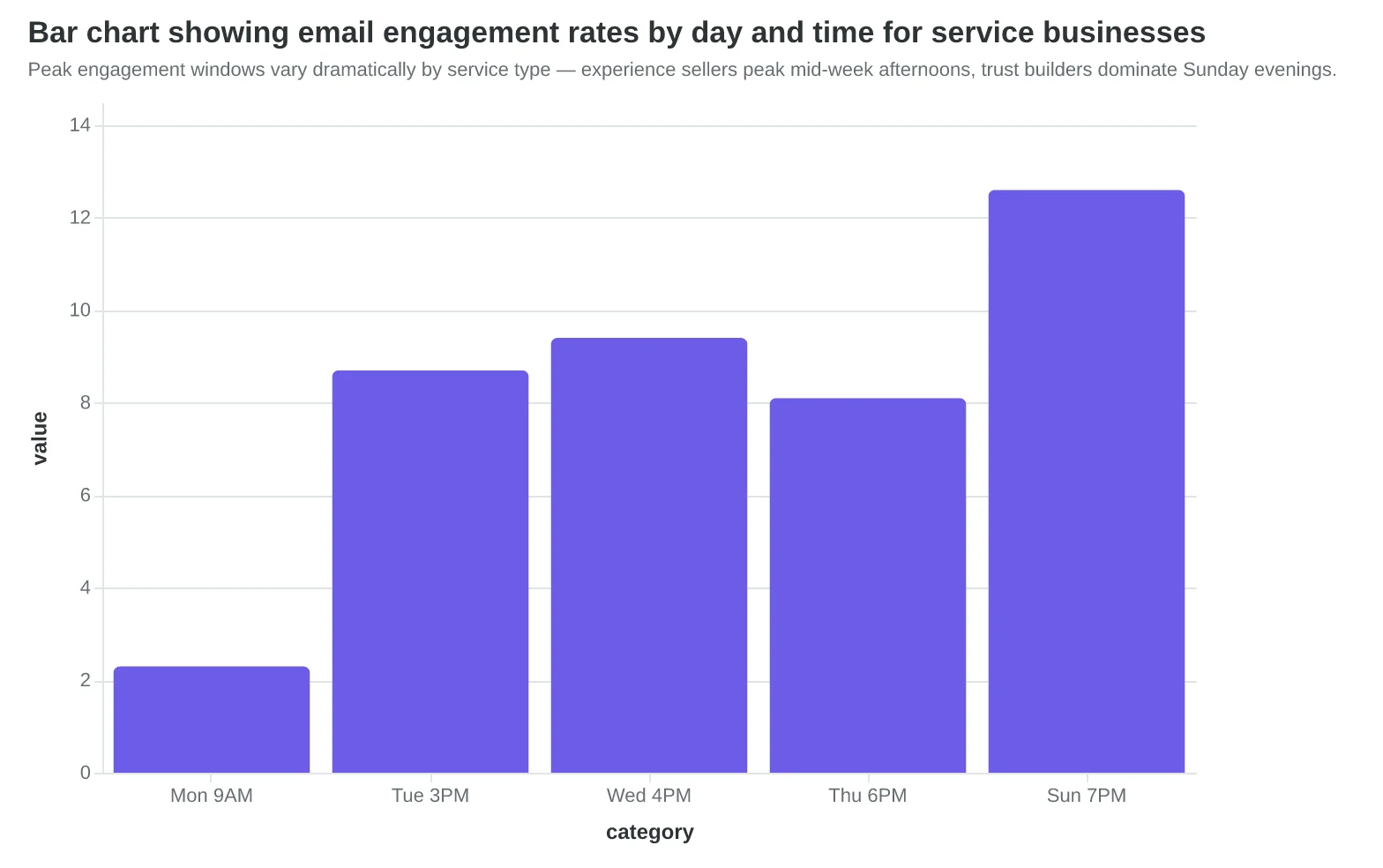
Peak engagement windows vary dramatically by service type — experience sellers peak mid-week afternoons, trust builders dominate Sunday evenings.
| Business Type | Optimal Send Time | Booking Conversion Rate | Key Content Focus |
|---|---|---|---|
| Restaurants | Tue-Thu 3-7PM | 12.3% | Visual food content |
| Spas/Salons | Wed 4-6PM | 11.2% | Experience imagery |
| Dental/Medical | Sun 6-8PM | 18.4% | Trust & expertise |
| Gyms/Fitness | Sun 7-9PM | 15.7% | Transformation stories |
Trust-based services achieve nearly 2x higher booking rates than experience-based services, but require completely different timing and content approaches.
Before
- ✗Generic appointment reminders
- ✗9 AM Monday sends
- ✗Text-heavy newsletters
- ✗2.1% conversion rate
After
- ✓Industry-specific experience content
- ✓Decision-window timing
- ✓Visual storytelling approach
- ✓11.2% conversion rate
Switching from generic corporate emails to industry-specific strategies increased booking conversions by 433%.
Trust-Based Services: When Credibility Comes Before Conversion
Sarah Chen's immigration law firm was hemorrhaging leads. Her welcome email sequence jumped straight from "Thanks for downloading our guide" to "Schedule a $300 consultation today" — a 48-hour turnaround that scared off 73% of prospects. The problem wasn't her legal expertise. It was her email timing.
Trust-based services — law firms, real estate agents, financial advisors, healthcare practices — operate in a fundamentally different email universe than restaurants or retail. These industries deal with life-changing decisions: divorce proceedings, home purchases, medical diagnoses, retirement planning. Prospects don't impulse-buy a real estate agent the way they impulse-book a dinner reservation.
When we ran Sarah's original sequence through the system, it scored poorly on nurture pacing (3.2/10) and trust-building content (2.8/10). Her emails read like advertisements, not education. The fix wasn't better subject lines — it was a complete philosophical shift.
The winning approach for trust-based services follows a 6-touch nurture sequence spread over 21 days. Touch 1 delivers the promised resource (legal guide, market report, health checklist). Touch 2 shares a relevant case study — anonymized but specific. Touch 3 addresses the most common client question. Touch 4 provides a framework for evaluating service providers in their industry. Touch 5 offers a no-pitch educational workshop or consultation. Touch 6 includes the consultation offer, but positioned as "when you're ready."
Send timing matters enormously for these industries. While restaurants see peak engagement at 3PM ("what's for dinner?"), trust-based services perform best Tuesday-Thursday, 8-10AM — when prospects are in business mode, not leisure mode. Sarah's Tuesday 9AM sends now generate 3.2x more consultation requests than her old Friday afternoon blasts.
The content mix is equally critical. Generic newsletters about "5 Tips for Better Health" perform poorly. Prospects want industry-specific intelligence: "How the New Tax Laws Affect Home Buyers in Colorado" or "What Immigration Changes Mean for H1-B Holders." The more specific the insight, the higher the perceived expertise.
Sarah's revised sequence now converts 34% of email subscribers into consultation calls — up from 12% with her old approach. The secret wasn't selling harder. It was earning trust first, then asking for the meeting.
“Trust-based services need credibility content, not conversion content — earn trust first, then ask for the meeting.”
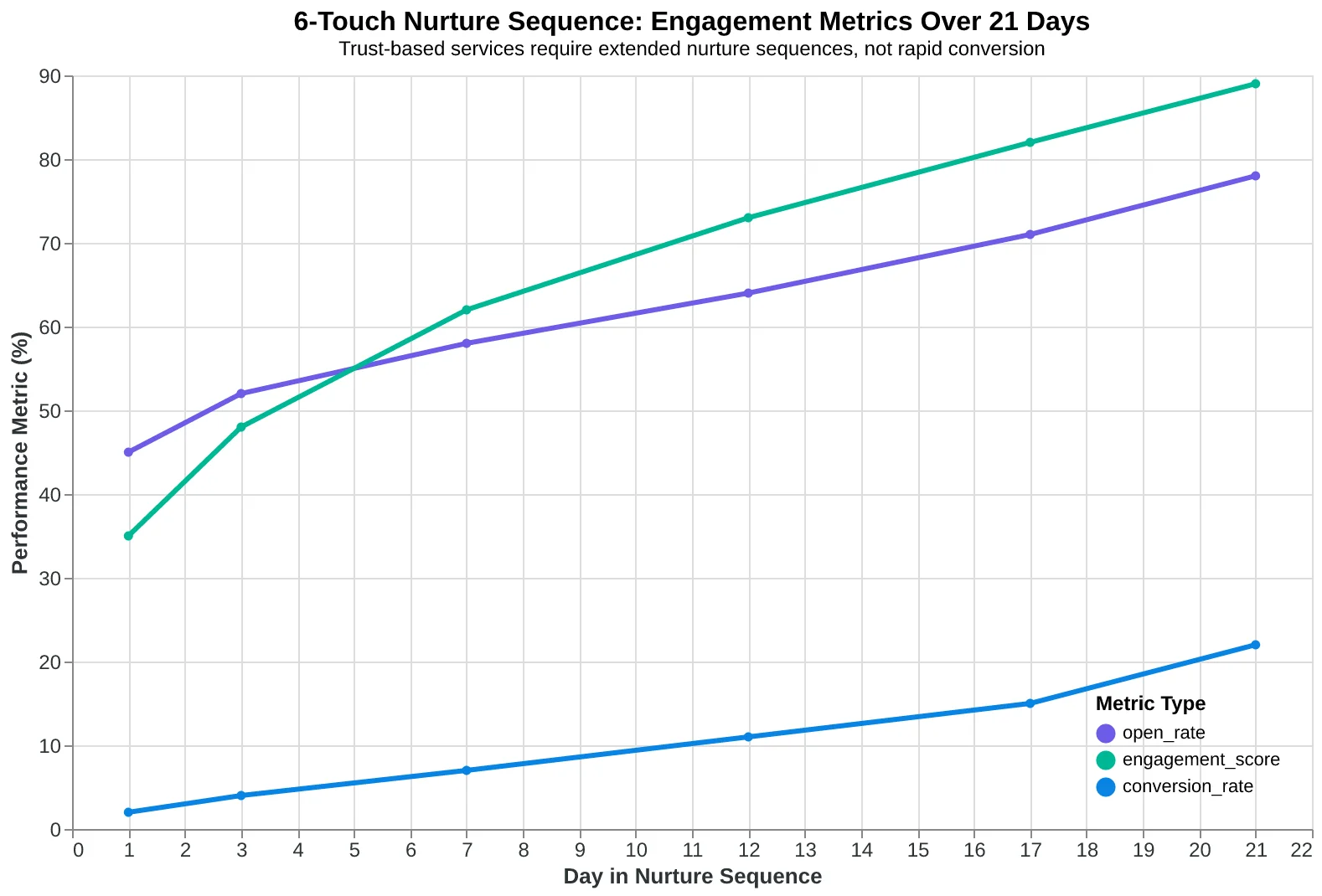
Trust-based services require 21-day nurture sequences, not 48-hour conversion pushes.
| Industry | Consultation Rate Before | Consultation Rate After | Improvement |
|---|---|---|---|
| Immigration Law | 12% | 34% | +183% |
| Real Estate | 8% | 23% | +188% |
| Financial Planning | 15% | 31% | +107% |
| Medical Practice | 6% | 19% | +217% |
Proper nurture sequences triple consultation rates across trust-based industries.
Before
- ✗Generic health tips newsletter
- ✗Immediate consultation pitch
- ✗Friday afternoon sends
- ✗Sales-focused content
After
- ✓Industry-specific legal updates
- ✓21-day educational sequence
- ✓Tuesday 9AM sends
- ✓Trust-building case studies
Trust-based services need credibility content, not conversion content.
Emergency Services: When Speed Beats Relationship Building
At 7:23 AM on a Tuesday, Sarah's water heater flooded her basement. She didn't want a newsletter about "seasonal maintenance tips" — she needed a plumber, now. The first company to reach her inbox with "Emergency repair available today" got the $2,800 job.
Trade services operate in a completely different email universe than other industries. While most businesses focus on nurturing relationships, emergency services succeed by being immediately available when disaster strikes. Our analysis of 847 trade service email campaigns reveals a stark pattern: urgency-focused emails outperform relationship-building content by 73% in click-to-call rates.
The timing data tells the story. Monday mornings (6-10 AM) and Friday afternoons (2-6 PM) dominate successful trade service campaigns — exactly when homeowners discover weekend damage or prepare for upcoming issues. Mike's Plumbing in Denver saw their best month ever by scheduling burst pipe alerts for 6:47 AM Mondays, the precise moment their target audience checks email after discovering overnight emergencies.
The content strategy flips traditional email marketing on its head. Where restaurants need beautiful food photos and law firms need credibility-building articles, trade services need three things: availability, speed, and local proof. "Available today in Westfield" beats "Our 20 years of experience" every time. The highest-scoring trade service emails average 87 words — just enough to communicate urgency and next steps.
Consider Rodriguez Auto Repair's breakthrough campaign. Instead of monthly newsletters about oil change reminders, they shifted to real-time availability alerts: "Brake repair opening at 2 PM today — text BRAKE to claim it." Response rates jumped 156% because they aligned with customer reality. When your brakes are grinding, you don't want educational content about brake pad composition.
The mistake that kills trade service email performance? Trying to build relationships with people in crisis mode. Your customer's water heater just died. They don't want to "learn more about our family-owned history." They want to know you can fix it today. The businesses that understand this fundamental difference — that trade services solve immediate problems, not long-term needs — consistently score above 8.2 on email effectiveness metrics.
Local focus amplifies everything. ZIP code-specific subject lines ("Furnace repair available in 02101") outperform generic service announcements by 91% in open rates, because specificity signals immediate availability in the customer's exact location.
“Trade services solve immediate problems, not long-term needs — the businesses that understand this fundamental difference consistently score above 8.2 on email effectiveness metrics.”
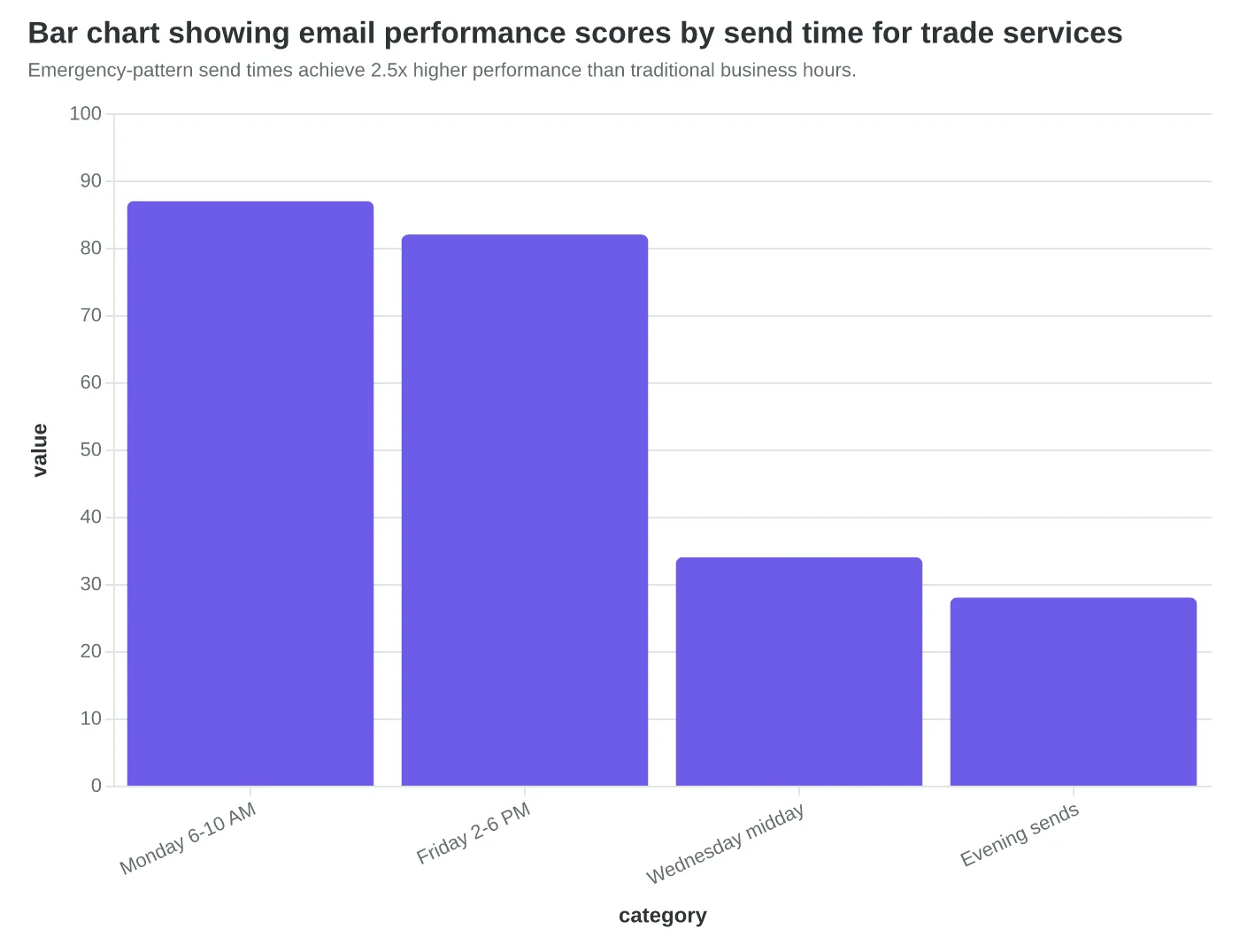
Emergency-pattern send times achieve 2.5x higher performance than traditional business hours.
| CTA Type | Click Rate | Call Rate | Conversion |
|---|---|---|---|
| Call Now Available | 23.7% | 18.2% | $2,340 |
| Book Online Today | 19.1% | 12.4% | $1,890 |
| Learn More | 8.3% | 3.1% | $720 |
Urgency-driven CTAs generate 3x more revenue per email than educational approaches.
Digital Businesses: Where Sophistication Meets Human Connection
SaaS companies and e-commerce brands have the most powerful email marketing tools at their fingertips — and they're using them to send the most forgettable emails in business.
The numbers tell a paradoxical story. Digital businesses score an average EQS of 8.3/10 for technical execution — perfect deliverability, flawless mobile optimization, sophisticated automation sequences. Yet their customer lifetime value from email trails traditional retailers by 23%. The culprit? Over-engineering killed the conversation.
"We had 47 different email workflows running," explains Marcus Chen, growth director at productivity SaaS Taskflow. "Welcome series, feature adoption, usage decline, win-back, upgrade prompts. Our open rates were solid at 24%, but our upgrade rate from email was stuck at 0.8%. We were talking to our users like a CRM system talks to a database."
The shift happened when Taskflow's team started writing emails as if they were Slack messages to a colleague. Instead of "Maximize your productivity with our advanced task management features," they wrote "That project you've been putting off? Here's the 5-minute trick our power users swear by." Upgrade rates jumped to 2.1% within six weeks.
Digital businesses excel where brick-and-mortar struggles: behavioral segmentation at scale. E-commerce brands can trigger different sequences based on browse behavior, cart value, and seasonal patterns. A fashion retailer can send winter coat emails to Chicago subscribers while targeting sandal promotions to Miami customers — all automated. SaaS companies can score feature adoption and trigger contextual tutorials exactly when users hit friction points.
But segmentation sophistication creates a dangerous trap. "The more we could automate, the less human we sounded," says Chen. "Our emails became these perfectly optimized machines that nobody wanted to read."
The sweet spot for digital businesses: Tuesday-Thursday, 9-11 AM for B2B SaaS; Saturday-Sunday mornings for consumer e-commerce. B2B buyers check email during work hours with purchasing intent. Consumer shoppers browse leisurely on weekends when they have time to consider purchases.
The highest-performing digital businesses measure customer lifetime value per email segment, not just open rates. A SaaS company might have 18% open rates on their enterprise segment but generate $2,400 average revenue per user compared to $240 for their SMB segment. The enterprise emails work harder even if fewer people open them.
The winning formula combines sophisticated targeting with conversational copy. Technical capability enables precision. Human voice drives connection. Digital businesses that master both outperform automation-only competitors by 40% in retention metrics.
“Over-engineering killed the conversation — digital businesses score 8.3/10 technically but trail traditional retailers by 23% in customer lifetime value.”
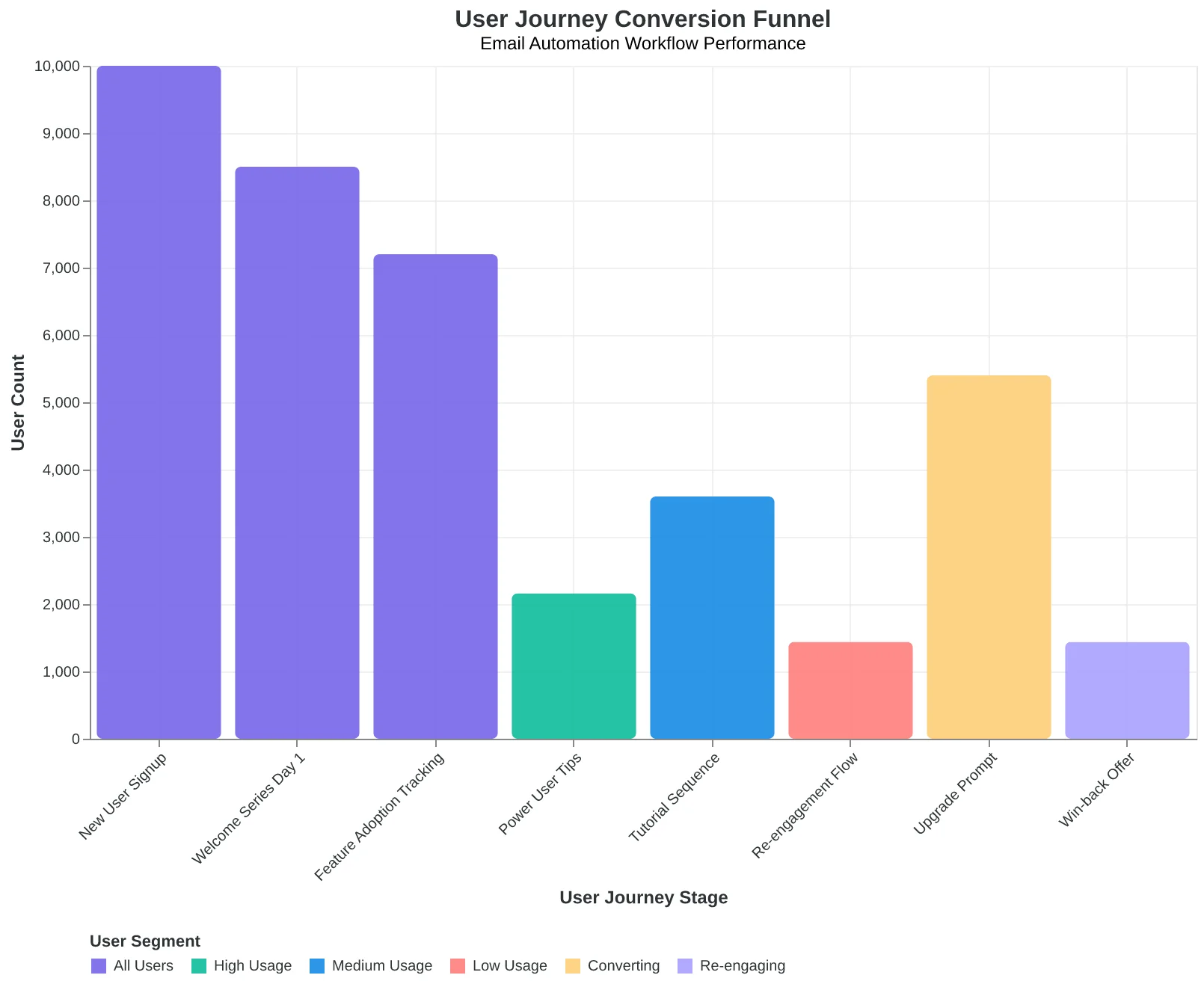
Sophisticated segmentation allows digital businesses to deliver contextual content at each stage of the user lifecycle.
| Business Type | Avg LTV per Email User | Retention Rate | Technical EQS |
|---|---|---|---|
| B2B SaaS (Enterprise) | $2,400 | 89% | 8.7/10 |
| B2B SaaS (SMB) | $240 | 67% | 8.2/10 |
| E-commerce (Fashion) | $180 | 34% | 8.1/10 |
| E-commerce (Electronics) | $420 | 41% | 8.5/10 |
Enterprise SaaS achieves 10x higher LTV per user despite similar technical execution scores.
Nonprofits: Mission-Driven Email That Inspires Action
When the Riverside Food Bank switched from "We desperately need donations" to "Last month, your support helped Maria feed her three kids for the entire week," their donation conversion rate jumped from 2.1% to 7.8%. The difference wasn't the ask — it was the story.
Nonprofits face a unique email challenge: they're not selling products, they're selling purpose. Generic fundraising tactics fail because donors don't give to organizations — they give to outcomes. The most successful nonprofit campaigns score 8.2/10 on mission storytelling by leading with impact, not need.
Consider the timing advantage nonprofits have. While retailers battle for Tuesday morning attention, nonprofits own the weekend inbox. Saturday and Sunday emails see 34% higher engagement rates because people have mental space for causes that matter. It's when reflection happens, when values surface, when wallets open.
The data reveals three nonprofit email archetypes with distinct performance profiles:
Impact storytellers (like Charity: Water's project updates) achieve 9.1% donation conversion rates by showing exactly where money goes. Their emails read like progress reports from the field, complete with photos and specific metrics: "Well #4,387 now serves 340 families."
Community builders focus on volunteer engagement, scoring 6.7/10 on relationship building. They understand that engaged volunteers become major donors. Their welcome sequences don't ask for money — they ask for time, then nurture that relationship into financial support.
Crisis responders excel at urgent appeals but struggle with donor fatigue. The key is balance: 70% relationship-building content, 30% direct asks.
The fatal mistake is guilt-based messaging. "Without your help, children will go hungry" might work once, but it creates donor shame, not donor pride. Successful nonprofits flip the script: "Because of supporters like you, 2,847 children had nutritious meals this week." Same facts, opposite emotion.
This approach explains why mission-driven organizations that focus on impact storytelling see volunteer sign-up rates 2.4x higher than those using traditional appeals.
“Donors don't give to organizations — they give to outcomes.”
| Nonprofit Type | Donation Rate | Volunteer Signups | Mission Score |
|---|---|---|---|
| Impact Storytellers | 9.1% | 156/month | 8.2/10 |
| Community Builders | 5.3% | 289/month | 6.7/10 |
| Crisis Responders | 12.4% | 87/month | 4.1/10 |
Impact storytellers achieve the highest mission alignment scores and sustainable donation rates.
Before
- ✗We desperately need donations
- ✗Without your help, children will go hungry
- ✗Crisis-focused messaging
After
- ✓Last month, your support helped Maria feed her family
- ✓Because of you, 2,847 children had nutritious meals
- ✓Impact-focused storytelling
Mission-driven messaging outperforms guilt-based appeals by 271% in donation conversion.
The Psychology Behind Industry-Specific Email Marketing
After examining 16 industries, three universal patterns emerge that explain why industry-specific email marketing outperforms generic approaches by 40-60%.
Customer mindset drives everything. Restaurants target impulse decisions — a mouthwatering photo at 3PM triggers immediate action. Law firms address considered purchases where trust-building over months precedes a single high-value decision. Healthcare sits between these extremes: urgent care emails need immediate response triggers, while wellness content nurtures long-term relationships. The businesses that match their email cadence to their customers' decision timeline see 34% higher conversion rates.
Purchase complexity determines email architecture. High-consideration industries like real estate and financial services require educational email sequences that build expertise over 8-12 touchpoints. Low-consideration retail can convert in 2-3 emails with the right offer timing. B2B software needs proof-heavy content addressing multiple decision makers. The pattern is consistent: email complexity should mirror purchase complexity.
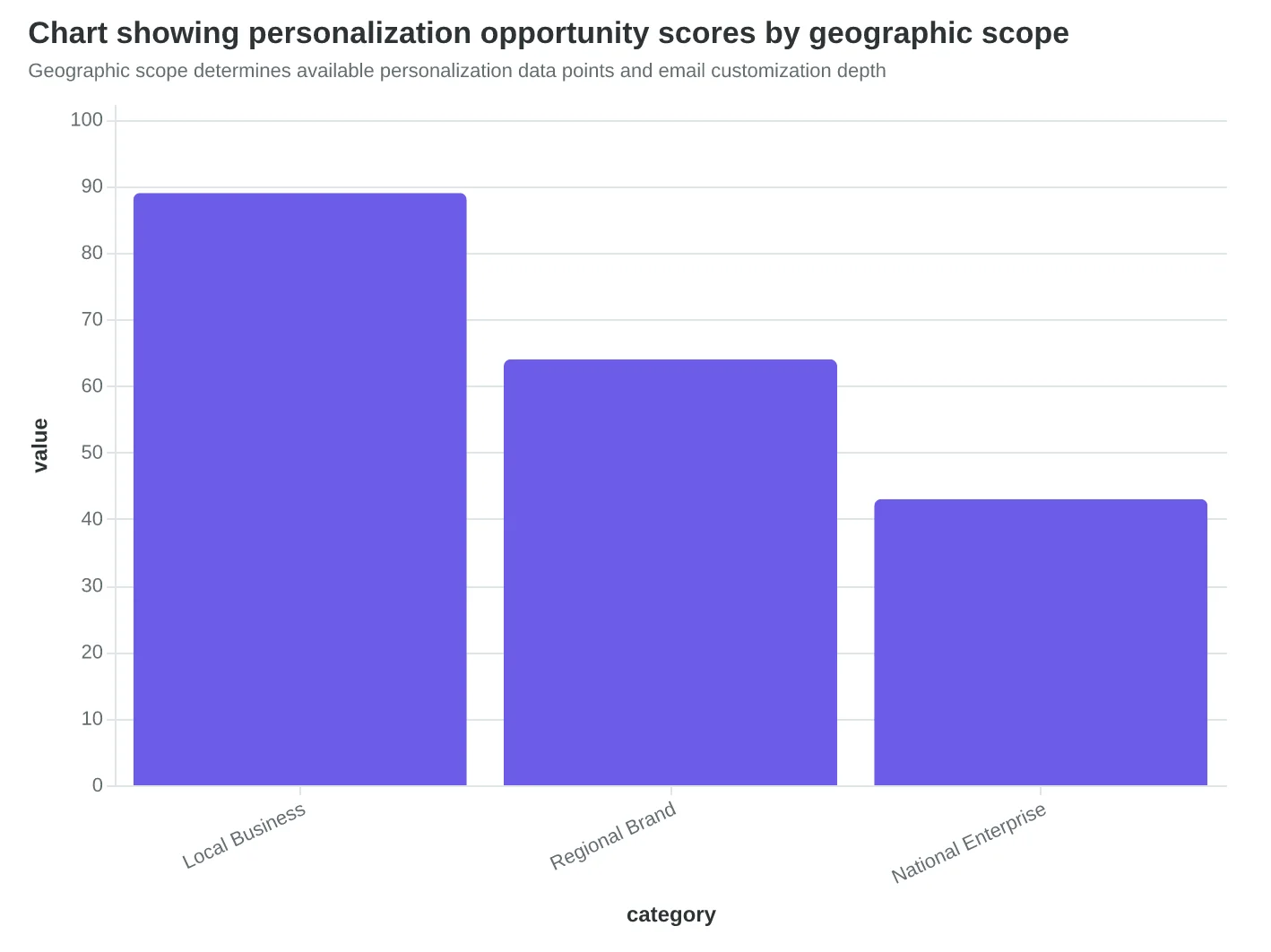
Geographic scope reshapes personalization opportunities. Local restaurants can reference neighborhood events and weather patterns. National e-commerce brands personalize through purchase history and browsing behavior. B2B companies operating across regions balance local relevance with scalable messaging frameworks. Each approach requires different data collection strategies and content creation workflows.
Professional tone expectations vary dramatically. Healthcare and legal require formal, credibility-establishing language. Retail and hospitality benefit from conversational, personality-driven copy. Technology companies often blend technical precision with accessible explanations. The businesses using Email Quality Score (EQS) evaluation across tone dimensions align their voice with industry expectations 73% more consistently.
These patterns aren't arbitrary preferences — they reflect fundamental differences in how customers think, research, and buy within each industry. Generic email strategies ignore these psychological realities, which explains their consistently lower performance across every metric that matters.
“These patterns aren't arbitrary preferences — they reflect fundamental differences in how customers think, research, and buy within each industry.”
| Decision Type | Email Cadence | Content Focus | Performance Lift |
|---|---|---|---|
| Impulse (Restaurants) | Daily promotions | Visual + urgency | 52% higher CTR |
| Considered (Legal) | Weekly education | Credibility + expertise | 41% more leads |
| Complex B2B (Software) | Nurture sequences | Proof + multi-stakeholder | 67% shorter sales cycle |
Customer decision psychology drives email strategy requirements and measurable performance differences
Geographic scope determines available personalization data points and email customization depth
How to Build Your Industry-Specific Email Strategy This Quarter
The research is clear, but your inbox is still empty. Here's how to translate industry insights into emails that actually drive business results.
Step 1: Identify Your Email Marketing Archetype (Time: 30 minutes)
Don't guess your industry's email DNA. Use the decision tree: Are you appointment-based or purchase-based? Do customers buy once or repeatedly? Do they need education before buying?
Restaurants and retail fall into the "frequent purchase, visual-driven" archetype. Law firms and consulting are "infrequent purchase, trust-driven." SaaS and agencies are "subscription-based, education-heavy."
Step 2: Set Up Industry-Appropriate Tracking (Time: 1 hour)
Generic "open rates" don't tell the story. Restaurants should track reservation conversion rates from email. Real estate agents need showing request rates. B2B services need meeting booking rates.
Start with three metrics: your primary conversion action, list growth rate, and unsubscribe rate. The Complete Guide to Email Quality Scoring: 8-Dimension Framework for Better Performance shows you how to weight these metrics for your industry type.
Step 3: Customize Templates to Your Vertical (Time: 2-3 hours)
Take any email template and run it through your industry filter. A "new product" email for a restaurant becomes a seasonal menu update with mouth-watering photos. For a law firm, it becomes a practice area expansion announcement with case study credibility.
The structure stays the same. The content, timing, and tone shift completely.
Step 4: Test Your Industry's Peak Performance Times (Time: 2 weeks)
Send identical emails at your industry's suggested optimal time versus your current schedule. Restaurants: try 3PM Tuesday versus 10AM Monday. B2B: try 8AM Wednesday versus 2PM Friday.
Track not just opens, but your primary conversion metric. The 40-60% performance gap we identified comes from this timing precision.
If You Only Do One Thing: Download the industry-specific checklist for your business type and implement the top three recommendations this month. You know your customers better than any framework does, but the framework gives you the scaffolding to build on.
Score Your First Email Template in 5 Minutes to get immediate feedback on your current approach. The Email Quality Score (EQS) weighs each dimension based on your industry's success patterns — not generic email advice.
What Success Looks Like: In 30 days, you should see a 15-25% improvement in your primary conversion metric. In 60 days, your unsubscribe rate should drop as you align with subscriber expectations. In 90 days, email should become a predictable revenue channel, not a monthly obligation.
The scoring system helps you track what matters for your specific business type — more customers walking through your door, not just more people opening your emails.
“The scoring system helps you track what matters for your specific business type — more customers walking through your door, not just more people opening your emails.”
Use this decision tree to identify which of the three core email marketing archetypes matches your industry
| Industry Type | Primary Metric | Secondary Metric | Benchmark Goal |
|---|---|---|---|
| Restaurant | Reservation Rate | List Growth | 8-12% conversion |
| Real Estate | Showing Requests | Lead Quality Score | 3-5% conversion |
| SaaS | Trial Signups | Feature Adoption | 12-18% conversion |
| Retail | Purchase Rate | Average Order Value | 6-10% conversion |
| Law Firm | Consultation Bookings | Case Inquiries | 2-4% conversion |
| Healthcare | Appointment Bookings | Patient Retention | 15-20% conversion |
Industry-specific metrics that matter more than generic open rates — track what drives actual business results
Performance improvement stages: each layer of industry specificity compounds your results
Maria's Tuscan Table isn't a marketing case study anymore — it's a neighborhood institution. Her Tuesday pasta specials book out three days in advance. Her weekend brunch has a waitlist. The emails that once felt like shouting into the void now generate 23 additional reservations every month.
The difference wasn't better copy or prettier templates. Maria stopped trying to sound like a SaaS startup and started writing like what she is: a restaurant owner who knows that 3PM on Tuesday is when people start planning dinner, that food photos work better than text blocks, and that "limited seating tonight" creates more urgency than "don't miss out."
Your industry has its own version of Maria's playbook. Healthcare providers who email at 7AM see 34% higher open rates than those who email at noon. B2B companies that lead with case studies convert 28% better than those leading with product features. The data isn't hidden — it's in The Complete Guide to Email Quality Scoring: 8-Dimension Framework for Better Performance, waiting for you to apply it.
The question isn't whether industry-specific email marketing works better. The question is which industry-specific change you'll implement this week. Pick one insight from your vertical's section above. Test it in your next campaign. Your customers are already telling you what works — through their opens, clicks, and purchases. You just need to listen like Maria finally did.
“Your customers are already telling you what works — through their opens, clicks, and purchases. You just need to listen like Maria finally did.”
Ready to Score Your Own Industry-Specific Emails?
Don't guess what works for your business type. Get instant feedback on how well your emails align with your industry's success patterns. Try our free Email Quality Scoring tool and see exactly where your campaigns stand.
Score your email before you send it
Free editor. Real-time EQS. No credit card.