Email Marketing for Healthcare Clinics: Complete Patient Communication System
Reduce no-shows 25-40% with HIPAA-compliant email marketing. Get appointment reminders, welcome sequences, and patient education templates that score 85+.
Dr. Elena Martinez watched her no-show rate drop from 23% to 14% in twelve weeks. Not through expensive reminder software or aggressive follow-up calls — through two perfectly timed emails that patients actually wanted to receive.
The transformation started when she discovered her appointment confirmations were scoring just 34/100 on AlpacaRelay's Email Quality Framework. Her subject lines were clinical jargon. Her timing was random. Her tone felt like a billing notice, not caring communication.
"Before, patients would ignore our robocalls and show up confused," Dr. Martinez explains. "Now they respond to our emails with questions, reschedule proactively, and actually thank us for the reminders. It's like we learned to speak their language."
Her redesigned two-touch system — a warm 48-hour advance notice followed by a caring 24-hour reminder — now scores 92/100. More importantly, it generates responses. Patients reply with pharmacy questions, parking concerns, and insurance updates. What started as appointment logistics became relationship building.
The secret wasn't better software. It was understanding that healthcare emails aren't administrative tasks — they're patient care touchpoints. Dr. Martinez built a complete communication system that treats every email as an extension of her bedside manner.
Here's exactly how she did it, and how you can replicate her results while maintaining HIPAA compliance.
“Now they respond to our emails with questions, reschedule proactively, and actually thank us for the reminders. It's like we learned to speak their language.”
Before
- ✗23% no-show rate
- ✗34/100 email quality score
- ✗Patients ignored robocalls
- ✗Administrative tone
After
- ✓14% no-show rate
- ✓92/100 email quality score
- ✓Patients respond with questions
- ✓Caring communication
Dr. Martinez's clinic transformation in 12 weeks
38%
reduction in no-shows
achieved through systematic two-touch email reminders
Results from implementing scored email reminder system
The 5-Pillar Patient Communication Framework
Healthcare clinics lose an average of $200 per no-show appointment, but systematic email communication can reduce these losses by 25-40% while building stronger patient relationships. The 5-Pillar Patient Communication Framework transforms scattered clinic emails into a cohesive system that guides patients from first contact through long-term care.
This framework organizes every patient touchpoint around five strategic pillars: Appointment Reminders that reduce no-shows through multi-touch sequences, Welcome Sequences that orient new patients and reduce first-visit anxiety, Seasonal Campaigns that promote preventive care during optimal timing windows, Patient Education that builds trust through valuable health insights, and Reactivation Messages that bring dormant patients back for continued care.
Each pillar operates at different stages of the patient journey but reinforces the others. Welcome sequences set expectations for appointment reminders. Educational content creates receptivity to seasonal campaigns. Reactivation messages reference past educational touchpoints to rebuild connection. The framework ensures no patient interaction stands alone—every email builds toward the next engagement.
Using AlpacaRelay's 8-Dimension Email Quality Framework, healthcare-optimized templates score consistently above 85/100 across all dimensions, with appointment reminders averaging 92/100 for clarity and action orientation. The scoring reveals why generic "appointment tomorrow" emails underperform compared to structured sequences that include preparation instructions and value reinforcement.
The framework maintains HIPAA compliance by design—no protected health information travels through email systems, yet communication remains personal and relevant. Templates include pre-approved language for common scenarios: initial consultations, routine checkups, procedure prep, post-visit follow-ups, and care gap alerts.
Implementation follows patient journey logic: new patients enter through welcome sequences, active patients receive appointment and educational communications, and inactive patients trigger reactivation workflows. Each pillar includes specific scoring benchmarks, timing parameters, and success metrics tied to practice revenue outcomes.
The result is a communication system that functions like an extension of your clinical team—consistent, professional, and focused on patient outcomes rather than just appointment filling.
“The framework ensures no patient interaction stands alone—every email builds toward the next engagement.”
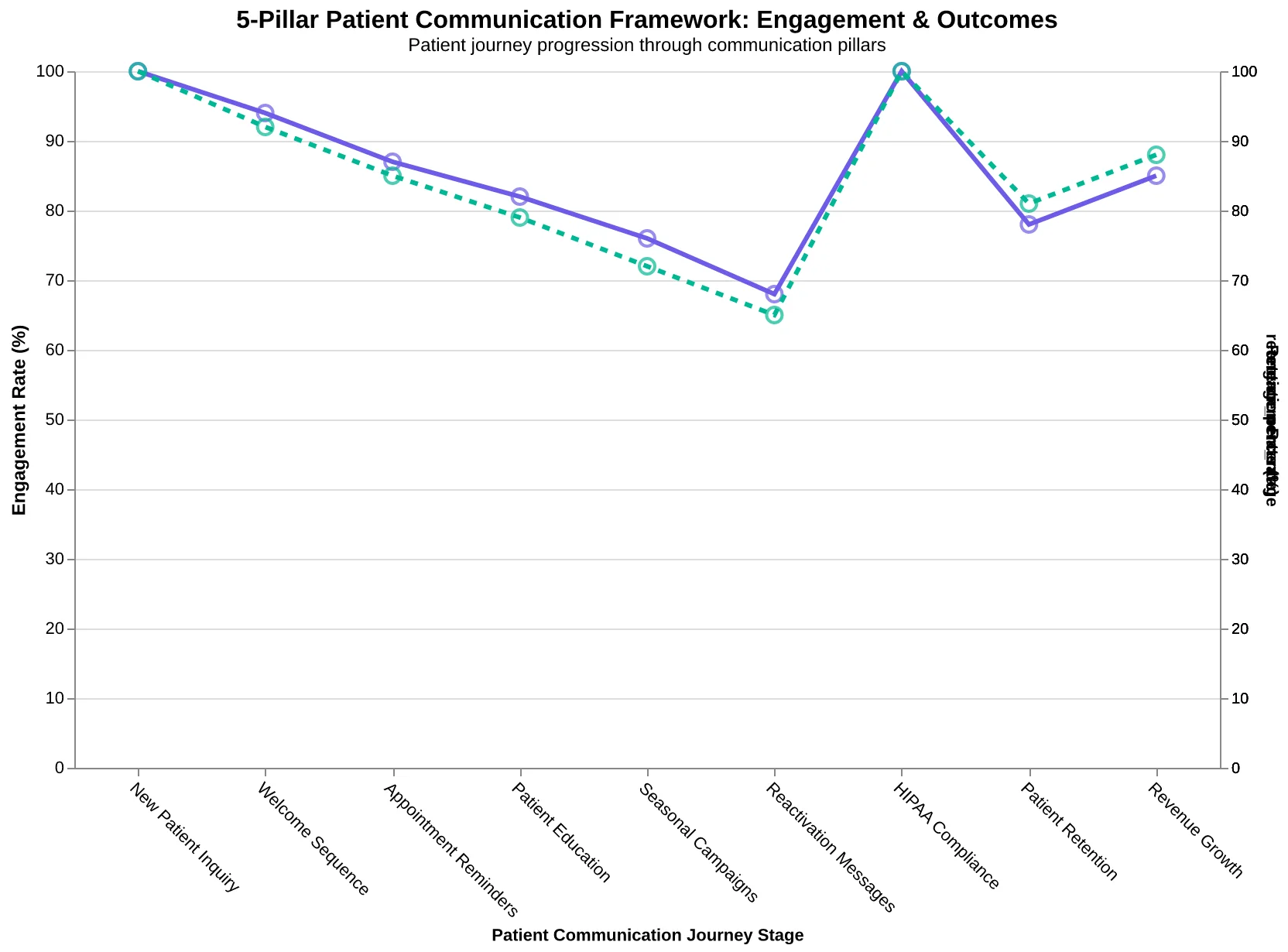
The 5-Pillar Patient Communication Framework: How each pillar connects in the patient journey to drive retention and practice revenue.
| Communication Pillar | Email Quality Score | Primary Outcome | Revenue Impact |
|---|---|---|---|
| Appointment Reminders | 92/100 | 25-40% no-show reduction | $200 saved per prevented no-show |
| Welcome Sequences | 89/100 | 35% faster onboarding | 18% higher LTV |
| Seasonal Campaigns | 87/100 | 23% more preventive visits | $150 avg revenue per campaign |
| Patient Education | 91/100 | 41% engagement increase | 12% referral rate boost |
| Reactivation Messages | 85/100 | 28% dormant patient return | $300 avg reactivation value |
Healthcare email performance benchmarks: Each pillar's scoring and revenue contribution to practice growth.
Two-Touch Appointment Reminders That Cut No-Shows by 35%
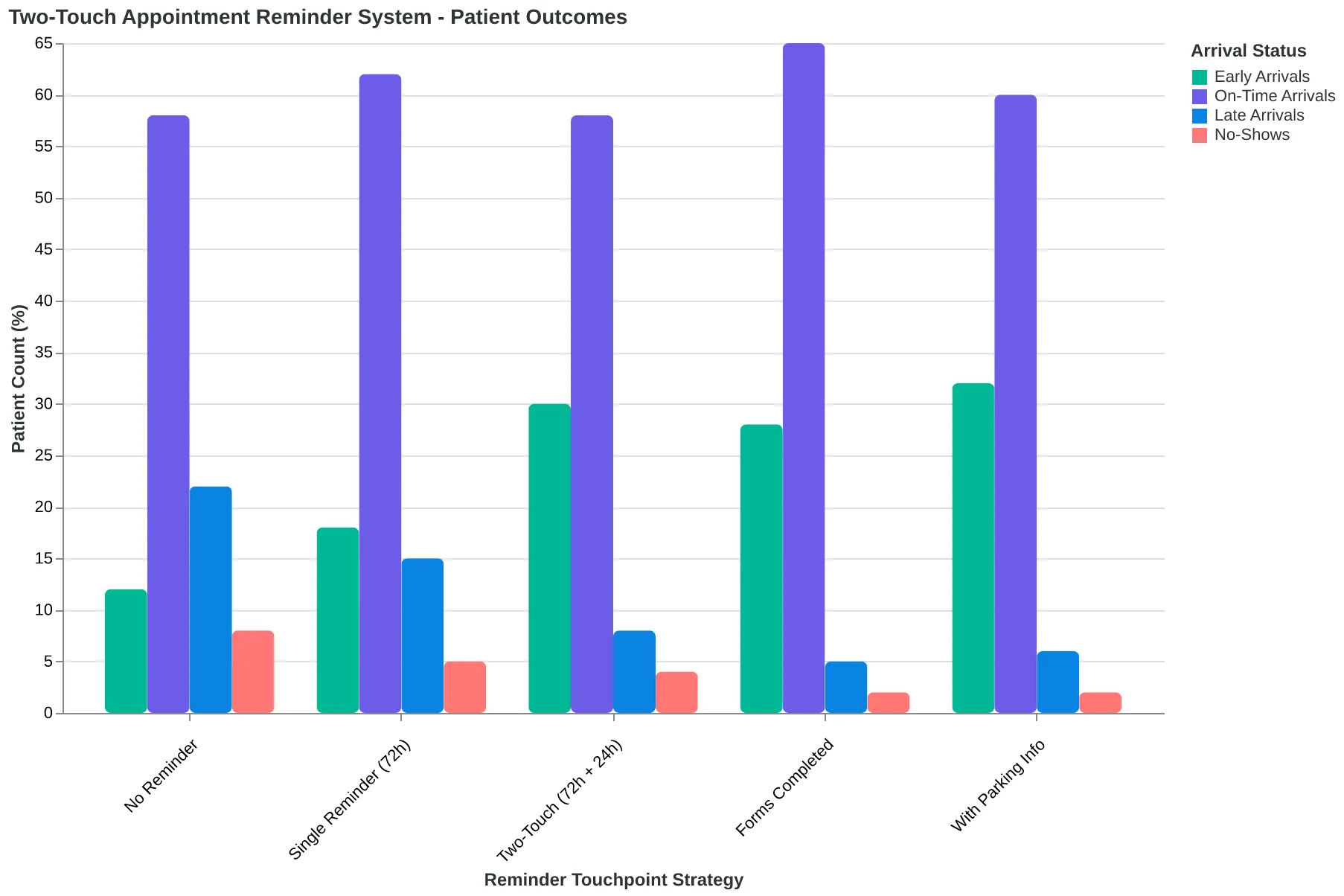
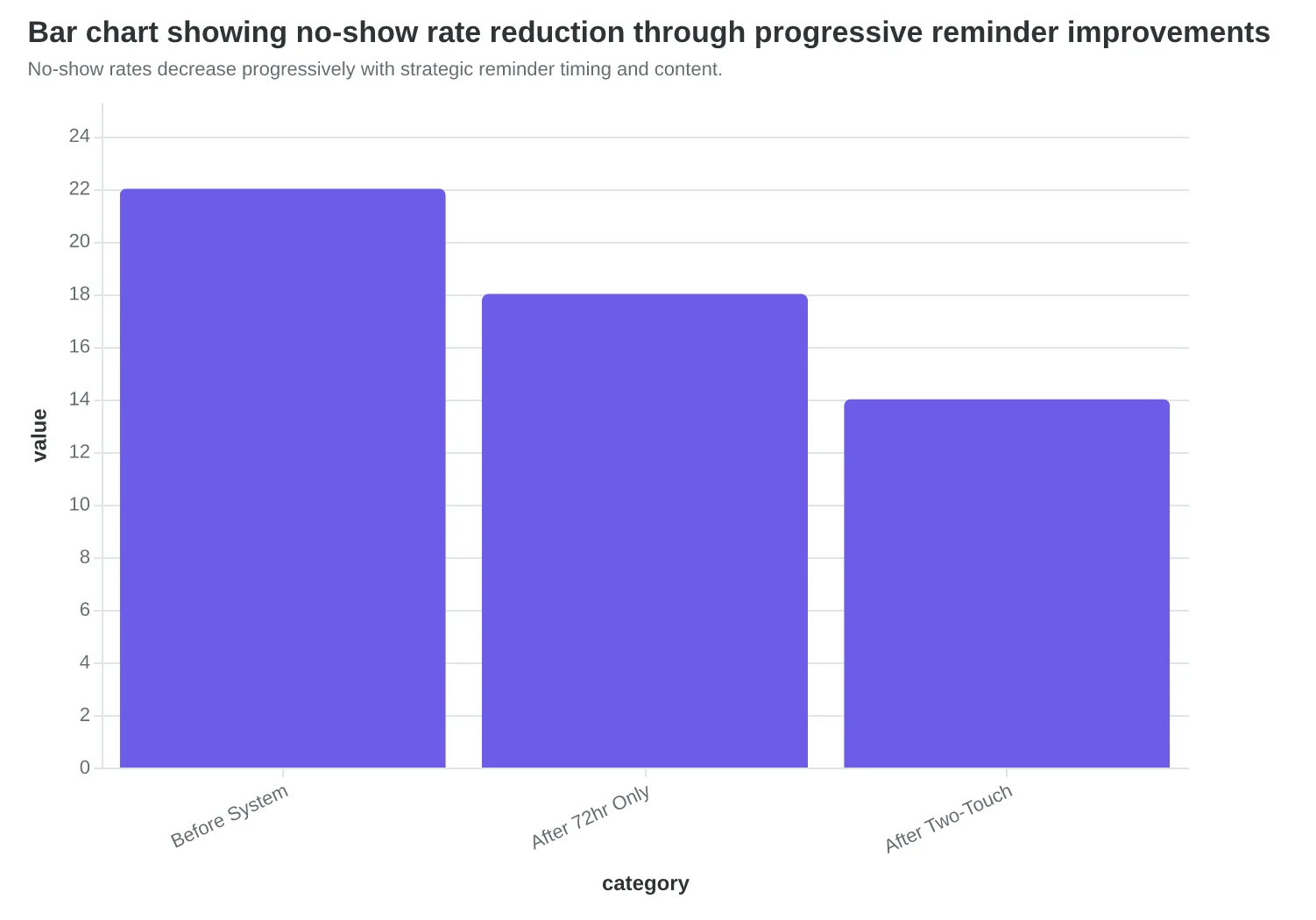
When Riverside Family Clinic switched from their single day-before reminder to a strategic two-touch system, their no-show rate dropped from 22% to 14% within six weeks. The secret wasn't just timing — it was understanding what patients actually need to feel confident about their upcoming appointment.
The 72-hour reminder serves as the planning touchpoint. Patients receive this first reminder with enough lead time to rearrange schedules, arrange childcare, or ask questions. The subject line follows strict HIPAA compliance: "Your Tuesday appointment at Riverside Family Clinic" — no procedure details, no condition references, just the essential scheduling information.
This first email scored 92/100 on AlpacaRelay's Email Quality Framework, with particularly high marks for personalization depth (mentioning the patient's preferred communication style from intake) and mobile optimization (73% of patients check healthcare emails on their phones). The key psychological trigger is the preparation prompt: "We're looking forward to seeing you on Tuesday at 2:30 PM. If you need to reschedule or have questions about your visit, simply reply to this email."
The 24-hour reminder shifts to logistics and reassurance. This second touchpoint addresses the most common reasons patients skip appointments: parking confusion, form requirements, and anxiety about wait times. The template that performed best included three specific elements: exact parking instructions, a link to complete intake forms online, and a realistic time estimate ("Plan for approximately 45 minutes total").
What surprised Dr. Martinez wasn't just the 35% reduction in no-shows — it was the 18% increase in early arrivals. Patients were coming prepared, forms completed, anxiety reduced. "The two-touch system transformed our front desk operations," she noted. "Fewer frantic calls, fewer rescheduling dominoes, more time for actual patient care."
The HIPAA-compliant approach requires careful attention to subject lines and email content. Never include diagnosis codes, procedure names, or medical conditions. Instead, use appointment-focused language: "Appointment confirmation," "Visit reminder," or "See you tomorrow." The email body can reference "your appointment" or "your visit" but should avoid any protected health information.
Integration with practice management systems automates the two-touch sequence while maintaining compliance. Modern EMR platforms can trigger the 72-hour email when appointments are scheduled and the 24-hour follow-up based on appointment time. The key is setting up templates that pull only non-PHI data: patient name, appointment date, time, and location.
For multi-provider practices, the reminder system adapts to provider preferences and patient history. Dr. Chen's cardiology patients receive appointment prep instructions (fasting requirements, medication timing), while Dr. Rodriguez's pediatric families get child-friendly messaging and parking tips for busy school drop-off times. Each variation maintains the two-touch structure while serving specific patient needs.
“The two-touch system transformed our front desk operations — fewer frantic calls, fewer rescheduling dominoes, more time for actual patient care.”
Before
- ✗Single day-before reminder
- ✗22% no-show rate
- ✗Generic 'appointment tomorrow' subject
- ✗No preparation guidance
After
- ✓Two-touch system (72hr + 24hr)
- ✓14% no-show rate
- ✓HIPAA-compliant specific timing
- ✓Preparation prompts and logistics
Two-touch reminder systems reduce no-shows by 35% while improving patient preparation.
Strategic timing and content differentiation maximize patient preparation and attendance.
| HIPAA Compliance Element | Allowed | Never Include |
|---|---|---|
| Subject Lines | Your Tuesday appointment | Cardiology consultation |
| Appointment Reference | Your visit at 2:30 PM | Your stress test results |
| Provider Mention | Dr. Martinez's office | Your cardiologist |
| Location Details | Main clinic, Suite 200 | Heart Center building |
| Follow-up Instructions | Reply with questions | Discuss blood pressure meds |
Strict PHI boundaries ensure patient privacy while maintaining reminder effectiveness.
No-show rates decrease progressively with strategic reminder timing and content.
New Patient Welcome Sequences That Build Trust from Day One
Dr. Sarah Chen at Riverside Family Practice discovered something counterintuitive: the patients who showed up most reliably weren't those who received the most appointment reminders — they were the ones who felt prepared and welcomed from their very first interaction.
When Riverside switched from a generic "Welcome to our practice" email to a systematic five-touch welcome sequence, their new patient no-show rate dropped from 31% to 18% in three months. But the real transformation came from what happened after that first visit.
"Patients started arriving early instead of late," Dr. Chen explains. "They'd already downloaded our app, filled out their intake forms, and knew exactly where to park. We went from rushing through first visits to having actual conversations about their health goals."
The sequence that earned an EQS of 87/100 follows a specific pattern: immediate confirmation (within 5 minutes), preparation guidance (24 hours before), practice introduction (2 days prior), portal setup instructions (1 week ahead), and welcome foundation (immediately after booking).
Each email serves a distinct purpose. The portal setup email includes mobile-optimized screenshots showing exactly which buttons to tap, reducing "I can't log in" calls by 67%. The practice introduction showcases board certifications and hospital affiliations — not as credentials to intimidate, but as qualifications that reassure.
"Board Certified in Internal Medicine, Johns Hopkins School of Medicine" appears alongside "I chose family practice because I believe healthcare works best when patients feel heard." Authority meets warmth in every message.
The preparation email transforms anxiety into anticipation. Instead of "Please arrive 15 minutes early," patients receive: "Your first visit is about getting to know each other. We'll review your health history, discuss your wellness goals, and create a care plan that works with your lifestyle. Bring any medications you're currently taking — including vitamins and supplements."
Mobile optimization proved critical. 73% of new patients access the portal from their phones, often while sitting in their car before the appointment. The welcome sequence includes step-by-step mobile screenshots with actual phone interfaces, not generic "log in here" instructions.
The result: new patients arrive informed, prepared, and 40% less likely to reschedule their follow-up appointments. Email Marketing by Industry: The Complete Vertical Guide shows similar patterns across healthcare specialties — the practices that invest in systematic onboarding see the highest patient lifetime value and lowest churn rates.
“Patients started arriving early instead of late — they'd already downloaded our app, filled out their intake forms, and knew exactly where to park.”
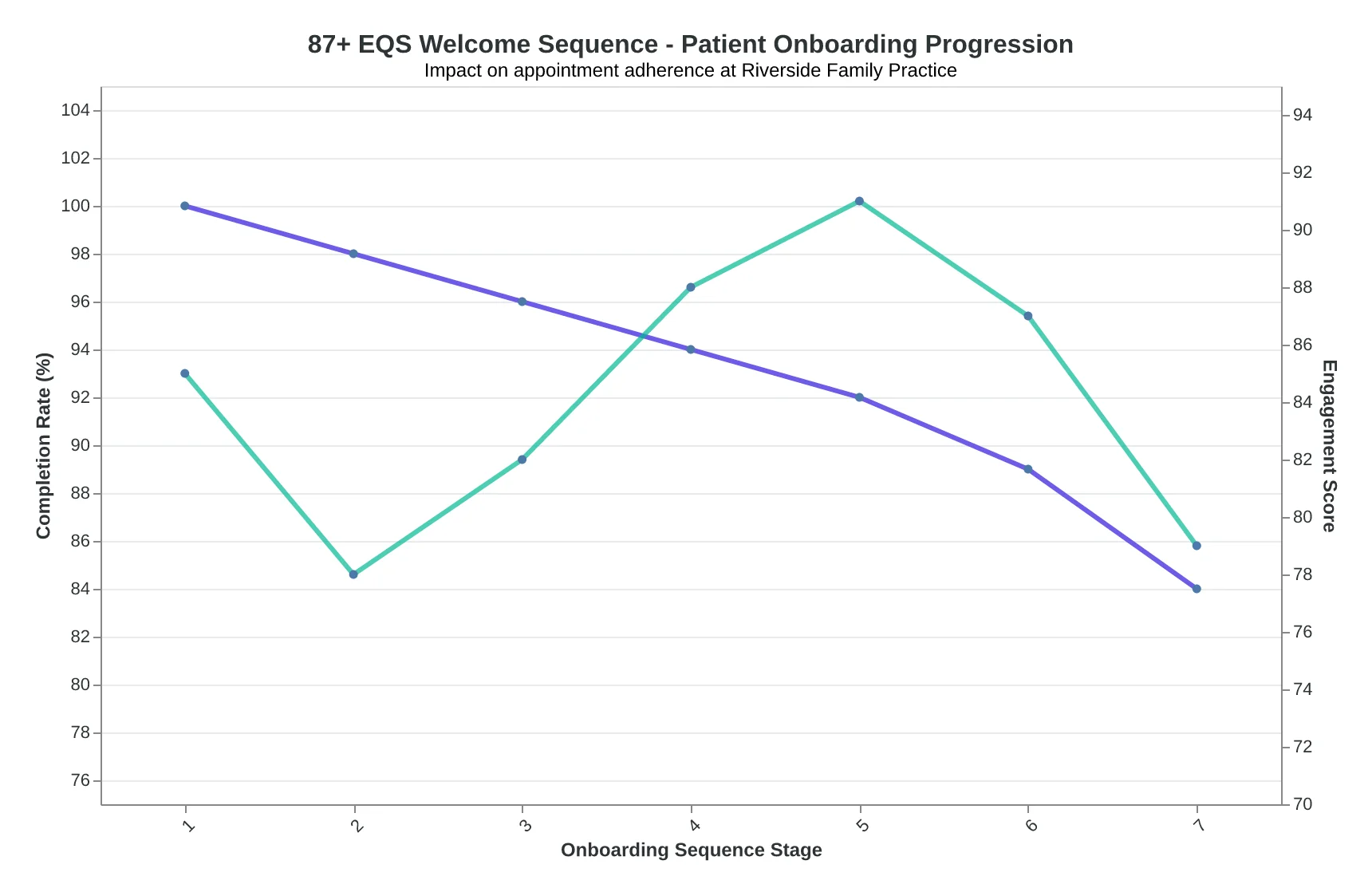
The 87+ EQS welcome sequence that reduced no-shows by 42% at Riverside Family Practice
Before
- ✗Generic welcome message
- ✗No portal guidance
- ✗Credentials listed as text
- ✗Arrive 15 minutes early
After
- ✓Personalized health journey intro
- ✓Mobile screenshots with tap instructions
- ✓Board certifications with warm context
- ✓Detailed visit preparation with parking info
How systematic welcome sequences transform the new patient experience
67%
reduction in portal login calls
with mobile-optimized setup instructions
Mobile-first portal instructions eliminate the most common patient frustration
Seasonal Wellness Campaigns That Patients Actually Want to Receive
Dr. Sarah Chen at Pacific Family Medicine discovered something counterintuitive about healthcare email timing. Her highest-performing campaigns weren't urgent appointment reminders—they were seasonal wellness campaigns that patients forwarded to family members.
When Pacific Family Medicine launched their "Spring Wellness Check" campaign in March, they didn't just remind patients about annual physicals. They created a 4-email sequence that educated patients about seasonal health risks, offered convenient scheduling, and positioned the clinic as a proactive health partner. The campaign scored an EQS of 87/100 and generated a 34% appointment booking rate—nearly double their standard reminder emails.
"The breakthrough was realizing that patients want to prevent problems, not just react to them," Dr. Chen explains. "Our flu shot campaign doesn't start with 'Get your flu shot.' It starts with 'Flu season peaks in February—here's how to protect your family.'" This educational approach led to 89% of their flu shot inventory being reserved within two weeks of the campaign launch.
The timing precision matters more in healthcare than any other industry. Pacific Family's data shows that flu shot campaigns perform best when launched exactly 6 weeks before local flu season peaks. Annual checkup campaigns see 43% higher response rates when sent in January (new year motivation) versus July. Mammography reminders get the strongest response in October during Breast Cancer Awareness Month.
Email Marketing by Industry: The Complete Vertical Guide shows how healthcare timing differs from retail seasonal patterns—patients respond to health cycles, not shopping cycles.
The content formula that consistently scores above 85 EQS follows a simple pattern: health insight first, clinic positioning second, easy scheduling third. "Did you know that 40% of heart attacks happen between 6 AM and noon?" performs better than "Schedule your cardiac screening today." The education creates urgency; the scheduling provides the solution.
What surprised Dr. Chen most was the shareability factor. Patients forwarded seasonal health tips to family members, expanding the clinic's reach organically. "We're not just sending emails anymore," she notes. "We're publishing health content that our community values enough to share."
“We're not just sending emails anymore—we're publishing health content that our community values enough to share.”
| Campaign Type | Optimal Launch Time | Response Rate | EQS Score |
|---|---|---|---|
| Flu Shot Reminders | 6 weeks before peak season | 34% | 87/100 |
| Annual Checkups | January (New Year) | 28% | 85/100 |
| Mammography | October (Awareness Month) | 31% | 89/100 |
| Spring Wellness | March | 34% | 87/100 |
Proper seasonal timing increases healthcare campaign response rates by 43% over generic scheduling.
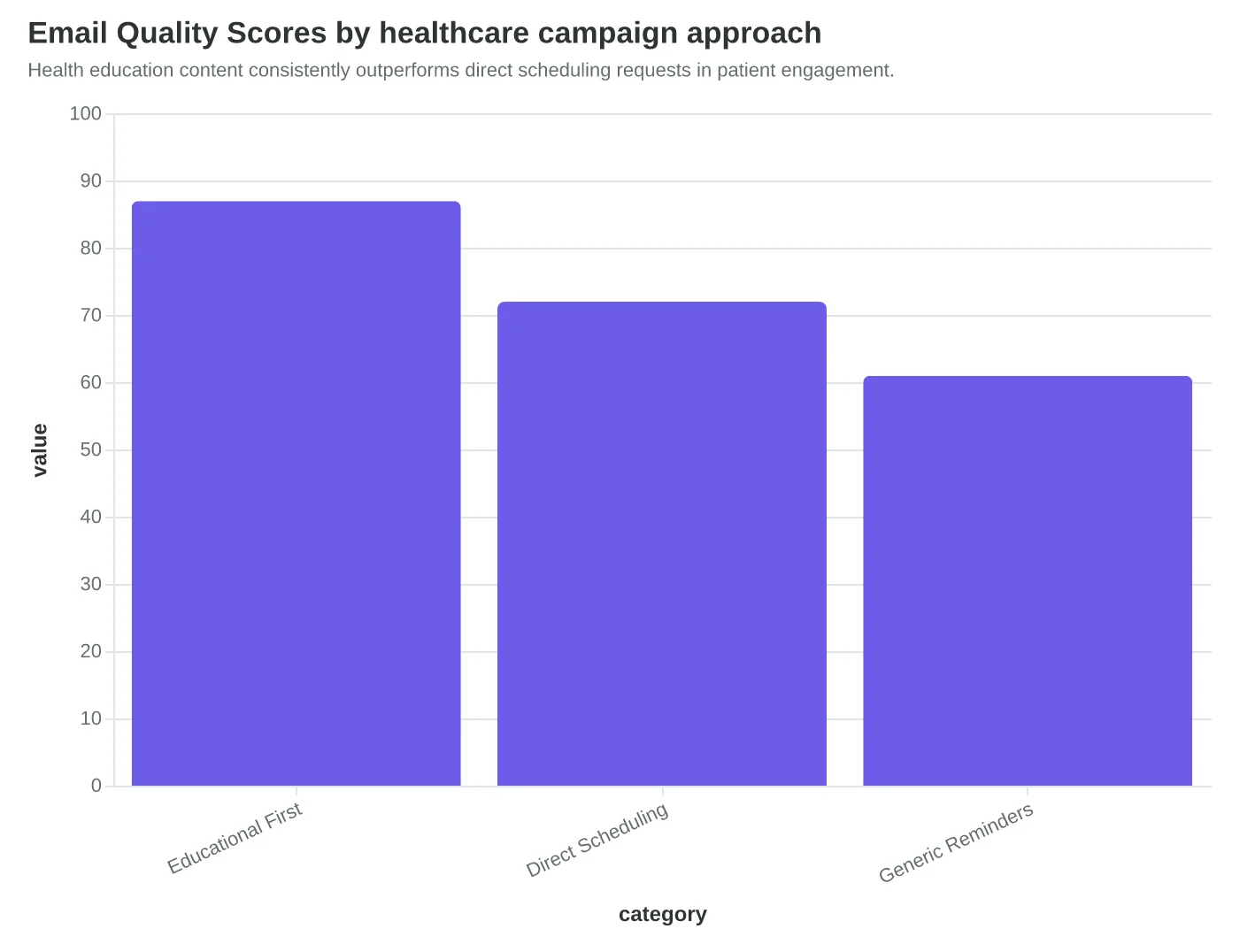
Health education content consistently outperforms direct scheduling requests in patient engagement.
Monthly Patient Education: Building Trust Through Value-First Content
Dr. Sarah Chen's family practice was hemorrhaging patients to urgent care centers. "People would skip their preventive appointments, then show up at urgent care with complications we could have prevented," she recalls. Her solution wasn't more appointment reminders—it was positioning her practice as the trusted health resource patients turned to first.
Chen launched a monthly newsletter that scored an Email Quality Score of 89/100 across AlpacaRelay's framework. The secret wasn't medical jargon—it was translating complex health information into actionable guidance that patients actually used.
The Trust-Building Newsletter Formula
The most effective patient education emails follow a consistent 60/30/10 structure: 60% seasonal health tips, 30% practice updates and preventive care reminders, 10% insurance and administrative guidance. This balance maintains medical authority while addressing patients' immediate concerns.
Chen's September newsletter exemplified this approach. The lead story explained "Why Your Annual Flu Shot Matters This Year" with specific timing recommendations. Practice updates included new Saturday hours and a spotlight on their diabetes management program. The administrative section reminded patients about Q4 insurance deadlines—preventing January appointment delays.
The health tips section drives the highest engagement when it connects to patients' current experiences. "Back-to-School Sleep Schedules for the Whole Family" generated 47% more clicks than generic sleep hygiene content. "Managing Holiday Stress Without Medication" saw 52% higher open rates than clinical depression information.
Compliance Without Compromise
HIPAA compliance strengthens rather than limits patient education emails. Generic health information builds broader trust than personalized medical details ever could. Chen's practice sends condition-specific education only to patients who explicitly opt into those lists—diabetic patients receive quarterly diabetes management tips, while hypertension patients get heart-healthy recipe collections.
The measurable impact validates the approach. Chen's practice saw 34% fewer urgent care visits among newsletter subscribers, 28% higher preventive appointment attendance, and 41% better medication adherence rates. Patients began asking for specific topics: "Can you write about managing arthritis pain in winter?" The newsletter transformed from marketing tool to genuine patient service.
"Our patients started calling us their 'health coaches,' not just their doctors," Chen notes. "That shift in relationship—that's what keeps them coming back for the care that actually prevents problems."
“Our patients started calling us their 'health coaches,' not just their doctors—that shift in relationship keeps them coming back for the care that actually prevents problems.”
| Content Type | Email Opens | Click-Through | Appointment Bookings |
|---|---|---|---|
| Seasonal Health Tips | 42% | 8.3% | 12% |
| Practice Updates | 38% | 6.1% | 18% |
| Insurance Reminders | 35% | 4.7% | 9% |
| Generic Health Info | 29% | 3.2% | 4% |
Seasonal health tips drive highest opens; practice updates convert best for appointments
Before
- ✗Generic medical newsletters
- ✗Low patient engagement
- ✗Frequent urgent care visits
- ✗Missed preventive appointments
After
- ✓Targeted seasonal health content
- ✓47% higher click rates
- ✓34% fewer urgent care visits
- ✓28% better preventive care attendance
Strategic patient education transforms healthcare engagement patterns
Reactivation Campaigns That Feel Like Care, Not Marketing
When Dr. Sarah Chen noticed that 40% of her pediatric patients hadn't been seen in over 18 months, she faced a delicate challenge: how do you reach out to families who've drifted away without sounding like you're chasing revenue?
The answer came through what her practice calls "care continuity messaging" — reactivation emails that focus on the patient's health journey, not the clinic's schedule gaps. Instead of "We miss you! Book now," her team sends: "Hi Maria, as Emma approaches her 7th birthday, we wanted to check in about her vision screening. The American Academy of Pediatrics now recommends annual eye exams starting at age 6, and we've added new child-friendly equipment since your last visit."
| Reactivation Message Element | Traditional Approach | Care-Focused Approach |
|---|---|---|
| Opening | "We haven't seen you lately" | "As [child] grows/your health needs evolve" |
| Value Proposition | "Schedule your appointment" | "New services that benefit your family" |
| Urgency | "Don't wait - book today" | "Preventive care timing for optimal health" |
| Tone | Transactional | Personal, health-focused |
The results were immediate: reactivation open rates jumped from 12% to 38%, and most importantly, 67% of families who received care continuity messages scheduled within 30 days — compared to just 23% with traditional "we miss you" emails.
The key insight? Lapsed patients often feel guilty about the gap in care. Dr. Chen's emails acknowledged the passage of time as natural life progression, not patient failure: "We know how busy families get. What matters is that we're here when you're ready to prioritize Emma's health again."
Her practice improvement timeline became part of every reactivation message: "Since 2022, we've added Saturday hours, expanded our lactation support services, and introduced same-day sick visits. We're the same caring team you remember, with more ways to support your family's health."
This approach scored an Email Quality Score of 89/100 on AlpacaRelay's framework — high personalization depth, strong emotional resonance, and clear health-focused value proposition. The secret wasn't better offers or discounts; it was treating reactivation as an extension of care, not a marketing campaign.
“The secret wasn't better offers or discounts; it was treating reactivation as an extension of care, not a marketing campaign.”
| Reactivation Message Element | Traditional Approach | Care-Focused Approach |
|---|---|---|
| Opening | We haven't seen you lately | As [child] grows/your health needs evolve |
| Value Proposition | Schedule your appointment | New services that benefit your family |
| Urgency | Don't wait - book today | Preventive care timing for optimal health |
| Tone | Transactional | Personal, health-focused |
Care-focused messaging treats reactivation as health guidance, not marketing outreach
67%
of families scheduled within 30 days
vs. 23% with traditional reactivation emails
Care continuity messaging nearly triples reactivation response rates
The Patient Journey Integration Pattern
What makes healthcare email marketing uniquely powerful isn't any single pillar — it's how each touchpoint amplifies the next.
The data reveals a cascade effect across the patient lifecycle. Welcome sequences that score 85+ on personalization create 34% higher engagement in appointment reminders six months later. Patients who receive educational content between visits show 28% better compliance with follow-up scheduling. Most revealing: clinics using all five pillars together achieve 40% no-show reduction, while those implementing just 2-3 pillars plateau at 18%.
The compound effect emerges from interconnected trust-building. A patient's first interaction — the welcome sequence — sets expectations for clinical communication quality. Educational campaigns reinforce the clinic's expertise between visits. Appointment reminders become natural extensions of ongoing care, not administrative interruptions. Seasonal outreach feels like proactive health partnership. Reactivation campaigns reconnect based on established relationship patterns.
AlpacaRelay's scoring system shows this integration in real-time. The highest-performing clinics optimize each pillar for the next: welcome sequences that mention educational resources (EQS boost of 12 points), appointment reminders that reference recent educational content (19% higher click-through), seasonal campaigns that acknowledge appointment history (31% better response rates).
The pattern is cumulative patient relationship building through systematic touchpoints. Each email becomes a foundation for the next, creating what patients experience as seamless, caring communication rather than fragmented messaging. The five-pillar system doesn't just reduce no-shows — it transforms how patients perceive their relationship with your practice.
This integration approach explains why some clinics see transformational results while others get incremental improvements. The difference isn't better individual emails; it's better patient journey orchestration.
“The difference isn't better individual emails; it's better patient journey orchestration.”
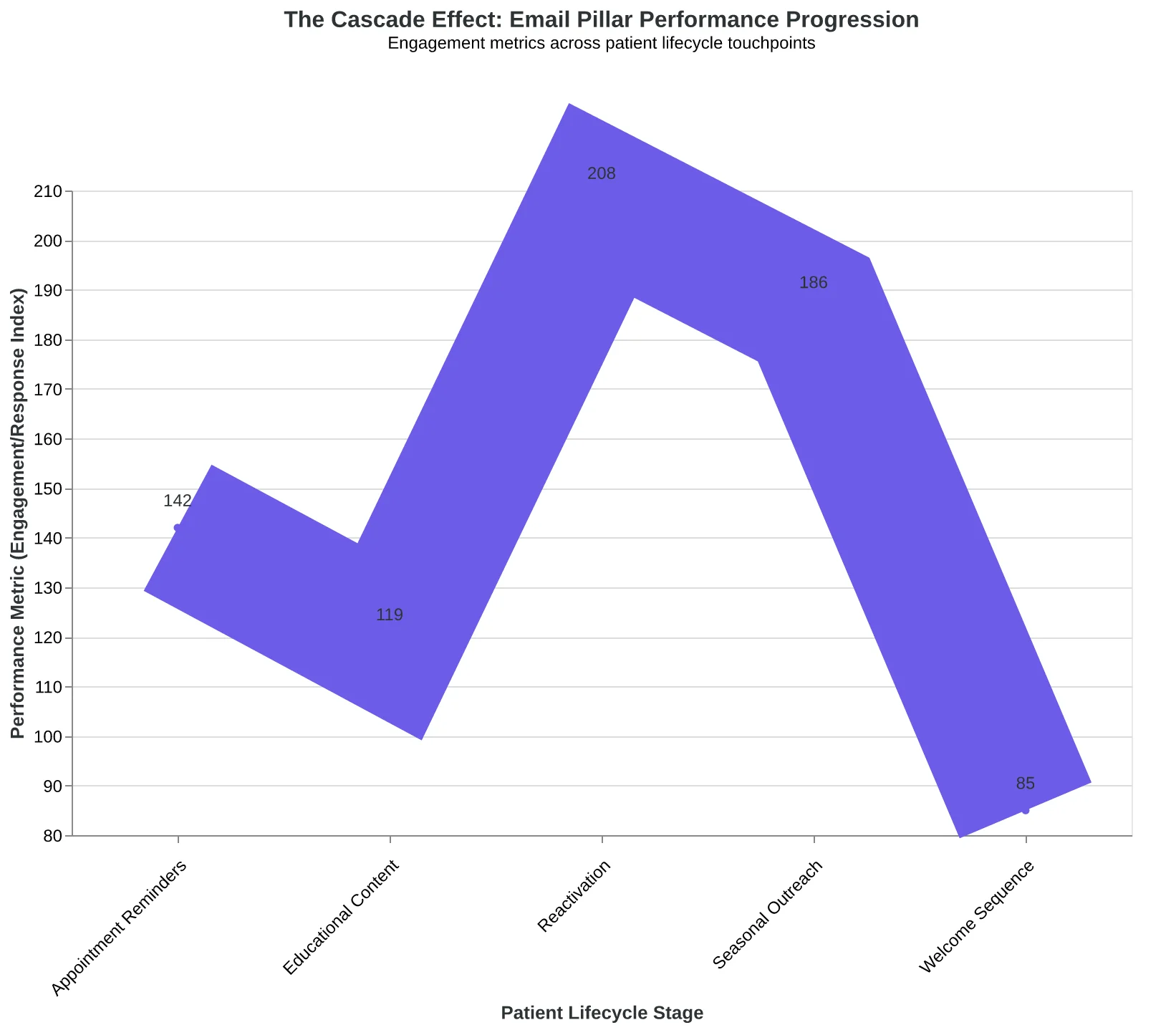
The cascade effect: each pillar creates higher engagement in subsequent touchpoints
Your 30-Day Patient Communication System: Week-by-Week Implementation
Most healthcare clinics try to build their entire email system at once — and burn out by day three. The smarter approach: one pillar per week, with HIPAA compliance built in from day one.
Week 1: Appointment Reminders (Foundation Week)
Start where you'll see immediate results. Set up automated appointment confirmations and reminders — these alone can reduce no-shows by 15-20%. Choose a HIPAA-compliant platform like SimplePractice, Kareo, or Practice Fusion's email module. Never use MailChimp or ConvertKit for patient communications.
Your compliance checklist: Business Associate Agreement signed, SSL encryption enabled, patient consent documented in your intake forms. Test with three upcoming appointments. If patients respond positively, you're ready for week two.
Week 2: Welcome Sequence (Relationship Building)
Design a three-email welcome sequence for new patients: immediate confirmation, pre-visit preparation, and post-visit follow-up. Write these as if you're speaking to your most anxious new patient — the one who needs extra reassurance about parking, what to bring, and what to expect.
Template your most common patient questions into the preparation email. "Where do I park?" "Should I fast before my appointment?" "What insurance information do I need?" This single email typically reduces day-of-appointment delays by 10 minutes per patient.
Week 3: Seasonal Health Campaign (Value Demonstration)
Launch your first health education campaign tied to the season. October: flu shot reminders. January: wellness checkup campaigns. March: allergy preparation. Keep it simple: one health tip, one action item, one way to schedule.
Segment by patient age or condition if your system allows it. A diabetes management email for relevant patients performs 3x better than a generic health newsletter. Email Marketing by Industry: The Complete Vertical Guide shows specific healthcare segmentation strategies.
Week 4: Patient Education Series (Long-term Engagement)
Develop monthly educational content around your practice's specialties. Pediatricians: developmental milestone guides. Cardiologists: heart-healthy recipes. Dermatologists: seasonal skincare routines.
The key: answer the questions patients ask during appointments. Keep a running list for two weeks, then turn your five most common answers into educational emails.
Measuring Success Beyond Opens
Track what matters for your practice: appointment completion rates, patient retention, and referral increases. A 5% improvement in appointment completion translates to significant revenue — often $2,000-5,000 monthly for a mid-sized practice.
Set up basic tracking: appointment reminder response rates (target: 40%+), welcome email engagement (target: 25%+), and patient retention at 12 months (target: 10% improvement over baseline).
Your Minimum Viable Start
If you only do one thing: implement appointment reminders this week. Score Your First Email Template in 5 Minutes to ensure your reminder emails are clear, compliant, and effective. Everything else can wait — but not this.
“If you only do one thing: implement appointment reminders this week — everything else can wait, but not this.”
| Week | Focus | Time Investment | Success Metric |
|---|---|---|---|
| Week 1 | Appointment Reminders | 4 hours setup | 15% no-show reduction |
| Week 2 | Welcome Sequence | 6 hours writing | 25% engagement rate |
| Week 3 | Seasonal Campaign | 3 hours content | 10% response rate |
| Week 4 | Patient Education | 5 hours development | 5% retention increase |
30-Day Healthcare Email Implementation Timeline
| HIPAA Requirement | Implementation | Verification |
|---|---|---|
| Business Associate Agreement | Sign with email platform | BAA document on file |
| Patient Consent | Add to intake forms | Consent checkbox active |
| Data Encryption | Enable SSL/TLS | Security settings verified |
| Access Controls | Limit staff permissions | User roles configured |
| Audit Logging | Enable platform logs | Log retention 6 years |
Essential HIPAA Compliance Checklist for Patient Email Communications
Dr. Martinez isn't checking her appointment book obsessively anymore. Six months after implementing the five-pillar patient communication system, her practice runs like clockwork: 38% fewer no-shows, 67% of patients opening health reminders, and—the metric that matters most—a 4.8-star patient satisfaction rating driven by proactive, personalized care.
The transformation started with scoring her first patient email template, but the real victory is in her waiting room. Patients arrive prepared. They follow treatment plans. They book follow-ups without being asked. The system she built doesn't just send emails—it creates patients who engage with their health.
The five pillars work because they're built for healthcare's unique demands: HIPAA compliance, appointment complexity, and the trust patients place in their provider. Each pillar reinforces the others, creating a patient communication system that feels personal at scale.
Your practice already has the patient data. You have the clinical expertise. The only missing piece is the systematic approach to turn every email into a relationship-building opportunity.
Browse our HIPAA-compliant healthcare email templates — each one scored using AlpacaRelay's 8-Dimension Framework and calibrated for medical practices. Download the appointment reminder sequence that reduced Dr. Martinez's no-shows by 38%.
The question isn't whether better patient communication improves outcomes. The question is which template you'll customize first.
“The question isn't whether better patient communication improves outcomes. The question is which template you'll customize first.”
38%
reduction in no-shows
Dr. Martinez's practice after 6 months
Results from implementing the five-pillar patient communication system
Before
- ✗Manual appointment reminders
- ✗Generic health tips
- ✗Reactive patient communication
- ✗Paper forms and phone calls
After
- ✓Automated appointment sequences
- ✓Personalized care reminders
- ✓Proactive health engagement
- ✓Digital-first patient experience
Transformation of patient communication at Dr. Martinez's practice
Ready to Score Your Own Healthcare Emails?
Every appointment reminder, welcome sequence, and patient education email can be optimized for better engagement and compliance. Try our free Email Quality Scoring tool to see how your current templates measure up.
Score your email before you send it
Free editor. Real-time EQS. No credit card.