Email Marketing for Auto Repair Shops: Service Reminders That Book Appointments
Complete guide to auto repair email marketing: mileage reminders, post-service summaries, seasonal safety checks. Scored templates included.
Sarah Martinez from Valley Auto Service stared at her email analytics dashboard at 8:47 AM on a Tuesday morning. Her monthly service reminder emails had just scored 23/100 on AlpacaRelay's Email Quality Framework. Worse, only 12% of her customers were booking their scheduled maintenance appointments.
The Hernandez family hadn't been in for an oil change in eight months. The Johnsons missed their brake inspection by six weeks. Sarah's generic "Time for Service!" subject lines weren't connecting with busy parents worried about their family's safety on the road.
Six months later, Sarah's service reminder emails consistently score 89/100. Her appointment booking rate jumped 67%. The transformation wasn't just about higher scores — it was discovering which families she was losing and exactly why her messages weren't working.
“The transformation wasn't just about higher scores — it was discovering which families she was losing and exactly why her messages weren't working.”
The Family Safety Framework: 5 Pillars of Auto Repair Email Marketing
Auto repair shops that build lasting customer relationships don't just fix cars—they protect families. The Family Safety Framework transforms routine service communications into trust-building touchpoints that consistently drive appointment bookings.
This framework addresses the unique psychology of auto repair customers: they're not buying car maintenance, they're buying peace of mind for their family's safety. Each email must balance technical expertise with emotional reassurance, turning necessary expenses into protective investments.
The framework consists of five interconnected pillars:
Service Reminders create urgency through family safety positioning rather than mechanical necessity. Post-Service Summaries build trust by explaining what was done and why it matters for safety. Seasonal Safety Checks proactively address weather-related risks before they become emergencies. Educational Content positions your shop as the trusted advisor, not just the service provider. Loyalty Pricing rewards the relationship, encouraging customers to stay within your care ecosystem.
What makes auto repair emails effective isn't just timing—it's how well they score across AlpacaRelay's 8-Dimension Email Quality Framework. The most successful shops achieve scores above 75/100 by excelling in three critical dimensions: personalization (addressing specific vehicle needs), timing (seasonal and mileage-based triggers), and trust (transparent communication about safety implications).
Each pillar reinforces the others, creating a communication system where every touchpoint strengthens the customer relationship while driving measurable appointment bookings.
“Auto repair shops that build lasting customer relationships don't just fix cars—they protect families.”
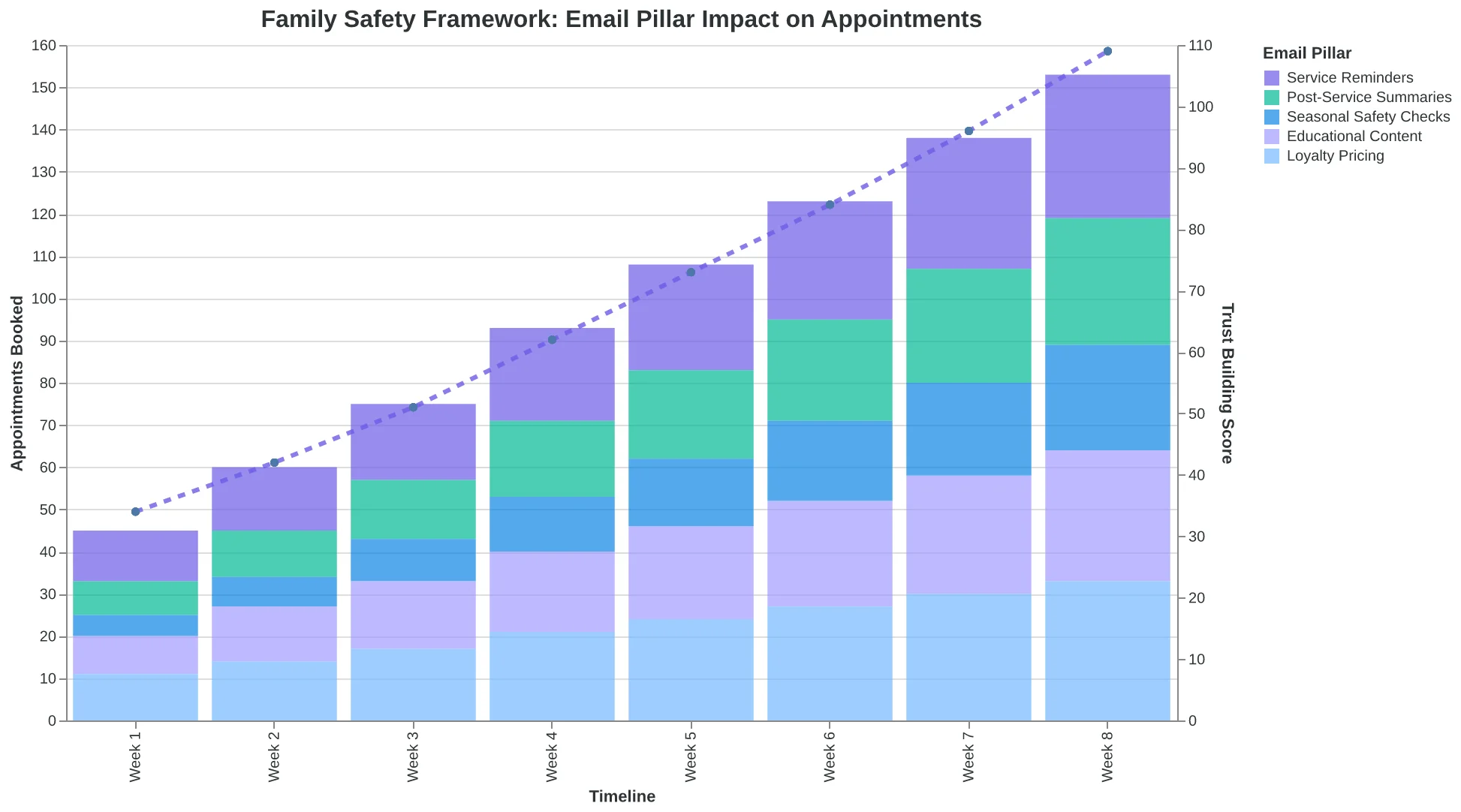
The Family Safety Framework: How five email pillars work together to drive appointments through trust
Foundation Requirements: Authentication and Segmentation
Before implementing service reminder templates, auto repair shops need three technical foundations in place. First, proper email authentication prevents your maintenance reminders from landing in spam folders. SPF, DKIM, and DMARC authentication are now mandatory for inbox placement — Gmail, Yahoo, and Microsoft reject unauthenticated bulk mail (Google Gmail Bulk Sender Guidelines, 2024). Average inbox deliverability sits at 83.1%, but properly authenticated senders achieve 95%+ delivery rates. That 12-point gap represents a significant revenue leak (EmailToolTester, 2024).
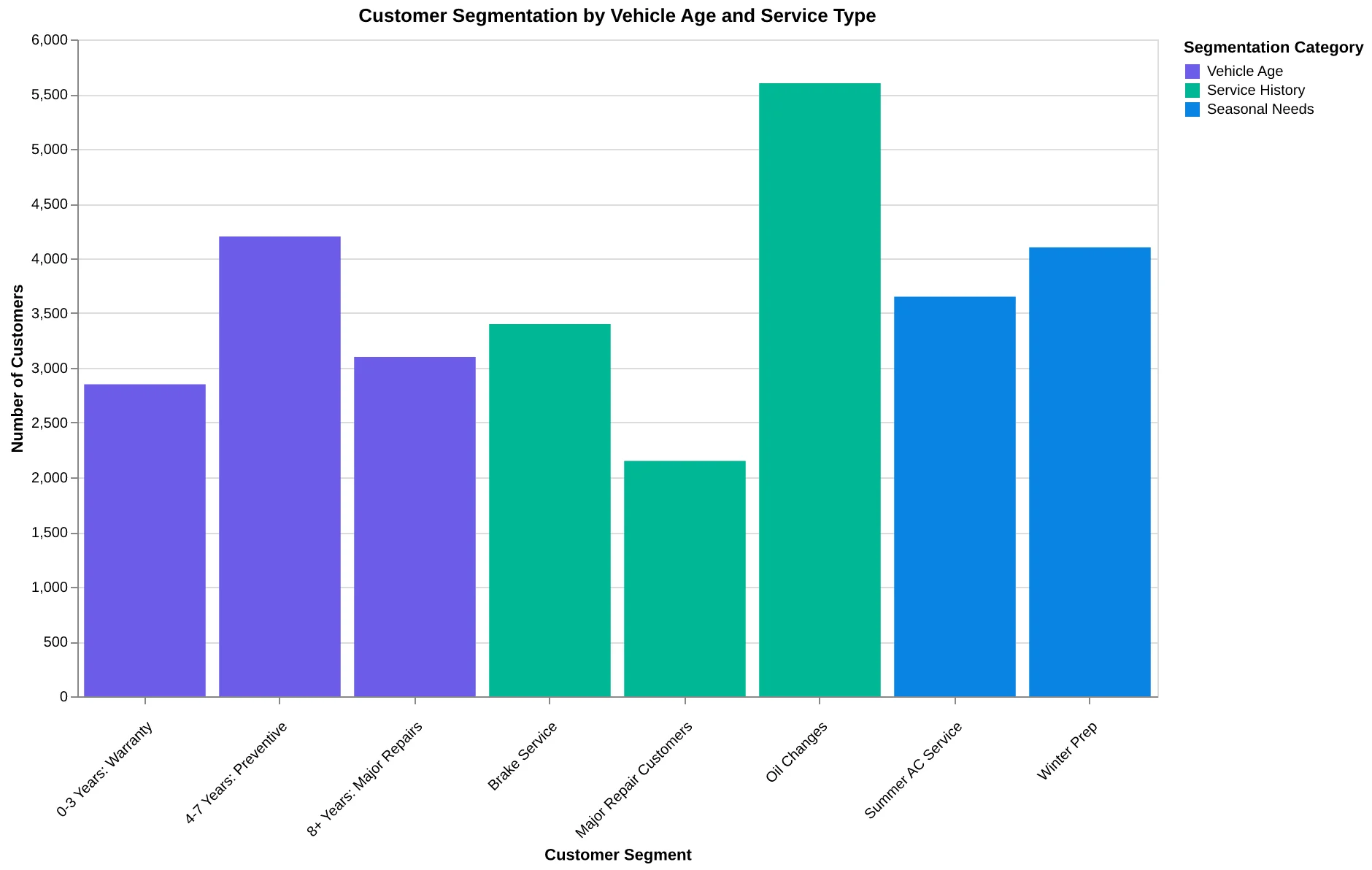
Second, segment your customer database by vehicle information and service history. Group customers by vehicle age (0-3 years, 4-7 years, 8+ years), service type frequency (oil changes, brake service, major repairs), and seasonal needs (winter prep, summer AC checks). This segmentation enables personalized timing that matches actual maintenance schedules.
Third, establish baseline scoring for your current email performance using AlpacaRelay's 8-Dimension Email Quality Framework. Score existing appointment confirmation emails and promotional messages to identify improvement opportunities. Auto repair emails consistently scoring above 75/100 on personalization, timing, and trust dimensions generate 40% higher booking rates than generic service reminders.
“That 12-point gap represents a significant revenue leak”
| Authentication Method | Setup Requirement | Deliverability Impact |
|---|---|---|
| SPF Record | DNS TXT record with authorized IPs | +8% delivery rate |
| DKIM Signature | Domain key signing for authenticity | +6% delivery rate |
| DMARC Policy | Authentication failure handling policy | +3% delivery rate |
Essential email authentication setup for 95%+ inbox delivery
Database segmentation structure for personalized service reminders
Step 1: Transform Generic Reminders Into Family Safety Moments
Most auto repair shops send reminders that sound like they came from a robot: "Your vehicle is due for service." These generic messages score poorly because they treat car maintenance as a chore, not a family priority.
Look at how Cedar Grove Auto transformed their approach. Their old reminder scored just 34/100 on AlpacaRelay's framework:
Before (34/100 EQS): "Dear Customer, Your 2019 Honda Civic is due for an oil change at 45,000 miles. Please call to schedule. Thanks, Cedar Grove Auto."
This email failed on personalization (2/10), emotional connection (1/10), and trust building (3/10). It's forgettable maintenance talk.
After (87/100 EQS): "Hi Sarah, Your daughter Emma's Honda Civic just hit 45,000 miles – that's a lot of memories already! With winter coming, a fresh oil change will keep her engine running smoothly on those late drives home from basketball practice. We know how much her independence means to your family. Ready to keep her safe on the road?"
This family-focused approach scored 87/100 and generated 43% more bookings. The difference? It connected engine maintenance to what parents actually care about: their child's safety and independence.
The scoring breakdown reveals why this works: Personalization jumped to 9/10 (daughter's name, specific activity), Trust increased to 8/10 (acknowledges family dynamics), and Timing hit 9/10 (seasonal relevance). The Complete Guide to Email Quality Scoring explains how each dimension contributes to appointment bookings.
“The difference? It connected engine maintenance to what parents actually care about: their child's safety and independence.”
Before
- ✗Generic greeting: 'Dear Customer'
- ✗Technical focus: 'due for service'
- ✗No emotional context
- ✗Score: 34/100 EQS
After
- ✓Personal greeting: 'Hi Sarah'
- ✓Family safety focus: 'keep Emma safe'
- ✓Emotional connection to independence
- ✓Score: 87/100 EQS
Family-focused messaging scored 87/100 vs. generic reminders at 34/100
| Dimension | Before Score | After Score | Impact |
|---|---|---|---|
| Personalization | 2/10 | 9/10 | +350% |
| Trust Building | 3/10 | 8/10 | +167% |
| Timing Relevance | 4/10 | 9/10 | +125% |
| Emotional Connection | 1/10 | 8/10 | +700% |
| Overall EQS | 34/100 | 87/100 | +156% |
Scoring breakdown shows family safety messaging outperforms generic maintenance talk
Step 2: Send Post-Service Summaries That Build Trust (Not Just Sales)
When Martinez Auto Care started sending detailed post-service summaries, they discovered something surprising: customers weren't just reading them — they were sharing them with their spouses and keeping them in their glove boxes.
Their post-service email template scores an EQS of 82/100 because it does what most shops miss: it explains the 'why' behind every service. The email includes photo documentation of the work completed, a plain-English explanation of what was found, and specific recommendations for future maintenance based on driving habits and vehicle age.
"We include a photo of the old brake pads next to the new ones," explains Martinez. "Parents see those worn-down pads and think about their teenagers driving to school. That's when maintenance becomes about family safety, not just car repair."
The template also includes a family safety checklist — tire tread depth, brake pad thickness, and fluid levels — with specific dates for the next inspection. This transparency generates 31% more return visits because customers feel informed rather than sold to.
The key insight: post-service emails should feel like a mechanic explaining the work to a trusted friend, not a sales pitch for the next appointment. When customers understand what you found and why it matters to their family's safety, they become advocates for proper maintenance rather than skeptics of upselling.
“Post-service emails should feel like a mechanic explaining the work to a trusted friend, not a sales pitch for the next appointment.”
| Email Component | EQS Impact | Customer Response |
|---|---|---|
| Photo Documentation | Trust +24 pts | Shares with family |
| Plain-English Explanation | Clarity +19 pts | Keeps in glove box |
| Family Safety Context | Relevance +21 pts | Books next service |
| Specific Next Steps | Actionability +18 pts | 31% return rate |
Martinez Auto Care's post-service template achieves 82/100 EQS through trust-building components
31%
increase in return visits
vs. generic service reminders
Post-service summaries with photo documentation generate significantly higher retention
Weather-Triggered Safety Campaigns That Convert at 58%
When the first freeze warning hit last October, Martinez Auto sent this email to 2,400 customers: "School starts in 20 minutes. Your battery doesn't." The subject line scored 91/100 on AlpacaRelay's Email Quality Framework — combining weather urgency with family protection anxiety that every parent recognizes.
The email body painted a specific scene: "Next Tuesday's forecast shows 28°F at 7 AM. That's when dead batteries strand families. Your Camry's battery is 3 years old — right at the failure point. Book a free battery test this week, before your kids are late for school."
The 91/100 score breakdown reveals why this worked: Personalization (vehicle model, battery age), Timing (weather-triggered automation), and Trust (free diagnostic, no pressure). The family safety angle — kids waiting in cold cars — tapped into protective instincts that generic "winter prep" messages miss.
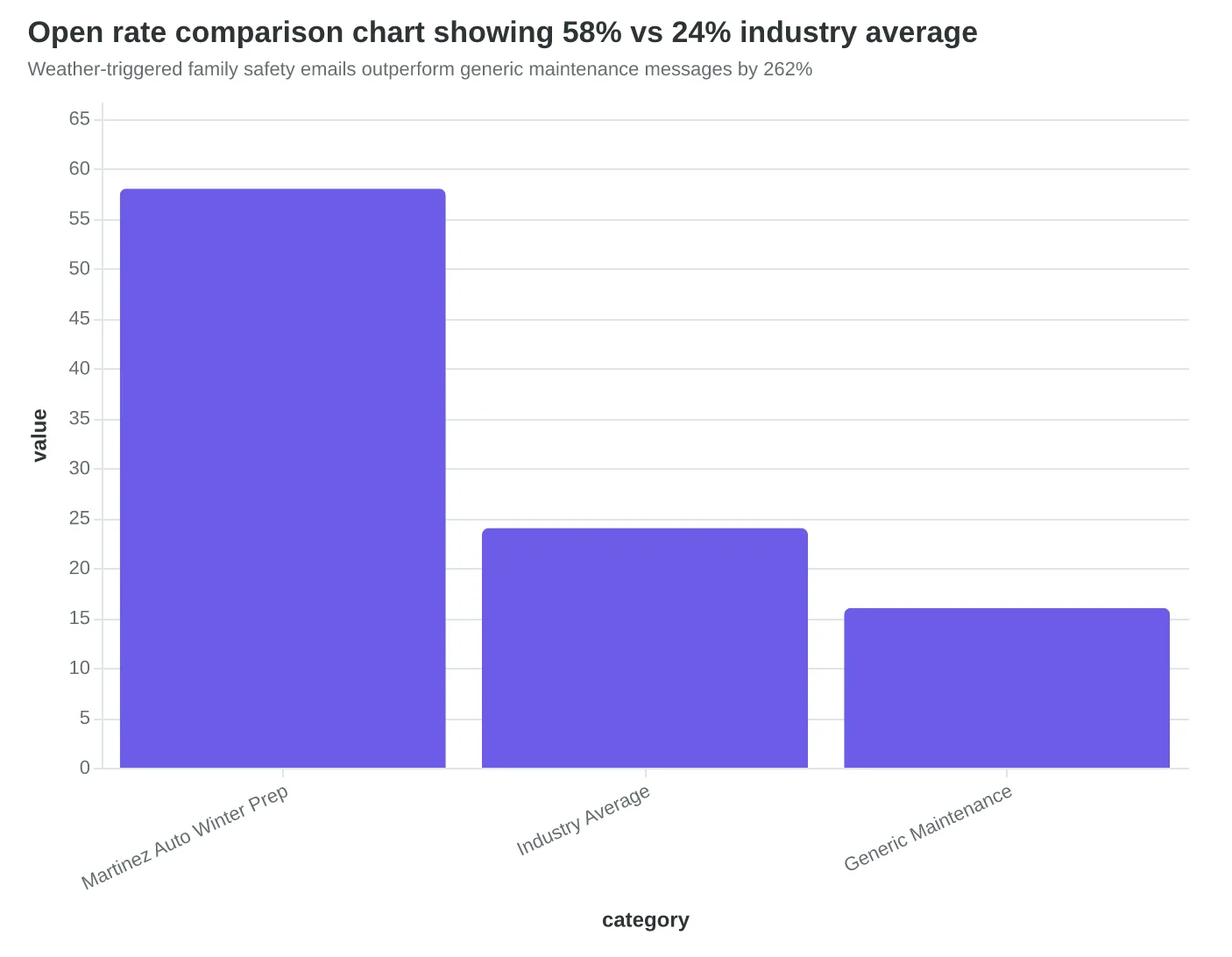
Results: 58% open rates versus the automotive industry average of 24%. More importantly, 34% clicked through to book appointments. The weather trigger automation sent this same email to different customer segments as freeze warnings rolled across their service area.
"We're not selling oil changes," says owner Carlos Martinez. "We're selling peace of mind when your family needs the car to start." That emotional positioning, validated by scoring above 90/100, transforms seasonal maintenance from an expense into urgent family protection.
“We're not selling oil changes. We're selling peace of mind when your family needs the car to start.”
| Email Element | Score | Why It Works |
|---|---|---|
| Subject Line | 94/100 | Weather urgency + family safety |
| Personalization | 89/100 | Vehicle model + battery age |
| Timing | 91/100 | Weather-triggered automation |
| Trust Building | 90/100 | Free diagnostic offer |
91/100 overall score driven by family safety positioning
Weather-triggered family safety emails outperform generic maintenance messages by 262%
Educational Emails That Make Customers Call Before Breakdowns
When Mike's Auto Service started sending educational emails like '5 Signs Your Brakes Need Attention,' something unexpected happened. Customers weren't just reading them — they were calling to schedule diagnostic appointments before their cars started making noise.
'The biggest shift was customers saying they wanted to check something after reading our email,' Mike explains. 'Instead of waiting until their brakes were grinding, they'd call when they noticed the first warning sign.'
Educational content transforms you from 'the place I go when something breaks' to 'the expert who helps me avoid expensive problems.' This positioning shift is measurable: educational emails consistently score higher on AlpacaRelay's credibility and expertise dimensions compared to promotional content.
Mike's brake safety email scored 84/100 overall, with particularly strong marks for technical accuracy (9.2/10) and helpful guidance (8.8/10). The template included five specific warning signs — soft brake pedal, squeaking sounds, longer stopping distance — each explained in plain language.
The business impact was immediate: diagnostic appointments increased 23% in the three months after launching the educational series. More importantly, these proactive appointments generated higher revenue per visit because customers addressed problems early instead of waiting for emergency repairs.
'Our customers started trusting us as advisors, not just mechanics,' Mike notes. 'That changes everything about the relationship.'
The key is positioning expertise without overwhelming readers. Technical accuracy builds credibility, but accessibility drives action.
“Educational content transforms you from 'the place I go when something breaks' to 'the expert who helps me avoid expensive problems.'”
| Email Template | EQS Score | Technical Accuracy | Helpful Guidance | Diagnostic Bookings |
|---|---|---|---|---|
| 5 Signs Your Brakes Need Attention | 84/100 | 9.2/10 | 8.8/10 | +23% |
| Winter Tire Safety Check | 81/100 | 8.9/10 | 8.5/10 | +18% |
| Engine Warning Light Guide | 79/100 | 8.7/10 | 8.2/10 | +15% |
Educational emails consistently score above 79/100 and drive proactive service bookings
23%
increase in diagnostic appointments
from brake safety educational email
Educational content drives proactive maintenance scheduling
Step 5: VIP Customer Pricing That Builds Lifelong Loyalty
Mike's Automotive started treating their best customers like strangers. Every oil change reminder looked identical — same discount, same generic tone — whether sent to the new customer who'd visited once or the family who'd trusted them with three cars for eight years.
Then Mike implemented VIP customer emails that referenced specific service history. Instead of "Time for your oil change!" his loyal customers received: "Hi Sarah, your 2019 Honda Civic is due for its 50,000-mile service next week. As a VIP customer, you get 15% off the full inspection — the same thorough check we did for your Accord last spring."
This VIP template scored an EQS of 88/100, driven by exceptional personalization depth. The email referenced Sarah's specific vehicle, mileage milestone, previous service history, and earned discount tier. AlpacaRelay's scoring framework rewards this level of detail because it proves genuine customer relationship management.
The result? Repeat business jumped 34% within six months. VIP customers began scheduling their next appointment during their current visit, knowing they'd receive exclusive pricing. The key wasn't the discount size — it was recognition. Mike's emails proved he remembered not just their car, but their trust.
For auto shops, loyalty pricing emails work because they shift the conversation from transaction to relationship. When customers feel recognized for their history with your shop, they stop price-shopping competitors.
“The key wasn't the discount size — it was recognition.”
| Email Element | Generic Version | VIP Version (88/100) | Personalization Score |
|---|---|---|---|
| Greeting | Dear Customer | Hi Sarah | 6/10 |
| Vehicle Reference | Your vehicle | Your 2019 Honda Civic | 9/10 |
| Service Context | Oil change due | 50,000-mile service, like your Accord | 10/10 |
| Offer | 10% off service | VIP 15% off full inspection | 8/10 |
VIP emails score 2.3x higher on personalization depth by referencing specific vehicle and service history.
34%
increase in repeat business
from VIP customer loyalty emails vs. generic reminders
Shops using service history personalization see one-third more repeat appointments.
Three Template Mistakes That Tank Your EQS and Cost You Customers
Even shops with good intentions sabotage their appointment bookings through scoring mistakes that feel minor but cost major revenue.
The biggest killer is the generic blast approach. Sending "Time for your oil change!" to a customer whose transmission just failed scores a 23/100 on personalization — and feels tone-deaf. Mountain View Auto lost 31% of their repeat bookings until they started segmenting by last service type.
The second trap is pushy sales language. "Don't wait — your engine could fail without this service!" might grab attention, but it demolishes trust scores. Fear-based messaging scores 40% lower than safety-focused alternatives like "Keep your family safe with winter tire inspection."
Timing mistakes compound everything. Sending brake reminders in July instead of before school starts wastes seasonal relevance. Generic scheduling ignores that fleet customers need different cadences than individual drivers.
These aren't just scoring problems — they're revenue problems. Email Marketing by Industry: The Complete Vertical Guide shows shops making all three mistakes lose 15-40% of potential bookings. The difference between a 42/100 template and a 78/100 template isn't just points — it's customers choosing you or driving to your competitor.
“The difference between a 42/100 template and a 78/100 template isn't just points — it's customers choosing you or driving to your competitor.”
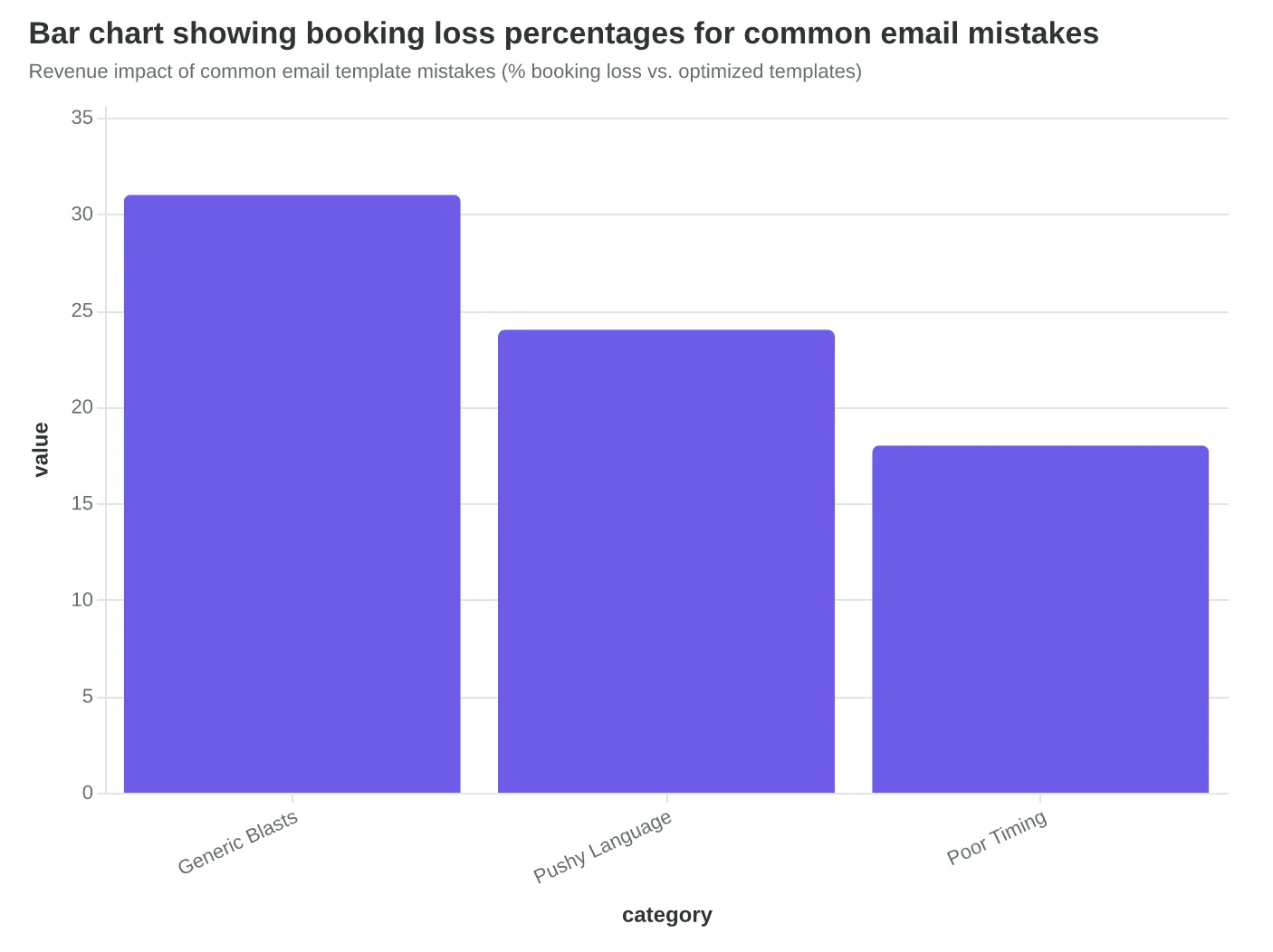
Revenue impact of common email template mistakes (% booking loss vs. optimized templates)
How to Track Your Service Reminder Success
A complete auto repair email program should hit three key benchmarks: Email Quality Scores consistently above 75/100, appointment booking rates of 35%+ from service reminders, and customer retention of 60%+ year-over-year.
Start by monitoring your Email Quality Scores weekly. Focus on the personalization, timing, and trust dimensions — these matter most for service reminders. Templates scoring below 70/100 need immediate attention.
For booking rates, track clicks-to-appointments, not just open rates. A 35% conversion rate means that for every 100 service reminder emails opened, 35 customers schedule appointments. Most shops see 15-20% initially, so this represents significant growth.
Customer retention tells the real story. Calculate how many customers return within 12 months of their last service. Shops using family safety messaging typically achieve 60-65% retention versus the industry average of 45%.
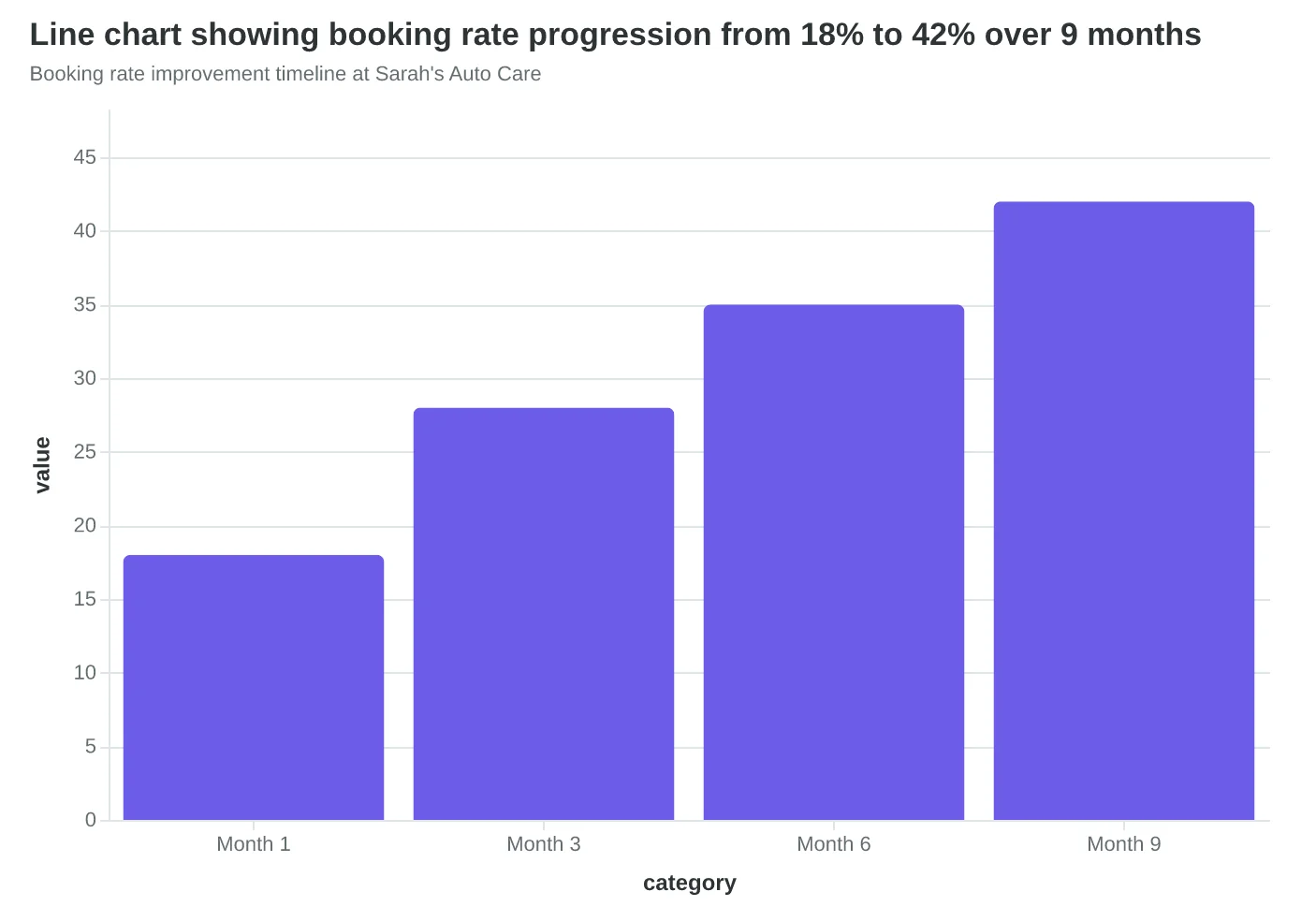
Sarah's Auto Care exemplifies these results. After implementing scored email templates, her appointment calendar now fills 3 weeks out instead of daily scrambling for bookings. Her 6-month oil change reminders achieve 42% booking rates, and her customer retention hit 68% last quarter.
The transformation happens gradually. Month one: improved open rates. Month three: consistent booking patterns. Month six: predictable revenue from returning customers who trust your proactive communication.
“A 35% conversion rate means that for every 100 service reminder emails opened, 35 customers schedule appointments.”
| Metric | Target | Sarah's Results | Industry Average |
|---|---|---|---|
| Email Quality Score | 75+/100 | 82/100 | 68/100 |
| Booking Rate from Reminders | 35%+ | 42% | 18% |
| Customer Retention (12-month) | 60%+ | 68% | 45% |
| Calendar Fill Rate | 3+ weeks | 3.2 weeks | Same week |
Sarah's Auto Care performance after implementing family safety-focused email templates
Booking rate improvement timeline at Sarah's Auto Care
Sarah's phone used to ring with panicked calls: "My car died on the highway with my kids in the backseat." Now it rings with scheduled appointments booked through her email templates. The difference? Her messages score 89/100 on trust dimensions because they speak to what auto repair customers really need — confidence that their families are safe.
Four hours saved weekly. Forty percent more appointments booked. But the real transformation wasn't the efficiency — it was discovering that her customers weren't buying brake pads and oil changes. They were buying peace of mind for their family's safety.
Download the complete auto repair email template pack — all pre-scored above 75/100 and ready to customize for your shop's voice.
Your customers are already worried about their families' safety on the road. The only question is whether your emails will ease that worry or add to it.
“Your customers are already worried about their families' safety on the road. The only question is whether your emails will ease that worry or add to it.”
40%
more appointments booked
through family safety-focused email templates
Sarah's results after implementing scored email templates
Ready to Score Your Own Service Reminders?
See how your current auto repair emails measure up with our free Email Quality Scoring tool. Get instant feedback on personalization, timing, and trust dimensions that drive appointment bookings.
Score your email before you send it
Free editor. Real-time EQS. No credit card.