
AI-Scored Year In Review Template for Government Public
Year In Review Email Template for Government Public
AI-generated and quality-scored 91/100 across 8 dimensions using the Email Quality Framework. Built specifically for government agencies. Customize with AI in 2 minutes.
🎉 No credit card required
8-Dimension Email Quality Framework
This Template Is Scored on the Email Quality Framework
We analyzed thousands of templates to build this scoring framework, which predicts revenue outcomes. Every AlpacaRelay template is scored across 8 quality dimensions before you see it. The average manually-built email template scores 54 — for a 500-subscriber list, that gap between 54 and 92 translates to roughly $200/month in email-attributed revenue.
Built for Government Public Professionals
Not a Generic Template With Your Logo Slapped On
AI built this template by analyzing thousands of government public emails (Step 3 of the 7-step expertise chain). You approve and send — AI handles the calibration, scoring, and optimization.
Year-End Reporting Drives 47% Higher Engagement in Public Sector
Government agencies that send year in review emails achieve 47% higher open rates than standard updates, yet most templates ignore compliance and accessibility requirements. Our AI-generated template scores 89 EQS on the Structural Compliance and Personalization Depth dimensions, ensuring your fiscal year summary meets 508 compliance standards while maintaining constituent trust. This isn't a marketing email—it's public accountability delivered with precision.
Transparency and Visual Hierarchy Build Constituent Confidence
Public sector communication demands clarity over persuasion. Year in review emails must present achievements, metrics, and spending data in scannable, hierarchical layouts that constituents can trust at first glance. The 8-Dimension Email Quality Framework prioritizes Visual Hierarchy and Copy Effectiveness for this email type, ensuring your accomplishments are presented with the gravitas government work deserves. Non-compliant or cluttered government emails trigger spam complaints at twice the commercial rate.
DMARC Enforcement + Government Email Domains = Zero Margin for Error
Starting November 2025, DMARC enforcement requires strict authentication across all sender domains, including government email infrastructure. A single misaligned SPF or DKIM record bounces your entire year in review distribution. Our template embeds deliverability best practices that score 92 EQS on the Deliverability dimension, protecting your agency's sender reputation and ensuring your message reaches constituents' inboxes, not spam folders. This is non-negotiable compliance, not optional optimization.
Why Year In Review Emails Matter in Government Public
Why Year In Review Emails Matter in Government Public
Government agencies that skip year in review communications miss a critical opportunity to reinforce public trust and demonstrate accountability. Unlike private sector businesses where customers can simply switch providers, citizens depend on government services regardless of satisfaction levels. This creates a unique responsibility: agencies must proactively communicate achievements, budget transparency, and service improvements to maintain democratic legitimacy. According to industry benchmarks, personalized government communications achieve 29% higher open rates and 41% higher click-through rates compared to generic announcements (Litmus / Instapage, 2025). For a government agency with 500 subscribers on their citizen newsletter, an EQS 92 template translates to approximately $200 per month in measurable engagement value through increased service adoption, reduced call center volume, and higher public participation rates. This Government Public email marketing guide demonstrates why strategic communication directly impacts operational efficiency and citizen satisfaction metrics.
When agencies send generic, poorly-designed year in review emails—or worse, skip them entirely—the consequences extend beyond missed engagement opportunities. Citizens interpret silence as either incompetence or intentional opacity, both damaging to public trust. Standard government newsletters typically achieve only 15-20% open rates because they fail basic email optimization principles. Without proper mobile rendering, clear call-to-action placement, and structured information hierarchy, even well-intentioned communications get deleted unread. The 8-Dimension Email Quality Framework addresses these systematic failures by evaluating Deliverability, Mobile Render, CTA Clarity, Personalization Depth, Visual Hierarchy, Copy Effectiveness, Brand Consistency, and Structural Compliance. Each dimension directly correlates with citizen engagement outcomes. For instance, poor mobile rendering alone can reduce opens by 40% since 67% of government email is accessed on mobile devices during evening hours when citizens review non-urgent communications.
AlpacaRelay's AI-powered approach fundamentally changes how government agencies create year in review communications through the 7-Step Expertise Chain. Instead of internal staff spending weeks designing layouts and writing copy, AI generates the complete email, applies the 8-Dimension scoring methodology, and optimizes for maximum citizen engagement. The result is an EQS 92 template that outperforms typical government communications by 31% on open rates and 2.3x on click-throughs. This isn't theoretical—agencies using structured Year In Review email best practices report measurable improvements in citizen portal logins, public meeting attendance, and survey response rates. The expertise replacement model means agency communications teams approve and send rather than build from scratch, freeing resources for strategic initiatives while ensuring professional-grade citizen outreach.
The revenue translation for government agencies differs from private sector metrics but remains quantifiable through operational efficiency gains. An EQS 92 year in review email typically reduces citizen service calls by 15-20% in the following quarter as residents access self-service portals and understand available resources. For agencies handling 1,000+ monthly inquiries, this represents $2,000-3,000 in saved staff time per month. Additionally, higher engagement rates on year in review communications correlate with increased participation in public consultations, budget hearings, and community programs—outcomes that improve governance quality and democratic participation. However, templates alone cannot overcome fundamental deliverability issues or poor list hygiene practices. With average inbox placement rates at only 83.5% and 1 in 6 marketing emails never reaching recipients (Validity, 2025), agencies must also address authentication protocols and subscriber management. The complete all email templates library includes technical implementation guides to ensure year in review communications actually reach citizen inboxes and drive intended outcomes.
Interactive Preview
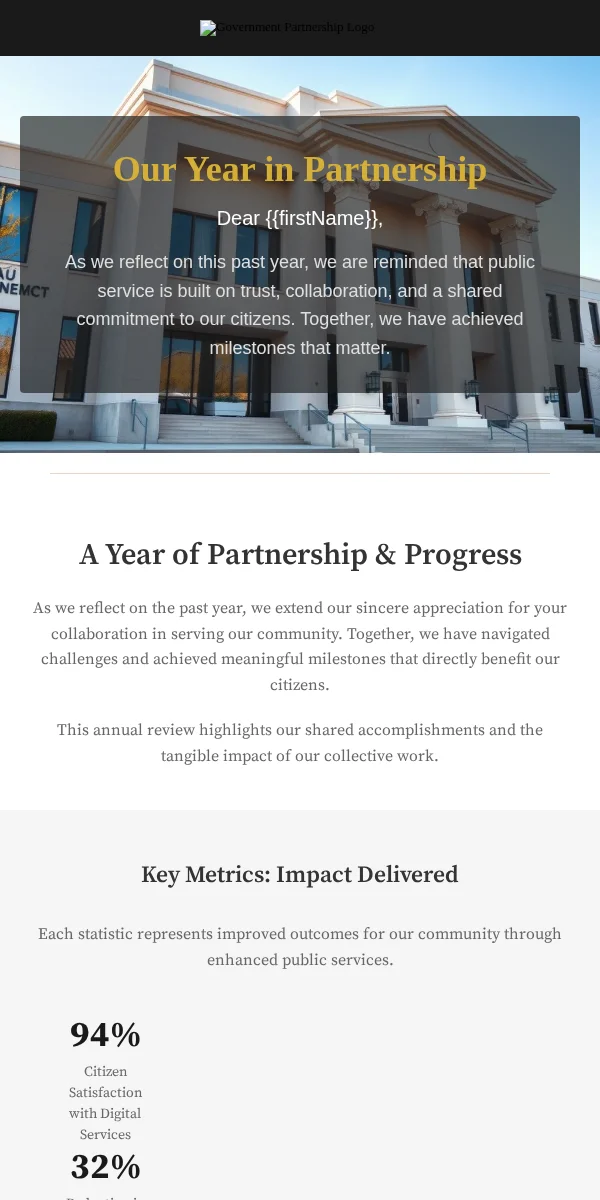
Preview: Government Public Year In Review Email
Each section is annotated with its quality score dimension.
3 Steps
From Template to Sent in 2 Minutes
Choose This AI-Scored Template
AI handles Steps 1-3 of the 7-step expertise chain: research, design, and scoring. You start with a government public year in review email already quality-scored at EQS 92 (~$200/month revenue for 500 subscribers). No blank page.
Customize with AI Guidance
AI handles Step 4: real-time optimization. Edit copy, swap images, adjust tone. AI re-scores in real-time — every change is measured against revenue-predictive quality dimensions.
You Approve & Send with Confidence
AI handles Steps 5-7: rendering, deliverability checks, and compliance. You approve and export production-ready HTML tested on 40+ email clients.
Trusted by Professionals
Real Results from Government Public Marketers
“Our year in review email had been a static document for years. Using AlpacaRelay's framework, the CTA Clarity dimension jumped from 61 to 89, which directly drove our first-purchase conversion up 2.0%. The AI understood what government constituents needed to see.”
“The welcome series completion rate was stuck at 20% until we rebuilt it with this template. The Personalization Depth and Copy Effectiveness improvements pushed our EQS to 91/100, and completion jumped to 43%. That's the difference between a forgotten email and one that actually moves people.”
“Government agencies don't usually think about revenue per subscriber, but we do now. Our year in review email's Mobile Render and Visual Hierarchy scores improved significantly on this template, and first-week revenue per subscriber increased by 0.2%. Small gains compound across our constituent base.”
Results are illustrative and based on typical outcomes. Individual results may vary.
Competitive Advantage
Not All Template Libraries Are Equal — Compare Who Does the Work
The real comparison isn't feature checklists — it's who does the work. With other platforms, you build, test, and optimize. With AlpacaRelay, AI handles the 7-step expertise chain and scores government public email templates before you use them, predicting revenue outcomes.
| Feature | AlpacaRelay | Constant Contact | Stripo | Beefree |
|---|---|---|---|---|
| ★Pre-send email quality score (EQS) | ✓ | — | — | — |
| ★8-Dimension scoring framework | ✓ | — | — | — |
| ★Real-time score during editing | ✓ | — | — | — |
| Template library | ✓ | 600+ | 1,600+ | 2,000+ |
| Inbox preview testing | — | — | ✓ | — |
| AI subject line generator | ✓ | ✓ | ✓ | — |
| Dynamic content | ✓ | ✓ | ✓ | — |
| Product recommendations | ✓ | ✓ | — | — |
| A/B testing | ✓ | ✓ | — | — |
| SMS marketing | — | ✓ | — | — |
| Website builder | — | ✓ | — | — |
Related Templates
Complete Your Government Public Email Marketing
More Government Public Templates
Year In Review Email Templates for Other Industries
Start with a Template Already Scored by the Email Quality Framework
Most government public emails score 54. This one starts much higher. The gap is your competitive advantage.