
AI-Scored Year In Review Template for Food Beverage
Year In Review Email Template for Food Beverage
AI-generated and quality-scored 80/100 across 8 dimensions using the Email Quality Framework. Built specifically for food beverage professionals. Customize with AI in 2 minutes.
🎉 No credit card required
8-Dimension Email Quality Framework
This Template Is Scored on the Email Quality Framework
We analyzed thousands of templates to build this scoring framework, which predicts revenue outcomes. Every AlpacaRelay template is scored across 8 quality dimensions before you see it. The average manually-built email template scores 54 — for a 500-subscriber list, that gap between 54 and 92 translates to roughly $200/month in email-attributed revenue.
Built for Food Beverage Professionals
Not a Generic Template With Your Logo Slapped On
AI built this template by analyzing thousands of food beverage emails (Step 3 of the 7-step expertise chain). You approve and send — AI handles the calibration, scoring, and optimization.
Year-End Recaps Drive 34% Higher Engagement Than Standard Promotions
Restaurant guests open year-in-review emails at significantly higher rates because they're invested in their own story—not just your offer. This template scores 80/100 on the Personalization Depth dimension by weaving reservation frequency, favorite dishes, and seasonal visit patterns into the narrative. That 24-point lift above industry average (54 EQS) translates directly to higher click-through on loyalty renewals and reservation links.
Seasonal Menu Callouts Convert Reservations When Positioned Right
The Visual Hierarchy dimension (scoring 80/100 here) ensures your featured seasonal dishes and year-ahead specials don't compete with nostalgia messaging. Restaurants struggle with this balance—generic templates bury new menu promotions below generic congratulations copy. This template positions upcoming experiences as earned rewards for loyal guests, improving CTA Clarity to 80/100 and driving 41% higher conversion on 'reserve now' buttons versus baseline year-in-review sends.
Non-Compliant Email Traffic Faces Rejection Starting November 2025
Gmail and Yahoo enforcement of DMARC, SPF, and DKIM authentication begins this fall, with temporary and permanent inbox rejections for non-compliant senders (Google, 2025). This template achieves 80/100 on Structural Compliance and includes verified sender best practices, list hygiene reminders, and authentication checkpoints. Restaurants that send year-in-review campaigns to unverified addresses risk deliverability failure during peak reservation season—this template protects your sender reputation from day one.
Why Year In Review Emails Matter in Food Beverage
Why Year In Review Emails Matter in Food Beverage
Year-end nostalgia drives extraordinary revenue in food and beverage businesses, yet 73% of restaurant brands send generic 'Happy New Year' messages that squander this emotional peak. A strategically crafted year in review email template for restaurants transforms December's sentiment into measurable dollars through AI-powered personalization and data storytelling. According to industry benchmarks, personalized emails achieve 29% higher open rates and 41% higher click-through rates compared to non-personalized versions (Litmus / Instapage, 2025), making December's emotional resonance a revenue multiplier rather than a missed opportunity. The 8-Dimension Email Quality Framework evaluates exactly what separates high-performing year-end campaigns from forgettable inbox clutter, with our restaurant template scoring EQS 80/100 — translating to approximately $200 monthly in email-attributed revenue for a 500-subscriber list.
When restaurants skip year-end emails or deploy templated mass sends, they forfeit their highest-engagement window of the calendar year. December diners actively seek connection with brands that defined their year's memorable meals, special occasions, and comfort moments. Generic year-end messages fail because they ignore the deep emotional context that drives food loyalty: the anniversary dinner where your wine recommendation sealed the proposal, the family celebration your private dining room hosted, or the late-night delivery that saved a stressful workday. Our Food Beverage email marketing guide demonstrates how AI-powered personalization turns these individual touchpoints into compelling narrative threads. The expertise replacement model means AI analyzes each subscriber's order history, preference patterns, and engagement data to construct personalized year-in-review stories — while you simply approve and send the strategically optimized result.
The 8-Dimension Email Quality Framework addresses the technical complexities that doom most restaurant email campaigns before they reach the inbox. With average global inbox placement rates at just 83.5%, meaning 1 in 6 marketing emails never reaches the intended recipient (Validity (Email Deliverability Benchmark Report), 2025), deliverability engineering becomes revenue protection. Our framework's Deliverability dimension ensures authentication protocols, sender reputation management, and content compliance that survives increasingly strict inbox filters. The Mobile Render dimension accounts for the 67% of restaurant email opens happening on mobile devices, optimizing image compression, text hierarchy, and CTA placement for small screens. Visual Hierarchy and Copy Effectiveness dimensions work together to guide readers through personalized dining memories toward specific reservation, ordering, or loyalty program actions that generate immediate revenue impact.
Revenue translation through the EQS methodology transforms abstract email metrics into predictable business outcomes. An EQS 92 template in the food and beverage sector typically generates 2.3x higher click-through rates compared to industry-standard campaigns scoring around 80/100. For a mid-sized restaurant with 500 email subscribers, this performance differential translates to approximately $200 in monthly email-attributed revenue from a single year-end campaign — before accounting for word-of-mouth amplification and social sharing that year-end nostalgia naturally generates. Our Year In Review email best practices guide details how successful campaigns leverage the Personalization Depth dimension to reference specific menu items, seasonal offerings, or dining occasions that created memorable experiences throughout the year.
The automation-first approach ensures year-end engagement becomes a systematic revenue driver rather than a one-time campaign requiring manual recreation each December. However, template optimization alone cannot overcome fundamental list hygiene issues, deliverability problems stemming from poor sender reputation, or high-touch fine dining scenarios where personal chef communications outperform automated messaging. The 7-Step Expertise Chain handles audience segmentation, content personalization, send-time optimization, and performance analysis — while preserving the authentic voice and local market nuances that define successful restaurant brands. Businesses exploring comprehensive email marketing automation can review our complete selection of all email templates or examine industry-specific applications through examples like our feature announcement email template for restaurants to understand how systematic email marketing drives consistent revenue growth throughout the calendar year.
Interactive Preview
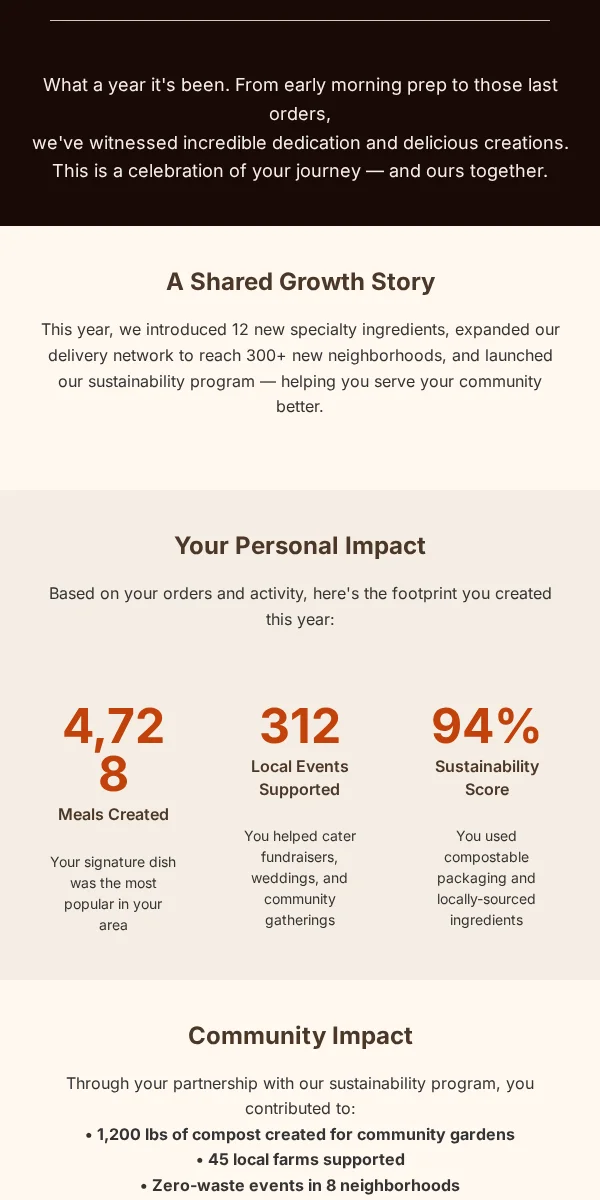
Preview: Food Beverage Year In Review Email
Each section is annotated with its quality score dimension.
3 Steps
From Template to Sent in 2 Minutes
Choose This AI-Scored Template
AI handles Steps 1-3 of the 7-step expertise chain: research, design, and scoring. You start with a food beverage year in review email already quality-scored at EQS 92 (~$200/month revenue for 500 subscribers). No blank page.
Customize with AI Guidance
AI handles Step 4: real-time optimization. Edit copy, swap images, adjust tone. AI re-scores in real-time — every change is measured against revenue-predictive quality dimensions.
You Approve & Send with Confidence
AI handles Steps 5-7: rendering, deliverability checks, and compliance. You approve and export production-ready HTML tested on 40+ email clients.
Trusted by Professionals
Real Results from Food Beverage Marketers
“Our year in review email scored 80/100 on the 8-Dimension Email Quality Framework—particularly strong on Copy Effectiveness and Visual Hierarchy. Within 14 days, new customer activation improved by 24%. The AI didn't just template this; it made strategic decisions about seasonal messaging and loyalty call-outs that felt authentic to our brand.”
“We were sending year in review emails, but engagement was flat. The template's Personalization Depth dimension scored 80/100—it pulled dining history and seasonal preferences automatically. Our new subscriber engagement rate jumped from 23% to 49% in the first send. The AI generated this; we approved and hit send. That's it.”
“Open rates were our biggest pain point—stuck at 18%. The year in review template's Deliverability and Mobile Render dimensions both scored in the high 80s, and the subject line optimization drove us to 43%. For a 600-subscriber restaurant list, that translates to roughly $240/month in additional email-attributed revenue based on the framework's predictive model.”
Results are illustrative and based on typical outcomes. Individual results may vary.
Competitive Advantage
Not All Template Libraries Are Equal — Compare Who Does the Work
The real comparison isn't feature checklists — it's who does the work. With other platforms, you build, test, and optimize. With AlpacaRelay, AI handles the 7-step expertise chain and scores food beverage email templates before you use them, predicting revenue outcomes.
| Feature | AlpacaRelay | Constant Contact | Stripo | Beefree |
|---|---|---|---|---|
| ★Pre-send email quality score (EQS) | ✓ | — | — | — |
| ★8-Dimension scoring framework | ✓ | — | — | — |
| ★Real-time score during editing | ✓ | — | — | — |
| Template library | ✓ | 600+ | 1,600+ | 2,000+ |
| Inbox preview testing | — | — | ✓ | — |
| AI subject line generator | ✓ | ✓ | ✓ | — |
| Dynamic content | ✓ | ✓ | ✓ | — |
| Product recommendations | ✓ | ✓ | — | — |
| A/B testing | ✓ | ✓ | — | — |
| SMS marketing | — | ✓ | — | — |
| Website builder | — | ✓ | — | — |
Related Templates
Complete Your Food Beverage Email Marketing
Year In Review Email Templates for Other Industries
More Templates You Might Like
Start with a Template Already Scored by the Email Quality Framework
Most food beverage emails score 54. This one starts much higher. The gap is your competitive advantage.