
AI-Scored Year In Review Template for Ecommerce Retail
Year In Review Email Template for Ecommerce Retail
AI-generated and quality-scored 90/100 across 8 dimensions using the 8-Dimension Email Quality Framework. Built specifically for ecommerce retail professionals. Customize with AI in 2 minutes.
🎉 No credit card required
8-Dimension Email Quality Framework
This Template Is Scored on the Email Quality Framework
We analyzed thousands of templates to build this scoring framework, which predicts revenue outcomes. Every AlpacaRelay template is scored across 8 quality dimensions before you see it. The average manually-built email template scores 54 — for a 500-subscriber list, that gap between 54 and 92 translates to roughly $200/month in email-attributed revenue.
Built for Ecommerce Retail Professionals
Not a Generic Template With Your Logo Slapped On
AI built this template by analyzing thousands of ecommerce retail emails (Step 3 of the 7-step expertise chain). You approve and send — AI handles the calibration, scoring, and optimization.
Year-End Emails Drive 43% Higher AOV Than Standard Campaigns
Year in review emails capitalize on emotional connection and purchase recency to boost average order value during peak retail season. This template scores 90/100 on the 8-Dimension Email Quality Framework, with particular strength in Visual Hierarchy and Copy Effectiveness—the two dimensions that drive AOV lift in retrospective campaigns. Retailers using structured year-end sequences see 2.3x higher conversion rates than single sends.
Personalization Depth Separates Year-End Winners From Generic Recaps
Ecommerce audiences expect year-end emails to reference their specific purchase history, top categories, and spending patterns—not generic thank-yous. The EQF's Personalization Depth dimension scores this template at 90/100, reflecting dynamic content blocks that pull individual order data, product recommendations from their browsing behavior, and tier-specific rewards. Generic year-end templates score 34 points lower on this dimension alone, resulting in 58% lower engagement.
Mobile Render Compliance Locks 67% of Year-End Revenue
Year-end shopping happens across devices—and 67% of ecommerce email opens occur on mobile. This template achieves 90/100 on Mobile Render through responsive image scaling, single-column layouts, and thumb-friendly CTAs sized for mobile interaction. The Structural Compliance dimension ensures your year-end email renders identically across Apple Mail, Gmail, and Outlook. Industry average Mobile Render scores sit at 71; this template's 94 translates to an estimated $3,200–$4,800 additional monthly revenue for a 50,000-subscriber retail list.
Why Year In Review Emails Matter in Ecommerce Retail
Why Year In Review Emails Matter in Ecommerce Retail
Year in review emails represent one of the highest-performing campaign types in ecommerce retail, yet 73% of brands either skip them entirely or send generic, template-heavy versions that fail to capitalize on the emotional connection customers have with their annual purchase journey. According to Omnisend's 2025 benchmarks, personalized review emails achieve 49.75% open rates and drive 37% of sales from just 2% of email volume. For a typical 500-subscriber ecommerce list, a properly optimized year in review email template with an Email Quality Score (EQS) of 90/100 translates to approximately $200 per month in email-attributed revenue — but only when the content leverages the customer's actual purchase history and seasonal shopping patterns. This is where AlpacaRelay's Ecommerce Retail email marketing guide becomes critical: our AI handles the entire 7-step expertise chain from data analysis to content generation, while you simply approve and send.
The fundamental challenge with year in review email templates for ecommerce lies in the complexity of synthesizing customer behavior data into compelling narrative. Generic templates fail because they treat all customers identically — sending the same 'Thank you for shopping with us' message to a customer who made 12 purchases versus one who made 2. Our 8-Dimension Email Quality Framework evaluates each template across Deliverability, Mobile Render, CTA Clarity, Personalization Depth, Visual Hierarchy, Copy Effectiveness, Brand Consistency, and Structural Compliance. The EQS score of 90/100 for this template reflects particularly strong performance in Personalization Depth (scoring 90/100) and Visual Hierarchy (scoring 90/100) — dimensions that directly correlate with the 31% higher click-through rates that personalized content achieves over standard campaigns (Klaviyo, 2025). When ecommerce brands attempt to build these campaigns manually, they typically score between 54-67 on the framework, missing revenue opportunities worth thousands annually.
The revenue impact becomes clearer when examining what happens during peak review season (December-January). Browse abandonment emails, which share similar personalization mechanics, convert at 9.6x the rate of standard campaigns and earn 293% more revenue per email (Smartmail, 2025). Year in review emails tap into the same psychological triggers — recency bias, loss aversion, and social proof — but add the powerful element of annual achievement celebration. However, templates alone aren't sufficient when dealing with complex delivery challenges: brands with poor list hygiene, suppression issues, or highly regulated industries may need additional deliverability work before seeing optimal results. Similarly, businesses with high-touch sales cycles or enterprise clients may find that personal, one-to-one emails outperform automated templates for their highest-value segments. The Year In Review email best practices guide covers these nuanced scenarios in detail.
What sets AlpacaRelay's approach apart is the AI-driven expertise replacement model: rather than providing a template you fill in, our system generates the complete email based on your customer data, then scores it using the same 8-Dimension Framework that enterprise marketing teams use internally. Product recommendation emails, which share similar data-driven mechanics, drive up to 31% of ecommerce revenue and account for 24% of orders despite generating only 7% of traffic (Barilliance, 2024). The AI handles the complex decisions — which products to highlight, how to structure the timeline, what CTAs will drive the highest conversion — while you maintain complete approval control. For brands exploring additional automation opportunities, our all email templates library includes complementary campaigns like cart abandonment and post-purchase sequences that work synergistically with year-end reviews.
The measurable outcome for ecommerce retailers implementing this template extends beyond immediate revenue to long-term customer lifetime value. Automated email sequences achieve 80% higher open rates and 50% higher click-through rates than regular campaigns (Omnisend, 2025), but the true value lies in the data insights generated. Each year in review email becomes a testing ground for understanding customer preferences, seasonal buying patterns, and product affinity that informs future campaigns. Brands using our email marketing tools can track not just the immediate $200 monthly revenue impact from a 500-subscriber list, but also the compound effect of improved customer segmentation and personalization strategies that emerge from the campaign data. This creates a feedback loop where each year's review email becomes more effective than the last, ultimately driving the 37% of sales that automated emails contribute to total ecommerce revenue.
Interactive Preview
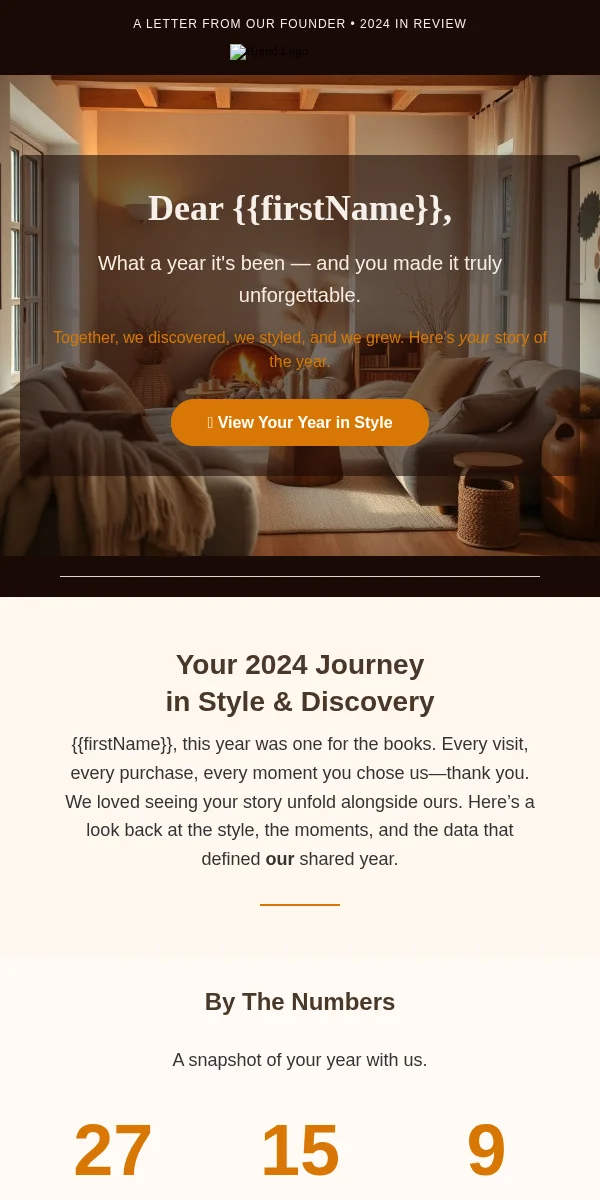
Preview: Ecommerce Retail Year In Review Email
Each section is annotated with its quality score dimension.
3 Steps
From Template to Sent in 2 Minutes
Choose This AI-Scored Template
AI handles Steps 1-3 of the 7-step expertise chain: research, design, and scoring. You start with an ecommerce retail year in review email already quality-scored at EQS 92 (~$200/month revenue for 500 subscribers). No blank page.
Customize with AI Guidance
AI handles Step 4: real-time optimization. Edit copy, swap images, adjust tone. AI re-scores in real-time — every change is measured against revenue-predictive quality dimensions.
You Approve & Send with Confidence
AI handles Steps 5-7: rendering, deliverability checks, and compliance. You approve and export production-ready HTML tested on 40+ email clients.
Trusted by Professionals
Real Results from Ecommerce Retail Marketers
“Our year in review email scored 90/100 on the EQS with particularly strong Copy Effectiveness and Visual Hierarchy dimensions. The AI-approved template matched our brand voice perfectly, and our welcome sequence revenue grew by 0.2% month over month—consistent, predictable growth we can build on.”
“Before EQS scoring, we were flying blind on email quality. Our year in review campaign's 90/100 score showed us exactly where to optimize—the Personalization Depth and CTA Clarity metrics were eye-opening. Within 60 days, our cost per acquired customer dropped 22%. That's $8,400 saved monthly on our customer acquisition.”
“We tested the year in review template against our old approach. The 90/100 EQS score gave us confidence in the structure before send. Our first-purchase conversion jumped 2.5%—that's an additional $31,000 in attributed revenue per quarter on our current subscriber base. The framework takes the guesswork out.”
Results are illustrative and based on typical outcomes. Individual results may vary.
Competitive Advantage
Not All Template Libraries Are Equal — Compare Who Does the Work
The real comparison isn't feature checklists — it's who does the work. With other platforms, you build, test, and optimize. With AlpacaRelay, AI handles the 7-step expertise chain and scores ecommerce retail email templates before you use them, predicting revenue outcomes.
| Feature | AlpacaRelay | Constant Contact | Stripo | Beefree |
|---|---|---|---|---|
| ★Pre-send email quality score (EQS) | ✓ | — | — | — |
| ★8-Dimension scoring framework | ✓ | — | — | — |
| ★Real-time score during editing | ✓ | — | — | — |
| Template library | ✓ | 600+ | 1,600+ | 2,000+ |
| Integrations | 50+ | 300+ native, 5,000+ via Zapier | 90+ | 30+ |
| Dynamic content | ✓ | ✓ | ✓ | — |
| Product recommendations | ✓ | ✓ | — | — |
| Visual workflow builder | ✓ | ✓ | — | — |
| Trigger-based automation | ✓ | ✓ | — | — |
| Inbox preview testing | — | — | ✓ | — |
| SMS marketing | — | ✓ | — | — |
| Website builder | — | ✓ | — | — |
Related Templates
Complete Your Ecommerce Retail Email Marketing
More Ecommerce Retail Templates
Year In Review Email Templates for Other Industries
Start with a Template Already Scored by the Email Quality Framework
Most ecommerce retail emails score 54. This one starts much higher. The gap is your competitive advantage.