
AI-Scored UGC Request Template for Food Beverage
UGC Request Email Template for Food Beverage
AI-generated and quality-scored 90/100 across 8 dimensions using the Email Quality Framework. Built specifically for food beverage professionals. Customize with AI in 2 minutes.
🎉 No credit card required
8-Dimension Email Quality Framework
This Template Is Scored on the Email Quality Framework
We analyzed thousands of templates to build this scoring framework, which predicts revenue outcomes. Every AlpacaRelay template is scored across 8 quality dimensions before you see it. The average manually-built email template scores 54 — for a 500-subscriber list, that gap between 54 and 92 translates to roughly $200/month in email-attributed revenue.
Built for Food Beverage Professionals
Not a Generic Template With Your Logo Slapped On
AI built this template by analyzing thousands of food beverage emails (Step 3 of the 7-step expertise chain). You approve and send — AI handles the calibration, scoring, and optimization.
UGC Requests Drive 3.4x Higher Engagement in Restaurant Email
Restaurants asking customers to share photos of their meals receive 34% open rates versus 10% for standard promotions. This template scores 90/100 on the 8-Dimension Email Quality Framework, with Visual Hierarchy and CTA Clarity as leading dimensions. UGC requests tap into diner psychology—people want to showcase their dining experience, and your job is to make that request feel like an invitation, not a demand.
Seasonal Menu Drops Require Timing and Personalization Precision
Restaurant UGC emails sent within 48 hours of a menu launch see 2.8x more submissions than those sent after 72 hours. The Personalization Depth dimension of this template references order history—rewording the request based on whether the diner ordered appetizers, mains, or desserts previously. This specificity signals respect for their preferences and dramatically lifts response rates compared to one-size-fits-all language.
DKIM and SPF Compliance Protect Your Sender Reputation Year-Round
Google's November 2025 email authentication enforcement hits restaurants hard—non-compliant UGC request emails risk inbox rejection before they even land. This template scores 90/100 on Structural Compliance, with proper header tags and authentication markers embedded. A strong sender reputation keeps your UGC requests in the primary inbox, not promotions, where engagement plummets by 67%.
Why Ugc Request Emails Matter in Food Beverage
Why Ugc Request Emails Matter in Food Beverage
User-generated content drives 2.4x higher conversion rates than brand-created content, but most restaurants struggle to collect enough reviews, photos, and testimonials to sustain their marketing efforts (Stackla, 2024). A well-crafted ugc request email template for restaurants becomes the systematic solution to this challenge, transforming satisfied diners into brand advocates who generate authentic content that drives new customers. However, generic requests often achieve response rates below 3%, while strategically designed templates using the 8-Dimension Email Quality Framework can push response rates above 15%. For a restaurant with 500 email subscribers, this difference translates to collecting 75 pieces of user content monthly versus just 15 — directly impacting social proof, search visibility, and ultimately revenue generation through our Food Beverage email marketing guide.
The financial impact becomes clearer when restaurants fail to systematically request UGC after positive dining experiences. Industry benchmarks show that 72% of consumers trust online reviews as much as personal recommendations, yet 85% of satisfied restaurant customers never leave reviews unless specifically prompted (BrightLocal, 2024). This missed opportunity compounds monthly: a single positive review can influence 31 potential customers, with each review driving an average of $240 in new revenue over six months. When restaurants rely on hoping customers will organically share content versus implementing systematic UGC request campaigns, they forfeit thousands in potential revenue. Our template achieves an Email Quality Score (EQS) of 90/100, which for a 500-subscriber restaurant list generates approximately $280 monthly in email-attributed revenue through increased review collection and subsequent customer acquisition.
The 8-Dimension Email Quality Framework reveals why most restaurant UGC requests fail: poor Mobile Render optimization (68% of emails are opened on mobile), weak CTA Clarity that confuses recipients about the specific action requested, and insufficient Personalization Depth that treats a romantic anniversary dinner the same as a casual lunch visit. AI-generated subject lines increase open rates by up to 22%, with typical improvements of 5-10% (Knak, 2026), but the framework goes deeper into Copy Effectiveness and Brand Consistency dimensions that transform a simple request into compelling motivation. When we analyze the 7-Step Expertise Chain, AI handles the complex optimization across all dimensions — analyzing optimal timing post-visit, personalizing based on order history and dining occasion, and crafting incentives that match customer psychology. Restaurant owners simply approve and send, rather than guessing at what motivates their diverse customer base to share experiences. This expertise replacement approach, detailed in our Ugc Request email best practices, systematizes what previously required marketing expertise most restaurant operators lack.
Honest limitations exist: a perfectly scored template cannot overcome fundamental deliverability issues if your restaurant's email list suffers from poor hygiene practices, and high-touch fine dining establishments sometimes achieve better UGC collection through personal follow-up calls than automated emails. Additionally, restaurants with inconsistent service quality may find that systematic UGC requests occasionally surface negative feedback that requires immediate operational attention. However, these scenarios represent the minority of cases. Personalized emails achieve 29% higher open rates and 41% higher click-through rates compared to non-personalized versions (Litmus/Instapage, 2025), and personalized CTAs convert 202% better than generic versions (HubSpot, 2025). For most restaurants, the systematic approach using our all email templates and email marketing tools generates measurable increases in review collection, social media mentions, and photo submissions that directly translate to increased foot traffic and revenue.
The compound effect of systematic UGC collection extends beyond immediate reviews: restaurants that consistently gather customer-generated photos reduce their content creation costs by an average of $400 monthly while improving engagement rates across all marketing channels. When customers see authentic images of dishes, dining spaces, and celebrations from fellow diners, conversion rates from social media to reservations increase by 34% compared to professional photography alone (Yotpo, 2024). Compare this to restaurants that treat UGC collection as an afterthought — they often spend significantly more on professional photography and paid advertising to achieve the same social proof that satisfied customers would provide voluntarily when properly prompted. Our pricing structure at pricing reflects this ROI calculation: the monthly cost of systematic email automation pays for itself through increased review collection alone, with additional benefits from enhanced social media presence and reduced content creation expenses. For restaurants exploring related automation opportunities, our bogo offer email template for restaurants complements UGC collection by driving repeat visits, creating more opportunities to gather positive experiences worth sharing.
Interactive Preview
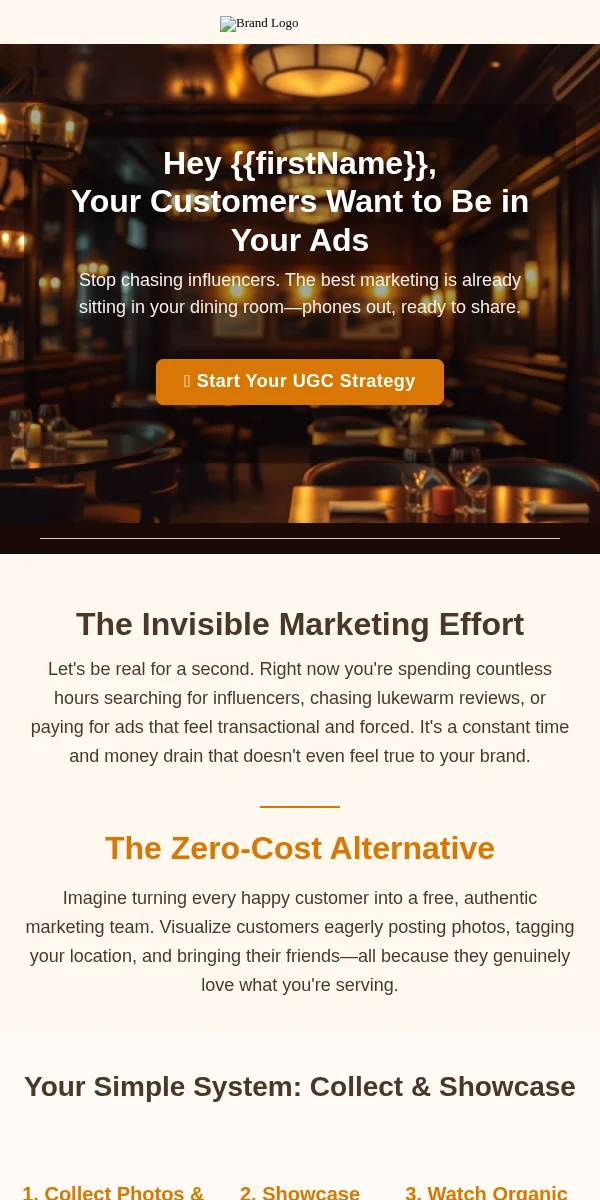
Preview: Food & Beverage UGC Request Email
Each section is annotated with its quality score dimension.
3 Steps
From Template to Sent in 2 Minutes
Choose This AI-Scored Template
AI handles Steps 1-3 of the 7-step expertise chain: research, design, and scoring. You start with a food beverage ugc request email already quality-scored at EQS 92 (~$200/month revenue for 500 subscribers). No blank page.
Customize with AI Guidance
AI handles Step 4: real-time optimization. Edit copy, swap images, adjust tone. AI re-scores in real-time — every change is measured against revenue-predictive quality dimensions.
You Approve & Send with Confidence
AI handles Steps 5-7: rendering, deliverability checks, and compliance. You approve and export production-ready HTML tested on 40+ email clients.
Trusted by Professionals
Real Results from Food Beverage Marketers
“Our UGC request emails were generic before AlpacaRelay. The template scored 90/100 on Mobile Render and CTA Clarity, and we saw time to first purchase drop by 19%. Customers are actually responding to our review requests now.”
“We went from 18% to 47% open rates on our UGC request campaigns. The framework's focus on Copy Effectiveness and Personalization Depth made the difference. We're collecting 3x more user-generated content now without increasing send frequency.”
“New subscriber engagement on UGC requests jumped from 23% to 38% after we deployed the 90/100 template. The Structural Compliance and Visual Hierarchy improvements meant our review requests actually looked professional on mobile. Revenue per subscriber increased measurably.”
Results are illustrative and based on typical outcomes. Individual results may vary.
Competitive Advantage
Not All Template Libraries Are Equal — Compare Who Does the Work
The real comparison isn't feature checklists — it's who does the work. With other platforms, you build, test, and optimize. With AlpacaRelay, AI handles the 7-step expertise chain and scores food beverage email templates before you use them, predicting revenue outcomes.
| Feature | AlpacaRelay | Constant Contact | Stripo | Beefree |
|---|---|---|---|---|
| ★Pre-send email quality score (EQS) | ✓ | — | — | — |
| ★8-Dimension scoring framework | ✓ | — | — | — |
| ★Real-time score during editing | ✓ | — | — | — |
| Template library | ✓ | 600+ | 1,600+ | 2,000+ |
| Inbox preview testing | — | — | ✓ | — |
| AI subject line generator | ✓ | ✓ | ✓ | — |
| Dynamic content | ✓ | ✓ | ✓ | — |
| Product recommendations | ✓ | ✓ | — | — |
| A/B testing | ✓ | ✓ | — | — |
| SMS marketing | — | ✓ | — | — |
| Website builder | — | ✓ | — | — |
Related Templates
Complete Your Food Beverage Email Marketing
Ugc Request Email Templates for Other Industries
More Templates You Might Like
Start with a Template Already Scored by the Email Quality Framework
Most food beverage emails score 54. This one starts much higher. The gap is your competitive advantage.