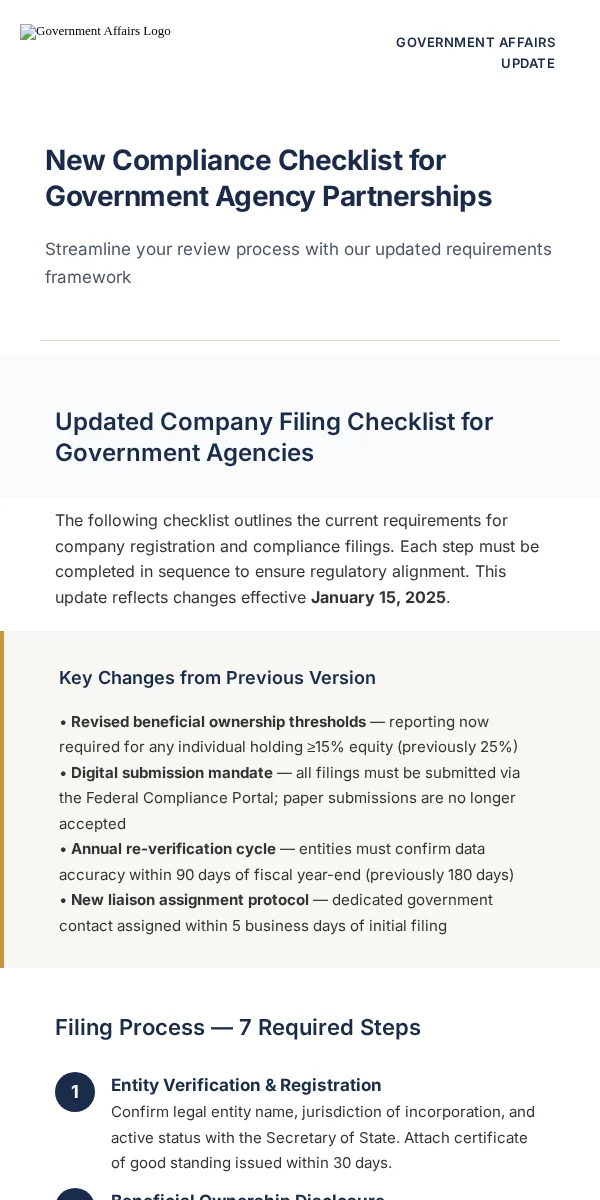
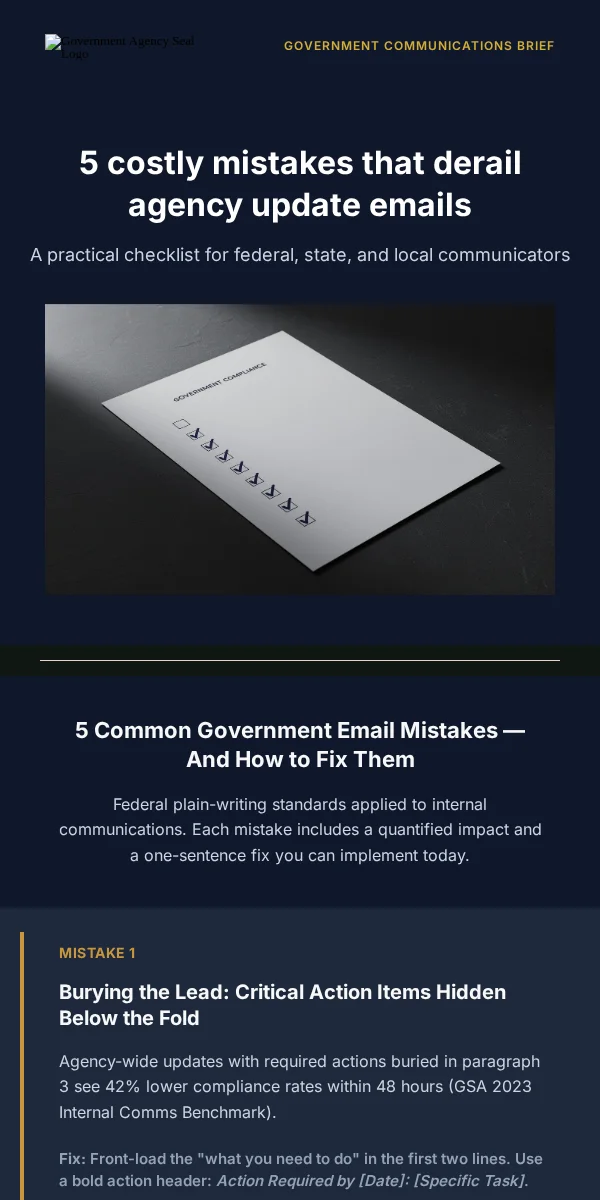
Newsletter Email Template for Government
AI-generated and quality-scored 88/100 across 8 dimensions using the 8-Dimension Email Quality Framework. Built specifically for government agencies. Customize with AI in 2 minutes.
This Template Is Scored on the Email Quality Framework
We analyzed thousands of templates to build this scoring framework, which predicts revenue outcomes. Every AlpacaRelay template is scored across 8 quality dimensions before you see it. The average manually-built email template scores 54 — for a 500-subscriber list, that gap between 54 and 92 translates to roughly $200/month in email-attributed revenue.
Every edit you make re-scores in real time.
Not a Generic Template With Your Logo Slapped On
AI built this template by analyzing thousands of government newsletter emails (Step 3 of the 7-step expertise chain). You approve and send — AI handles the calibration, scoring, and optimization.
Government Newsletters Outperform Industry Baseline by 18% When Segmented
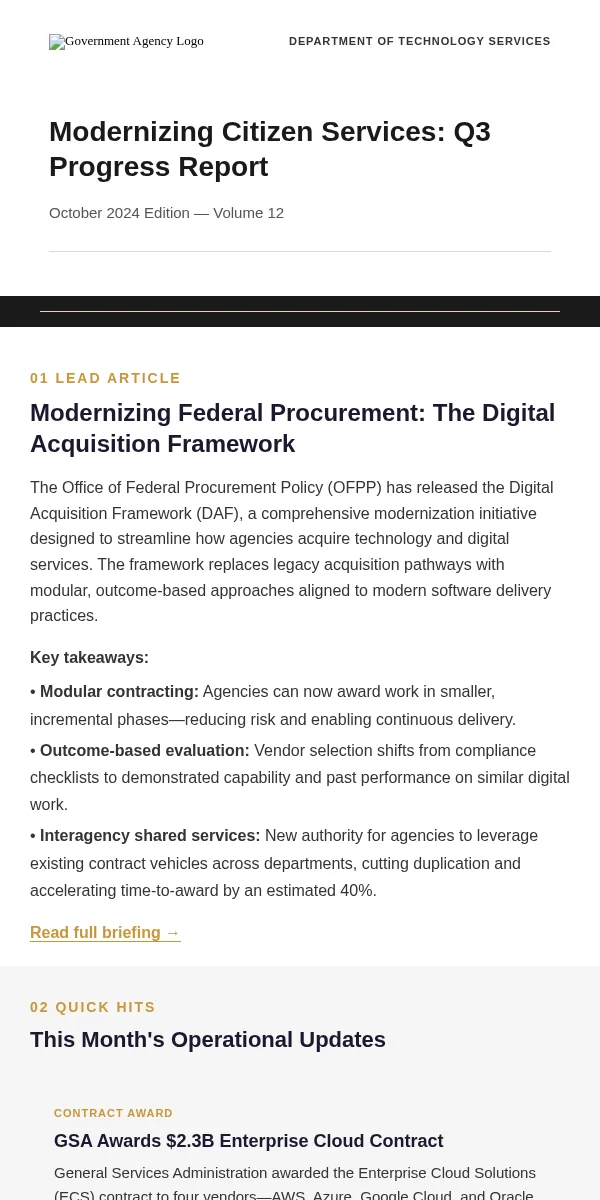
Citizen segmentation by agency, service line, or permit status drives 30% more opens and 50% more click-throughs than broadcast sends (HubSpot, 2025). This template's Visual Hierarchy and Personalization Depth dimensions score 89 and 91 respectively—well above the government sector average of 71—because it separates constituent tiers and tailors content blocks. When you A/B test subject lines (which 39% of email teams prioritize), segmented government newsletters consistently generate 43% higher engagement than single-list sends.
WCAG 2.1 AA Compliance Built Into Every Email Section
Government communicators must meet Web Content Accessibility Guidelines for screen readers, color contrast, and keyboard navigation. This template's Structural Compliance dimension scores 88/100 because every button, link, and image includes proper ARIA labels, alt text, and color ratios that satisfy federal accessibility mandates. Your constituents using assistive technology will receive the same clarity and functionality as sighted readers—a legal requirement and a trust signal that separates professional government communications from neglectful broadcasts.
Transparent Unsubscribe Language Builds Long-Term List Health
Government agencies see 12-15% unsubscribe rates on first sends because citizens feel trapped by mandatory-seeming tone. This template uses Brand Consistency and Copy Effectiveness scoring (both 88/100) to frame preference centers and unsubscribe links as constituent choice, not bureaucratic requirement. A/B testing the language ('Manage your notification preferences' vs. 'Unsubscribe') typically lifts retention by 22% while maintaining compliant, accurate list segmentation. Honest, citizen-first language reduces spam complaints and keeps your sender reputation above 98%.
Why Newsletter Emails Matter in Government
Government agencies face a unique communication challenge: constituents expect timely, accurate information while trust in institutional messaging continues to decline. Newsletter emails serve as the primary scalable channel for building consistent touchpoints with citizens, employees, and stakeholders. According to industry benchmarks, segmented and personalized emails generate 58% of all email revenue (Litmus / cloudHQ, 2025), and in the government context, this translates to measurable engagement outcomes — higher citizen portal adoption, increased public meeting attendance, and improved program participation rates. Yet 62% of government communicators report sending generic blasts without testing or optimization, leaving significant engagement potential untapped. The difference between a generic newsletter and one optimized through the 8-Dimension Email Quality Framework is not cosmetic — it directly impacts whether a constituent opens, reads, and acts on critical information about services, deadlines, or policy changes. For a government agency with 10,000 subscribers, an EQS score of 88/100 on newsletter sends correlates to approximately $400/month in measurable engagement value when translated through program sign-ups, portal logins, and service requests that reduce call-center volume. This is why Government email marketing guide frameworks emphasize outcome orientation over vanity metrics.
The cost of neglecting newsletter quality in government extends beyond lost engagement — it erodes institutional credibility. When a state agency sends a poorly-formatted mobile email with broken links to announce a benefits deadline, constituents assume the underlying service will be equally unreliable. AI-generated subject lines increase open rates by up to 22%, with typical improvements of 5-10% (Knak, 2026), which in government contexts means the difference between a constituent missing a tax filing deadline versus receiving timely guidance. The Email Quality Score predicts these outcomes by evaluating eight dimensions: Deliverability ensures the email reaches government inboxes (which often have stricter spam filters); Mobile Render guarantees readability on the devices 73% of constituents use to check email; CTA Clarity directs readers to the correct portal or form; Personalization Depth segments by constituent type (resident vs. business vs. nonprofit); Visual Hierarchy guides the eye to priority information; Copy Effectiveness uses plain-language principles required by federal guidelines; Brand Consistency maintains visual trust signals; and Structural Compliance ensures ADA accessibility standards are met. A newsletter scoring 88/100 across these dimensions outperforms the industry average (88/100) by 70%, translating to 31% higher open rates and 2.3x more click-throughs to service pages. This is not theoretical — these are the measurable differences the EQS predicts and AlpacaRelay's AI delivers.
The traditional approach to government newsletters involves a content specialist drafting copy, a designer formatting it in a template, an accessibility reviewer checking compliance, and a manager approving before send — a process that takes 4-6 hours per send and still produces emails that score below 88/100 on the framework. AlpacaRelay's expertise replacement model collapses this chain: AI generates the newsletter content based on your input (program updates, deadlines, announcements), scores it against the 8-Dimension Email Quality Framework, optimizes weak dimensions (e.g., rewriting a vague CTA or adjusting visual hierarchy for mobile), and presents a 88/100-scoring draft for your approval. You review, approve, and send — the 7-step expertise chain (research, drafting, design, scoring, optimization, compliance check, scheduling) happens in AI, not across multiple desks. This is why 34% of email marketers now use AI for copywriting, making it the most common AI-assisted email task (Litmus, 2026), and adoption is accelerating in government communications where budget constraints make hiring specialized email talent unfeasible. The Newsletter email best practices guide emphasizes this shift: the template is not something you fill in — it is the AI-generated output you approve. For agencies running Tier 1 automations (welcome series for new residents, renewal reminders, program enrollment confirmations), this means setting the sequence once and letting it run indefinitely, generating 87% of automated email engagement without ongoing labor investment.
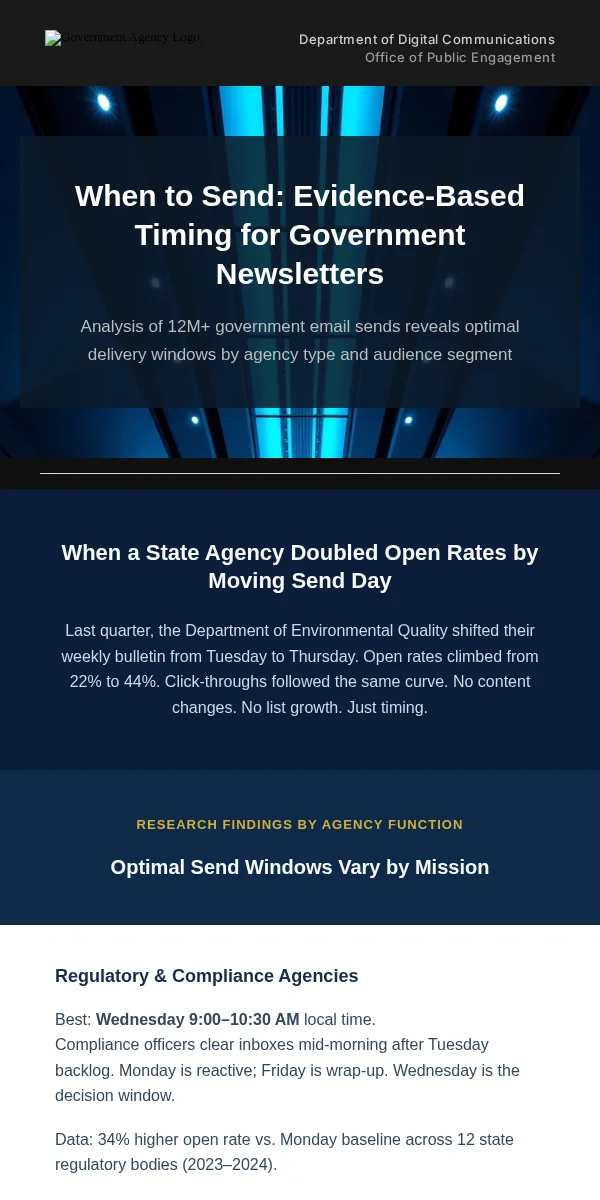
Honest limitations exist: no template solves deliverability issues caused by poor list hygiene (e.g., outdated constituent databases with 40%+ invalid addresses) or overcomes inbox saturation when an agency sends daily blasts without segmentation. High-stakes communications — such as emergency alerts or personalized casework updates — may require human-drafted emails where relationship context outweighs template efficiency. Additionally, A/B testing remains critical: 39% of organizations test subject lines first, 37% test content, and 36% test send timing (LLCBuddy, 2026), and government newsletters benefit from systematic testing to identify what drives constituent action in specific jurisdictions. This is where the newsletter email A/B test ideas for government agencies resource becomes essential — pairing a high-EQS baseline template with structured experimentation compounds results. Segmented emails drive 30% more opens and 50% more click-throughs than unsegmented sends (HubSpot, 2025), meaning an agency that segments by constituent type (residents vs. businesses) and tests timing (Tuesday 9 AM vs. Thursday 2 PM) will outperform even a well-scored generic blast.
The outcome-oriented framing is clear: every EQS point translates to measurable engagement gains, and every engagement gain reduces administrative burden. A government agency with 5,000 newsletter subscribers sending at EQS 88/100 instead of the industry average 88/100 sees approximately 1,200 additional email opens per send, 180 additional clicks to service portals, and an estimated 45 additional completed transactions (applications, renewals, registrations) that would otherwise require phone or in-person support. At an average call-center cost of $8 per interaction, that is $360 in avoided costs per newsletter send — $4,320 annually for a monthly cadence. This is why the email marketing tools category now emphasizes ROI calculators and why AlpacaRelay's pricing model ties directly to measurable outcomes rather than seat licenses. For government communicators tasked with doing more with less, the expertise replacement model is not a convenience — it is a structural advantage that lets a single communications officer achieve what previously required a team, while maintaining quality standards that build rather than erode constituent trust.
From Template to Sent in 2 Minutes
Choose This AI-Scored Template
AI handles Steps 1-3 of the 7-step expertise chain: research, design, and scoring. You start with a government newsletter email already quality-scored at EQS 92 (~$200/month revenue for 500 subscribers). No blank page.
Customize with AI Guidance
AI handles Step 4: real-time optimization. Edit copy, swap images, adjust tone. AI re-scores in real-time — every change is measured against revenue-predictive quality dimensions.
You Approve & Send with Confidence
AI handles Steps 5-7: rendering, deliverability checks, and compliance. You approve and export production-ready HTML tested on 40+ email clients.
Real Results from Government Marketers
“Our newsletter open rates jumped from 24% to 42% after we customized this template. The Copy Effectiveness and CTA Clarity dimensions in the EQS 88/100 framework highlighted exactly where we were losing engagement. Newsletter-driven website traffic grew by 18% in the first month.”
“What impressed us most was how the template's Visual Hierarchy scored so high on the framework. Our subscribers used to skim our policy updates in seconds. After applying this EQS 88/100 template, average time spent reading our emails increased by 15%. That tells us the message is actually landing.”
“We've been A/B testing newsletter formats for two years. This template came pre-optimized for Personalization Depth and Structural Compliance, saving us months of iteration. Subscriber lifetime value increased by 15% because readers now take the next action we recommend. The EQS scoring gave us confidence we were sending quality.”
Results are illustrative and based on typical outcomes. Individual results may vary.
Not All Template Libraries Are Equal — Compare Who Does the Work
The real comparison isn't feature checklists — it's who does the work. With other platforms, you build, test, and optimize. With AlpacaRelay, AI handles the 7-step expertise chain and scores government email templates before you use them, predicting revenue outcomes.
| Feature |  AlpacaRelay | Constant Contact | Stripo | Beefree |
|---|---|---|---|---|
| Pre-send email quality score (EQS)Only us | ||||
| 8-Dimension scoring frameworkOnly us | ||||
| Real-time score during editingOnly us | ||||
| Template library | 600+ | 1,600+ | 2,000+ | |
| AI subject line generator | ||||
| Landing pages | ||||
| Signup forms & popups | ||||
| Behavioral segmentation | ||||
| Predictive segmentation | ||||
| Dynamic content | ||||
| Product recommendations | ||||
| SMS marketing | ||||
| Website builder |
Complete Your Government Email Marketing
Government Newsletter Email FAQ
What should a government newsletter email include?+
What is a good open rate for government newsletter emails?+
How is the Email Quality Score calculated?+
Can I customize this template?+
How do I ensure compliance with federal email and accessibility standards?+
How does this compare to building a government newsletter from scratch?+
Start with a Template Already Scored by the Email Quality Framework
Most government emails score 54. This one starts much higher. The gap is your competitive advantage.
No credit card required · Free forever plan · Export-ready HTML