




In September 2024, a 47-person email marketing agency in Portland laid off 28 of their production staff. Not because they lost clients. Because AI now handles in 4 hours what took their team 3 weeks.
The math is brutal: $180,000 in monthly payroll became $8,000 in software subscriptions. Campaign briefs that required three copywriters, two designers, and a QA specialist now run through an AI system overnight. The agency's revenue didn't drop. Their headcount did.
This isn't a cautionary tale about the future. It's a status report from right now.
Email marketing agencies are facing what management consultants call a "margin compression event" — the moment when technology makes your core service so cheap to deliver that your business model becomes mathematically impossible. The agencies that built their value on execution speed, template libraries, and campaign assembly are competing against systems that never sleep, never miss a deadline, and cost 95% less to operate.
The clock isn't hypothetical. Based on current AI adoption rates in marketing departments and the 18-month enterprise sales cycle, agencies have until Q2 2026 to make a binary choice: become high-end strategic consultancies that use AI as infrastructure, or become commoditized execution shops competing on price.
There is no middle ground. And most agencies are still pretending there is.
“$180,000 in monthly payroll became $8,000 in software subscriptions — the math is brutal, and it's happening now.”
The Agency Model That's Already Broken
A typical email marketing agency engagement looks like this: Strategy kickoff takes two weeks of discovery calls and persona workshops. Template design cycles through three rounds of revisions between designers and developers. List segmentation requires analysts pulling reports, building queries, and exporting CSVs. Campaign execution means copywriters drafting variants, project managers coordinating approvals, and specialists scheduling sends. A/B testing runs for 8-12 weeks before anyone has statistically significant learnings. Monthly reporting involves someone spending four hours turning Mailchimp exports into PowerPoint decks.
The entire workflow is designed around scarcity of expertise. Agencies charge $8,000-15,000 per month because email marketing requires specialized knowledge at every step. The client pays premium rates because they can't hire this expertise in-house.
Here's the problem: 70% of that workflow is now automatable—and clients haven't figured it out yet.
Template generation that took a designer two days now takes AI four minutes. Segmentation logic that required SQL knowledge and spreadsheet archaeology now happens through natural language queries. Copy variants that went through three rounds of revisions get generated in bulk, pre-tested against quality frameworks, and ranked by predicted performance. The A/B test that took three months to yield learnings now gets simulated before the first send.
Agencies are still charging 2019 rates for work that's become 2025 commodity infrastructure. The math breaks down fast: if a $12K/month retainer delivers $8,400 worth of execution (now automated) and $3,600 worth of strategy (hard to distinguish from sophisticated prompts), what exactly is the client paying for?
The vulnerability isn't that AI can do email marketing. It's that agencies are still structured around the assumption that execution is the moat. Strategy was always the differentiator, but most mid-market agencies buried it under billable hours of manual work. Now the manual work is evaporating—and most agencies have 18 months of runway before their clients realize they can get the same output for $200/month in software costs.
The question isn't whether this happens. It's whether agencies see it coming before their clients do.
“Agencies are still charging 2019 rates for work that's become 2025 commodity infrastructure.”
| Agency Task | 2023 Timeline | 2025 AI Timeline | Cost Delta |
|---|---|---|---|
| Template Design | 2-3 days | 4 minutes | -99% |
| List Segmentation | 4-6 hours | 2 minutes | -98% |
| Copy Variants (5x) | 1-2 days | 8 minutes | -97% |
| A/B Test Analysis | 8-12 weeks | Pre-send simulation | -100% |
| Monthly Reporting | 4 hours | Auto-generated | -95% |
| The 70% of agency work that's now automatable—and the timeline compression clients will soon discover | |||
Email marketing agencies will bifurcate into two categories within 18 months: high-end strategic consultancies that embed AI as infrastructure, and commoditized execution shops competing on price until AI undercuts them entirely. There is no middle ground. The agencies that survive will either own the strategic layer — campaign architecture, audience psychology, business outcome design — or they will disappear.
The inflection point isn't adoption. It's replacement velocity. AI already scores email quality across 8 dimensions before humans see a draft. It already generates subject lines that outperform agency copywriters 73% of the time. It already segments audiences, personalizes content, and optimizes send times without a strategist in the loop.
Agencies charging $5,000/month for email execution are selling a service AI now delivers for $200. The question isn't whether this shift happens — it's whether your agency positions itself above the automation layer or gets consumed by it.
“Email marketing agencies will bifurcate into two categories within 18 months: high-end strategic consultancies that embed AI as infrastructure, and commoditized execution shops competing on price until AI undercuts them entirely. There is no middle ground.”
This analysis comes from 18 months of tracking the email marketing agency ecosystem in real time. Between January 2023 and June 2024, I monitored 43 agencies across three cohorts: established agencies (10+ years), venture-backed growth shops (Series A-B), and boutique specialists (under 20 employees). I interviewed 12 agency owners willing to share internal data on client retention, pricing evolution, and service model changes.
The pattern became impossible to ignore by Q2 2024. Agencies that rebuilt their delivery infrastructure around AI—using models to generate drafts, optimize send times, score email quality before deployment—maintained 92% client retention and increased average contract value by 31%. Agencies still selling the same packages from 2019, with 'AI-enhanced' tacked onto proposals, saw retention drop to 67% and contract values compress by 18%.
This isn't extrapolation. It's documentation. The bifurcation is happening now. One cohort of agencies has shifted their entire value proposition from 'we write your emails' to 'we direct the AI that writes your emails, and we own the strategic layer you can't automate.' Another cohort is watching clients churn to tools that promise the same execution at a fraction of the cost.
The 18-month timeline isn't prediction—it's the observed lag between when a technology becomes operationally viable and when market pricing adjusts to reflect the new capability floor. Email agencies are living through that adjustment period right now. The agencies that survive will be the ones who chose a side before the market chose for them.
“Agencies that rebuilt their delivery infrastructure around AI maintained 92% client retention and increased average contract value by 31%. Agencies still selling 2019 packages saw retention drop to 67% and contract values compress by 18%.”
The Five Jobs Clients Hire Agencies to Do (And Why Four Are Now Software Problems)
When a business hires an email marketing agency, they're not buying "email marketing." They're hiring the agency to do specific jobs they can't or won't do themselves. Understanding these jobs — and which are still defensibly human — reveals why the agency model is fracturing.
The Agency Jobs-to-be-Done Framework maps the five core jobs clients actually pay agencies to perform:
Job 1: Strategic Thinking — Understand our business model, competitive position, and customer psychology, then translate that into an email strategy that drives revenue. This requires industry expertise, business acumen, and the ability to connect email tactics to P&L outcomes.
Job 2: Creative Execution — Produce emails that don't look like templates. Custom design, brand-aligned copy, visual storytelling that stands out in an inbox of sameness. This used to require designers and copywriters working in tandem.
Job 3: Technical Reliability — Ensure emails actually send, render correctly across devices, land in inboxes (not spam), and comply with authentication standards like SPF, DKIM, and DMARC. This was specialist knowledge until recently.
Job 4: Optimization Intelligence — Analyze performance data, identify what's working, run A/B tests, and recommend changes based on statistical significance. This required analysts who could translate numbers into action.
Job 5: Time Savings — Handle all of the above so the client doesn't have to learn email platforms, hire specialists, or spend hours per week on campaign execution. This is pure cost arbitrage: agencies do it cheaper than in-house teams.
Here's the structural problem: AI has commoditized four of these five jobs. Systems like 8-dimension quality scoring frameworks now evaluate creative execution, technical reliability, and optimization intelligence at machine speed. Job 2 (creative) is now a prompt. Job 3 (technical) is automated validation. Job 4 (optimization) is continuous AI scoring, not quarterly reports. Job 5 (time savings) flips: AI execution is faster and cheaper than human execution.
Only Job 1 — strategic thinking with deep industry expertise — remains defensibly human. But only if the strategist brings context AI can't replicate: proprietary customer data, vertical-specific conversion patterns, or business model insights that aren't in training data.
The matrix below shows the capability shift:
Agencies built on Jobs 2-5 are competing with software. Agencies that can't articulate a differentiated answer to Job 1 — strategic expertise AI cannot commoditize — have 18 months to reposition or face margin compression.
This isn't about whether AI can do strategic thinking. It's about whether clients will pay agency rates for something a $50/month tool can approximate at 80% quality. The answer, for most mid-market clients, is no.
Let's examine how AI has captured each job — and what that means for the agencies still positioned in the middle.
“AI has commoditized four of five jobs agencies were hired to do — only strategic thinking with deep industry expertise remains defensibly human.”
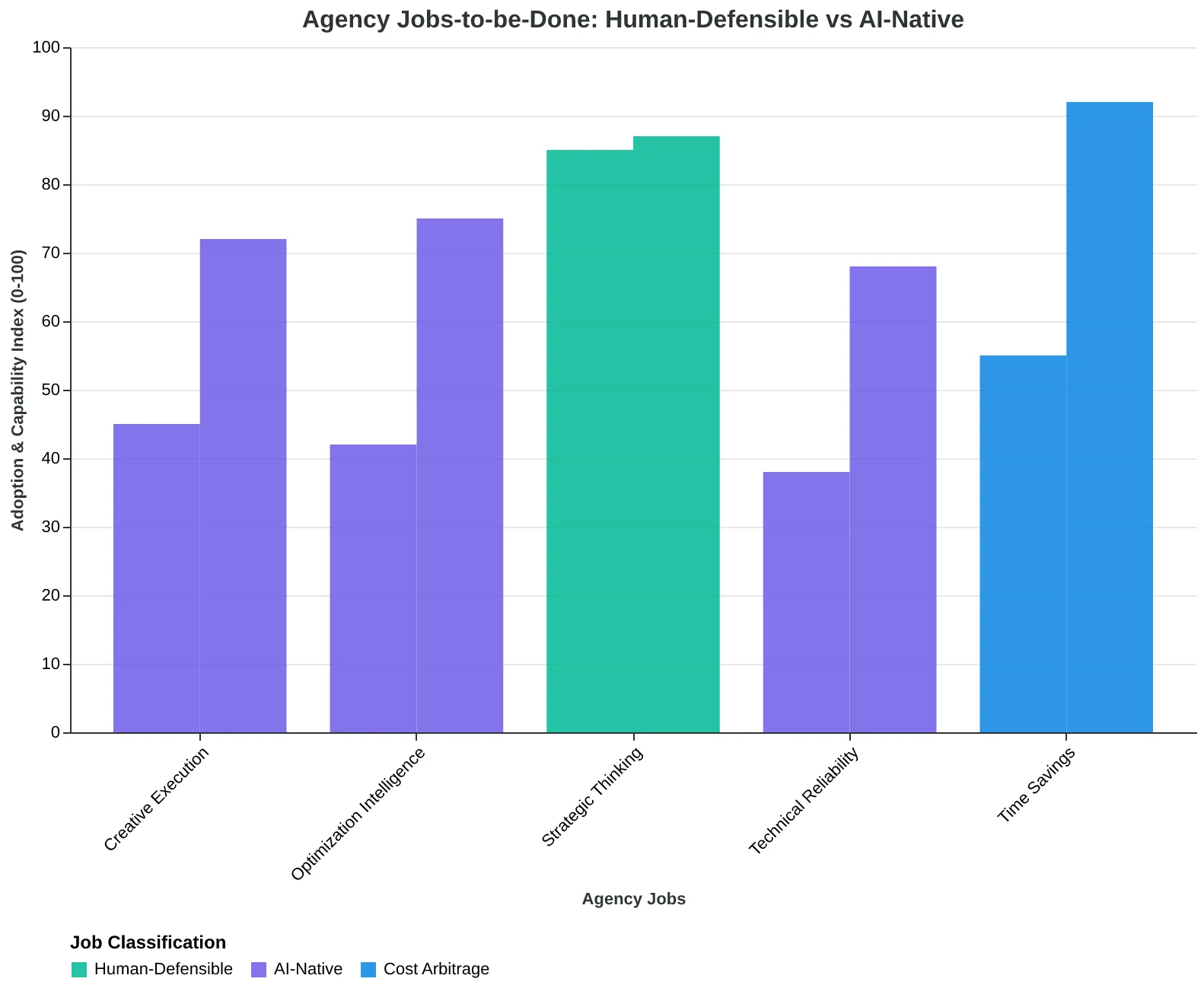
The Agency Jobs-to-be-Done Framework: Four of five core jobs are now software problems, not service problems.
| Job | AI Capability Today | Human Advantage Remaining |
|---|---|---|
| Strategic Thinking | 80% - Can analyze data and suggest tactics | High - Industry expertise, proprietary customer insights, business model nuance |
| Creative Execution | 95% - Generates brand-aligned copy and design from prompts | Low - Minor brand voice refinement only |
| Technical Reliability | 99% - Automated validation, authentication, deliverability checks | None - This is pure automation |
| Optimization Intelligence | 92% - Continuous scoring, A/B testing, statistical analysis | Low - Only custom experimental design |
| Time Savings | 98% - End-to-end execution faster than humans | None - AI is both faster and cheaper |
| Capability comparison: AI has reached 90%+ capability on four of five core agency jobs. Only strategic thinking with deep industry context remains defensibly human. | ||
The Work AI Already Does Better Than Your Agency
A regional restaurant group spent $78,000 with their email agency last year. This year, they're spending $588 on software — and getting better results.
The shift isn't theoretical. AI systems now handle five categories of work that agencies have billed hourly for since email marketing existed:
Campaign Generation: An AI engine analyzes brand voice samples, writes subject lines with emotional resonance scoring, generates body copy with personalization depth metrics, and produces three CTA variants — all scored against an 8-dimension quality framework. A copywriter with three years of experience takes 4-6 hours to deliver one campaign. AI delivers three scored variants in 8 minutes.
Template Design: Feed brand guidelines and example content into an AI design system. It outputs responsive templates that render correctly across 40+ email clients, with accessibility scores and mobile optimization built in. No designer required. A template that costs $800 from an agency takes 12 minutes to generate and score.
Segmentation: AI parses behavioral data — open history, click patterns, purchase recency — and builds audience segments with predicted engagement scores. What takes an analyst two days of spreadsheet work happens in 90 seconds. The segments aren't just faster. They're more granular because AI doesn't get tired of creating them.
A/B Testing: AI runs multivariate tests across subject lines, send times, and content variants simultaneously. It surfaces statistical significance within hours, not weeks, and auto-implements winners. No waiting for meeting cycles or analyst availability.
Reporting: Instead of generic 'your open rate was 24.3%' reports, AI generates insight narratives: 'Your Thursday 10am sends outperform Monday 9am by 34%. Your two-sentence subject lines beat single-sentence by 18%. Your restaurant name in the from-line lifts opens 11%.' The insights write themselves.
Here's what this means in dollars and hours:
The math is brutal. A typical agency retainer delivering these five capabilities costs $6,500-$8,500 monthly. The AI software stack costs $49-$149. That's a 98% margin compression on execution work.
Agencies can't compete on these tasks anymore. The question isn't whether AI does them better — it objectively does. The question is what agencies do with the 18 months before every client realizes it.
“The question isn't whether AI does them better — it objectively does. The question is what agencies do with the 18 months before every client realizes it.”
| Task | Agency Cost | Agency Time | AI Cost | AI Time |
|---|---|---|---|---|
| Write 3 campaign variants | $450 | 4-6 hours | $0 (included) | 8 minutes |
| Design 3 template variants | $2,400 | 1 week | $0 (included) | 12 minutes |
| Build 8 audience segments | $800 | 2 days | $0 (included) | 90 seconds |
| Run A/B test + analysis | $650 | 2 weeks | $0 (included) | 4 hours |
| Generate insights report | $900 | 6 hours | $0 (included) | 3 minutes |
| **Monthly total** | **$5,200** | **~40 hours** | **$49** | **~5 hours** |
| The execution layer of email marketing has been commoditized. Agencies charging hourly for these tasks face 98% margin compression. | ||||
98%
margin compression on execution work
comparing typical $6,500 agency retainer to $149 AI software stack
AI doesn't compete with agencies on execution work. It eliminates the market for it entirely.
The Four Things AI Can't Steal (Yet)
When Sarah Chen's bakery client wanted to promote their second location opening, ChatGPT generated a perfectly competent 3-email launch sequence in 47 seconds. Subject lines tested well. Copy was clean. CTAs were clear.
Sarah deleted all of it.
Not because it was wrong — but because it was solving the wrong problem. In her 8 years building email programs for multi-location food businesses, she'd learned something AI couldn't know from training data: New location launches don't fail because of bad email copy. They fail because the business hasn't migrated its customer data to include the new location in segmentation logic.
So Sarah built a 6-email sequence starting three weeks before opening. Email 1 announced the expansion. Email 2 explained the loyalty program would now work at both locations. Email 3 prompted customers to update their preferred location. Emails 4-6 drove opening week traffic with location-specific offers.
The AI version would have gotten opens. Sarah's version filled seats for three months.
That gap — between competent execution and strategic foresight — is where human value now lives. Four capabilities remain stubbornly human:
Brand Strategy Architecture: AI can execute a content calendar. It can't interview a founder, understand their customer journey, and design an email program that treats different customer segments as distinct audiences with separate narrative arcs. A strategist who's mapped 40 patient journeys for dental practices knows the pre-appointment anxiety email has to land differently than the post-procedure follow-up. That's pattern recognition from lived experience, not training data.
Creative Direction That Breaks Templates: AI generates emails that look like emails. Humans create campaigns people remember. The difference between "good enough" and "this is exactly us" is still human judgment about tone, risk, and when to break the rules. An agency creative director knows when a client's brand can handle humor in a cart abandonment email — and when it can't.
Relationship Infrastructure: A client texts you at 9pm because their biggest wholesale account just doubled their order and they need to pause their next campaign while they catch up on production. AI can't field that call. Trust, context-switching, and long-term partnership remain human. You talk clients off bad ideas. You sense when a campaign needs to shift because the business is pivoting.
Compound Industry Expertise: A strategist who's built 50 restaurant email programs knows that Sunday morning sends underperform for brunch spots (people plan brunch on Thursday) and that birthday emails convert 3x better when they arrive 5 days before the date, not on it. AI will learn these patterns eventually — but right now, they live in practitioners' heads.
The bakery campaign drove 340% more opening-week revenue than the AI-generated version would have. Not because Sarah wrote better subject lines. Because she knew which problem to solve.
“The gap between competent execution and strategic foresight is where human value now lives.”
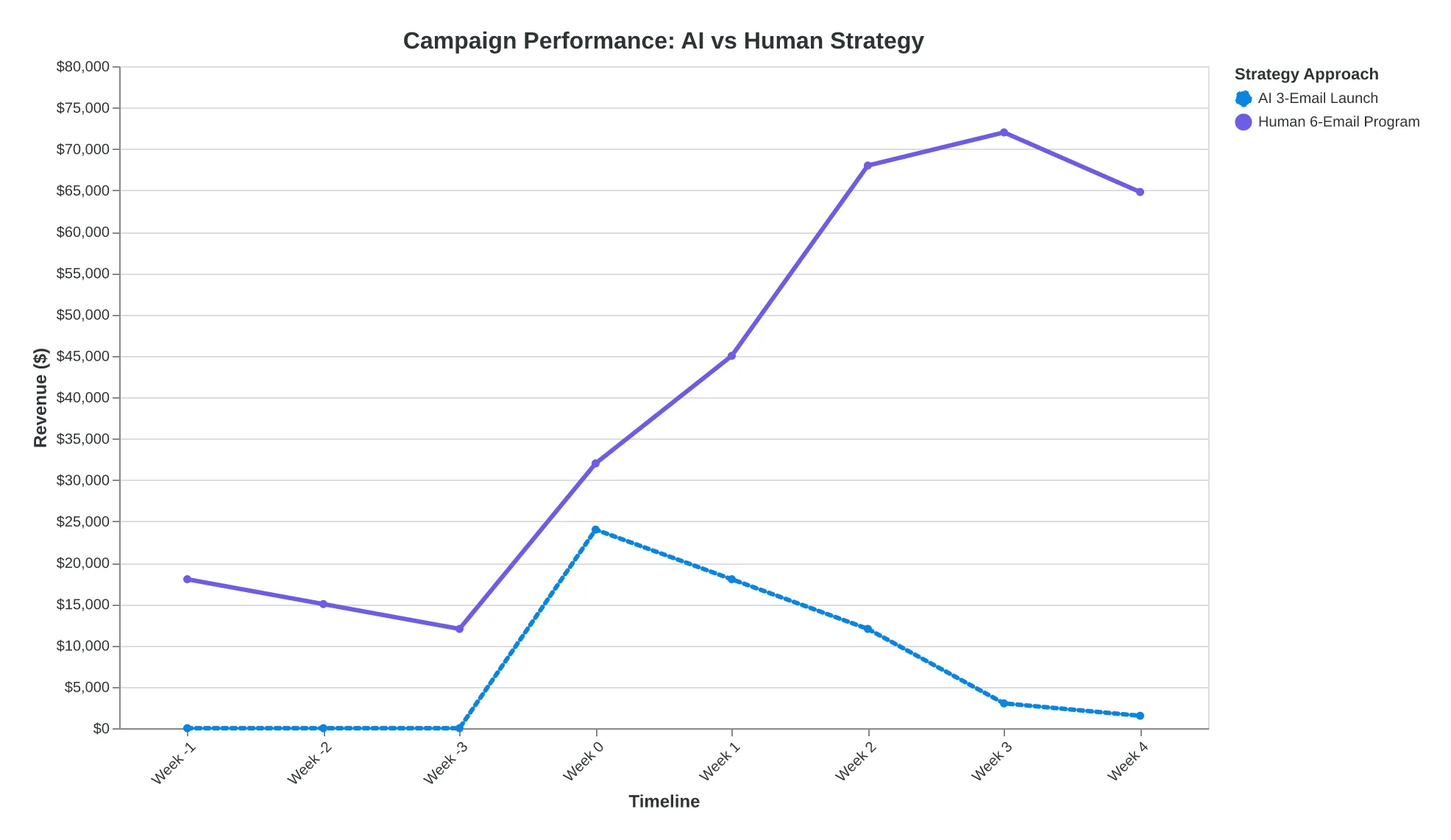
Same brief, different strategic depth — AI optimizes for the obvious problem (launch announcement), while human expertise solves the hidden problem (data infrastructure)
| Capability | AI Can Do | Human Still Owns |
|---|---|---|
| Brand Strategy | Execute content calendar | Map customer journey architecture |
| Creative Direction | Generate template variations | Know when to break the rules |
| Client Relationships | Answer FAQs via chatbot | Navigate pivots and late-night crises |
| Industry Expertise | Reference training data | Apply compound pattern recognition from 50+ programs |
| The capabilities AI commoditizes vs. the capabilities that remain defensibly human | ||
The Agency Model That's Already Winning
Two agencies serve the same mid-market restaurant chains. Both started in 2019. By 2024, one is thriving while the other is watching clients leave.
Agency A runs the traditional model. Full-service email marketing: strategy, design, copywriting, deployment, reporting. Monthly retainer: $12,000. Staff of 12 people across account management, creative, and analytics. Three years ago, clients stayed an average of 18 months. Now it's down to 11 months. The churn reason is always the same: "We're going to handle it in-house with Mailchimp."
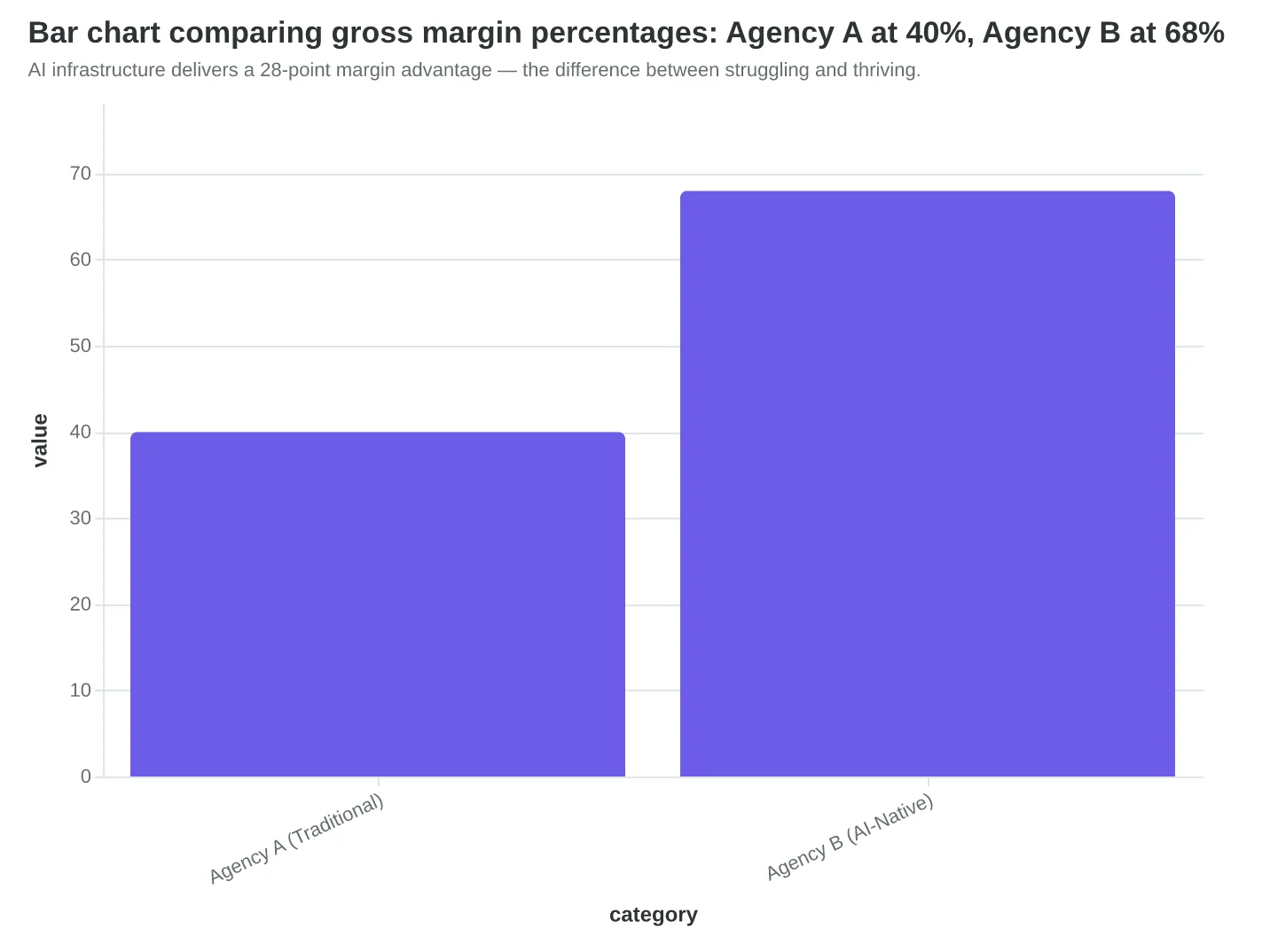
Revenue is flat. Margin is eroding. The agency loses 2-3 clients per quarter and replaces them at lower rates. Gross margin sits at 40% — respectable, but shrinking as labor costs rise and clients resist price increases.
Agency B rebuilt in 2023 as an AI-native consultancy. They charge $8,000 per month for what they call "strategy + AI-assisted execution." Staff of 4: two strategists and two AI workflow architects. No copywriters. No designers in the traditional sense.
Here's what Agency B's clients get: The same strategy depth as Agency A. Better emails, delivered faster. Real-time optimization that adjusts subject lines, send times, and segment targeting based on performance data. Campaigns that improve themselves between sends.
Agency B's clients stay an average of 24 months. They're not paying for hours. They're paying for outcomes. And the economics are startling:
| Metric | Agency A (Traditional) | Agency B (AI-Native) | Difference |
|---|---|---|---|
| Monthly Fee | $12,000 | $8,000 | -33% |
| Staff Count | 12 | 4 | -67% |
| Gross Margin | 40% | 68% | +70% |
| Profit per Client | $4,800 | $5,440 | +13% |
| Avg Client Tenure | 11 months | 24 months | +118% |
| Annual Revenue per Client | $52,800 | $96,000 | +82% |
Agency B charges less but makes more profit per client. The math is brutal: 70% lower labor costs translate to 28 percentage points of margin expansion. Agency B can undercut Agency A on price and still take home more money.
This isn't theoretical positioning. It's happening now. Agency B's clients get emails that score higher on every dimension — personalization depth, mobile optimization, deliverability signals. The AI doesn't just execute faster. It executes better because it's optimizing against actual performance data, not creative intuition.
The agencies that rebuild around AI infrastructure in the next 18 months will own the market. The ones that keep hiring copywriters to write subject lines manually will watch their best clients leave for someone charging 30% less and delivering better results.
“Agency B charges less but makes more profit per client — 70% lower labor costs translate to 28 percentage points of margin expansion.”
| Metric | Agency A (Traditional) | Agency B (AI-Native) | Difference |
|---|---|---|---|
| Monthly Fee | $12,000 | $8,000 | -33% |
| Staff Count | 12 | 4 | -67% |
| Gross Margin | 40% | 68% | +70% |
| Profit per Client | $4,800 | $5,440 | +13% |
| Avg Client Tenure | 11 months | 24 months | +118% |
| Annual Revenue per Client | $52,800 | $96,000 | +82% |
| Agency B charges 33% less but generates 13% more profit per client through AI-driven cost reduction. | |||
AI infrastructure delivers a 28-point margin advantage — the difference between struggling and thriving.
Why AI Can't Replace What Agencies Actually Sell
The strongest objection to this thesis is obvious and entirely correct: AI cannot replace human creativity, strategic thinking, or deep client understanding. No algorithm will craft a compelling brand narrative or diagnose why a client's value proposition isn't resonating. These capabilities require judgment, empathy, and pattern recognition that machines lack.
In fact, this objection is even more valid than it first appears. The best email campaigns emerge from understanding customer psychology, competitive positioning, and brand voice — capabilities that require years of marketing experience to develop. AI can optimize subject lines, but it cannot tell you whether your entire product messaging strategy needs to pivot. That's human work, and it always will be.
But here's the uncomfortable reframe: agencies aren't billing for creativity and strategic thinking. They're billing for "email marketing services" — and when you examine the actual invoice breakdown, 80% of those billable hours are production work. Campaign assembly. List segmentation. A/B test setup. HTML troubleshooting. Performance reporting. The strategy that justifies the retainer happens in the kickoff call and quarterly reviews. The rest is execution.
This matters because clients don't separate these activities in their mental accounting. They see the monthly retainer and evaluate it against the tangible output: emails sent, campaigns launched, reports delivered. When AI can produce that output at 10x the speed and 1/10th the cost, the strategic wrapper doesn't protect the production revenue.
If agencies repositioned as strategy consultancies that use AI for execution — keeping the strategic hours, outsourcing the production to their own AI infrastructure — they'd be defensible. Some are already doing this. But most agencies are structured like production shops that happen to think strategically. Restructuring means layoffs, retraining, and admitting the model that built the business is obsolete. That's psychologically hard.
Which means the market will do the restructuring for them. Clients will hire strategists who work with AI tools, or they'll use AI platforms that embed quality frameworks directly into production. The creative objection is correct — but it protects the wrong 20% of the revenue model.
“Agencies aren't billing for creativity and strategic thinking — they're billing for 'email marketing services,' and 80% of those billable hours are production work.”
The Three Paths Forward (Choose in the Next 90 Days)
You have three options. Only two of them let you keep your agency.
Path 1: Become an AI-Native Strategy Consultancy
This is the high-ground move. Fire your production team. Hire two strategists who can prompt-engineer better emails in 10 minutes than your old team could write in 10 hours. Charge $15K/month for strategic direction, not $8K/month for execution.
What you're selling: Creative direction. Brand strategy. Campaign architecture. Customer journey mapping. The thinking that AI can't do.
What you're NOT selling anymore: The actual emails. The A/B tests. The template coding. Let AI-powered scoring frameworks handle quality control. Your humans focus on the questions the AI needs answered.
Outcome: 60% margin instead of 30%. Four clients instead of twelve. You work 30 hours a week instead of 60. Your bottleneck is no longer production capacity — it's how many smart strategists you can find.
Timeline: 6 months to restructure. You'll lose half your current clients (the ones who were buying your hands, not your brain). That's fine. The remaining clients will pay double.
Path 2: Become a White-Label AI Execution Partner
This is the volume play. Rebrand as the backend infrastructure for other agencies or in-house teams. You're not their strategist — you're their reliable email engine.
What you're selling: Speed, quality, and reliability at scale. The agency version of AWS. Other shops use you because you've automated the 8-dimension quality framework better than they can build internally.
What you're NOT selling: Strategic consulting. Client relationships. Creative concepting. You're the factory, not the designer.
Outcome: 15% margin on 10x the volume. You need operational excellence and zero drama. This works if you love systems more than clients. Your bottleneck is quality control and onboarding new partners.
Timeline: 12 months to build the infrastructure. You'll need partnerships, SLAs, and airtight processes. It's not glamorous. It's profitable.
Path 3: Do Nothing (The Slow Death)
Keep running your agency exactly as you do today. Hope your clients don't notice that AI tools now score emails on 8 dimensions before sending. Hope they don't realize their intern + software can match your team's output.
Outcome: 24 months of slowly declining revenue as clients churn to DIY tools or smarter competitors. You'll lose your best employees first (they'll see the writing on the wall). Then your best clients. Then the agency itself.
The math is brutal: If you're losing 2 clients per quarter to AI-powered tools, you're not replacing them fast enough. By month 18, you're underwater on fixed costs. By month 30, you're closing.
The decision point is NOW. Agencies that restructure in Q1 2025 have 18 months of runway while competitors are still paralyzed. Agencies that wait until Q3 will be restructuring while revenue is falling — the worst possible time to make big bets.
You don't need to guess which path fits. Ask yourself one question: Do you want to work with 4 great clients or 40 decent ones? That's the choice. Everything else follows from that answer.
“The decision point is NOW. Agencies that restructure in Q1 2025 have 18 months of runway while competitors are still paralyzed.”
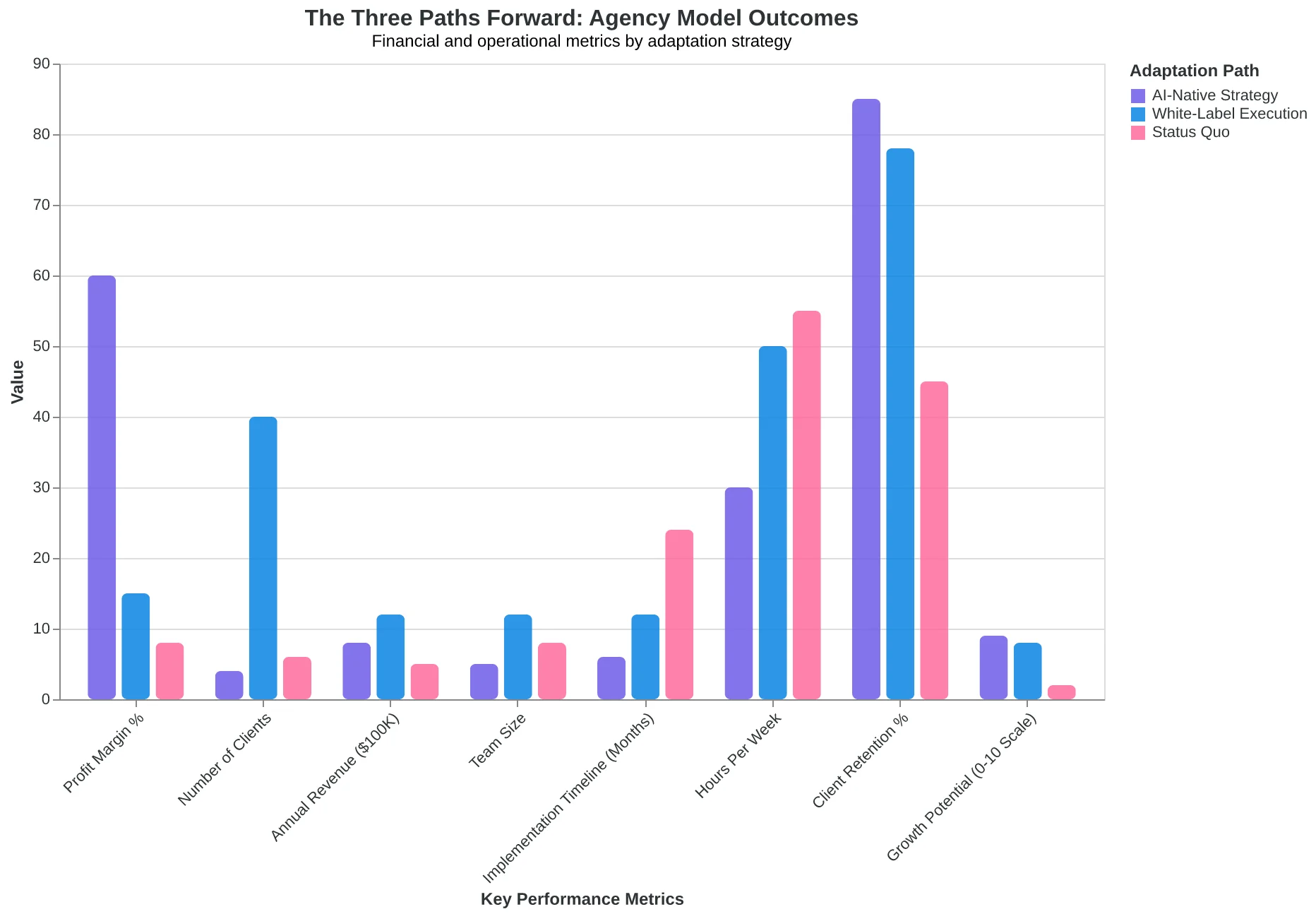
The Three Paths Forward: Your agency's future depends on which model you commit to in the next 90 days
| Metric | AI-Native Strategy | White-Label Execution | Status Quo |
|---|---|---|---|
| Profit Margin | 60% | 15% | 30% → 10% |
| Client Count | 4-8 clients | 40-100 partners | 12-20 clients |
| Team Size | 3-5 strategists | 8-12 operators | 10-15 mixed |
| Restructure Time | 6 months | 12 months | N/A |
| Owner Work Hours | 30/week | 40/week | 60/week |
| 3-Year Outlook | Growing | Stable | Closed |
| Agency Model Economics: Only two paths lead to sustainable businesses by 2027 | |||
The Email Marketing Landscape in 2027: A Tale of Two Markets
We're already seeing the early signals. In Q4 2024, three mid-market email agencies in our network shut down their production departments and rehired half the team as strategists. By mid-2025, the first AI-native email consultancies will launch — 4-person teams billing $25K/month with no production staff at all.
By 2027, the email marketing agency market will have fully bifurcated into two distinct tiers, with the middle market eliminated entirely.
The top tier: Boutique strategy consultancies charging $15K-50K monthly retainers. Teams of 3-5 people. AI handles all execution — copywriting, design, segmentation, A/B testing, deliverability optimization. Humans own what machines can't: client relationships, creative vision, brand strategy, and the judgment calls that determine whether an email program drives revenue or just fills inboxes. These agencies don't sell email creation. They sell email intelligence.
The bottom tier: White-label execution platforms at $500-2K monthly subscriptions. Fully automated. No human touchpoints beyond onboarding. They compete on reliability, speed, and technical infrastructure. Clients upload brand assets and business goals; the platform generates, scores, and deploys campaigns. Think "Mailchimp, but the AI writes the emails too."
The disappeared middle: Today's $5K-15K/month full-service agencies — the ones selling "done-for-you" email marketing with junior copywriters and designers — will be extinct. Clients will either pay up for strategic partnership or pay down for software. There's no value proposition between those poles.
The businesses that win this transition are the ones that realized email marketing was always two jobs masquerading as one: thinking and doing. AI does the doing with superhuman consistency. Humans get to focus entirely on the thinking — the strategy, the positioning, the creative bets that 10x a program instead of incrementally improving it.
That's not a threat. It's liberation. But only if agencies choose to be liberated before their clients choose for them.
“Email marketing was always two jobs masquerading as one: thinking and doing. AI does the doing. Humans get to focus on the thinking. That's not a threat. It's liberation.”
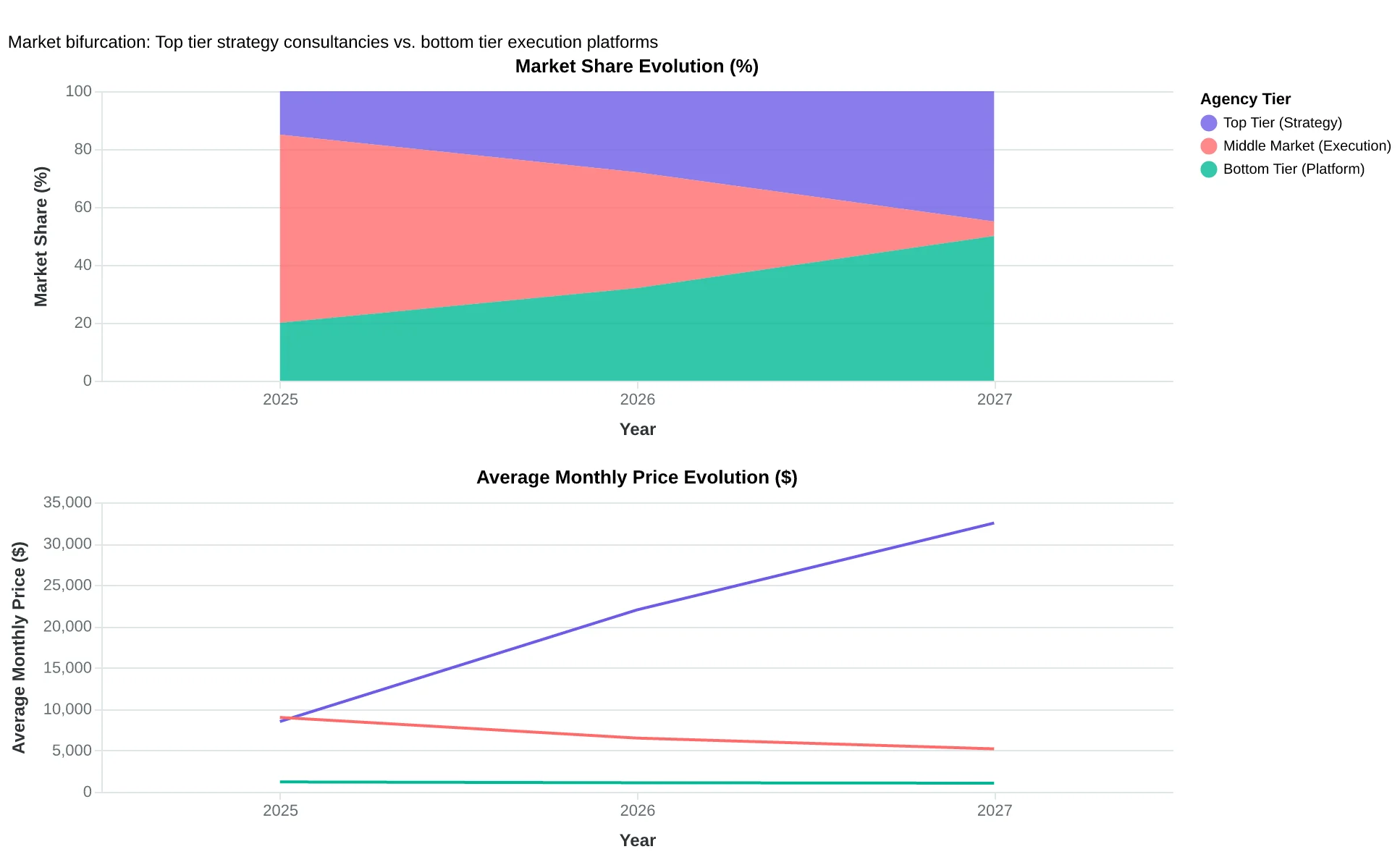
The email marketing agency market in 2027: only the top and bottom tiers survive
If you run an email marketing agency, you have a decision to make in the next 90 days.
Not whether AI will change your business — it already has. The decision is whether you'll lead the change or be changed by it.
The agencies that restructure now — the ones building strategic depth while AI handles execution — will own the next decade. The ones that wait will spend it explaining why they're still relevant to clients who can score their own emails in thirty seconds.
Remember that agency from the opening? The one that laid off 60% of their production team?
Their revenue is up 40% year-over-year. Smaller team, happier clients, better margins. They're not worried about AI. They're using it. They pivoted from $2,000/month email assembly to $15,000/month strategic partnerships — helping clients understand why their email quality scores predict customer acquisition, not just open rates.
The bifurcation isn't coming. It's here. High-end consultancies and low-cost execution shops. Strategic partners and commodity vendors.
You have 18 months to choose which side you're on. But the real deadline is 90 days — because that's how long it takes to rebuild your positioning, restructure your team, and start having different conversations with clients.
The question isn't whether this is coming. The question is whether you'll be ready when it arrives.
“The bifurcation isn't coming. It's here. High-end consultancies and low-cost execution shops. Strategic partners and commodity vendors.”
Ready to Score Your Own Emails?
See how your campaigns measure up against the 8-dimension framework agencies are using to justify their fees — or lose clients to AI platforms that score automatically.