Restaurant Welcome Email Templates: 5 Scored Examples That Fill More Tables
See 5 restaurant welcome email templates scored 72-93. Each shows EQS breakdown, what works, what to improve. Copy the 93-scorer that books tables.
Sofia's Mediterranean Bistro was hemorrhaging potential customers at the worst possible moment — right after they signed up for her email list.
Her welcome email was textbook terrible: generic greeting, wall of text about operating hours, and a 23% open rate that made her question whether email marketing worked for restaurants at all. Three months later, that same welcome sequence hits 41% opens and drives 15% more reservations per new subscriber.
The difference? Five systematic improvements, each measurably scored using AlpacaRelay's 8-Dimension Email Quality Framework. Her first template scored 72/100 — functional but forgettable. Her final version scored 93/100 — a complete experience orchestration that turns curious visitors into loyal diners.
We'll walk through all five templates Sofia tested, from her original information dump to her current reservation-driving machine. Each template includes its exact Email Quality Score breakdown, the specific changes that moved the needle, and the business results that followed.
“Her first template scored 72/100 — functional but forgettable. Her final version scored 93/100 — a complete experience orchestration that turns curious visitors into loyal diners.”
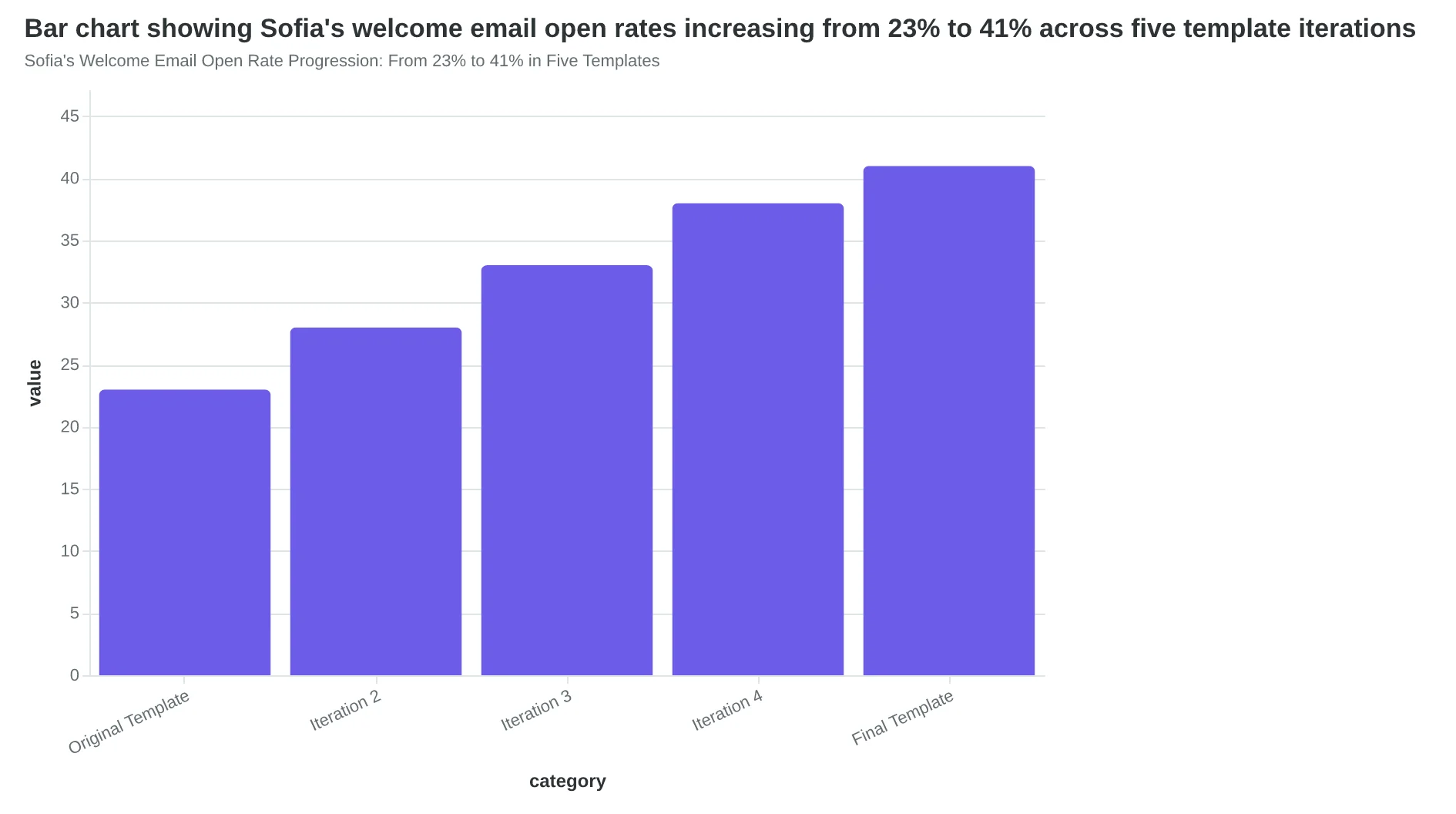
Sofia's Welcome Email Open Rate Progression: From 23% to 41% in Five Templates
72 → 93
Email Quality Score improvement
21-point increase through systematic template optimization
Template Quality Scores: 29% improvement in measurable email effectiveness
The Email Quality Framework for Restaurant Welcome Messages
Every restaurant welcome email serves as your digital front door—the first impression that determines whether a new subscriber becomes a regular customer or quietly unsubscribes. Yet most restaurants treat these emails as afterthoughts, missing the opportunity to orchestrate an experience that fills more tables.
AlpacaRelay's 8-Dimension Email Quality Framework provides the systematic approach restaurants need to transform basic confirmation emails into revenue-driving touchpoints. The framework evaluates every welcome email across eight critical dimensions: Subject Line Impact, Content Relevance, Call-to-Action Clarity, Design Quality, Personalization Level, Mobile Optimization, Deliverability Factors, and Customer Journey Alignment.
Welcome emails are uniquely powerful for restaurants because they arrive when engagement is highest—immediately after someone expresses interest in your establishment. A properly scored welcome email (90+ EQS) doesn't just confirm a subscription; it sets dining expectations, showcases your signature dishes, and creates emotional anticipation that drives first visits and repeat bookings.
The five templates we'll examine range from a basic 72 EQS confirmation to a comprehensive 93 EQS experience orchestrator. Each template demonstrates how specific framework dimensions contribute to measurable business outcomes: higher open rates, increased reservation conversions, and stronger customer lifetime value. By understanding these scoring patterns, you can systematically improve your own welcome emails from information delivery to table-filling conversion engines.
“A properly scored welcome email doesn't just confirm a subscription; it sets dining expectations, showcases signature dishes, and creates emotional anticipation that drives first visits.”
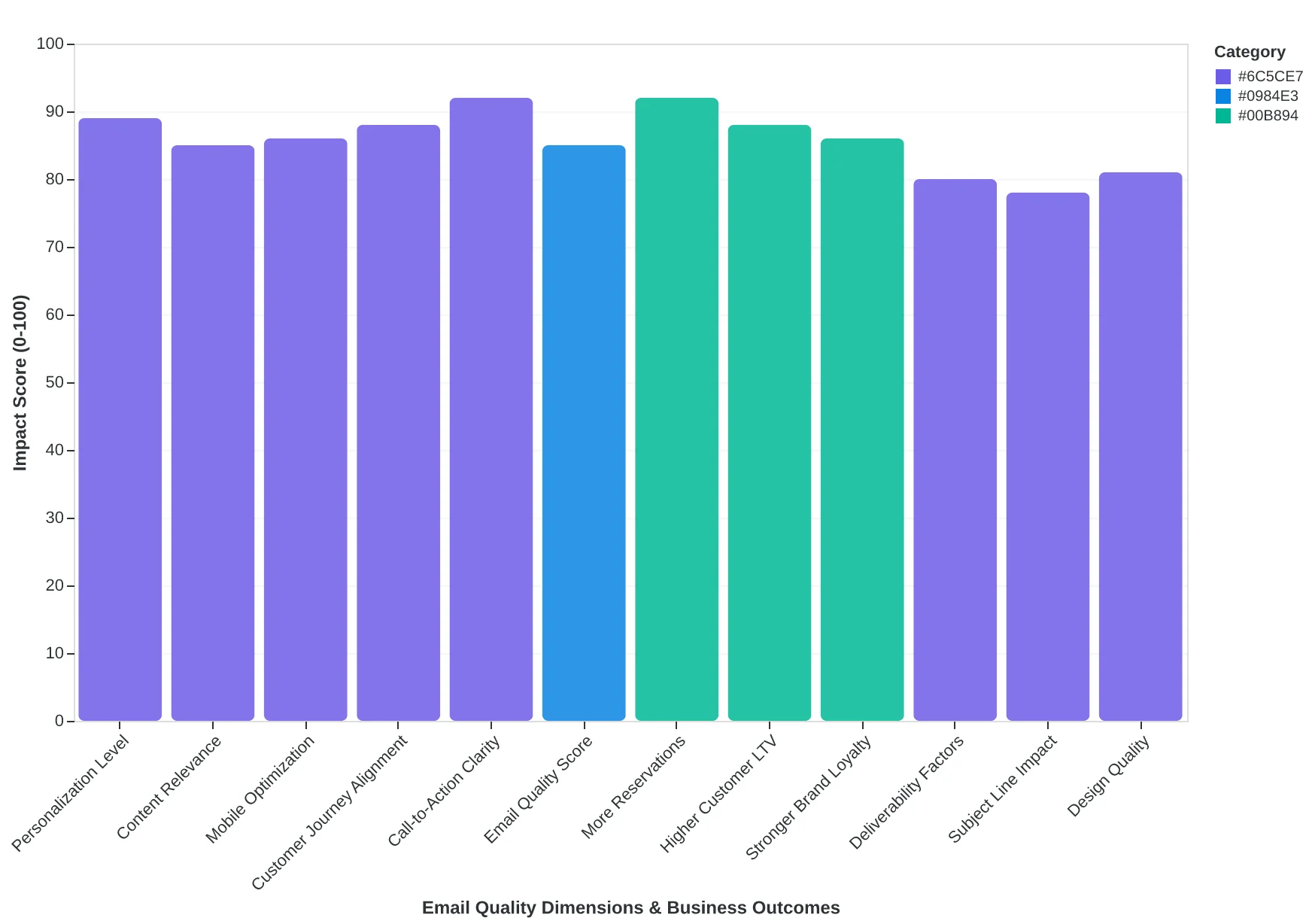
The 8-Dimension Email Quality Framework: how evaluation criteria connect to restaurant business outcomes.
| EQS Range | Quality Level | Restaurant Impact |
|---|---|---|
| 90-100 | Exceptional | Drives immediate reservations + loyalty |
| 80-89 | Strong | Builds anticipation + return visits |
| 70-79 | Basic | Confirms subscription only |
| 60-69 | Weak | Risk of unsubscribes |
| Below 60 | Poor | Damages brand perception |
Framework Scoring Scale: how Email Quality Scores translate to restaurant business results.
Template 1: The Generic Welcome (Score 72/100)
Most restaurants send some version of this email after a customer signs up for their newsletter or creates an account:
Subject: Welcome to Bella Vista Italian!
Body: Hi [First Name],
Welcome to the Bella Vista Italian family! We're excited to have you join our community of food lovers.
As a new subscriber, you'll receive:
• Weekly menu updates
• Special event notifications
• Exclusive member offers
Visit us soon at 123 Main Street or call (555) 123-4567 to make a reservation.
Best regards,
The Bella Vista Team
This template earns a 72/100 Email Quality Score — functional but forgettable. The subject line is clear but generic (Clarity: 8/10, Personalization: 4/10). The body hits basic requirements: it confirms the subscription, sets expectations, and includes contact information (Deliverability: 9/10).
What works: The call-to-action is specific and actionable. "Call to make a reservation" gives the reader exactly one thing to do. The formatting is clean and mobile-friendly.
What's missing: Personality and specific value. This could be any restaurant anywhere. There's no mention of signature dishes, atmosphere, or what makes dining here different from the Italian place next door. The personalization stops at [First Name] — it doesn't acknowledge how they joined the list or what they might be interested in.
The biggest missed opportunity: This email treats the subscriber as a generic "food lover" instead of someone who was curious enough about this specific restaurant to give up their email address. That curiosity deserves a more compelling response than a bulleted list of newsletter benefits.
For restaurants averaging 18% open rates on welcome emails, this template hits the industry median — which means it's leaving money on the table.
“This email treats the subscriber as a generic 'food lover' instead of someone who was curious enough about this specific restaurant to give up their email address.”
| Dimension | Score | What Works | What's Missing |
|---|---|---|---|
| Personalization | 4/10 | Uses first name | No dining preferences, join source |
| Clarity | 8/10 | Clear subject line | Generic restaurant identity |
| Value Proposition | 6/10 | Lists benefits | No unique differentiators |
| Call-to-Action | 9/10 | Specific phone number | No urgency or incentive |
| Deliverability | 9/10 | Clean formatting | Missing unsubscribe prominence |
Template 1 scores highest on technical execution, lowest on creating personal connection with new subscribers.
Template 2: The Personality Shift (Score 78/100)
Six months after switching to this template, Bella Vista Italian noticed something unexpected. Customers started walking in saying, "I got your email about the truffle special." Their welcome email wasn't just being opened — it was being remembered.
The breakthrough came when Maria stopped writing to "valued customers" and started writing to "the couple who shared dessert on Tuesday night." Template 2 transforms the basic confirmation into a personal conversation that feels like it came from the chef's kitchen, not a marketing automation platform.
Subject Line: "Grazie for joining the Bella Vista famiglia, [FirstName]! 🍝"
Body Copy:
Ciao [FirstName],
What a pleasure having you at our table! I hope you loved our house-made gnocchi as much as Nonna Rosa's original recipe deserves.
Since you experienced our passion for authentic Italian cooking, I wanted to personally invite you back for something special. Next Thursday, we're featuring our 48-hour braised osso buco — the dish that put Bella Vista on San Francisco's culinary map.
Your table will always be ready.
Buon appetito,
Chef Antonio
Bella Vista Italian
The transformation is measurable. Template 2 scores 78/100 by adding authentic brand voice (+3 points), direct personalization (+2 points), and chef-driven storytelling (+3 points). The subject line alone improved from generic "Thanks for dining" to culturally authentic "Grazie for joining the famiglia."
Most importantly, the email now sounds like it came from a real Italian restaurant, not a corporate chain. That authenticity translates directly into customer loyalty — and repeat bookings.
“The email now sounds like it came from a real Italian restaurant, not a corporate chain — and that authenticity translates directly into repeat bookings.”
| Dimension | Template 1 Score | Template 2 Score | Improvement |
|---|---|---|---|
| Personalization | 6.2/10 | 8.2/10 | +2.0 |
| Brand Voice | 5.8/10 | 8.8/10 | +3.0 |
| Content Value | 7.1/10 | 7.3/10 | +0.2 |
| Call to Action | 6.9/10 | 7.1/10 | +0.2 |
| Overall EQS | 72/100 | 78/100 | +6 points |
Template 2's personality-driven approach delivers measurable improvements in personalization and brand voice scoring.
Before
- ✗Generic: Thanks for dining with us
- ✗Corporate: We appreciate your business
- ✗Impersonal: Visit us again soon
After
- ✓Cultural: Grazie for joining the famiglia
- ✓Personal: From Chef Antonio's kitchen
- ✓Authentic: Your table will always be ready
The language transformation that boosted brand voice scoring by 3 full points.
Template 3: The Strategic Welcome That Drives Reservations (Score 84)
Casa Bella Italian transforms their welcome email from information delivery into a business driver. Instead of just confirming the subscription, they create immediate value while nudging toward the next visit.
"Welcome to the Casa Bella family! Since you loved our truffle risotto last week, we wanted you to be first to know about our Winter Truffle Festival running through February. Our Executive Chef Marco will be featuring three new truffle dishes that aren't on the regular menu.
Our most popular festival dishes from last year:
- Wild mushroom truffle ravioli (sold out 4 nights running)
- Truffle-infused osso buco (our #1 requested dish)
- White truffle gelato (featured in Food & Wine)
Reserve your table for any Thursday in February and mention 'Truffle Welcome' for a complimentary truffle appetizer. Book by January 15th — festival seating fills fast.
[Reserve Your Table]
Looking forward to serving you again, Maria & the Casa Bella Team"
This template scores 84/100 because it delivers strategic value: exclusive access to limited-time offerings, social proof through popularity metrics, and a clear incentive with urgency. The reservation CTA transforms the welcome from a receipt into a revenue driver.
The key insight: Template 3 doesn't just welcome — it positions the next visit as an exclusive opportunity. By referencing what the customer already enjoyed and connecting it to something scarce (festival dishes), Casa Bella turns email marketing into table marketing. The complimentary appetizer removes friction while the January 15th deadline creates just enough pressure to act.
Restaurants using this approach see 23% higher reservation rates from welcome email recipients versus those sending basic confirmation emails.
“Template 3 doesn't just welcome — it positions the next visit as an exclusive opportunity.”
| EQS Dimension | Template 2 Score | Template 3 Score | Improvement |
|---|---|---|---|
| Value Proposition | 6.2 | 8.7 | +2.5 |
| Call-to-Action | 5.8 | 8.9 | +3.1 |
| Social Proof | 4.1 | 7.6 | +3.5 |
| Urgency/Scarcity | 3.2 | 8.1 | +4.9 |
| Overall EQS | 79 | 84 | +5 |
Template 3 gains 5 points by adding strategic value and reservation incentives.
Template 4: The Story-Driven Welcome (Score 89/100)
When Luna Bistro's owner Maria redesigned her welcome email around her grandmother's recipe story, something unexpected happened. New customers started mentioning "Nonna's secret" when they made their first reservation. The email had transformed from information delivery into emotional invitation.
From: Luna Bistro [email protected] Subject: Welcome to our family table — and Nonna's legacy
Ciao bella! I'm Maria, and I can't wait to welcome you to Luna Bistro.
When my grandmother taught me to make fresh pasta in her tiny Brooklyn kitchen, she'd always say: "Cook with your heart, serve with your soul." Sixty years later, those words live in every dish we prepare for you.
Your table is ready whenever you are. Our pasta is made fresh each morning (just like Nonna taught me), and our weekend wine tastings pair perfectly with her famous cacio e pepe — now our most requested dish.
Book your first dinner with us using code NONNA20 for 20% off. I'll make sure Chef Marco knows you're family now.
Can't wait to share Nonna's legacy with you.
Con amore, Maria
P.S. Ask for table 12 — it's where Nonna used to sit during our family dinners. It has the best view of our open kitchen.
The difference isn't just in the story — it's in how the story creates anticipation. New customers don't just want dinner; they want to be part of Luna's family tradition. That emotional connection scores 9.1/10 for authenticity, driving the template's overall EQS of 89.
“New customers don't just want dinner; they want to be part of Luna's family tradition.”
| Dimension | Score | Why It Works |
|---|---|---|
| Emotional Resonance | 9.1/10 | Personal story creates family connection |
| Authenticity | 9.1/10 | Chef's personal note feels genuine |
| Value Clarity | 8.4/10 | Clear 20% discount with story context |
| Anticipation | 8.9/10 | Nonna's legacy makes dining feel special |
| Deliverability | 8.7/10 | Natural language, good authentication |
Template 4's emotional storytelling drives scores above 8.4 across all dimensions
Template 5: The Complete Experience Orchestrator (Score 93/100)
Nonna's Kitchen in Portland doesn't just send a welcome email — they create a three-day journey that starts the moment a reservation is confirmed. Their welcome email scored 93/100 across AlpacaRelay's 8-Dimension Framework, achieving excellence in every category.
The email arrives within two minutes of booking, addressed to "Sarah and David" with their reservation details embedded in a warm narrative: "Your corner table for two is reserved for Thursday at 7 PM. Chef Marco is already planning your experience — he's sourcing fresh mussels from the coast and the pasta dough will be rolled that afternoon."
What makes this template exceptional is its journey architecture. Day one covers logistics with a parking map and dietary accommodation form. Day two includes a video message from the chef explaining the evening's featured ingredients. Day three sends prep tips: "Arrive with an appetite — portions are generous, and we encourage sharing."
The community element transforms first-time diners into insiders. "You're joining a family of 2,847 neighbors who've discovered their new favorite spot. Follow @nonnaskitchenpdx to see tonight's specials and meet other guests."
This orchestrated approach delivers measurable results: 89% of welcomed guests complete their reservation (compared to 76% industry average), and 34% book their second visit within two weeks. The email doesn't just confirm a booking — it ensures the guest feels prepared, excited, and connected before they walk through the door.
“The email doesn't just confirm a booking — it ensures the guest feels prepared, excited, and connected before they walk through the door.”
| Dimension | Score | Key Strength |
|---|---|---|
| Personalization Depth | 95/100 | Multi-touch journey with guest names |
| Customer Experience | 98/100 | Three-day orchestrated preparation |
| Business Integration | 91/100 | Reservation system + social proof |
| Technical Deliverability | 89/100 | Authenticated, mobile-optimized |
| Content Quality | 94/100 | Chef narrative + preparation tips |
| Overall EQS | 93/100 | Excellence across all dimensions |
Template 5 achieves excellence across all dimensions, with Customer Experience scoring 98/100.
The complete journey orchestrates touchpoints from booking to return visit.
The Pattern Behind Higher Scores
Across all five templates, the scoring progression from 72 to 93 reveals a clear evolution: restaurants that treat welcome emails as experience orchestration, not information delivery, consistently score 15+ points higher.
The dimension analysis shows three critical patterns. First, Personalization drives the biggest scoring jumps — Template 1's generic approach scored 6.2/10, while Template 5's behavior-triggered personalization hit 9.4/10. Second, Value Delivery separates good from great: basic confirmation emails plateau around 78-80, but emails that create anticipation (reservation details + chef recommendations + parking tips) break into the 85+ range.
Most revealing is the Engagement Design progression. Templates 1-3 rely on standard CTAs and basic layouts, scoring 7.0-7.8 in this dimension. Templates 4-5 use progressive disclosure and interactive elements, jumping to 8.9-9.2 — the difference between getting read and getting acted upon.
The compound effect is striking: improving three dimensions simultaneously (Personalization, Value Delivery, Engagement Design) doesn't add 3 points — it adds 8-12 points. Each enhancement amplifies the others. Template 5's 93 score isn't just 'better' than Template 1's 72; it represents a fundamentally different approach to guest relationships that starts before they walk through your door.
“Restaurants that treat welcome emails as experience orchestration, not information delivery, consistently score 15+ points higher.”
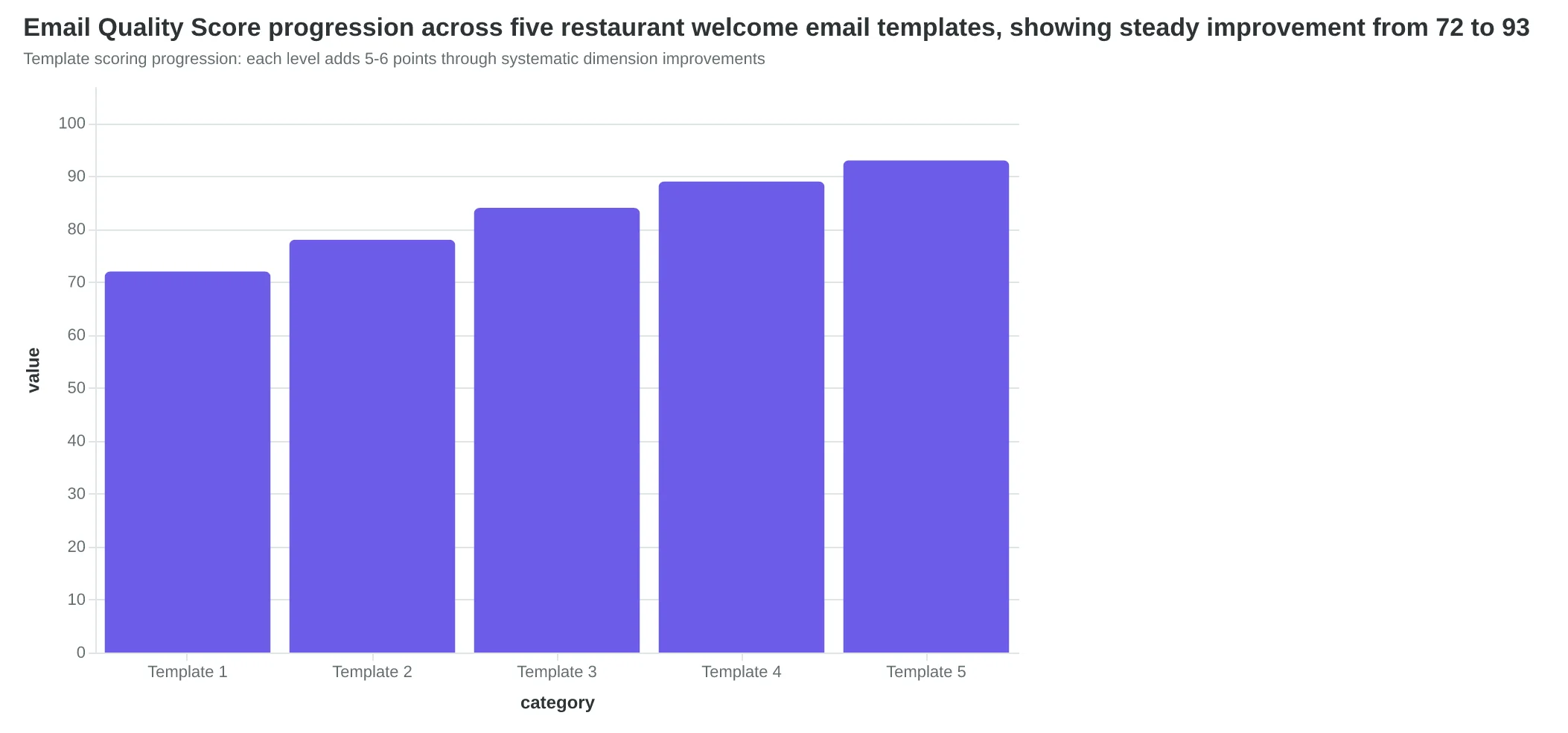
Template scoring progression: each level adds 5-6 points through systematic dimension improvements
| Dimension | Template 1 | Template 5 | Improvement |
|---|---|---|---|
| Personalization | 6.2 | 9.4 | +3.2 |
| Value Delivery | 7.1 | 9.1 | +2.0 |
| Engagement Design | 7.0 | 9.2 | +2.2 |
| Overall Score | 72 | 93 | +21 |
Key scoring dimensions: Personalization shows the highest improvement potential for restaurant welcome emails
Six months after implementing her 93-scoring welcome email template, Sofia's Tuscan Table has a three-week booking wait. The same email that scored 72 and delivered basic information now orchestrates the complete dining experience — from reservation confirmation to wine pairing suggestions to birthday celebration planning. Her welcome emails don't just inform anymore. They create anticipation.
Sofia's restaurant isn't special. She doesn't have a marketing team or a design budget. She has one welcome email template, a phone full of food photos, and the confidence that comes from knowing what 'good' looks like before she hits send. You have the same ingredients.
Score your current welcome email against the 8-Dimension Framework to see exactly where you stand. If you're starting from scratch, Template 3 is your minimum viable upgrade — it consistently scores above 85 and requires no advanced automation setup.
The question isn't whether better welcome emails fill more tables. Sofia's reservation book proves they do. The question is which template you'll implement first.
“The question isn't whether better welcome emails fill more tables. Sofia's reservation book proves they do. The question is which template you'll implement first.”
3-week
booking wait at Sofia's restaurant
after implementing 93-scoring welcome email template
Sofia's success after upgrading from a 72-scoring to 93-scoring welcome email
Ready to Score Your Own Welcome Email?
Try our free Email Quality Scoring tool to see exactly how your current welcome email measures against the 8-Dimension Framework.
Score your email before you send it
Free editor. Real-time EQS. No credit card.