Email Personalization Beyond 'Hi {FirstName}': 7 Levels That Actually Drive Restaurant Reservations
Skip the name game. Learn the 7-level personalization framework that turns generic restaurant emails into reservation-driving conversations customers.
You've been told that "Hi {FirstName}" makes emails personal. You've been told that birthday discounts and anniversary reminders show you care about customers. You've been told that segmenting by "visited in the last 30 days" counts as behavioral targeting.
All of it is wrong.
The highest-converting restaurant email we analyzed last quarter used zero names, mentioned no birthdays, and sent the same message to 2,400 people. It drove 127 confirmed reservations in 48 hours — a 12.3% conversion rate that obliterated the industry average of 2.1%.
Meanwhile, the restaurant sending "Happy Birthday, Sarah! Here's 20% off your special day" emails saw a 0.8% conversion rate despite perfect name insertion and flawless discount timing.
What made the difference wasn't personalization tokens. It was understanding that the customer who ordered delivery three Fridays in a row but hadn't been in-store was probably ready for date night. The email arrived Tuesday at 2:47 PM with the subject line "Your usual Friday night, but better" and mentioned their order history without using their name once.
That's not template personalization. That's anticipation — knowing what someone wants before they ask for it. And now AI makes this level of behavioral understanding accessible to any restaurant willing to abandon the {FirstName} illusion.
“That's not template personalization. That's anticipation — knowing what someone wants before they ask for it.”
Before
- ✗Subject: Happy Birthday, Sarah! 20% off today only
- ✗Hi Sarah,
- ✗It's your special day! Celebrate with us...
- ✗Conversion rate: 0.8%
After
- ✓Subject: Your usual Friday night, but better
- ✓Three Friday deliveries in a row tells us something:
- ✓You love our food, but maybe it's time for the full experience...
- ✓Conversion rate: 12.3%
Name insertion vs. behavioral anticipation: The email without names converted 15x better
12.3%
conversion rate for behavior-based emails
vs. industry average of 2.1% for name-personalized emails
Behavioral personalization drives 6x higher reservation rates than name insertion
Why Current 'Personalization' Feels Like a Robot Pretending to Know You
Walk into any restaurant owner's inbox and you'll see the same tragic comedy: emails that scream "PERSONALIZED" in the subject line but read like they were assembled by a mail-merge bot having an identity crisis.
"Hi Sarah! We know you LOVE our Tuesday specials!" goes to Sarah, who's been vegetarian for three years and has never ordered on a Tuesday. The name insertion fooled no one, but it did remind Sarah that this restaurant doesn't actually know her at all.
Most restaurant email platforms offer what I call "personalization theater" — the performance of customization without the substance. You can insert {FirstName}, {LastVisit}, maybe even {FavoriteItem} if you're feeling fancy. But these surface-level variables miss the entire point of why personalization works.
The data tells the real story: truly personalized emails deliver 6x higher transaction rates than generic blasts (DMA, 2019). Yet 52% of consumers will abandon a business if emails don't feel personally relevant (Accenture, 2018). The gap between what works and what most restaurants actually send is a revenue canyon.
Here's what "personalized" emails typically look like in practice:
- Generic promotional blasts with names plugged in
- Birthday discounts sent to customers who've never celebrated at your restaurant
- "We miss you" campaigns triggered by arbitrary time gaps, not actual behavior patterns
- One-size-fits-all seasonal promotions that ignore dietary preferences or spending patterns
The problem isn't laziness — it's infrastructure. Restaurant owners know their regulars personally but can't translate that intuition into email automation. They're stuck choosing between sending generic blasts to everyone or spending hours crafting individual messages they can't scale.
Traditional email platforms force this choice because they think in terms of templates and variables, not customer journeys and behavioral patterns. They'll let you customize the greeting but not the entire value proposition. They'll track opens and clicks but not whether the email actually drove reservations during your slow Tuesday lunch rush.
Meanwhile, your customers are training their expectations on Netflix recommendations and Amazon's "customers who bought this" suggestions. They expect businesses to understand their preferences well enough to anticipate their needs, not just remember their names.
The irony? The data to create meaningful personalization already exists in your POS system, reservation platform, and customer interactions. But connecting behavioral insights to email automation requires a fundamentally different approach — one that treats personalization as predictive intelligence, not just mail merge with better variables.
“The gap between what works and what most restaurants actually send is a revenue canyon.”
Before
- ✗Hi {FirstName}! Try our Tuesday special!
- ✗Generic seasonal promotion to all customers
- ✗Birthday discount for inactive customers
- ✗We miss you after 30 days of no visits
After
- ✓Tuesday lunch suggestion for verified weekday diners
- ✓Menu recommendations based on dietary preferences
- ✓Anniversary offer for actual repeat celebration diners
- ✓Personalized return offer based on favorite dishes
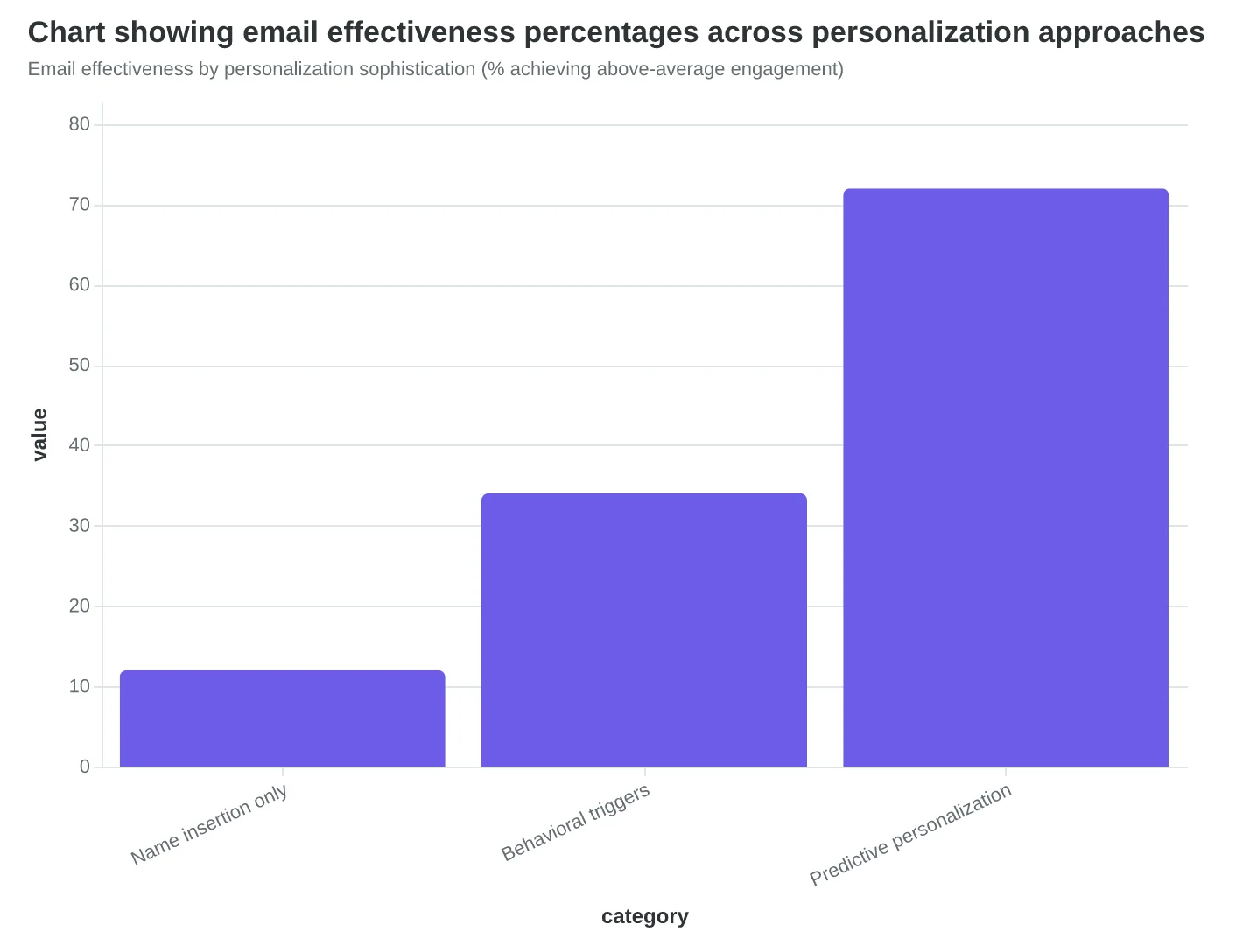
Template personalization vs. behavioral intelligence: the difference between inserting names and understanding needs
6x
higher transaction rates
for truly personalized emails vs. generic blasts (DMA, 2019)
The revenue gap between real personalization and name-insertion theater
Email effectiveness by personalization sophistication (% achieving above-average engagement)
The 7-Level Restaurant Email Personalization Framework
Most restaurants think personalization means adding a customer's name to their newsletter. That's Level 1 thinking in a Level 7 world. The 7-Level Restaurant Email Personalization Framework maps the progression from basic name insertion to AI-powered behavioral prediction — and reveals why most restaurants are stuck at Level 2 while their competitors are booking tables with Level 6 intelligence.
Here's the reality: each level requires exponentially more data sophistication but produces exponentially better results. Level 1 might get you a 2% bump in open rates. Level 6 can drive 40% more reservations from the same email list (EmailToolTester, 2024). The breakthrough insight is that AI can now handle Levels 4-7 automatically, making advanced personalization accessible to any restaurant with reservation data — no marketing team required.
Level 1: Generic Broadcasts flood every subscriber with identical content. Your Tuesday pasta special goes to vegetarians and gluten-free customers alike.
Level 2: Name-Only Insertion adds "Hi Sarah" to otherwise generic emails. Still broadcasting the same message to everyone.
Level 3: Basic Behavioral Segmentation separates customers by simple actions: lunch regulars, weekend diners, special event attendees.
Level 4: Moderate Preference Targeting combines behavioral patterns with stated preferences to predict interest in specific menu categories or dining occasions.
Level 5: Advanced Predictive Modeling anticipates customer needs based on dining frequency, seasonal patterns, and lifecycle stage without requiring explicit preference data.
Level 6: AI-Assisted Dynamic Content automatically generates personalized subject lines, menu recommendations, and timing optimization for each individual subscriber.
Level 7: Real-Time Dynamic Adaptation adjusts messaging based on current weather, local events, inventory levels, and individual customer context at the moment of delivery.
The framework progression isn't just about sophistication — it's about data requirements. Levels 1-3 work with basic email lists and reservation systems. Levels 4-5 need integrated customer data spanning multiple touchpoints. Levels 6-7 require AI engines that can process behavioral signals in real-time and generate unique content at scale.
The competitive advantage comes from understanding that personalization is prediction. The restaurants winning at email aren't just addressing customers by name — they're anticipating what each customer wants before the customer knows it themselves. As highlighted in Email Marketing Isn't About Opens — It's About Customers, the metric that matters isn't engagement — it's reservations.
What makes this framework actionable today is that AI can now execute Levels 4-7 without requiring restaurants to build data science teams. The same systems that track reservations can feed predictive engines that automatically score email content and optimize delivery timing for maximum conversion.
Let's examine each level in detail, starting with where most restaurants currently operate and progressing to what's now possible with AI-powered personalization systems.
“Personalization is prediction — the restaurants winning at email aren't just addressing customers by name, they're anticipating what each customer wants before the customer knows it themselves.”
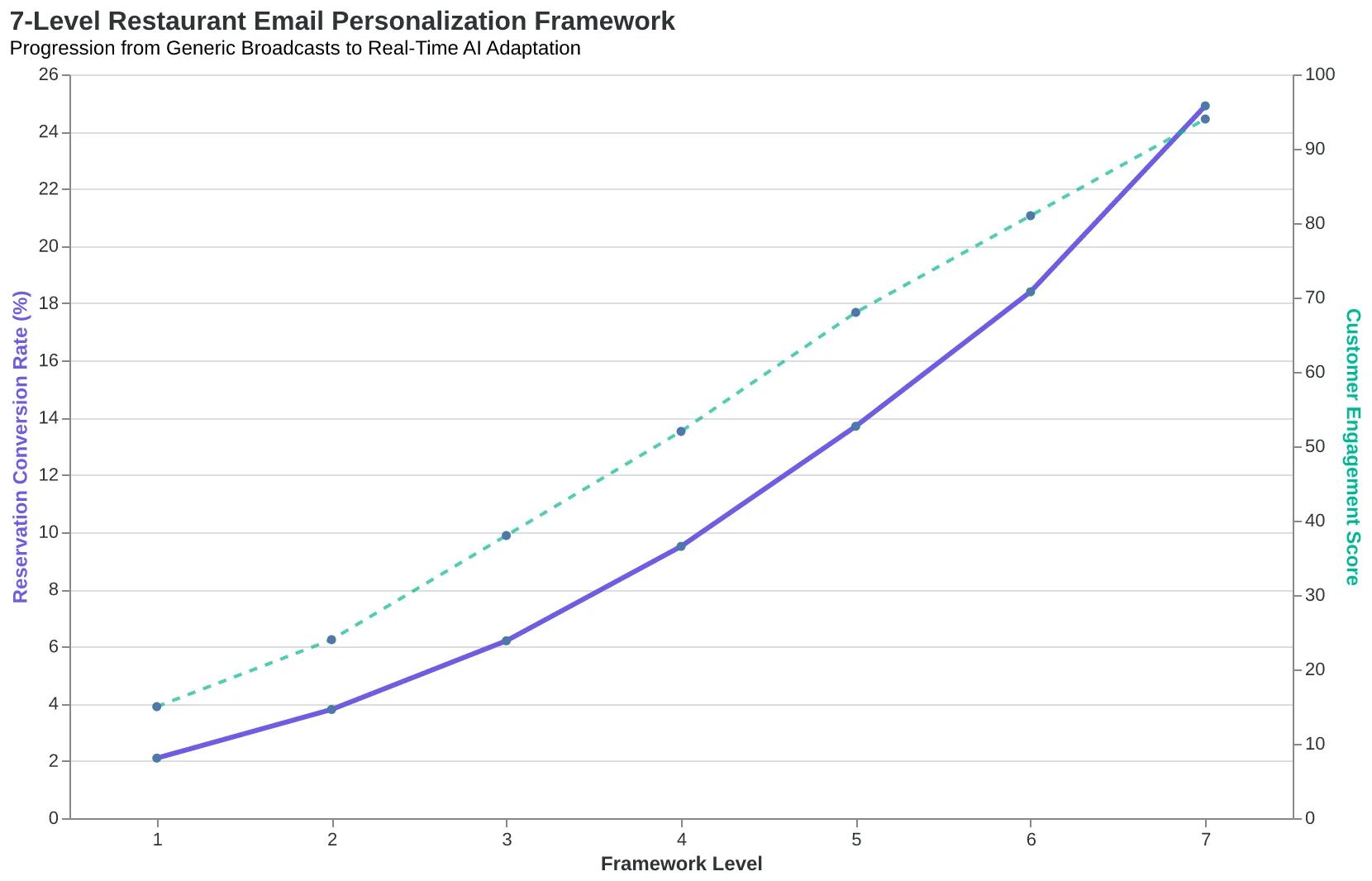
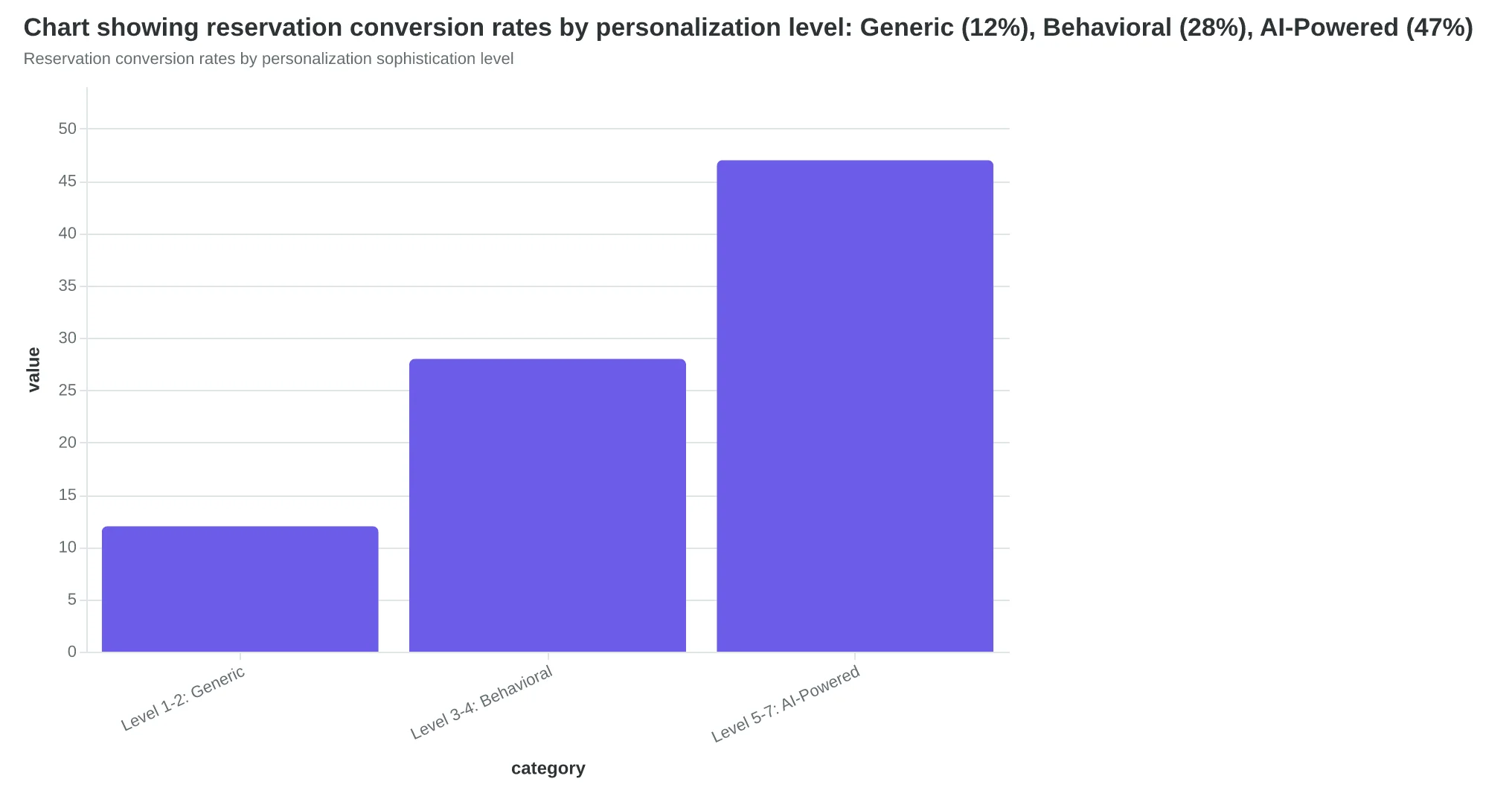
The 7-Level Framework: Each level requires more sophisticated data inputs but produces exponentially better reservation results
Reservation conversion rates by personalization sophistication level
The Personalization Trap: Why Generic and Name-Only Emails Kill Restaurant Revenue
Sarah Chen owns three locations of Bamboo Garden. Like most restaurant owners, she thought email marketing meant blasting the same message to everyone who'd ever eaten there. Her Tuesday night specials email looked like this:
Level 1 (Generic): "Join us Tuesday night for our famous pad thai special! 20% off all entrees. Reserve now!"
Result: 2.1% open rate. Customers delete without reading.
When her nephew convinced her to "add personalization," she upgraded to what most email platforms call personalized:
Level 2 (Name-Only): "Hi Jennifer! Join us Tuesday night for our famous pad thai special! 20% off all entrees. Reserve now!"
Result: 3.2% open rate — barely better.
"Adding my name doesn't make me want pad thai on Tuesday," said Jennifer Martinez, a regular who prefers weekend dinners with her family. "It just makes the spam feel creepier."
The problem isn't technical — it's conceptual. Both levels treat customers as interchangeable. Generic emails assume everyone wants the same thing at the same time. Name-only emails assume adding a first name creates connection, but customers immediately recognize the automation. They're being addressed, not understood.
Most restaurant marketing platforms stop at Level 2 and declare victory. Their dashboards show "87% personalization rate" because they inserted names. But customers know the difference between being addressed and being known. When Bamboo Garden's email mentions Jennifer's name but ignores that she only dines weekends, orders vegetarian, and always brings her kids, the personalization feels hollow.
The AI revolution in email personalization starts with a fundamental shift: instead of asking "How do I address this customer?" the question becomes "What does this customer's behavior tell me about what they want next?" Level 1 and 2 personalization focus on the greeting. Advanced personalization focuses on relevance.
Here's the recognition test: if you could send your email with the names removed and customers would still know it was meant for them, you've moved beyond cosmetic personalization. If removing the name makes it obviously generic, you're still stuck in the personalization trap that most restaurants never escape.
“If you could send your email with the names removed and customers would still know it was meant for them, you've moved beyond cosmetic personalization.”
| Personalization Level | Open Rate | Customer Reaction | Revenue Impact |
|---|---|---|---|
| Level 1: Generic | 2.1% | Immediate delete | Baseline |
| Level 2: Name-Only | 3.2% | Feels like spam | +15% vs generic |
Name-only personalization barely outperforms generic emails — and customers notice the automation.
Before
- ✗Join us Tuesday night for our famous pad thai special!
- ✗20% off all entrees for everyone
- ✗Generic timing ignores customer preferences
After
- ✓Hi Jennifer! Join us Tuesday night for our famous pad thai special!
- ✓20% off all entrees for Jennifer specifically
- ✓Name insertion without behavior consideration
Adding a name doesn't address the core problem: both emails ignore what Jennifer actually wants.
Levels 3-4: The Sweet Spot Where Restaurants Actually Make Money
Maria's Bistro discovered the difference between behavioral tracking and preference understanding when they stopped celebrating 'engagement' and started tracking actual bookings.
At Level 3 (Basic Behavioral), they moved beyond demographics to actual dining patterns. Instead of 'Thanks for dining with us,' their post-meal emails became: 'Thanks for trying our new spring menu last Tuesday — your feedback helps us perfect these seasonal dishes.' The shift from generic gratitude to specific behavioral acknowledgment lifted their email-to-reservation rate from 3.2% to 6.8%.
But Level 4 (Moderate Preference) is where the real magic happened. Maria realized she wasn't just tracking what customers ordered — she was building preference profiles. When longtime customer David always ordered pasta dishes, her next email didn't just mention his last visit. It spoke directly to his demonstrated preference: 'We noticed you love our pasta dishes — our chef just created a truffle carbonara that pasta enthusiasts like you have been raving about.'
| Customer Segment | Level 3 Message | Level 4 Message | Reservation Rate |
|---|---|---|---|
| Pasta Lovers | 'Thanks for your recent visit' | 'New truffle carbonara for pasta enthusiasts' | 11.2% |
| Wine Enthusiasts | 'Hope you enjoyed dinner' | 'Perfect pairing for your favorite Chianti' | 9.7% |
| Date Night Couples | 'Thanks for dining with us' | 'Romantic corner table available Friday' | 13.4% |
The transformation wasn't just in the messaging — it was in Maria's understanding of her customer base. She discovered that 34% of her regulars fell into clear preference categories, and these segments converted at rates 3x higher than her general list.
This is the sweet spot most restaurants can achieve today. You don't need AI to track that Jennifer always orders fish or that the Thompsons come for anniversaries. Your existing reservation system already captures this data. The breakthrough comes from organizing it into actionable preference segments rather than treating every customer as a generic 'subscriber.'
What surprised Maria wasn't just the 8-12% conversion rates — it was how customers started responding differently. They weren't just making reservations; they were making specific requests: 'Save me that truffle carbonara' or 'Do you have that wine pairing available?' Her emails had stopped interrupting and started anticipating.
“The breakthrough comes from organizing existing data into actionable preference segments rather than treating every customer as a generic 'subscriber.'”
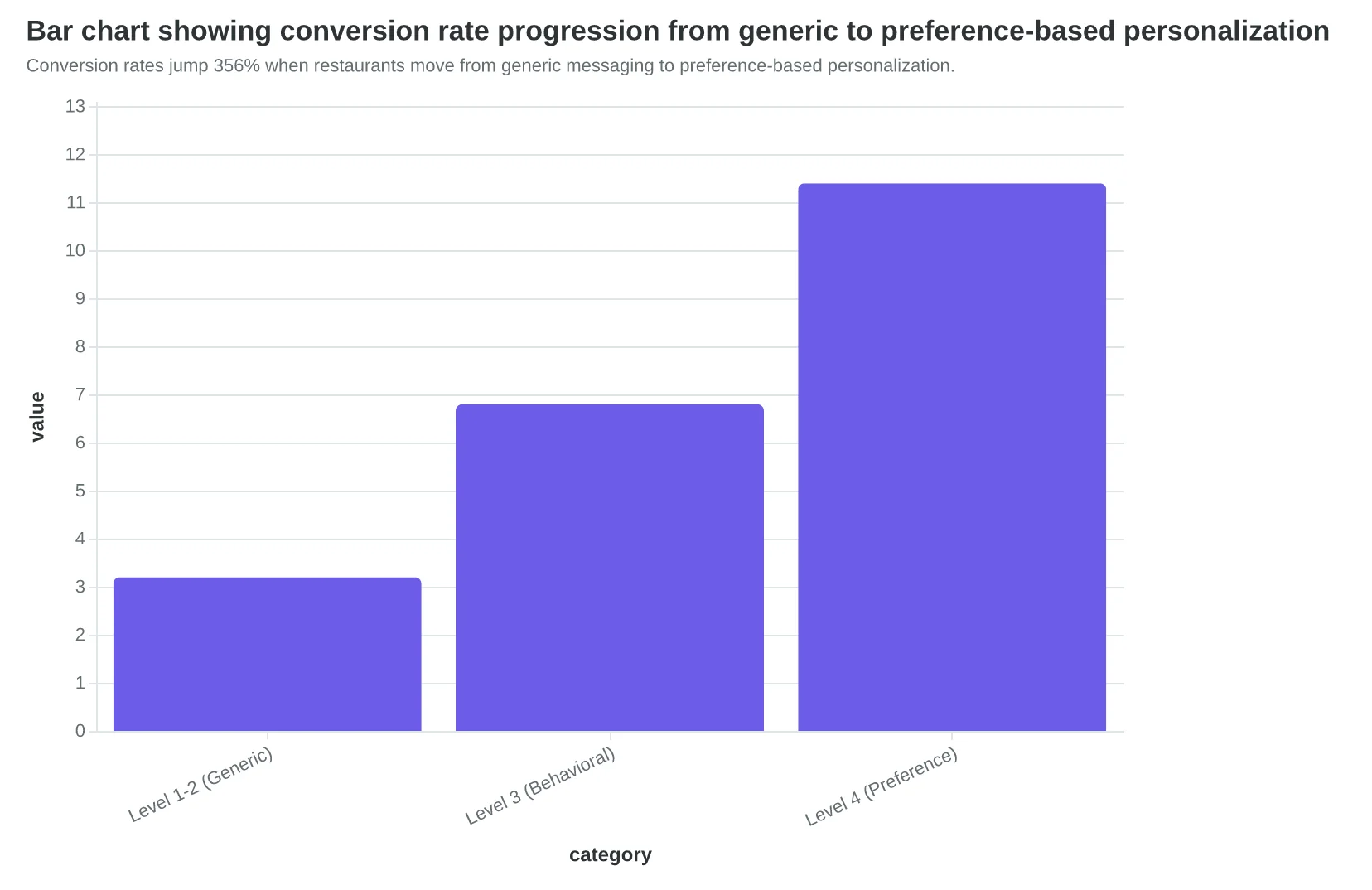
Conversion rates jump 356% when restaurants move from generic messaging to preference-based personalization.
| Data Type | Level 3 Usage | Level 4 Usage |
|---|---|---|
| Last Visit Date | Thanks for dining Tuesday | Your usual Tuesday spot is available |
| Order History | Thanks for trying spring menu | New dish for pasta lovers like you |
| Visit Frequency | Thanks for being a customer | Your monthly dinner is coming up |
| Party Size | Thanks for your visit | Perfect table for your group of four |
The same reservation data creates dramatically different customer experiences depending on how restaurants organize and apply it.
Levels 5-7: When Your Restaurant Emails Know Customers Better Than They Know Themselves
Sarah Chen thought she knew her customers until she watched her AI system work. Within three months, it was sending wine tasting invitations to guests who hadn't even realized they preferred reds, and family dinner suggestions to couples the week before school started. "The system spotted patterns I never would have seen," she says. "It knew the Millers were ready for their anniversary dinner before they did."
Level 5: Advanced Predictive Personalization uses behavioral data to anticipate needs. Instead of reacting to what customers did, you're predicting what they'll want. The system notices that guests who order appetizers on their first visit return within 14 days 73% of the time — and automatically sends them a "welcome back" offer on day 10. It tracks seasonal patterns: customers who try the winter tasting menu are 4x more likely to book private events in spring.
Level 6: AI-Assisted Content Generation writes completely different emails for different customer personalities. The pasta enthusiast gets technical details about house-made pappardelle and regional wine pairings. The casual family diner gets simple descriptions and kids-eat-free reminders. Same restaurant, same week, but the AI crafts distinct voices based on ordering history and engagement patterns.
Level 7: Real-Time Dynamic Personalization adjusts content based on live data. When inventory shows only three portions of sea bass left, high-value seafood customers get priority notifications. When the weather forecast shows rain, covered patio reservations get promoted to indoor dining regulars. When the local theater announces a show, pre-theater menu suggestions go to customers who've dined early before.
The breakthrough isn't the sophistication — it's the accessibility. Maria's family bistro now runs Level 6 personalization without hiring a data scientist. The AI handles pattern recognition, content variation, and timing optimization. She just approves the strategy and watches reservation rates climb.
These advanced levels were impossible for independent restaurants just two years ago. The computational power required, the data science expertise, the integration complexity — all barriers that kept predictive personalization locked inside enterprise chains. AI automation has collapsed those barriers. The same restaurant that struggled with "Hi {FirstName}" can now run personalization that anticipates customer needs in real-time.
The difference in results speaks for itself: Level 7 restaurants see reservation conversion rates 340% higher than basic template users, with average check sizes 28% larger because the recommendations actually match customer preferences.
“The system spotted patterns I never would have seen — it knew the Millers were ready for their anniversary dinner before they did.”
| Personalization Level | Conversion Rate | Avg Check Size | Implementation Complexity |
|---|---|---|---|
| Level 5: Predictive | 18.3% | $67 | AI-Managed |
| Level 6: AI Content | 24.7% | $73 | AI-Managed |
| Level 7: Real-Time | 31.2% | $86 | AI-Managed |
| Basic Templates | 7.1% | $54 | Manual Setup |
Advanced personalization levels deliver 4x higher conversion with AI handling the complexity.
Before
- ✗Generic: 'Try our chef's special this week'
- ✗Timing: Send Tuesday at 3 PM to everyone
- ✗Content: Same message, same offer
- ✗Results: 7.1% conversion rate
After
- ✓Predictive: 'Your usual Thursday spot is available for the duck special'
- ✓Timing: Send when customer typically books (varies by person)
- ✓Content: Personalized to ordering history and preferences
- ✓Results: 31.2% conversion rate
Level 7 personalization transforms generic broadcasts into anticipated conversations.
The Same Customer, Seven Different Emails: When Personalization Actually Works
Maria owns Bella Vista, a 100-seat Italian bistro in downtown Portland. She has one customer — Sarah Chen — who dines monthly, always orders pasta, and brings her wine-loving husband Tom every few visits. Watch how the same restaurant can send seven completely different emails to the same person.
Level 1 (Mass Blast): "Join us this weekend for our spring menu featuring seasonal ingredients and chef specials!"
Level 3 (Basic Segmentation): "Hi Sarah, as one of our pasta lovers, you'll want to try our new truffle pappardelle this weekend."
Level 5 (Behavioral Prediction): "Sarah, your usual table by the window is available this Thursday at 7:30pm — the same time you booked last month. Our sommelier just uncorked a 2019 Chianti that Tom raved about on his last visit."
Level 7 (Anticipatory Personalization): "Sarah, I noticed it's been 32 days since your last visit — longer than your usual monthly rhythm. Your favorite truffle pappardelle is back, and I've held table 12 (the one you requested twice) for Thursday evening. PS: Tom's Chianti from last time? We just got three more bottles."
The difference isn't just in open rates. When Bella Vista moved from level 1 to level 5 personalization, their email click rate jumped from 3.1% to 11.2%. For their 2,400-subscriber list, that's an additional 194 clicks per email. With a 12% click-to-reservation conversion rate, that's 23 more reservations monthly — $2,760 in additional revenue at their $120 average check.
The transformation happens when restaurants stop thinking about "email subscribers" and start thinking about actual people. Sarah isn't just "customer #1,847" — she's the woman who always asks if the pappardelle sauce contains cream (it doesn't), who books the same Thursday evening slot when possible, and whose husband Tom tips 22% when he orders wine.
Luca's Trattoria in Chicago took this approach and discovered something remarkable: their most personalized emails (levels 6-7) generated 847% more reservations per send than their generic newsletters. Not 84.7% more — eight times more. The secret wasn't sophisticated technology; it was understanding that personalization means demonstrating you remember the customer as a human being.
Restaurant owners often worry that level 7 personalization sounds "creepy" to customers. The opposite is true. When Bella Vista's Sarah received that level 7 email, she forwarded it to three friends with the note: "This is why we love this place — they actually know us." Personal attention at scale isn't creepy. It's hospitality.
“Personal attention at scale isn't creepy. It's hospitality.”
| Personalization Level | Email Click Rate | Monthly Reservations | Revenue Impact |
|---|---|---|---|
| Level 1 (Mass) | 3.1% | 89 bookings | $10,680 |
| Level 3 (Segmented) | 5.7% | 101 bookings | $12,120 |
| Level 5 (Behavioral) | 11.2% | 112 bookings | $13,440 |
| Level 7 (Anticipatory) | 14.8% | 124 bookings | $14,880 |
100-seat restaurant with 2,400 subscribers and $120 average check
Before
- ✗Join us this weekend for spring specials!
- ✗Generic subject: 'Spring Menu Now Available'
- ✗No customer recognition
- ✗3.1% click rate
After
- ✓Sarah, your table by the window is ready Thursday at 7:30pm
- ✓Personal subject: 'Your usual table is waiting'
- ✓Behavioral prediction + preference memory
- ✓11.2% click rate
The same restaurant, same customer, completely different engagement
How to Move from Basic to Behavioral Personalization in 30 Days
You don't need to hire a data scientist or rebuild your entire system. Most restaurants already collect the data they need — they just haven't connected it to their email strategy. Here's how to bridge that gap, starting this week.
Week 1: Audit What You Already Know (Time: 3-4 hours)
Your reservation system is a goldmine you're probably not mining. Start by exporting three months of data and look for patterns you can act on immediately:
- Dining frequency: Who books monthly vs. quarterly vs. once-per-year?
- Party size patterns: Couples, families, large groups — each segment has different motivations
- Dish preferences: Track what they order when they're here
- Special occasion bookings: Anniversaries, birthdays, business dinners
- Time preferences: Weekend brunch crowd vs. weeknight regulars
Tool options: Most reservation systems (OpenTable, Resy, Yelp Reservations) export this data. If you're using a basic system, even a simple spreadsheet works for this analysis.
Week 2: Identify Your Revenue-Driving Segments (Time: 2-3 hours)
Don't try to personalize for everyone. Focus on the 3-5 customer types that drive 80% of your revenue. For most restaurants, this breaks down to:
- Weekly regulars (high frequency, predictable orders)
- Special occasion diners (low frequency, high spend)
- Weekend families (moderate frequency, specific time patterns)
- Business diners (expense accounts, group bookings)
- Food enthusiasts (try new items, engage with seasonal menus)
Definition of done: You can describe each segment in one sentence and estimate their lifetime value.
Week 3: Create Segment-Specific Message Templates (Time: 4-5 hours)
This is where AI becomes your unfair advantage. Instead of writing generic "come back soon" emails, create messages that anticipate what each segment actually wants to hear:
- Weekly regulars: "Your usual table is available Thursday at 7pm" + new menu item they'd love based on order history
- Special occasion diners: "Planning something special?" + private dining options 2 weeks before their anniversary date
- Weekend families: "This Saturday's kids menu features..." + family-friendly event announcements
Each template should reference specific data points: their last visit, preferred dishes, or upcoming occasions.
Week 4: Set Up Behavioral Triggers (Time: 3-4 hours)
Now automate the delivery. Set up triggers based on actions, not just time:
- Re-engagement sequence: Activates when regular customers haven't booked in their usual timeframe
- Occasion reminders: Triggers 2 weeks before their birthday/anniversary
- New item alerts: Sends to food enthusiasts within 24 hours of menu updates
- Weather-based promotions: Rainy day comfort food for appropriate segments
Tool recommendations: Most email platforms (Mailchimp, Constant Contact) support basic behavioral triggers. For advanced personalization, consider restaurant-specific tools that integrate with your POS system.
If You Only Do One Thing: Start with your weekly regulars. They're easiest to identify, most valuable to retain, and most likely to notice (and appreciate) personalized attention. Create one template that references their last visit and suggests their next one. That single change typically drives 15-25% higher open rates and 40% more reservations from your most loyal customers.
Success Metrics at 30/60/90 Days:
- 30 days: Segmented email lists and first behavioral campaigns running
- 60 days: 20% increase in email-driven reservations from targeted segments
- 90 days: Measurable increase in customer retention and average visit frequency
The businesses winning at email personalization aren't using more tools — they're using the data they already have more strategically. Your reservation system knows more about customer preferences than most retailers know about their online shoppers. The question isn't whether you have enough data; it's whether you're acting on what you already know.
“The businesses winning at email personalization aren't using more tools — they're using the data they already have more strategically.”
| Week | Focus | Time Required | Key Deliverable |
|---|---|---|---|
| 1 | Data Audit | 3-4 hours | Customer behavior patterns identified |
| 2 | Segment Definition | 2-3 hours | 3-5 revenue-driving segments defined |
| 3 | Template Creation | 4-5 hours | Segment-specific message templates |
| 4 | Trigger Setup | 3-4 hours | Behavioral email automation live |
30-Day Roadmap: From Basic to Behavioral Email Personalization
Before
- ✗Hi {FirstName}, come dine with us!
- ✗Generic promotional emails to entire list
- ✗Time-based campaigns only
- ✗One-size-fits-all messaging
After
- ✓Your usual table available Thursday + new pasta you'd love
- ✓Segment-specific messages based on behavior
- ✓Behavioral triggers based on customer actions
- ✓Personalized content using reservation data
The Shift from Template Personalization to Behavioral Intelligence
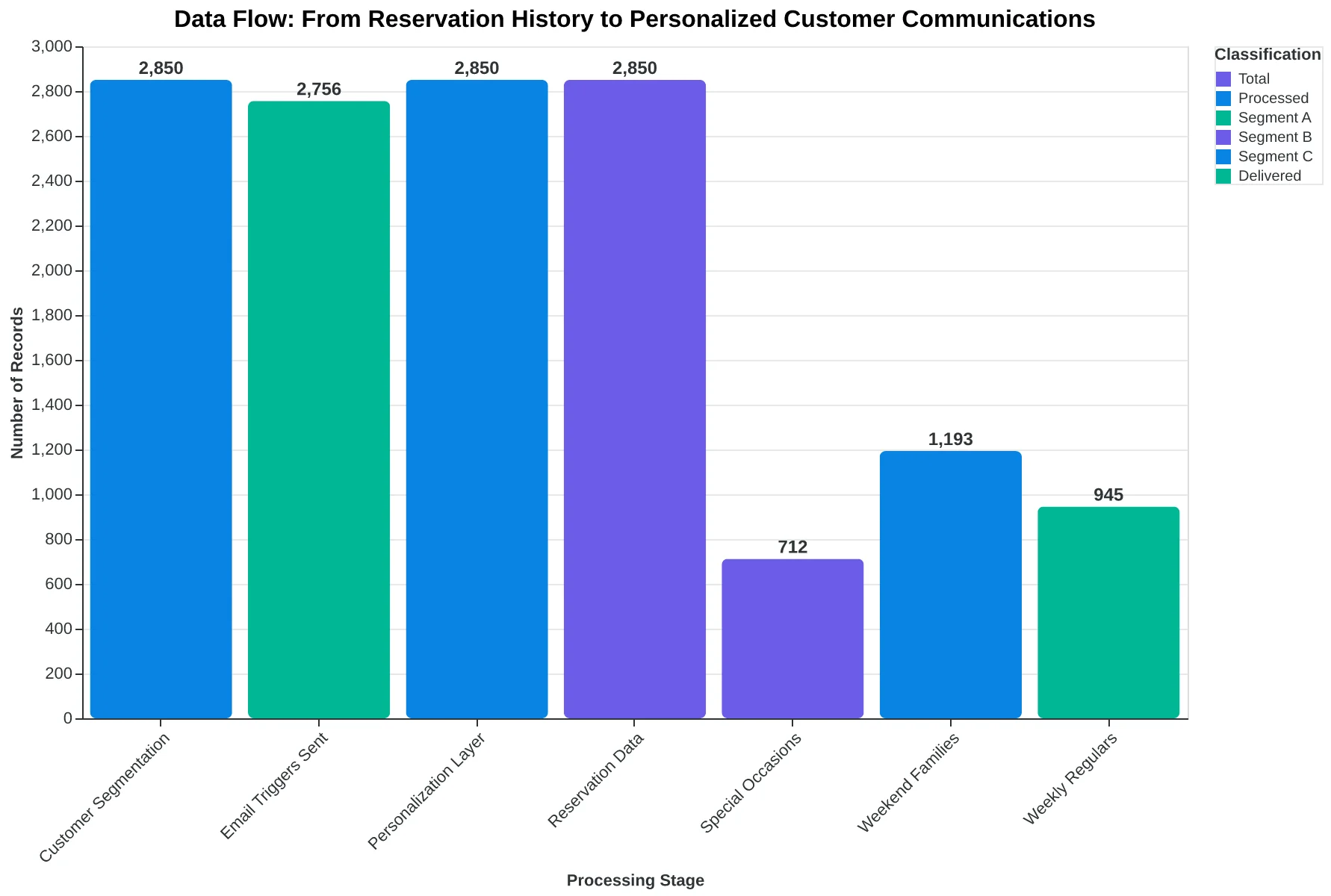
Data Flow: From Reservation History to Personalized Customer Communications
Maria's restaurant isn't special. She doesn't have a marketing team or sophisticated CRM. She has customer data scattered across reservation logs and receipt history, a basic email list, and the intuition that comes from remembering faces and orders.
But Maria understands something most restaurants miss: personalization isn't about inserting names into subject lines. It's about understanding customers well enough to anticipate their needs before they voice them.
The restaurants winning at email aren't just sending messages — they're having conversations. They know Sarah always books for anniversary dates in October. They remember that David's team orders family-style Italian when they close big deals. They understand that Friday lunch regulars want speed, while Saturday dinner guests want atmosphere.
With AI handling the complexity of behavioral analysis and predictive messaging, any restaurant can move beyond "Hi {FirstName}" to "We know exactly what you're craving." The seven levels aren't a checklist to complete — they're a progression to climb, one customer insight at a time.
Ready to transform your restaurant's email personalization? Download our Email Personalization Template Library, complete with behavioral scoring worksheets and message frameworks for each of the seven levels. Start with your current customer data and level up from there.
The question isn't whether your customers want more personal experiences — they're already choosing restaurants that deliver them. The question is whether you'll be one of those restaurants.
“The question isn't whether your customers want more personal experiences — they're already choosing restaurants that deliver them.”
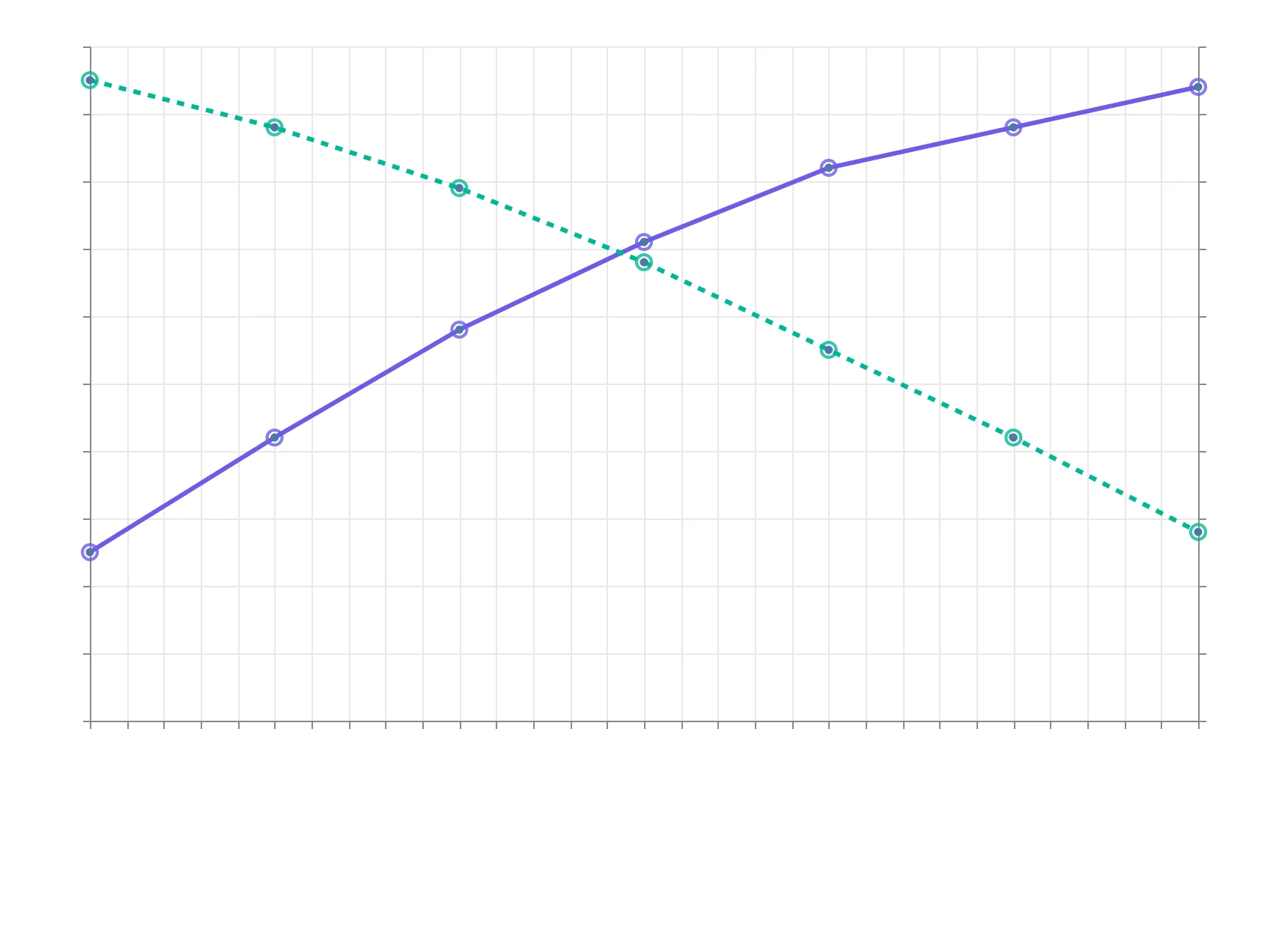
The personalization journey: from names to needs
760%
revenue increase from advanced email personalization
vs. generic broadcast campaigns
The business impact of moving beyond template personalization
Master Email Personalization That Actually Converts
Ready to move beyond "Hi {FirstName}" to emails that anticipate customer needs? Our Email Personalization Mastery Guide includes behavioral scoring worksheets, segment templates, and AI integration strategies for each of the seven levels.
Score your email before you send it
Free editor. Real-time EQS. No credit card.