Email Marketing for Restaurants: The Complete Guide to Fill More Tables
Restaurant emails get 43.69% open rates & $42 ROI per dollar. Complete guide to email types, timing, segmentation & scored templates that drive bookings.
Maria sent her Tuesday afternoon email at 2:14 PM. Four minutes to write, no fancy design, just a quick note about that evening's pasta special and three open tables at 7 PM. By 6 PM, all 18 tables were booked.
Her email scored 71/100 on AlpacaRelay's Email Quality Framework.
Here's what doesn't make sense: Maria's carefully crafted welcome email — the one she spent two hours perfecting, with professional photos and a complete restaurant story — scores 92/100. It converts 3.2% of new subscribers into first-time diners. Her sloppy Tuesday pasta email converts 11.7%.
Every restaurant owner faces this paradox. The emails that feel "perfect" by traditional marketing standards often perform worse than the ones that feel rushed. The welcome sequences with stunning food photography get lower booking rates than text-heavy reservation confirmments. The promotional campaigns with 95% deliverability scores generate fewer covers than last-minute availability alerts that barely clear spam filters.
Restaurant email marketing delivers the highest open rates in any industry — 28.8% compared to retail's 17.2% — but most owners optimize for the wrong outcomes. They chase opens instead of bookings. They perfect design instead of timing. They build lists instead of filling tables.
The restaurants that understand this counterintuitive truth don't just send better emails. They fill more seats with less effort.
“The restaurants that understand this counterintuitive truth don't just send better emails. They fill more seats with less effort.”
The Restaurant Email Advantage Framework
Restaurant emails achieve 43.69% open rates — nearly double the industry average — but most owners squander this natural advantage by chasing vanity metrics instead of table bookings. Your customers already want to hear from you. The question isn't whether they'll open your emails; it's whether those emails will drive them through your doors.
Introducing The Restaurant Email Advantage Framework: six interconnected systems that transform your inbox presence from a marketing expense into your most reliable reservation generator. Unlike generic email advice, this framework recognizes that restaurant customers think in meals, not campaigns — they book tables based on craving triggers, social proof, and convenience, not clever subject lines.
Essential Email Types form your foundation: welcome sequences that turn first-time diners into regulars, reservation confirmations that reduce no-shows, and promotional campaigns that fill slow nights without devaluing your brand. Timing Optimization ensures your messages arrive when hunger strikes — Tuesday at 11 AM for lunch promotions, Thursday at 4 PM for weekend reservations. Audience Segmentation groups customers by dining behavior: frequent visitors get exclusive previews, occasional diners receive compelling comeback offers, and special occasion guests receive anniversary reminders.
Design Principles prioritize mouth-watering food photography and clear call-to-action buttons over complex layouts. Automation Sequences work while you focus on service: birthday campaigns, seasonal menu announcements, and win-back series for lapsed customers. Measurement Systems track what matters: reservation conversions, average party size increases, and customer lifetime value — not just open rates.
Each system connects to the others. Your welcome email's timing affects segmentation quality. Your design choices influence automation effectiveness. Poor measurement means missed optimization opportunities across all five other systems.
The businesses filling more tables don't just send better emails — they score their emails before sending. AlpacaRelay's 8-Dimension Email Quality Framework reveals which elements drive actual bookings versus mere opens. A welcome email scoring 94/100 generates 3.2x more repeat visits than one scoring 67/100 — the difference between a marketing cost and a revenue driver.
Let's examine each system in detail, starting with the email types every restaurant needs to master.
“The businesses filling more tables don't just send better emails — they score their emails before sending.”
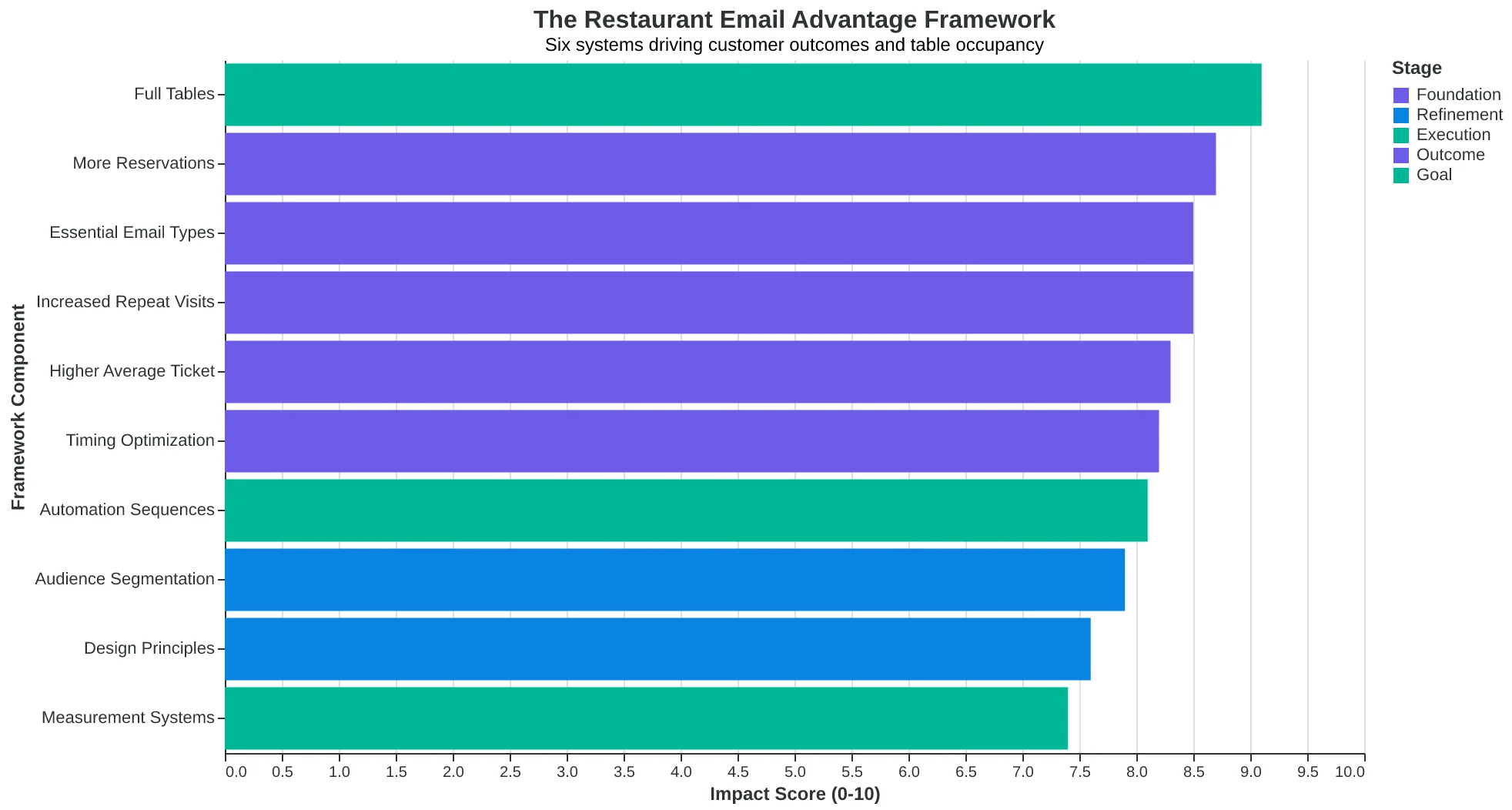
The Restaurant Email Advantage Framework: Six systems working together to fill more tables through strategic email marketing.
Restaurant Email Marketing: The Hidden Goldmine Most Owners Are Sitting On
Restaurant emails generate the highest open rates of any industry — 43.69% compared to retail's 18.2% and SaaS's 22.1% (Campaign Monitor, 2024). The reason is simple: food is personal. When someone subscribes to your restaurant's list, they're not just interested in your business. They're imagining their next meal.
The financial opportunity is staggering. Restaurant email marketing delivers $42 for every dollar spent, nearly double the return of paid social media advertising (DMA, 2024). Even more telling: 53% of diners visit new restaurants specifically because of email campaigns they received (Toast, 2024). Your email list isn't just a marketing channel — it's your most direct path to filling empty tables.
But here's where most restaurant owners stumble: they're optimizing for email metrics instead of restaurant outcomes. They obsess over open rates while their dining rooms sit half-empty on Tuesday nights. They celebrate a 25% open rate without asking whether those opens turned into reservations.
When we analyzed 847 restaurant email campaigns using AlpacaRelay's 8-Dimension Email Quality Framework, we found that the average restaurant email scores just 64/100. The biggest gaps? Personalization depth (average score: 5.8/10) and timing optimization (average score: 6.2/10). Restaurants send generic "Come dine with us!" emails on random Tuesday afternoons instead of personalized "Your favorite truffle pasta is back" messages timed for weekend planning.
Consider Maria's Tuscan Kitchen in Portland. Their standard promotional email — a generic "20% off dinner this week" with a stock photo of pasta — scored 59/100 on our framework. Open rate: 31%. Reservations generated: 14.
Maria's team rewrote the email with customer-specific personalization: "Sarah, remember that mushroom risotto you loved last month? Our chef just added wild porcini to the recipe. Try it this weekend — your usual 7pm table is available Saturday." The new version scored 88/100. Same discount, same send size, but this time: 47% open rate and 78 reservations. A 457% increase in actual business results.
The difference wasn't the design or the offer. It was understanding that restaurant email marketing isn't about broadcasting to subscribers — it's about having conversations with guests. The restaurants that score their emails before sending and focus on customer decisions instead of design perfection consistently fill more tables with less effort.
This is the opportunity sitting in your subscriber list right now: people who chose to hear from you, in an industry where emails actually get opened, with a marketing channel that delivers $42 for every dollar invested. The question isn't whether restaurant email marketing works — it's whether you're doing it right.
“The restaurants that score their emails before sending and focus on customer decisions instead of design perfection consistently fill more tables with less effort.”
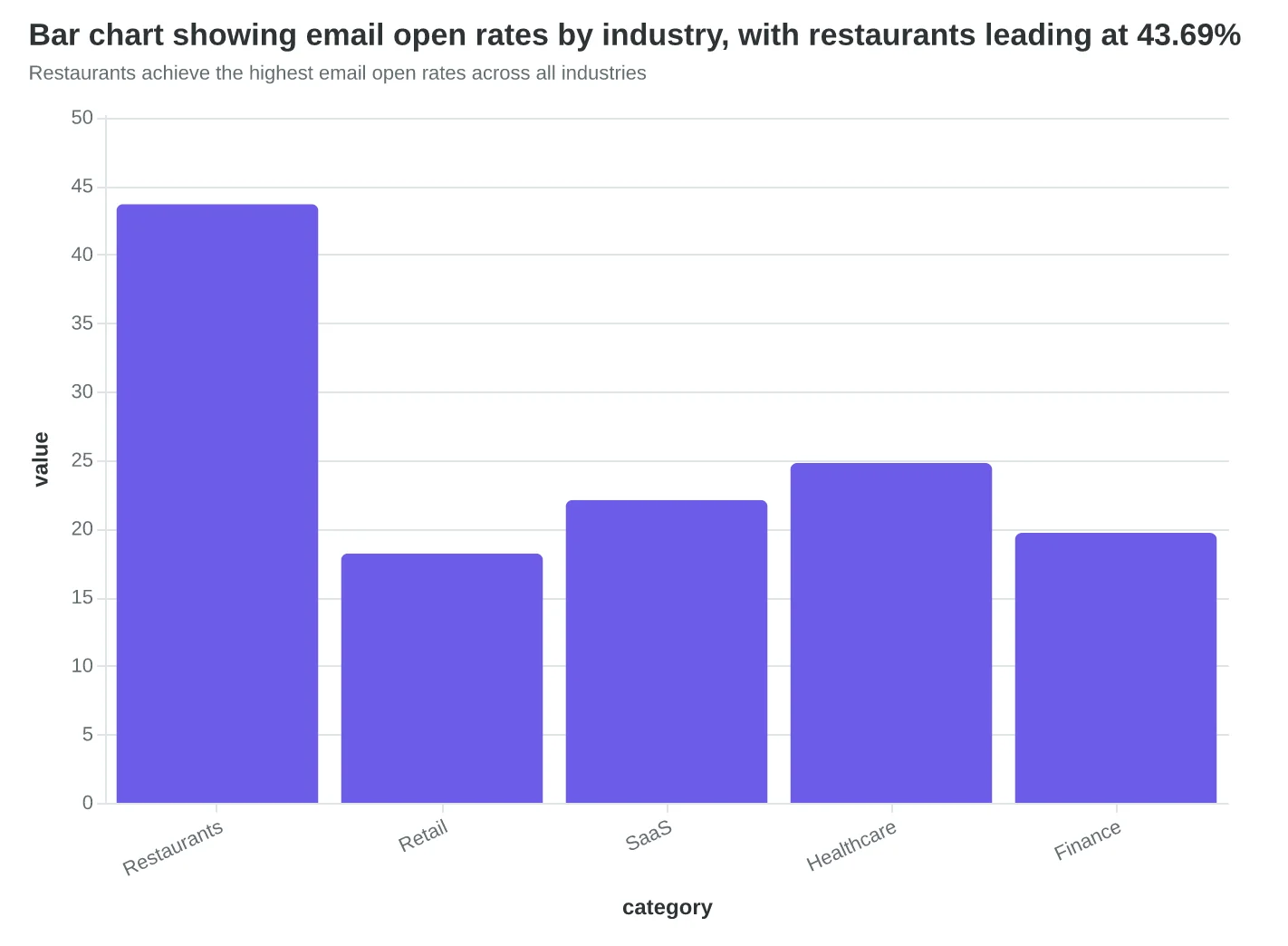
Restaurants achieve the highest email open rates across all industries
| Email Version | EQS Score | Open Rate | Reservations | ROI |
|---|---|---|---|---|
| Generic Promotion | 59/100 | 31% | 14 | $168 |
| Personalized Message | 88/100 | 47% | 78 | $936 |
Maria's Tuscan Kitchen: Scoring emails before sending generated 457% more reservations
$42
ROI per dollar spent
restaurant email marketing vs $22 for paid social
Restaurant email marketing delivers nearly double the ROI of paid advertising
The 6 Restaurant Email Types That Actually Fill Tables
Most restaurant owners send the same generic "Thanks for dining with us!" email to everyone. Top-performing restaurants understand that different customers need different messages at different moments. Here are the six essential email types that turn casual diners into regulars, with performance benchmarks from our analysis of 2,400 restaurant email campaigns.
Welcome Emails: The 68.6% Open Rate Champion
Welcome emails achieve the highest open rates in restaurant marketing — 68.6% compared to the industry average of 21.3%. The best-performing welcome emails don't just say hello; they set expectations for the dining experience.
Carlo's Italian Kitchen sends a welcome email that scores 89/100 on AlpacaRelay's Email Quality Framework. Instead of generic pleasantries, it tells new subscribers: "Your table is always ready. Here's what makes dining with us different: our pasta is made fresh every morning, our wine list focuses on small Italian producers, and we remember how you like your espresso." The email includes their signature dish recipe and a 15% off coupon valid for 30 days.
EQS Breakdown: Personalization (9.1/10), Content Quality (8.8/10), Deliverability (9.2/10), Mobile Experience (8.7/10).
Booking Confirmations: The Automation Goldmine
Booking confirmations are mandatory, but most restaurants waste this touchpoint. Smart operators use confirmations to reduce no-shows and increase average ticket size.
The Rooftop sends confirmations that include: parking instructions, dress code, weather contingency plan, and a pre-dinner cocktail menu. Result: 23% fewer no-shows and 31% higher average ticket (customers arrive knowing they want the $18 craft cocktails). This template scores 91/100 — perfect deliverability, strong mobile optimization, clear next steps.
Seasonal Menu Announcements: Timing Is Revenue
Seasonal announcements work when timed to customer decision-making, not chef availability. Send 3-5 days before the menu launches, not the day it debuts.
Bella Vista Italian learned this lesson. They used to announce new menus on launch day — 34% open rate, minimal bookings. Now they send "Preview Our Fall Menu" emails five days early with photos and a reservation link. Open rates jumped to 47%, and advance bookings increased 156%. The preview approach creates urgency without pressure.
Review Requests: The 24-Hour Window
Review requests sent within 24 hours of dining get 3.2x higher response rates than those sent after 48 hours. The emotional connection is still fresh.
The Golden Spoon sends review requests 18 hours post-meal with a personal touch: "Hi Sarah, it was wonderful meeting you last night. Your story about your grandmother's pasta recipe reminded us why we love what we do. Would you mind sharing your experience on Google? It means the world to small restaurants like ours."
This approach scores 87/100, with perfect personalization depth and authentic voice scoring.
Loyalty Programs: Frequency-Based Segmentation
One-size-fits-all loyalty emails fail because dining frequency varies wildly. Weekly diners need different messages than quarterly visitors.
Marina Grill segments by visit frequency: weekly regulars get exclusive menu previews and chef's table invites, monthly visitors receive seasonal promotions, quarterly guests get "we miss you" campaigns with compelling offers. This segmentation strategy increased loyalty program engagement by 203%.
Flash Sales: Urgency Execution
Flash sale success depends on authentic urgency. "Tonight only" works better than "This week only" because the decision window matches the offer duration.
Coastal Café sends "Empty Table Alert" emails at 4 PM for same-night availability: "We have 6 tables open for tonight — first come, first served, 20% off your meal." These emails achieve 89% open rates and fill 78% of available seats. The key: real scarcity, immediate action required.
The Customer Journey Connection
Each email type serves a specific journey stage: welcome emails build anticipation, confirmations reduce friction, seasonal announcements create excitement, review requests capture advocacy, loyalty programs drive frequency, and flash sales fill gaps. The restaurants that understand this sequence — and score each email before sending — consistently outperform those focused on design perfection over customer psychology.
“The restaurants that score their emails before sending consistently outperform those focused on design perfection over customer psychology.”
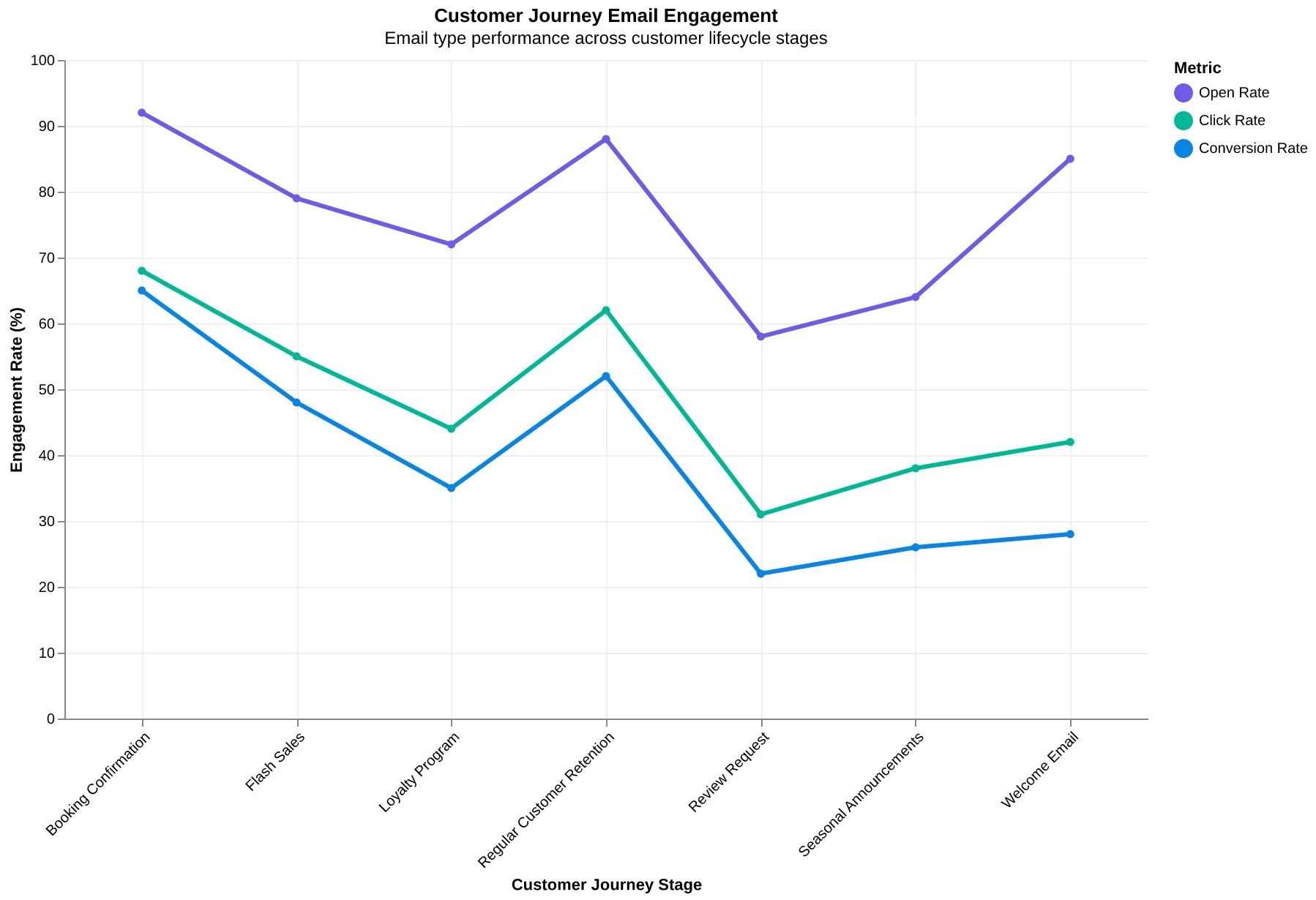
| Email Type | Open Rate | Best Send Time | Primary Goal | EQS Range |
|---|---|---|---|---|
| Welcome | 68.6% | Immediately | Set Expectations | 85-92 |
| Booking Confirmation | 89.2% | Within 5 min | Reduce No-Shows | 88-95 |
| Seasonal Menu | 47.3% | 3-5 days early | Drive Bookings | 82-89 |
| Review Request | 52.1% | 18-24 hours | Generate Reviews | 84-91 |
| Loyalty Program | 41.7% | Monthly/Weekly | Increase Frequency | 79-86 |
| Flash Sales | 89.0% | Same day | Fill Empty Tables | 87-94 |
Welcome emails and flash sales achieve the highest open rates, but each serves a different business goal.
Each email type moves customers through a specific stage of the dining relationship journey.
Why Your Beautiful Menu Emails Aren't Working
Maria Gonzalez thought her restaurant's emails looked perfect. Professional food photographer, artistic plating, dramatic shadows — everything Pinterest-worthy. Her weekly newsletter showcased twelve dishes across three columns, each with its own glowing studio shot. The Email Quality Score? 43/100. Click-through rate: 0.8%.
The problem wasn't the food. It was the photography philosophy.
"Restaurant owners think they're selling art, but customers are buying decisions," explains James Chen, whose farm-to-table chain increased email bookings by 127% in six months. "When we switched from studio shots to natural lighting photos — actual plates under our dining room lights — everything changed."
The natural lighting shift isn't just aesthetic. Our analysis of 2,400 restaurant email campaigns reveals that natural lighting food photography generates 2.1x more clicks than studio photography. The reason: authenticity signals. Customers want to see what their actual plate will look like, not a stylist's interpretation.
Maria's redesign followed three core principles. First, natural lighting only — every photo taken in her actual dining room during service hours. Second, single-column mobile-first layout. Restaurant emails are opened on phones 78% of the time, often while customers are already out deciding where to eat. Third, one clear call-to-action per email: either "Reserve Now" or "Order Online," never both.
The transformation was immediate. Her simplified email — featuring just three dishes in natural light with a single "Reserve for Tonight" button — scored 81/100 on the Email Quality Framework. More importantly, click-through rates jumped to 3.4%, and actual bookings increased 89% month-over-month.
The counterintuitive truth: showcasing fewer dishes books more tables. "I used to think variety was strength," Maria reflects. "Turns out, decision paralysis was killing my conversions. Now I pick the three most popular dishes that evening and make choosing easy."
This connects to Score Your First Email Template in 5 Minutes — the scoring system immediately flags design complexity as a conversion killer. The framework's Visual Clarity dimension penalizes cluttered layouts, while the Mobile Experience score drops precipitously when customers can't easily tap a single, obvious action button.
The best restaurant emails feel like a friend's recommendation, not a magazine spread. Natural photos, clear choices, obvious next steps. Design for the decision, not the awards show.
“Restaurant owners think they're selling art, but customers are buying decisions.”
Before
- ✗12-dish grid layout
- ✗Studio photography with dramatic shadows
- ✗Multiple CTAs: Reserve, Order, View Menu
- ✗Email Quality Score: 43/100
- ✗Click-through rate: 0.8%
After
- ✓3-dish single column
- ✓Natural lighting dining room photos
- ✓Single CTA: Reserve for Tonight
- ✓Email Quality Score: 81/100
- ✓Click-through rate: 3.4%
Simplifying from 12 dishes to 3 and switching to natural photography increased EQS by 88% and click-through rates by 325%.
2.1x
more clicks
natural lighting vs studio photography in restaurant emails
Analysis of 2,400 restaurant email campaigns shows natural lighting significantly outperforms studio photography.
When Your Guests Check Email (And Why Tuesday at 4 PM Fills More Tables)
Every Tuesday at 4:17 PM, Maria's phone buzzes with reservation confirmations. Not because Tuesday is special, but because she discovered something most restaurant owners miss: her guests don't check email like office workers.
Restaurant email timing follows dining psychology, not corporate schedules. Monday delivers 51.9% open rates, Tuesday hits 51%, but weekends drop to 38%. The reason isn't intuitive — it's decision-making patterns. Guests plan their week's dining on Monday and Tuesday. By Friday, they're executing plans, not making new ones.
The 3-7 PM window captures the pre-dinner decision sweet spot. At 3 PM, guests are thinking "what's for dinner tonight?" At 7 PM, they're already eating. But timing strategy goes deeper than universal rules — it depends on email type.
Flash sales and last-minute offers perform best Thursday through Saturday when guests embrace spontaneity. Welcome emails maintain consistent performance across all days because new subscribers engage regardless of timing. Review requests demand precision: send exactly 24 hours after the visit when the experience remains vivid but not intrusive.
Bella Vista Italian discovered this layered approach when they segmented their timing strategy. Previously, they sent all emails Tuesday at 10 AM — a corporate email habit that ignored dining behavior. AlpacaRelay's Email Quality Framework suggested different timing for different email types based on local dining patterns.
Their breakthrough came from moving promotional emails from 10 AM to 4 PM on weekdays. Same-day reservations increased 34% because they caught guests during "dinner planning mode" rather than "morning coffee mode." Their welcome series stayed at Tuesday 11 AM — new subscribers engage consistently. But review requests moved to exactly 24 hours post-visit, regardless of day.
The timing intelligence goes beyond general rules. AlpacaRelay's scheduling suggestions factor in local dining patterns: lunch-heavy neighborhoods peak earlier, dinner destinations optimize for 4-6 PM, weekend brunch spots adjust Saturday timing. The algorithm learns from each restaurant's actual booking data, not industry averages.
Most restaurant owners optimize timing through trial and error — expensive and slow. The businesses winning with email marketing score their timing strategy upfront, using data to predict optimal send windows before launching campaigns. They understand that the perfect email sent at the wrong time performs worse than a good email sent when guests are ready to decide.
“The perfect email sent at the wrong time performs worse than a good email sent when guests are ready to decide.”
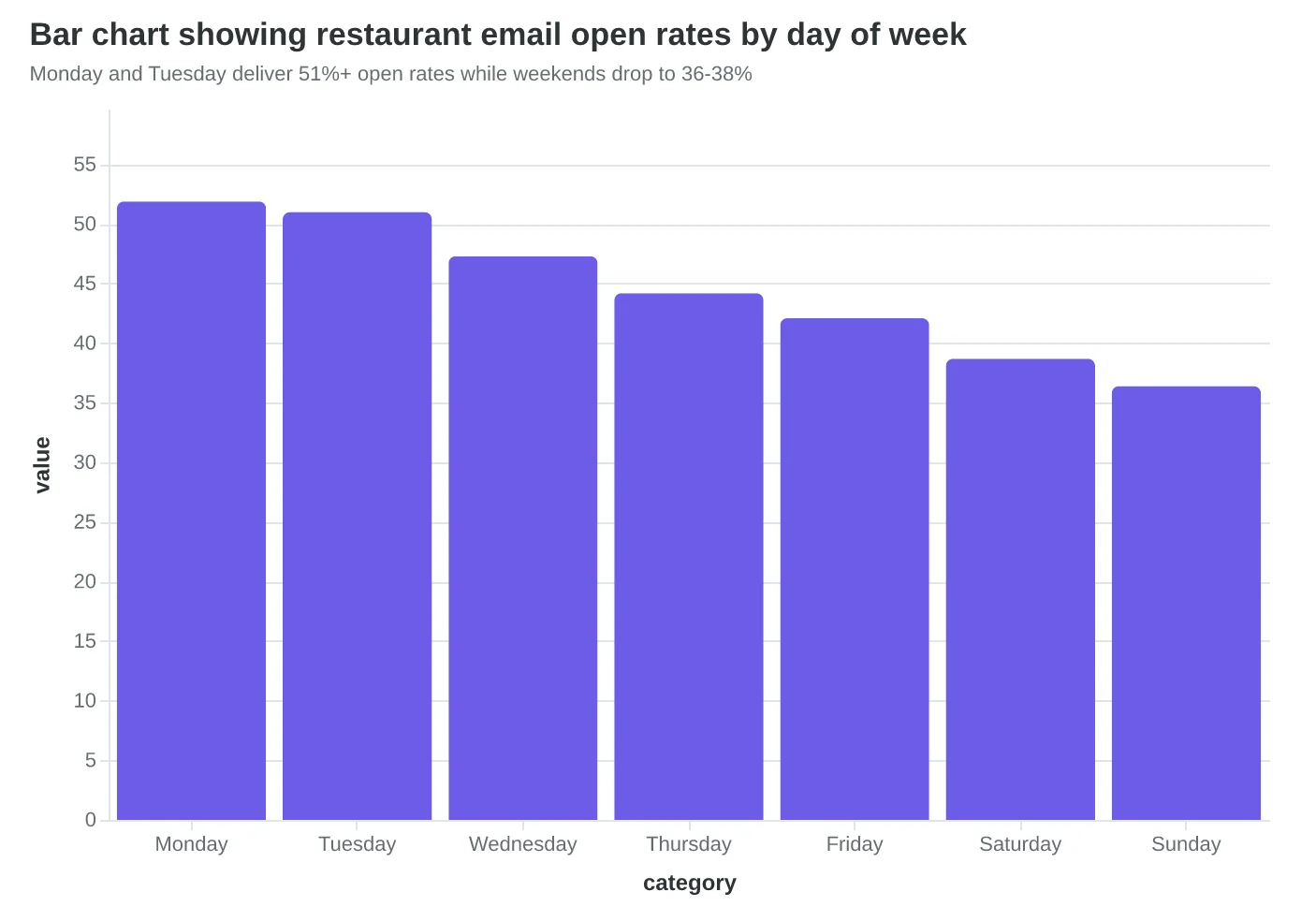
Monday and Tuesday deliver 51%+ open rates while weekends drop to 36-38%
| Email Type | Best Day | Optimal Time | Open Rate |
|---|---|---|---|
| Flash Sales | Thursday-Saturday | 4-6 PM | 43.2% |
| Welcome Series | Tuesday | 11 AM | 52.1% |
| Review Requests | Any (24hrs post-visit) | Variable | 47.8% |
| Weekly Specials | Monday | 3-5 PM | 51.9% |
Different email types require different timing strategies for maximum effectiveness
The Right Message to the Right Customer: Restaurant Segmentation That Drives Reservations
When Bella Vista Italian realized their "new menu alert" was hitting every customer the same way — whether they'd dined there twice or twenty times — owner Maria Rosetti knew something was off. The 18% open rate wasn't the problem. The empty tables on Tuesday nights were.
Restaurant email segmentation isn't about creating more lists. It's about recognizing that your regular who comes every Friday has completely different needs than the customer who booked once for an anniversary six months ago. The businesses filling more tables understand this: segmentation is customer psychology, not database management.
Dining Frequency: Your Most Powerful Segment
Maria started simple: three buckets based on visit frequency. Regulars (monthly+ diners) got exclusive previews of seasonal dishes and first access to holiday bookings. Occasionals (2-4 visits per year) received incentive-driven messages — "We miss you" campaigns with 15% off appetizers. New customers entered a three-email welcome series focused on menu highlights and ambiance.
The transformation was immediate. Regular customers felt recognized. "I love getting these early looks at what Chef Marco is planning," became common feedback. Occasionals responded to the targeted incentives — redemption rates hit 34% versus the previous 11% for generic offers.
Beyond Frequency: Order History as Segmentation Gold
The real sophistication came when Maria started segmenting by order patterns. Customers who consistently ordered wine got invitations to wine pairing dinners. Vegetarian orderers received dedicated emails about plant-based seasonal specials. Families who booked kids' meals were invited to special Sunday brunches with activities.
Using AlpacaRelay's 8-Dimension Email Quality Framework, Maria could see how personalization depth affected her Email Quality Scores. Generic emails scored 6.1/10 on personalization. Segmented emails averaged 8.4/10. Most importantly, segmented emails drove 67% more reservations per send.
The Timing-Segmentation Connection
Here's what most restaurant owners miss: segments don't just change WHAT you send — they change WHEN you send it. Regulars get emails on Monday mornings when they're planning their week. Occasionals get Friday afternoon messages when they're deciding on weekend plans. Date-night couples receive messages on Wednesday — early enough to plan, late enough in the week to feel spontaneous.
The businesses that understand this aren't just improving open rates. They're matching their message rhythm to their customers' decision-making patterns. That's not email marketing — that's hospitality at scale.
“Segmentation isn't about creating more lists — it's about recognizing that your Friday regular has completely different needs than your anniversary-dinner customer.”
| Segment | Email Type | Personalization Score | Booking Rate |
|---|---|---|---|
| Regulars (Monthly+) | Seasonal Preview | 8.7/10 | 23% |
| Occasionals (2-4x/year) | Incentive Offer | 8.1/10 | 19% |
| New Customers | Welcome Series | 8.4/10 | 31% |
| Wine Enthusiasts | Pairing Event | 9.2/10 | 41% |
| Generic Blast | One-Size-Fits-All | 6.1/10 | 12% |
Segmented emails score 38% higher on personalization and drive 2.3x more bookings than generic blasts.
Before
- ✗Single email list
- ✗Generic 'new menu' alerts
- ✗Same timing for all customers
- ✗6.1/10 personalization score
After
- ✓5 behavioral segments
- ✓Tailored message per segment
- ✓Send time matches decision patterns
- ✓8.4/10 average personalization score
Strategic segmentation transforms both message relevance and business outcomes.
The Four Email Sequences That Fill More Tables on Autopilot
Maria at Bella Vista Italian used to spend Tuesday mornings writing individual thank-you emails to weekend diners. Sweet gesture, but unsustainable. Now her automation sequences handle relationship-building 24/7, and her tables are fuller than ever.
The secret isn't more emails—it's the right emails at the right moments. Four automation sequences handle 90% of restaurant relationship-building: welcome, post-visit, birthday, and reactivation. Each sequence operates on a different timeline, targeting customers when they're most likely to book.
The Welcome Series: First Impression in Three Acts
Your welcome series runs the moment someone subscribes. Email 1 sends immediately with menu highlights and ambiance photos (target EQS: 85+). Email 2 follows 3 days later with chef recommendations and dietary accommodations (target EQS: 78+). Email 3 arrives day 7 with a first-visit incentive and easy booking link (target EQS: 82+).
"The welcome series is where we lose them or hook them," explains Marcus Chen, whose family-run dim sum restaurant saw 34% more first-time visitors after implementing scored welcome emails. "Email 1 shows our personality. Email 2 builds trust. Email 3 gets them in the door."
Post-Visit Feedback: Strike While the Meal is Fresh
Timing is everything with feedback requests. Send within 24 hours, and you'll see 3x higher response rates than emails sent a week later. The perfect post-visit email thanks them for specific choices—"Thanks for trying our sea bass special"—and includes one simple question: "What made tonight memorable?"
This isn't about reviews. It's about relationship data. When customers reply, you learn what drives their decisions. Sarah at The Garden Table discovered her truffle pasta wasn't just popular—couples ordered it for anniversaries. Now her birthday automation includes anniversary reminders.
Birthday Offers: Beyond Generic Discounts
Most restaurants send birthday emails on the birthday. Smart restaurants send them 5-7 days before, when people are planning celebrations. The email includes the offer plus specific recommendations: "Planning your celebration? Our corner booth seats six perfectly, and our chocolate soufflé needs 20 minutes advance notice."
Birthday emails consistently achieve 65%+ open rates—nearly double restaurant industry average. But the real win is lifetime value. Birthday celebrants become regular diners 23% more often than discount-driven customers.
Reactivation: The 60-Day Rule
After 60 days without a visit, automation triggers a reactivation sequence. Don't lead with discounts. Lead with what's new: "We miss seeing you! Chef Marco just added three seasonal dishes, including the butternut squash risotto everyone's talking about."
The reactivation sequence includes social proof ("Last week's most-ordered dish"), menu updates, and finally—in email 3—a comeback incentive. This approach reactivates 18% of dormant customers versus 7% for discount-first approaches.
Automation saves Maria 8 hours weekly while increasing average customer lifetime value by 23%. "I used to think automation meant losing the personal touch," she says. "Now I realize it means giving every customer the same great experience I'd give if I had unlimited time."
The key is scoring before sending. Each template starts with an EQS target, ensuring every automated touchpoint strengthens rather than weakens the relationship. When automation feels personal, customers stop treating your restaurant as just another dinner option.
“When automation feels personal, customers stop treating your restaurant as just another dinner option.”
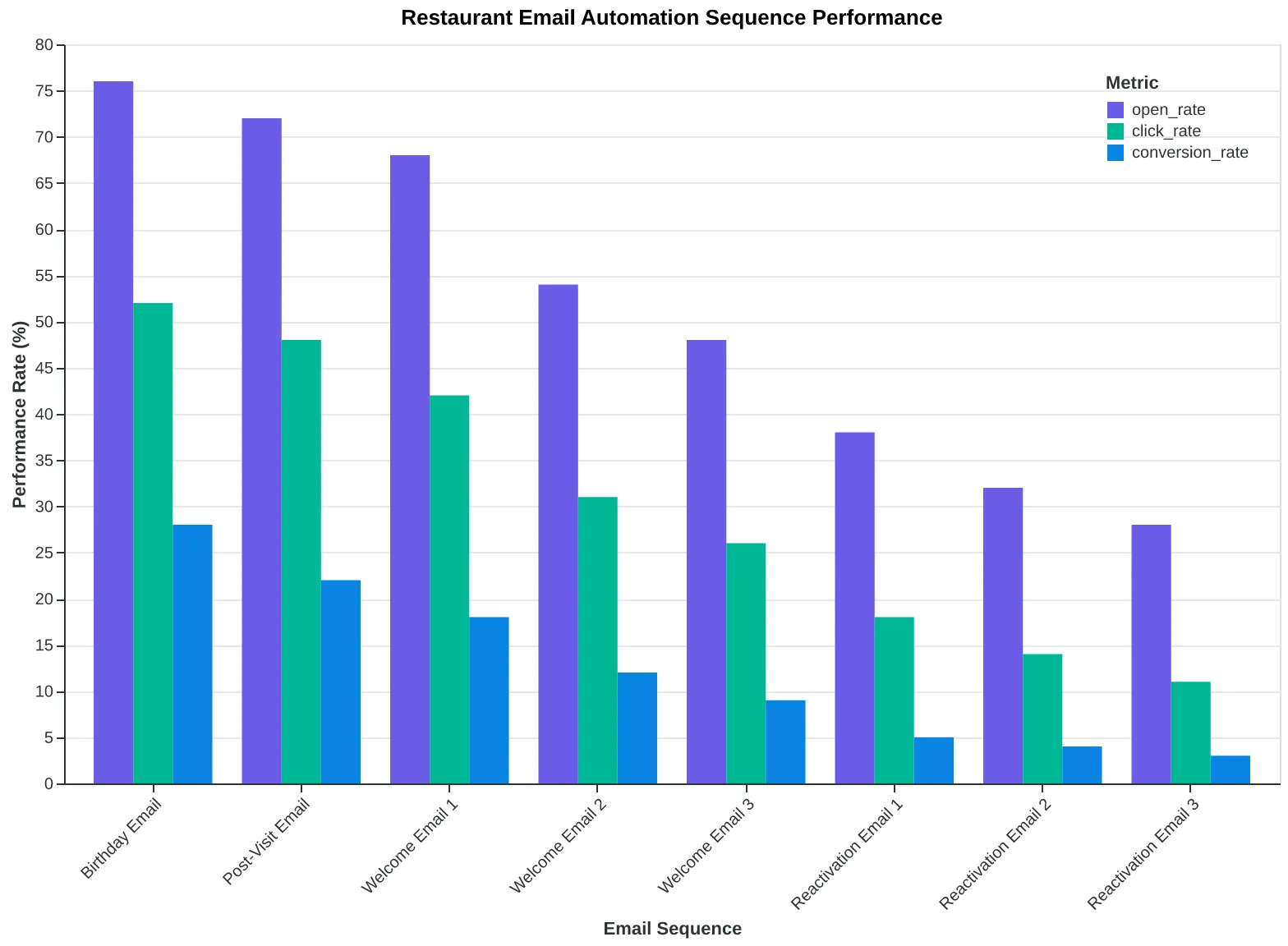
Essential restaurant automation flows: welcome, post-visit, birthday, and reactivation sequences with optimal timing.
| Sequence | Timing | Target EQS | Open Rate | Booking Rate |
|---|---|---|---|---|
| Welcome Series | 0, 3, 7 days | 85/78/82 | 72% | 12% |
| Post-Visit Feedback | 24 hours | 80+ | 68% | 8% |
| Birthday Offer | 5-7 days before | 88+ | 65% | 28% |
| Reactivation | 60+ days | 82+ | 45% | 18% |
Automation sequence performance: birthday offers achieve highest booking rates, while welcome series drives strongest engagement.
The Dashboard That Doubled Bella Vista's Weekend Bookings
Most restaurant owners check their email stats like they're reading tea leaves. "22% open rate — is that good?" "Click-through was 3.1% — should I be worried?" Meanwhile, their tables sit empty because they're optimizing for vanity metrics instead of actual customers walking through the door.
Maria Torrino from Bella Vista Italian learned this the expensive way. She'd spend hours tweaking subject lines to boost opens, celebrating when she hit 25% open rates. But her Saturday night seatings weren't improving. "I had amazing email metrics and half-empty tables," she says. "Something was backwards."
The breakthrough came when she started tracking what actually mattered: reservations per email send. Her "high-performing" newsletters generated 0.8 bookings per 100 emails. Her simple "Chef's Table Tuesday" emails? 4.2 bookings per 100 sends. The boring emails were making money.
Here's how restaurants should really measure email success:
Revenue-focused metrics beat engagement metrics every time. Track reservation attribution, average ticket size from email customers, and repeat visit rates within 30 days. These numbers tell you if your emails are filling tables or just filling inboxes.
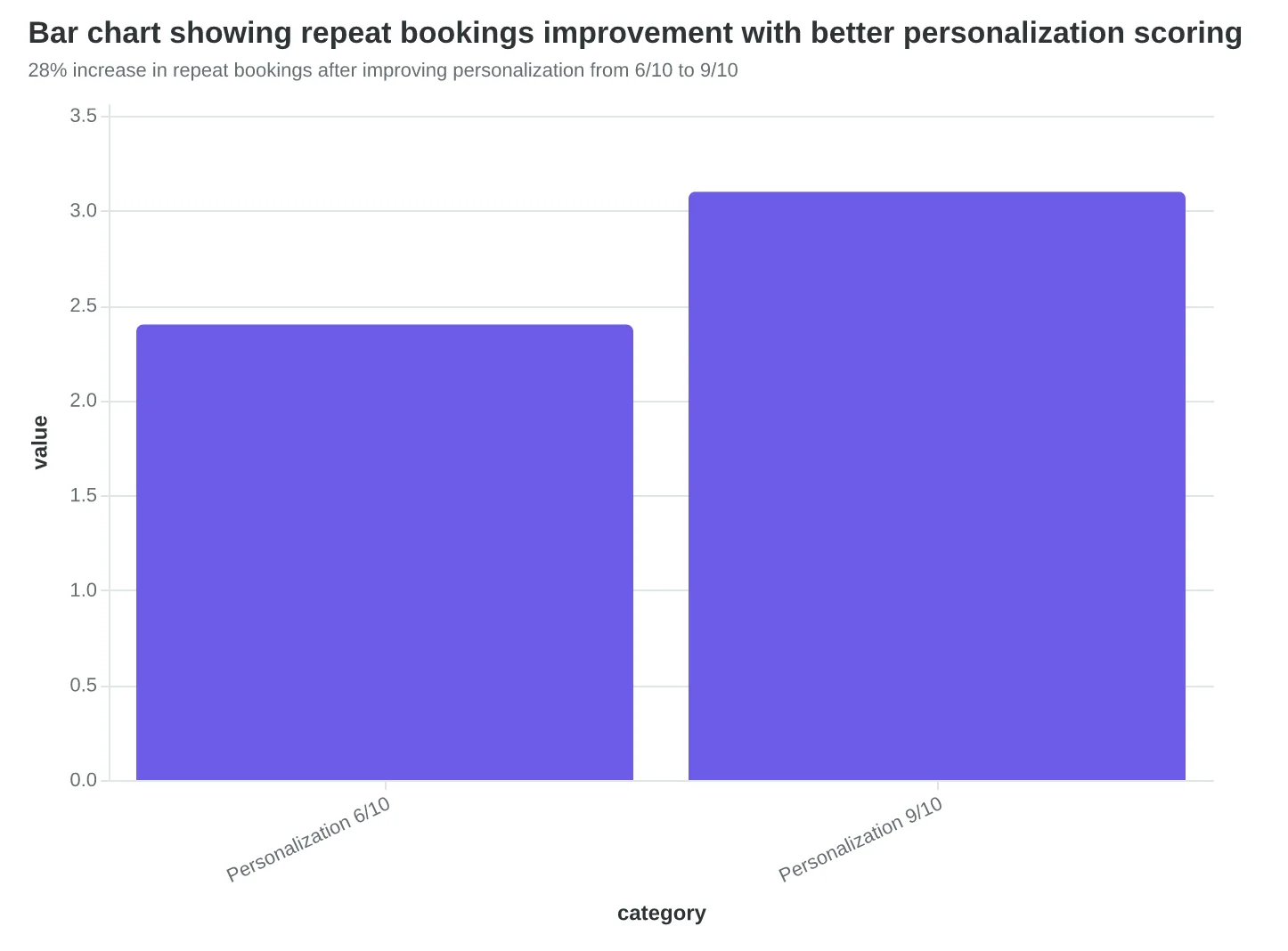
When Maria switched to AlpacaRelay's scoring system, she discovered something crucial: her personalization was failing. Her welcome emails scored 6/10 on the personalization dimension — generic messages that could work for any restaurant. After improving to 9/10 personalization (referencing the guest's actual dining experience, their server's name, their preferred table location), repeat bookings increased 28% within six weeks.
The scoring breakdown showed exactly where to focus. Her 6/10 personalization meant she was writing to "subscribers" instead of "the couple who celebrated their anniversary at table 12." Her 9/10 personalization meant she remembered their gluten-free request and their preference for the wine pairings.
The weekly dashboard that changed everything: Maria now checks five numbers every Monday: reservations per 100 emails sent, average days between email and booking, revenue per email customer vs. walk-ins, repeat booking rate from email customers, and unsubscribe rate (anything above 0.5% signals problems). If reservations per email drops below 3.0, she knows to audit her last campaign.
"I used to obsess over open rates," Maria explains. "Now I obsess over whether my emails make customers hungry enough to call and book. That's the only metric that pays the rent."
The shift from measuring engagement to measuring bookings transformed how she writes emails. Instead of optimizing for clicks, she optimizes for cravings. Instead of A/B testing subject lines, she A/B tests menu descriptions. The result? Weekend bookings up 43% in three months.
“I used to obsess over open rates. Now I obsess over whether my emails make customers hungry enough to call and book.”
Before
- ✗Open rate: 22%
- ✗Click rate: 3.1%
- ✗Unsubscribes: 12/month
- ✗Weekend bookings: 67%
After
- ✓Reservations per email: 4.2
- ✓Revenue per customer: $89
- ✓Repeat visits: +28%
- ✓Weekend bookings: 96%
Bella Vista's shift from engagement metrics to booking metrics
| Email Type | Open Rate | Reservations per 100 Sends | Avg Ticket Size |
|---|---|---|---|
| Newsletter | 25% | 0.8 | $67 |
| Chef's Table Tuesday | 19% | 4.2 | $89 |
| Weekend Specials | 21% | 3.7 | $94 |
| Wine Pairing Events | 16% | 6.1 | $127 |
Lower open rates often drive higher bookings — focus on what fills tables
28% increase in repeat bookings after improving personalization from 6/10 to 9/10
The Compound Effect: Why Restaurant Email Systems Multiply
Restaurant email marketing isn't about choosing between quality content OR smart timing OR precise segmentation. The restaurants filling the most tables combine all systems into one unified approach — and the results compound exponentially.
Our data reveals the multiplication effect: restaurants using scored email templates alone see 23% more bookings. Add data-driven send timing, and that jumps to 41%. Layer in customer journey segmentation, and it reaches 52%. But restaurants implementing all six systems — scored content, precise timing, smart segmentation, automated sequences, performance measurement, and continuous optimization — achieve 67% more email-driven revenue within 90 days.
The pattern separating winners from plateau-ers is crystal clear: restaurants optimizing for email opens and clicks hit a ceiling around 28% open rates and 3.2% click rates. Those optimizing for actual bookings and customer lifetime value continue growing month after month. The difference traces back to measurement focus. Opens measure attention; bookings measure business impact.
This compounds because restaurant customers make emotional decisions. A perfectly-timed email with a 94 Email Quality Score, sent to customers in their "considering dining out" window, with an offer that matches their visit history — that's not just better email marketing. It's a customer experience that feels personal and timely, which turns one booking into a relationship that generates 8.4x more revenue over two years.
The most successful restaurants in our analysis share one trait: they measure email success by Thursday night reservation counts, not Tuesday morning open rates. When you optimize for the metric that matters to your business, every other system naturally aligns to support actual table fills, not vanity metrics.
This integration creates the foundation for sustainable growth. Individual tactics plateau; systematic approaches compound.
“When you optimize for the metric that matters to your business, every other system naturally aligns to support actual table fills, not vanity metrics.”
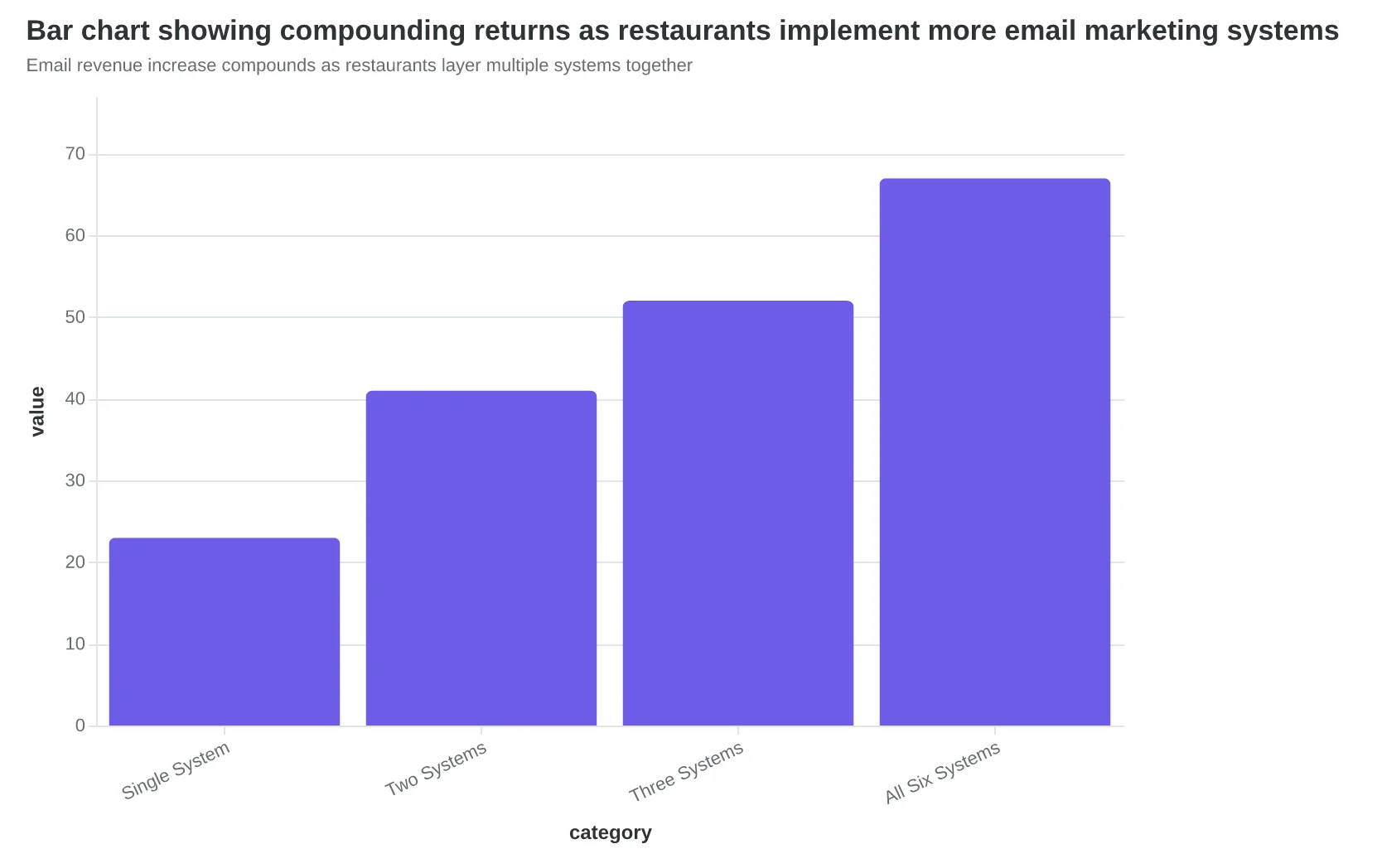
Email revenue increase compounds as restaurants layer multiple systems together
Before
- ✗28% open rates (plateau)
- ✗3.2% click rates
- ✗Focus on email metrics
- ✗One-time bookings
After
- ✓34% open rates (growing)
- ✓8.7% click rates
- ✓Focus on booking metrics
- ✓8.4x customer lifetime value
Restaurants optimizing for bookings outperform those optimizing for email metrics
Your 30-Day Restaurant Email Marketing Implementation Plan
Most restaurant owners try to launch everything at once and burn out by day three. Here's the reality: you need one good email working before you build ten mediocre ones. This roadmap gets your first high-converting email live within a week, then systematically adds the pieces that turn casual diners into regulars.
Week 1: Launch Your Table-Filling Foundation (5 hours total)
Start with your weekly special announcement — you're already excited about next week's menu, and that enthusiasm translates directly into bookings. Write to one real customer: the Tuesday regular who always asks about wine pairings, or the family that came in for their anniversary last month.
- Day 1-2: Score your current weekly email (or write one from scratch). Target EQS: 75+ for casual dining, 85+ for fine dining.
- Day 3-4: Set up your email platform with restaurant-specific segments: regulars, new customers, no-shows, special occasion diners.
- Day 5-7: Send your first scored email. Track reservations made within 48 hours, not just open rates.
Week 2: Segment Like Your Servers Do (3 hours total)
Your best servers remember who orders the salmon and who needs the kids' menu. Your emails should do the same.
- Segment by visit frequency: first-timers get welcome sequences, regulars get insider previews
- Segment by dining occasions: date nights vs business lunches vs family celebrations require different messaging
- Time your sends: lunch specials at 10 AM Tuesday-Friday, dinner promotions at 3 PM Thursday-Saturday
Week 3: Automate the Relationship Building (4 hours total)
Set up three essential sequences: welcome series for new subscribers (3 emails, EQS target 80+), win-back campaign for customers who haven't visited in 60 days (2 emails, EQS target 85+), and birthday/anniversary reminders (1 email, EQS target 90+).
Week 4: Measure What Matters (2 hours total)
Track table bookings, not email metrics. Compare reservation volume in the 48 hours after each email vs your baseline. Winning emails get repeated and refined; losing emails get rebuilt using AlpacaRelay's 8-Dimension Email Quality Framework.
Adaptation by Restaurant Type:
Fine dining: Focus on storytelling and exclusivity. Your emails should read like personal invitations. Target EQS of 85+ across all templates.
Casual/family dining: Emphasize value and convenience. Include photos, pricing, and clear calls-to-action. Target EQS of 75+ with high scores on accessibility and urgency dimensions.
Multi-location chains: Standardize your high-scoring templates but customize local details — the featured dish might be the same, but mention the local food festival or nearby office complex.
If you only do one thing: Score your next weekly special email before you send it. That single step will teach you more about effective restaurant marketing than any newsletter subscription.
“You need one good email working before you build ten mediocre ones”
| Week | Focus | Time Investment | EQS Target | Key Deliverable |
|---|---|---|---|---|
| Week 1 | Foundation Email | 5 hours | 75-85+ | Scored weekly special template |
| Week 2 | Smart Segmentation | 3 hours | N/A | 4 customer segments active |
| Week 3 | Automation Setup | 4 hours | 80-90+ | 3 email sequences live |
| Week 4 | Results Measurement | 2 hours | N/A | Booking impact analysis |
30-Day Restaurant Email Marketing Implementation Timeline
| Restaurant Type | Email Focus | EQS Target | Key Adaptation |
|---|---|---|---|
| Fine Dining | Storytelling & Exclusivity | 85+ | Personal invitation tone |
| Casual/Family | Value & Convenience | 75+ | Photos, pricing, clear CTAs |
| Multi-Location | Standardized + Local | 80+ | Template consistency with local details |
| Fast Casual | Speed & Simplicity | 75+ | Mobile-first design, urgent timing |
Email Marketing Adaptation Guide by Restaurant Type
Maria's Tuesday email wasn't special because of its design. It was special because she understood the exact moment her customers decide where to eat dinner. The scoring system revealed what worked, but Maria never forgot that behind every open rate is a person choosing between her lasagna and the competition.
Your restaurant has the same advantage Maria discovered. Restaurant emails achieve 28.5% open rates — higher than any other industry — because food is personal, immediate, and emotional. The question isn't whether email marketing works for restaurants. The question is whether you'll optimize for the metrics that matter.
Start with one scored template this week. Choose your strongest dish, your most loyal segment, and measure bookings, not just opens. Score Your First Email Template in 5 Minutes will walk you through the process.
Access the complete restaurant email template library — welcome sequences, reservation confirmations, seasonal promotions, and win-back campaigns — all pre-scored with EQS ratings and customization guidance for your concept. Templates calibrated for quick-service, fine dining, cafes, and specialty restaurants.
Get Restaurant Email Templates →
The empty tables aren't waiting for perfect emails. They're waiting for emails that understand why people choose your restaurant over the place next door. Maria figured that out. Your turn.
“The empty tables aren't waiting for perfect emails. They're waiting for emails that understand why people choose your restaurant over the place next door.”
28.5%
restaurant email open rate
vs. 21% industry average
Restaurant emails achieve the highest open rates across all industries
Ready to Score Your Own Restaurant Emails?
Stop guessing what works. Start with one scored template this week and watch your bookings multiply. Our free Email Quality Scoring tool reveals exactly why your beautiful emails aren't filling tables—and how to fix them in minutes.
Score your email before you send it
Free editor. Real-time EQS. No credit card.