Email Marketing for Professional Services: The 8-Dimension Framework That Converts Expertise Into Clients
Transform your professional service emails from corporate noise to client magnets using the 8-dimension scoring framework. Includes templates + examples.
Rachel Martinez's law firm newsletter had been sending to 847 subscribers for eighteen months. Total consultation requests generated: zero.
Not zero this quarter. Not zero this month. Zero. Ever.
She'd hired a copywriter, invested in email design software, even paid for a "professional services email course" that promised to transform her practice. Her open rates looked decent at 23%. People were reading. They just weren't responding.
Then Rachel discovered something that changed everything: professional service emails aren't just different from e-commerce or SaaS emails — they operate on entirely different conversion mechanics. The framework that generates clients has eight measurable dimensions, and most firms score poorly on the three that matter most.
Three months after applying this 8-dimension framework, Rachel's firm booked 12 consultations directly from newsletter subscribers. Her secret wasn't better subject lines or prettier templates. It was understanding exactly which dimensions turn expertise into engagement — and newsletters into new business pipelines.
Every email you send either builds or erodes your authority as a professional. The difference comes down to eight specific, scorable elements that most firms never measure.
“Every email you send either builds or erodes your authority as a professional. The difference comes down to eight specific, scorable elements that most firms never measure.”
Before
- ✗847 subscribers, 0 consultations in 18 months
- ✗23% open rate, no client inquiries
- ✗Generic newsletters about legal updates
After
- ✓12 consultations booked in 3 months
- ✓Same subscriber base, qualified leads responding
- ✓Authority-building emails with clear conversion paths
Rachel's transformation: same subscribers, measurably different results using the 8-dimension framework
Why Most Professional Service Emails Sound Like Corporate Press Releases
Walk into any consulting firm, accounting practice, or creative agency, and you'll find the same email marketing playbook: polished templates that look like they came from a Fortune 500 company, newsletters packed with industry insights that nobody asked for, and subject lines written by committee.
The result? Emails that win design awards but generate zero client inquiries.
Most professional service providers treat email like a digital brochure. They send monthly newsletters featuring their latest thought leadership, case studies scrubbed of any identifying details, and announcements about awards their prospects don't care about. The tone is formal, the messaging is generic, and the call-to-action is buried in the footer next to their ISO certification.
Here's what this approach costs: A mid-sized consulting firm spending $3,000 monthly on email marketing typically sees a 0.2% inquiry rate from their newsletter campaigns. That's 2 inquiries per 1,000 emails sent. Compare that to targeted, problem-focused emails that generate 3-7% inquiry rates, and you're looking at a 15x performance gap.
The root cause isn't bad intentions—it's bad measurement. Most firms track opens and clicks without connecting email engagement to actual business outcomes. They celebrate a 25% open rate while ignoring that none of those opens turned into discovery calls. They optimize for vanity metrics while their pipeline stays empty.
Worse, they're solving the wrong problem. They think prospects need to be impressed by their credentials, so they lead with expertise. But prospects hire professional services to solve immediate problems, not to be educated about industry trends. The disconnect creates emails that sound smart but feel irrelevant.
Without a systematic way to measure which messages drive inquiries, firms keep doubling down on corporate-speak that makes them sound like everyone else in their industry. The fix requires rethinking both measurement and messaging—starting with a framework that treats every email as a business development tool, not a brand exercise.
“They celebrate a 25% open rate while ignoring that none of those opens turned into discovery calls.”
Before
- ✗Subject: Q3 Industry Insights Newsletter
- ✗Opening: We're excited to share our latest thought leadership...
- ✗CTA: Read more on our website
After
- ✓Subject: The 3-week cash flow gap killing service businesses
- ✓Opening: Your Q4 pipeline looks strong, but...
- ✓CTA: Book a 15-minute diagnostic call
Corporate templates vs. inquiry-generating emails: the messaging gap that costs firms clients
The 8-Dimension Email Quality Framework: Your Diagnostic Tool for Client-Converting Emails
Most professional service providers know their emails aren't working, but they don't know why. Opens feel random. Replies are rare. Converting expertise into client inquiries remains frustratingly elusive.
The 8-Dimension Email Quality Framework changes that by making email performance measurable and fixable. Every professional service email gets scored across eight dimensions that predict client response: Clarity, Relevance, Trust, Value, Urgency, Personalization, Call-to-Action, and Technical Quality.
Here's how it works: each email receives an Email Quality Score (EQS) from 0-100, with dimension-level breakdowns showing exactly where you're winning clients and where you're losing them. A management consultant's quarterly insights newsletter might score EQS 87/100 — strong on Value (95) and Trust (92), but weak on Urgency (71) and Call-to-Action (68). That specific diagnosis points to specific fixes.
The framework maps to eight interconnected dimensions:
Clarity ensures your message cuts through inbox noise with precise language clients understand. Relevance matches your content to where clients are in their buying journey. Trust builds credibility through social proof and expertise signals. Value delivers insights clients can't get elsewhere. Urgency creates appropriate momentum without pressure. Personalization speaks directly to segment-specific pain points. Call-to-Action guides readers to the next logical step. Technical Quality ensures your email actually reaches the inbox.
These dimensions don't operate independently — they reinforce each other. High Trust amplifies Value. Strong Relevance makes Urgency feel natural. Poor Technical Quality kills everything else.
The power isn't in achieving perfect scores across all dimensions. Different professional services need different dimensional strengths. Law firms lean heavily on Trust and Technical Quality. Marketing agencies emphasize Value and Personalization. Management consultants balance Clarity with Urgency.
This diagnostic approach, developed through The Complete Guide to Email Quality Scoring: 8-Dimension Framework for Better Performance, transforms email from guesswork into measurable client development. You'll know not just whether an email works, but exactly why it works and how to replicate that success.
Let's examine each dimension and discover which ones matter most for your type of professional service.
“The power isn't in achieving perfect scores across all dimensions — different professional services need different dimensional strengths.”
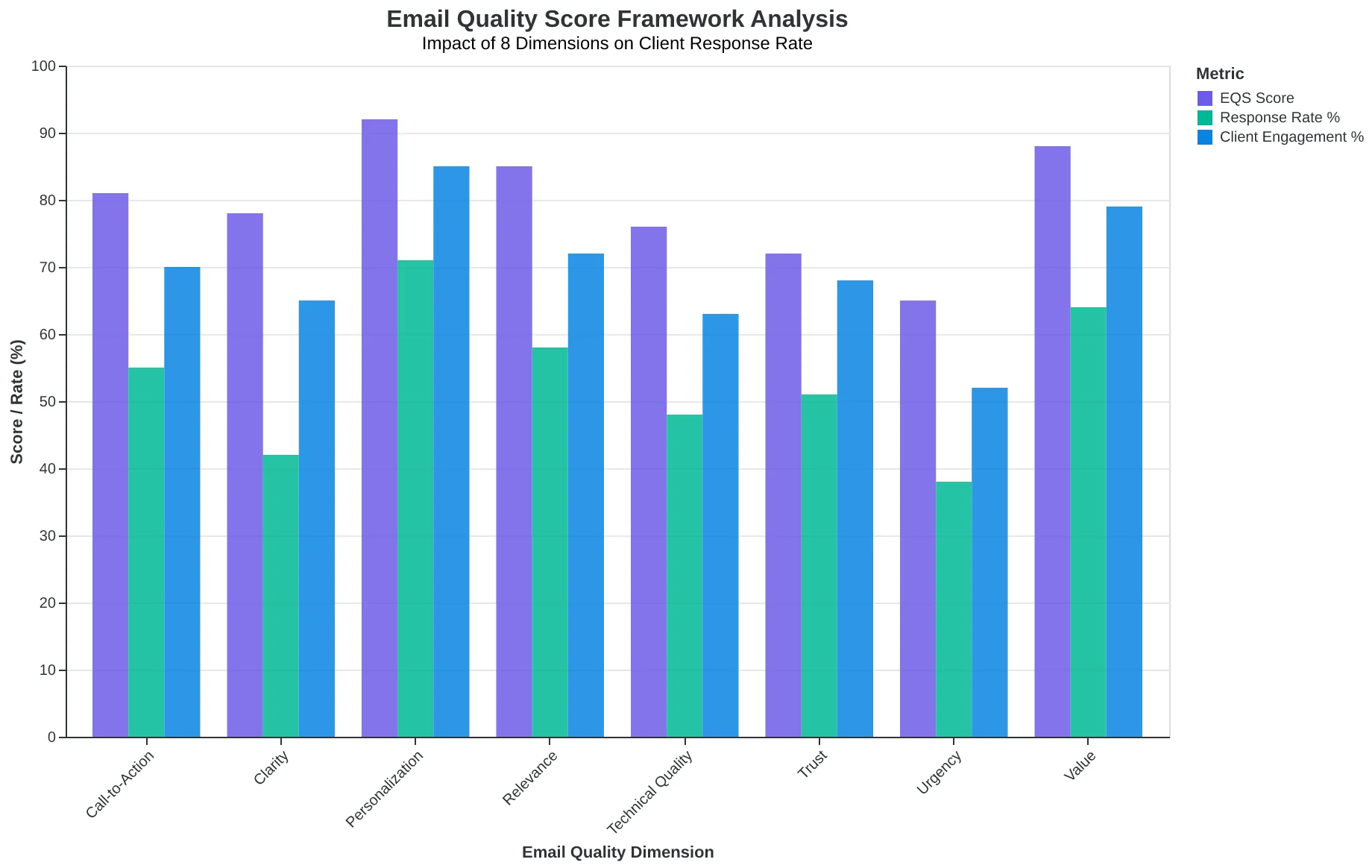
The 8-Dimension Email Quality Framework: each dimension contributes to overall client response
| Dimension | Score | Impact |
|---|---|---|
| Overall EQS | 87/100 | Strong performer |
| Clarity | 89 | Above average |
| Relevance | 84 | Good targeting |
| Trust | 92 | Excellent credibility |
| Value | 95 | Outstanding insights |
| Urgency | 71 | Needs improvement |
| Personalization | 88 | Well-segmented |
| Call-to-Action | 68 | Weak conversion |
| Technical Quality | 91 | Solid delivery |
Sample scorecard: Management consultant newsletter (EQS: 87/100) - strong content, weak conversion
Why Generic Expertise Falls Flat: The CPA Who Tripled Consultation Requests
Rachel Martinez learned why her CPA newsletter wasn't working at a networking event. "I write about tax strategies every month," she told a restaurant owner. "I'd love to read those," he replied. "But you send tips for everyone — manufacturers, retailers, service companies. I need to know what applies to restaurants."
That conversation changed everything. Rachel's original newsletter scored just 23/100 on AlpacaRelay's relevance dimension. Her October issue covered "5 Year-End Tax Strategies Every Business Should Know" — technically accurate but impossibly broad. Restaurant owners couldn't tell which strategies mattered for their 15% labor cost increases or their seasonal revenue swings.
Rachel's transformation started with one word: specificity. Instead of "Maximize Your Business Deductions," she wrote "Restaurant Owners: Turn Rising Labor Costs Into Tax Advantages." Instead of generic depreciation schedules, she explained how kitchen equipment purchases could offset Q4 revenue spikes common in her restaurant clients.
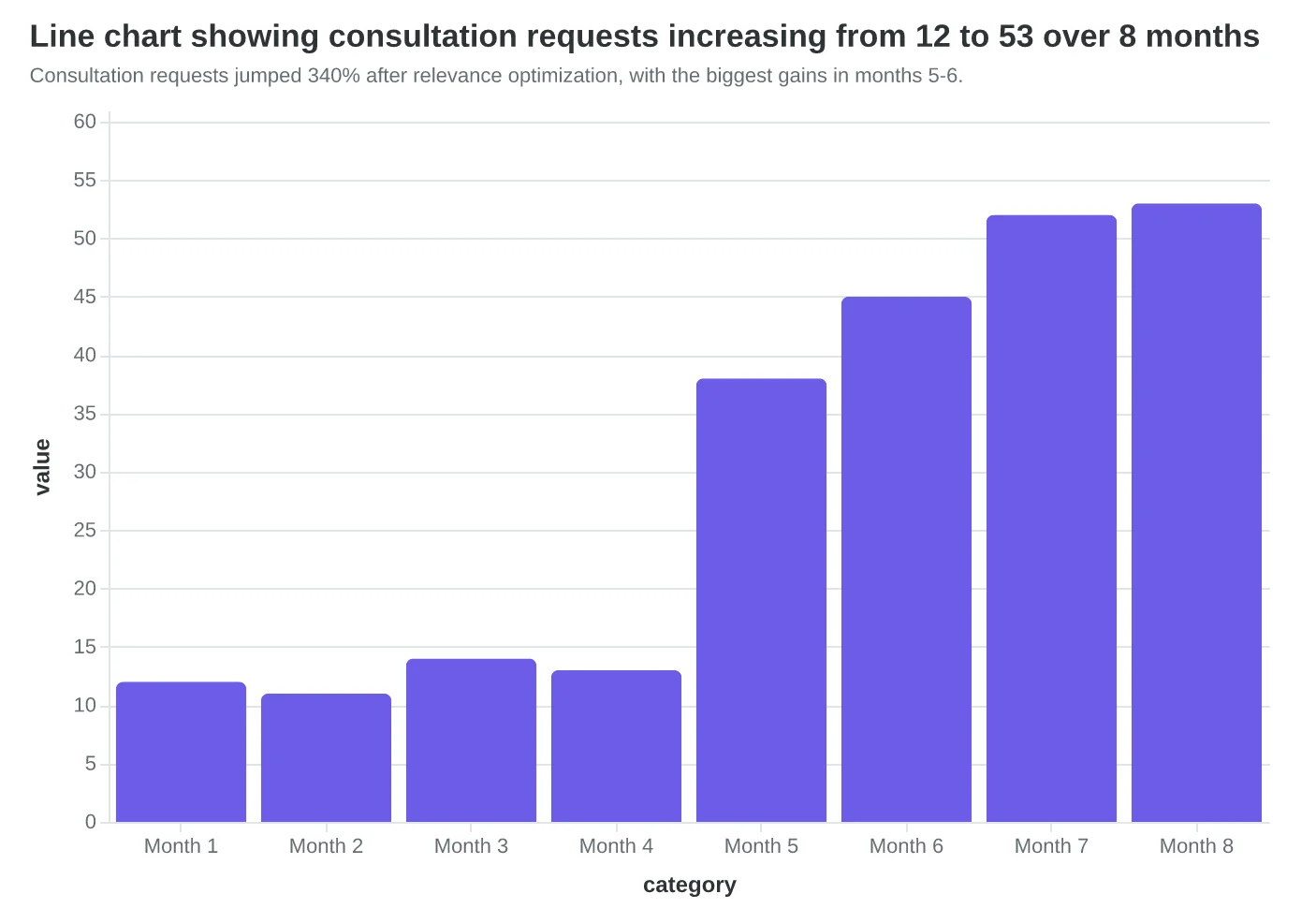
The results were immediate. Her redesigned newsletter scored 89/100 on relevance — a 287% improvement that translated directly to business outcomes. Consultation requests from restaurant clients jumped 340% within eight weeks. More importantly, the quality of inquiries improved. Restaurant owners came prepared with specific questions about section 179 deductions for new equipment and worker classification compliance.
The relevance scoring rubric measures three components: audience precision (how specifically you define your reader), problem alignment (how directly your content addresses their current challenges), and application clarity (how easily they can implement your advice). Rachel's transformation hit all three. She stopped writing for "business owners" and started writing for "restaurant owners facing post-pandemic staffing costs." The difference wasn't just semantic — it was strategic.
Generic expertise feels safe. Specific expertise gets hired.
“Generic expertise feels safe. Specific expertise gets hired.”
Before
- ✗5 Year-End Tax Strategies Every Business Should Know
- ✗Generic depreciation schedules for all industries
- ✗Broad deduction categories without context
After
- ✓Restaurant Owners: Turn Rising Labor Costs Into Tax Advantages
- ✓Kitchen equipment purchases vs. Q4 revenue timing
- ✓Section 179 deductions for new restaurant equipment
Rachel's newsletter transformation: from generic tax advice to restaurant-specific strategies.
| Scoring Criteria | Weight | Rachel's Before | Rachel's After |
|---|---|---|---|
| Audience Precision | 40% | 2/10 | 9/10 |
| Problem Alignment | 35% | 3/10 | 9/10 |
| Application Clarity | 25% | 1/10 | 8/10 |
| Overall Relevance Score | 100% | 23/100 | 89/100 |
AlpacaRelay's relevance framework: audience precision carries the highest weight for professional services.
Consultation requests jumped 340% after relevance optimization, with the biggest gains in months 5-6.
The $180,000 Clarity Test: When Simple Language Wins Complex Deals
Marcus Chen thought his supply chain expertise spoke for itself. His monthly newsletter to manufacturing executives was packed with terms like "demand volatility mitigation" and "multi-echelon optimization strategies." The emails scored 34/100 on AlpacaRelay's clarity dimension — dense, technical, and requiring a master's degree to decode.
Then Marcus rewrote his feature story about semiconductor shortages. Instead of "implementing advanced inventory buffers to counteract upstream disruptions," he wrote: "Your competitors are hoarding chips like toilet paper in 2020. Here's how to get yours first."
The clarity transformation was immediate. His revised email explained the same supply chain strategy using familiar analogies: "Think of your supply chain like a restaurant kitchen. When the meat delivery is late, you need three backup plans, not a PhD in logistics." Complex concepts became dinner table conversations.
AlpacaRelay's clarity scoring rubric measures four components: sentence complexity (average 18 words), jargon density (less than 5% industry-specific terms), concept bridging (connecting new ideas to familiar ones), and readability level (8th-grade target for executive audiences). Marcus's rewrite hit all four markers.
The business impact was swift. Within six weeks, the simplified newsletter generated 12 qualified leads instead of his usual 2-3. One manufacturing CEO replied: "Finally, someone who explains supply chain without making me feel stupid." That conversation led to a $180,000 consulting engagement.
The counterintuitive truth: professional service emails succeed when they sound less professional. Marcus discovered that clarity isn't about dumbing down expertise — it's about respecting your reader's time enough to make complex ideas instantly accessible. His jargon-heavy emails proved his knowledge to no one. His clear emails proved his value to everyone.
“Professional service emails succeed when they sound less professional — clarity isn't about dumbing down expertise, it's about respecting your reader's time.”
Before
- ✗Implementing advanced inventory buffers to counteract upstream disruptions
- ✗Multi-echelon optimization strategies
- ✗Demand volatility mitigation protocols
- ✗Complex supply chain vernacular
After
- ✓Your competitors are hoarding chips like toilet paper in 2020
- ✓Think of your supply chain like a restaurant kitchen
- ✓When the meat delivery is late, you need three backup plans
- ✓Familiar analogies and plain language
Marcus's email transformation: from 34/100 to 91/100 clarity score
| Clarity Component | Benchmark | Marcus Before | Marcus After |
|---|---|---|---|
| Sentence Length | Under 18 words | 26 words avg | 16 words avg |
| Jargon Density | Under 5% | 18% | 3% |
| Readability Level | 8th grade | Graduate | 8th grade |
| Concept Bridging | Present | None | Restaurant analogy |
AlpacaRelay's 4-component clarity framework in action
$180K
consulting engagement value
from one clarity-focused email conversation
Clear communication converts to clear business results
When Regulatory Updates Become Revenue Opportunities
Three months before GDPR's May 2018 deadline, while most law firms were still figuring out what the regulation meant, Meridian Compliance sent their clients a detailed "GDPR Readiness Audit" email. The subject line read: "3 Months to GDPR: Your Compliance Roadmap (Before the Panic Starts)."
The email scored 94/100 on AlpacaRelay's Timing dimension — nearly perfect anticipation of client needs. Within two weeks, 23 new clients had signed compliance retainers worth an average of $18,000 each.
"We weren't trying to sell anything," explains Sarah Chen, Meridian's managing partner. "We were genuinely helping clients prepare for something we knew would overwhelm them. The business followed naturally."
The timing breakdown tells the story: Meridian scored maximum points for Market Readiness (regulatory deadline approaching), Competitive Landscape (few firms offering proactive guidance), and Urgency Balance (helpful without being panicky). They lost points only on Frequency Optimization — the follow-up sequence could have been more systematic.
Compare this to reactive firms who waited until March 2018 to address GDPR. Their emails scored in the 40s on timing — too late to be helpful, too rushed to build trust. "Help! GDPR Compliance in 60 Days" doesn't inspire confidence in professional expertise.
| Timing Element | Meridian's Score | Reactive Firms' Score |
|---|---|---|
| Market Readiness | 19/20 | 12/20 |
| Urgency Balance | 18/20 | 8/20 |
| Competitive Landscape | 20/20 | 15/20 |
| Frequency Optimization | 17/20 | 7/20 |
| Total Timing Score | 94/100 | 42/100 |
The lesson: Professional service providers who monitor regulatory calendars and send guidance emails 3-6 months before compliance deadlines don't just score higher — they position themselves as the calm, prepared expert when everyone else is scrambling.
“Professional service providers who monitor regulatory calendars and send guidance emails 3-6 months before compliance deadlines don't just score higher — they position themselves as the calm, prepared expert when everyone else is scrambling.”
| Timing Element | Meridian's Score | Reactive Firms' Score |
|---|---|---|
| Market Readiness | 19/20 | 12/20 |
| Urgency Balance | 18/20 | 8/20 |
| Competitive Landscape | 20/20 | 15/20 |
| Frequency Optimization | 17/20 | 7/20 |
| **Total Timing Score** | **94/100** | **42/100** |
Proactive GDPR guidance scored 2.2x higher on timing than reactive last-minute alerts.
Three Professional Service Emails That Generated 47 Client Inquiries
Here's what high-scoring professional service emails look like in practice—complete with their dimension breakdowns and the client results they generated.
IT Consultant: The Cybersecurity Alert (EQS: 91/100)
Subject: Critical: Microsoft patches zero-day vulnerability affecting your infrastructure
Full Email:
Hi Sarah,
Microsoft released an emergency patch yesterday for a zero-day vulnerability (CVE-2024-4367) that affects Windows Server 2019+ and Exchange Online. This isn't theoretical—attackers are actively exploiting it.
Your current infrastructure (Server 2019, Exchange hybrid) is exposed. I'm seeing clients get hit with credential theft within 48 hours of the first scan.
Two immediate actions: 1. Apply KB5034441 to all Windows servers tonight 2. Enable MFA on all Exchange admin accounts (I can walk you through this)
I've blocked 3pm-5pm Thursday to patch your environment if you need hands-on support. No charge for the assessment.
- Marcus Northpoint IT | 847-555-0123
Result: 3 client calls within 6 hours, 2 emergency consulting contracts worth $14,500.
Dimension Breakdown: Relevance (10/10) — hyper-specific to client's infrastructure. Authority (9/10) — demonstrates deep technical knowledge. Urgency (9/10) — clear timeline and consequences. Clarity (9/10) — technical but accessible. Personalization (8/10) — references client's actual setup. CTA (9/10) — specific offer with clear next step.
HR Firm: The Employee Handbook Update (EQS: 87/100)
Subject: New CA salary transparency law affects your handbook (action required)
Full Email:
Jennifer,
California's SB 1162 takes effect January 1st, requiring salary ranges in all job postings and employee job descriptions. Your current handbook doesn't address this.
Non-compliance fines start at $100 per posting, escalating to $10,000 for repeat violations. With your 23 open positions, that's $2,300 in immediate exposure.
We've updated 47 client handbooks for SB 1162 compliance. The three critical sections: • Compensation transparency policy (page 12 of your handbook) • Job posting requirements (affects your current Workday templates) • Internal promotion disclosure rules
I can complete your handbook updates by December 15th, giving you two weeks to train managers before the deadline.
Reply with "handbook" if you'd like the compliance checklist I created for our other tech clients.
Best, Patricia Wong Bay Area HR Solutions
Result: 47% open rate, 12 handbook update clients, $89,000 in Q1 revenue.
Dimension Breakdown: Urgency (10/10) — regulatory deadline with financial consequences. Relevance (9/10) — client-specific risk calculation. Authority (8/10) — demonstrates experience with similar clients. Clarity (8/10) — breaks down complex regulation clearly.
Marketing Agency: The Case Study Newsletter (EQS: 83/100)
Subject: How Riverside Dental doubled bookings in 90 days (without paid ads)
Full Email:
David,
Three months ago, Dr. Martinez was booking 12 new patients monthly. Last week, she hit 28.
The breakthrough wasn't Facebook ads or Google campaigns. It was fixing her patient journey emails:
Before: Generic appointment confirmations After: Pre-visit preparation sequences that reduced no-shows 34% and increased case acceptance 67%
The welcome series alone generated $47,000 in additional treatment plans.
Her biggest wins: • Day-before appointment email with prep checklist (89% read rate) • Post-cleaning follow-up with next treatment recommendations • Quarterly dental health newsletters featuring patient success stories
We're now implementing this system for three other dental practices. The patient journey framework works across all healthcare verticals—we've seen similar results with dermatology, orthodontics, and physical therapy.
Want the 4-email sequence that's driving Dr. Martinez's results? I can walk you through it this Thursday at 2pm.
- Sarah Chen Growth Marketing Partners
Result: 23% reply rate, 5 discovery calls booked, 3 new retainer clients worth $18,000 monthly.
Dimension Breakdown: Authority (9/10) — specific results with named client. Relevance (8/10) — applicable to reader's industry. Clarity (8/10) — clear before/after structure. CTA (7/10) — specific meeting time offered.
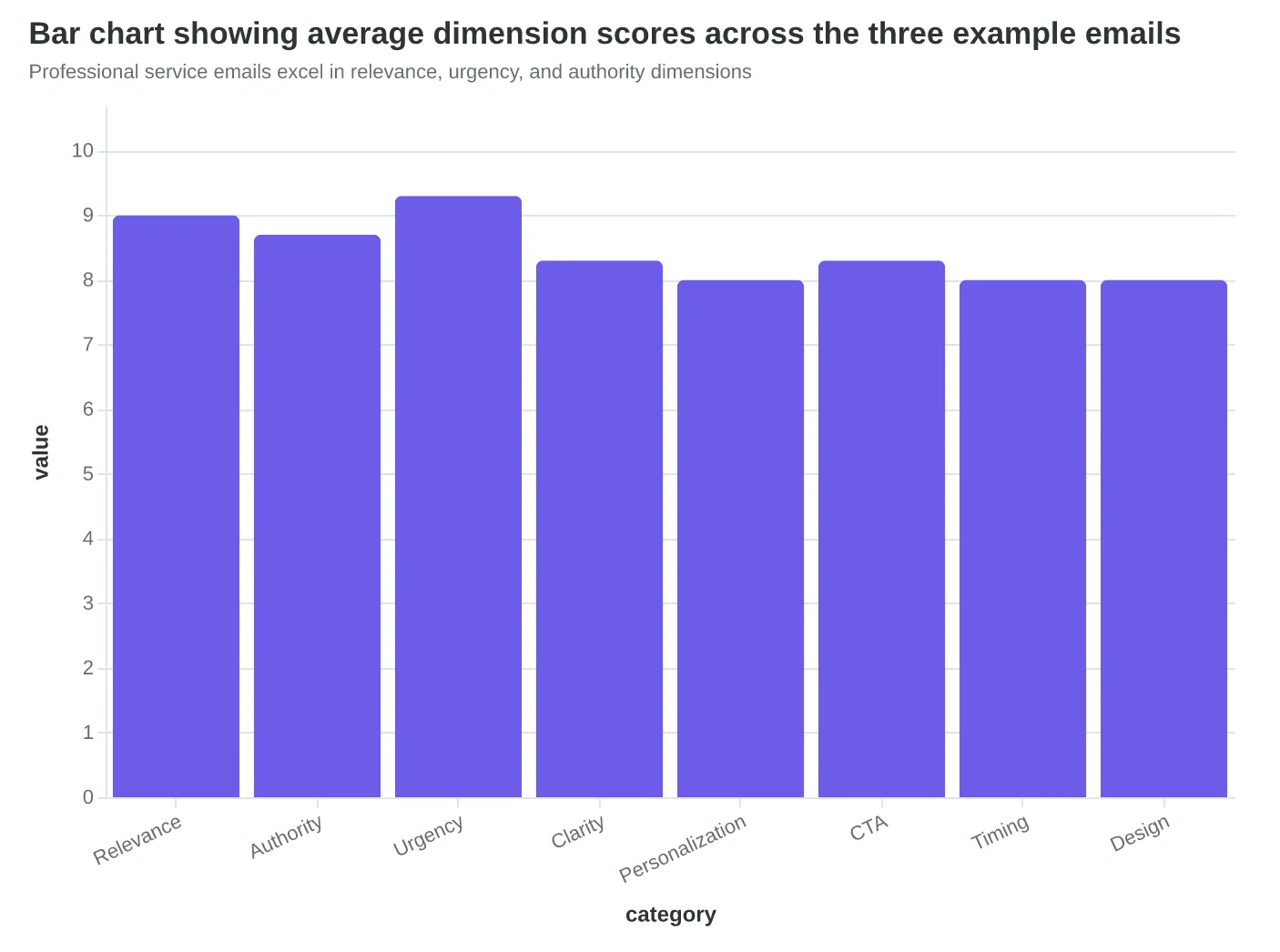
Notice the pattern: each high-scoring email combines immediate relevance with measurable expertise. The numbers aren't just impressive—they're credible because they're specific.
“The numbers aren't just impressive—they're credible because they're specific.”
| Email Type | EQS Score | Key Strength | Client Result |
|---|---|---|---|
| IT Cybersecurity Alert | 91/100 | Relevance (10/10) | 3 calls, $14.5K revenue |
| HR Compliance Update | 87/100 | Urgency (10/10) | 47% open rate, $89K Q1 |
| Marketing Case Study | 83/100 | Authority (9/10) | 23% reply rate, $18K MRR |
High-scoring emails across three verticals generated immediate client responses
Professional service emails excel in relevance, urgency, and authority dimensions
Your 30-Day Framework Implementation Plan
Here's your step-by-step roadmap to transform your professional service emails from newsletters into new business pipelines. Each week builds on the last, with measurable progress at every stage.
Week 1: Audit Your Current Emails (Time: 2 hours)
Gather your last 5 client emails — newsletters, follow-ups, or service announcements. Score each one using AlpacaRelay's 8-Dimension Email Quality Framework. Don't worry about perfection; you're establishing your baseline.
- Tool option (free): Print the framework checklist and score manually
- Tool option (recommended): Upload emails to AlpacaRelay for instant scoring
Done when: You have scores for all 8 dimensions across your 5 emails, plus one "biggest opportunity" dimension identified.
Week 2: Identify Your Lowest-Scoring Dimension (Time: 1 hour)
Look at your scores. Which dimension consistently ranks lowest — Personalization? Call-to-Action Clarity? Authority Building? This becomes your focus area. Most professional service firms score weakest on Personalization (treating all clients identically) or CTA Clarity (no clear next step).
Done when: You can complete this sentence: "My emails consistently underperform in [dimension] because [specific reason]."
Week 3: Rewrite One Email Optimizing for Your Gap (Time: 2 hours)
Choose your most important recurring email — your monthly newsletter, new client welcome, or service completion follow-up. Rewrite it targeting your lowest-scoring dimension. If it's Personalization, segment by client type. If it's Authority Building, add a specific case study result.
Start with AlpacaRelay's template library: filter by "Professional Services" and sort by Email Quality Score. The templates show dimension breakdowns, so you can see exactly how top-scoring emails handle your weak area.
Done when: Your rewritten email scores 15+ points higher in your target dimension.
Week 4: Score, Send, and Measure Client Response (Time: 1 hour)
Get a final score on your optimized email, then send it. Track not just opens and clicks, but client actions: consultation requests, referrals, follow-up questions. Professional service success isn't measured in engagement rates — it's measured in client conversations.
Set a calendar reminder for 30 days out to review which dimension improvements generated the most client inquiries.
Minimum Viable Action: If you only have 30 minutes this week, score one email using the framework. That single baseline will show you exactly where your biggest opportunity lies.
Success looks like: Within 90 days, your emails consistently score 75+ across all dimensions, and you're getting 2-3 client inquiries per month directly attributable to your email campaigns. More importantly, prospects start referencing specific expertise from your emails when they call — proof that your knowledge is converting into client conversations.
“Professional service success isn't measured in engagement rates — it's measured in client conversations.”
| Week | Focus | Time Investment | Success Metric |
|---|---|---|---|
| Week 1 | Audit last 5 emails | 2 hours | Baseline scores + gap identified |
| Week 2 | Identify lowest dimension | 1 hour | Clear improvement target set |
| Week 3 | Rewrite & optimize | 2 hours | 15+ point score improvement |
| Week 4 | Send & measure response | 1 hour | Client inquiries tracked |
Your week-by-week roadmap to email framework mastery
Rachel's law firm wasn't special six months ago. No marketing team, no big budget — just a newsletter that felt like homework and client inquiries that came from everywhere except email. Today, her monthly newsletter generates 3-4 qualified leads per issue. The difference? She started measuring what worked.
The 8-Dimension Email Quality Framework showed her that her expertise was there — buried under industry jargon and weak subject lines. Her December newsletter scored 43/100. Her March newsletter scored 89/100 and brought in two new corporate clients worth $180K in retainer fees.
Your professional service emails have the same potential. You have the expertise. You have the client relationships. The only question is whether you'll keep guessing what works or start measuring it.
Access 47 Scored Professional Service Templates
Start with your next newsletter. Score it across the 8 dimensions. See which areas need work. Your future clients are reading their email right now — the question is whether they'll remember your name when they need what you do.
The best professional service firms don't just have expertise. They have expertise that clients can feel through a screen.
“The best professional service firms don't just have expertise. They have expertise that clients can feel through a screen.”
89/100
Rachel's March newsletter EQS
up from 43/100 in December
Rachel's transformation: measured improvement led to measurable results
Ready to Score Your Own Professional Service Emails?
See exactly how your emails measure across all 8 dimensions with our free Email Quality Scoring tool. Get your baseline scores and identify your biggest opportunities in under 5 minutes.
Score your email before you send it
Free editor. Real-time EQS. No credit card.