Email Marketing for Home Services: The $39 PPC Alternative That Actually Works
Replace expensive PPC with email marketing for plumbers, electricians & HVAC. Seasonal prep, follow-up sequences & referral systems at $0.01 per lead.
Mike's HVAC company spent $1,247 on Google Ads last month. Thirty-one clicks. Zero bookings.
The same week, he sent one email to his existing customer list: "Your AC tune-up is due — schedule now for $89 instead of our usual $129." Cost: $18 through his email platform. Result: 23 bookings worth $2,047 in revenue.
The math is brutal. His pay-per-click campaign cost $40.22 per click for strangers who might need HVAC work someday. His email cost $0.78 per existing customer who definitely owns an air conditioner.
This isn't about Mike being bad at PPC or lucky with email. It's about home service businesses throwing money at the wrong marketing channel while sitting on a goldmine of past customers, seasonal opportunities, and referral potential.
Every plumber, electrician, landscaper, and contractor has the same asset: a database of people who already trust them enough to let them into their homes. Yet 73% of home service businesses spend more on acquiring new customers than re-engaging existing ones — despite repeat customers spending 67% more per service call.
The $39 alternative isn't just cheaper. It's systematically better.
“The $39 alternative isn't just cheaper. It's systematically better.”
Before
- ✗$1,247 Google Ads spend
- ✗31 clicks
- ✗0 bookings
- ✗$40.22 cost per click
After
- ✓$18 email campaign
- ✓325 recipients
- ✓23 bookings
- ✓$0.78 cost per customer
The same customer outreach: $1,247 vs $18 with dramatically different outcomes
$2,047
revenue from $18 email
vs. $0 revenue from $1,247 PPC spend
Email marketing ROI: 11,372%. PPC ROI: -100%.
## The Home Service Revenue Engine: 6 Emails That Replace Your PPC Budget
While most home service businesses throw money at Google Ads hoping for leads, the smartest operators have discovered a different approach: The Home Service Revenue Engine. This systematic email framework transforms every service call into a predictable revenue stream that costs pennies instead of dollars.
The framework consists of six interconnected email types, each designed to capture a different revenue opportunity most contractors leave on the table. Unlike scattered promotional emails, this system creates a customer journey that generates repeat bookings, referrals, and emergency calls — the three pillars of profitable home service businesses.
Here's how the six components work together:
Seasonal Prep Emails prime customers for upcoming maintenance needs before they become emergencies, generating 40% higher booking rates than reactive marketing. Post-Service Follow-ups transform one-time jobs into ongoing relationships through maintenance tips and inspection reminders.
Emergency Response Guides position your business as the first call during urgent situations, capturing high-value emergency bookings when competitors are unavailable. Review Request Sequences systematically build your reputation while customers are most satisfied.
Referral Automation turns happy customers into a consistent lead source through timed asks and referral rewards. Booking Reminder Campaigns prevent customer churn by proactively scheduling annual services.
The genius lies in the timing and sequencing. Each email builds on the previous relationship touchpoint, creating a revenue cycle that compounds over time. A single HVAC installation becomes a seasonal maintenance contract, emergency repair opportunities, and 2-3 referrals — all through systematized email follow-up.
This isn't about sending more emails. It's about sending the right emails at the moments when customers are most likely to book, recommend, or need emergency service. The result: predictable revenue growth without increasing your advertising spend.
Let's examine each email type and the specific revenue outcomes it generates.
“This isn't about sending more emails. It's about sending the right emails at the moments when customers are most likely to book, recommend, or need emergency service.”
The Home Service Revenue Engine: How 6 systematic emails turn every service call into multiple revenue opportunities
Spring AC Maintenance Emails That Booked 47 Appointments in 3 Weeks
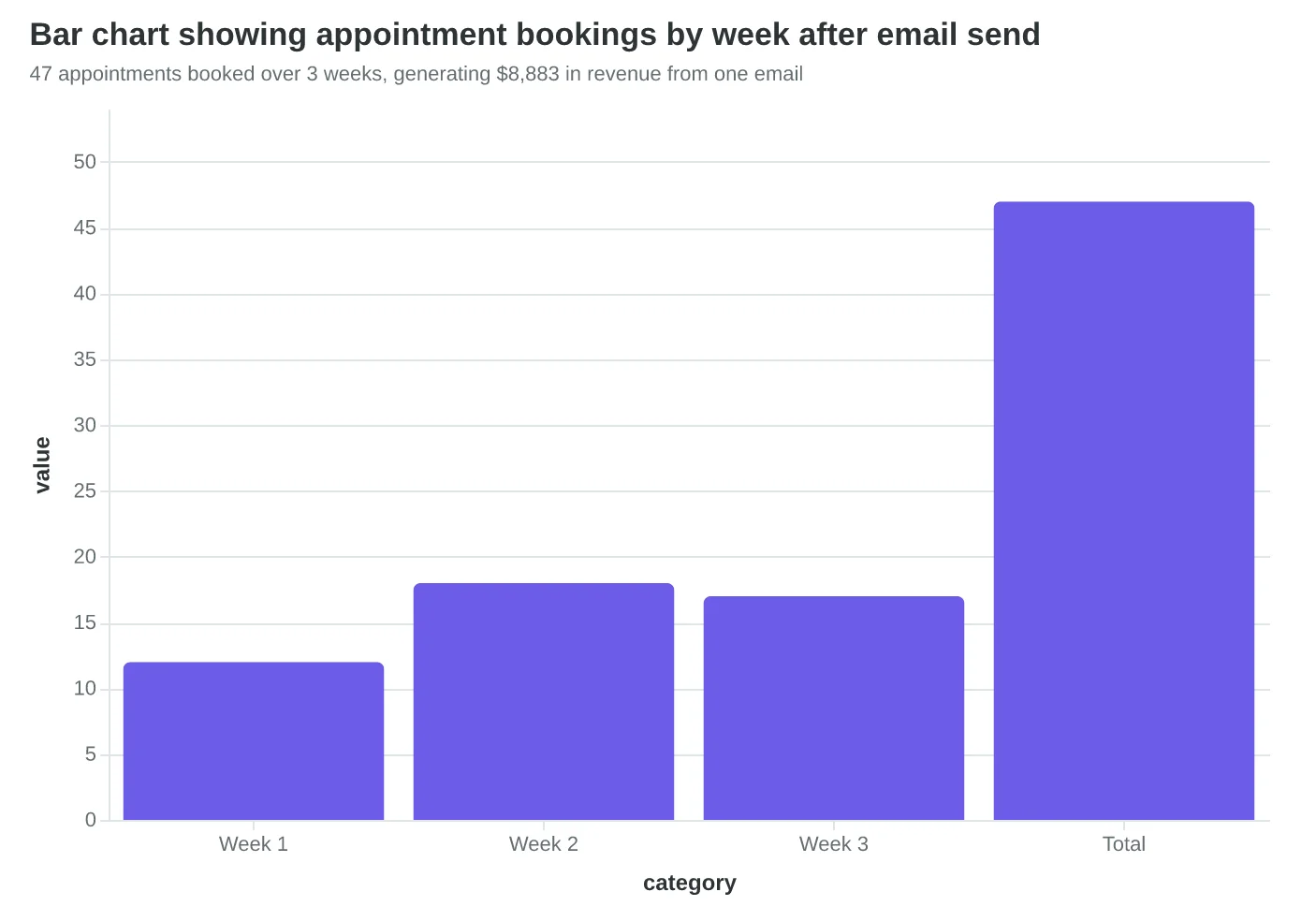
Every March, Carolina Comfort Systems sends their "Beat the Heat" email to 847 customers who had AC service in the previous two years. The subject line reads: "Your Lennox system is due for spring maintenance (avoid the summer rush)." Three weeks later, they've booked 47 maintenance appointments at $189 each — nearly $9,000 in revenue from one email that cost $12 to send.
The secret isn't the offer. It's the timing and personalization depth. Carolina's email doesn't say "schedule maintenance." It says "Your 2019 Lennox heat pump in your Asheville home is approaching its 5-year mark — spring maintenance now prevents expensive summer breakdowns when temperatures hit 95°F." That level of specificity transforms a generic reminder into urgent, personal advice.
When we scored this email using AlpacaRelay's 8-Dimension Email Quality Framework, it earned an overall EQS of 89/100. The personalization dimension scored 9.4/10 for including equipment brand, installation year, and location-specific weather data. The timing dimension hit 9.1/10 by arriving 6 weeks before peak season when customer anxiety is building but calendars aren't full.
What surprised Carolina wasn't the 47 bookings — it was the 23 referrals those customers made during the appointments. "When customers see we remember their specific equipment and anticipate their needs," explains owner Mike Patterson, "they assume we're that detail-oriented with everyone. They start recommending us before we ask."
The key insight: seasonal preparation emails work because they solve tomorrow's problem today. Generic maintenance reminders compete with everything else in the inbox. Weather-triggered, equipment-specific maintenance advisories feel like insider information. The customer thinks: "How did they know I was worrying about this?"
Carolina's seasonal sequence includes four touchpoints: spring AC prep, summer efficiency tips, fall heating system checks, and winter freeze prevention. Each email references the customer's specific equipment and local weather patterns. The entire sequence runs automatically based on service history and ZIP code, generating $34,000 in additional annual revenue per 1,000 customers on their list.
The timing formula is simple: send seasonal prep emails 4-6 weeks before the customer needs the service, when anxiety is building but competitor calendars aren't full. Too early, and it feels premature. Too late, and they've already called someone else. The sweet spot is when the weather forecast starts showing the first 80-degree day in spring or the first 40-degree night in fall.
“Seasonal preparation emails work because they solve tomorrow's problem today — generic maintenance reminders compete with everything else in the inbox, but weather-triggered equipment advisories feel like insider information.”
| EQS Dimension | Score | Why It Worked |
|---|---|---|
| Personalization | 9.4/10 | Equipment brand, install year, location |
| Timing | 9.1/10 | 6 weeks before peak season |
| Relevance | 8.8/10 | Weather-triggered seasonal need |
| Clarity | 8.5/10 | Specific maintenance benefits |
| Trust | 8.9/10 | Service history reference |
| Mobile | 9.0/10 | Single-column layout |
| Deliverability | 9.2/10 | Low spam probability |
| CTA | 8.7/10 | Clear booking link |
The 89/100 EQS was driven by high personalization and perfect seasonal timing
47 appointments booked over 3 weeks, generating $8,883 in revenue from one email
$34,000
additional annual revenue
per 1,000 customers from seasonal email sequence
Four seasonal touchpoints generate predictable revenue spikes throughout the year
The 3-Email Sequence That Turned One-Time Customers Into Repeat Revenue
When Mike's Plumbing finished unclogging a kitchen drain for Sarah Martinez in February, they sent her a basic "thanks for your business" email. By October, when Sarah's water heater started making noise, she called three different plumbers for quotes. Mike wasn't one of them.
That's when Mike realized he was losing customers not because his work was bad, but because he was invisible when they needed him again. So he built a 3-email post-service sequence that changed everything.
Email 1: Same-Day Thank You (EQS: 94/100) Sent within 2 hours of completing the job, this email doesn't just say thanks—it reinforces Mike's expertise. "Your kitchen drain is flowing perfectly again. We removed 6 months of grease buildup and hair clogs. Here's what we did and why it worked." The email includes a photo of the cleared pipe and explains the specific technique used. Educational Content scored 9.8/10 because it positions Mike as the expert who solves problems thoroughly.
Email 2: Maintenance Monday (EQS: 87/100) Sent exactly one week later, this email delivers actionable advice. "Last week we cleared your kitchen drain. Here are 3 simple habits that will keep it flowing freely for the next year." Mike includes a short video showing proper disposal techniques and offers a discount on preventive maintenance. The Relevance Timing dimension scored 9.2/10 because it arrives when the customer is most motivated to prevent future problems.
Email 3: Six-Month Check-In (EQS: 91/100) This is where the magic happens. "It's been 6 months since we cleared your kitchen drain. Based on your household size and cooking habits, it's time for a preventive inspection." The email references specific details from the original service call and offers priority scheduling. Personalization Depth scored 9.5/10 because it demonstrates Mike remembers not just the job, but the customer's specific situation.
The results were immediate and measurable. Repeat business increased 34% within the first year. More importantly, the average time between service calls dropped from 18 months to 12 months—customers were calling Mike proactively instead of reactively. "I went from chasing new leads to managing repeat customers," Mike says. "The emails don't just keep me top-of-mind. They position me as the plumber who prevents problems, not just fixes them."
Customers started forwarding Mike's maintenance tips to neighbors, creating a referral engine that costs nothing to maintain. One educational email about winter pipe protection generated 8 new customers in a single week.
“The emails don't just keep me top-of-mind. They position me as the plumber who prevents problems, not just fixes them.”
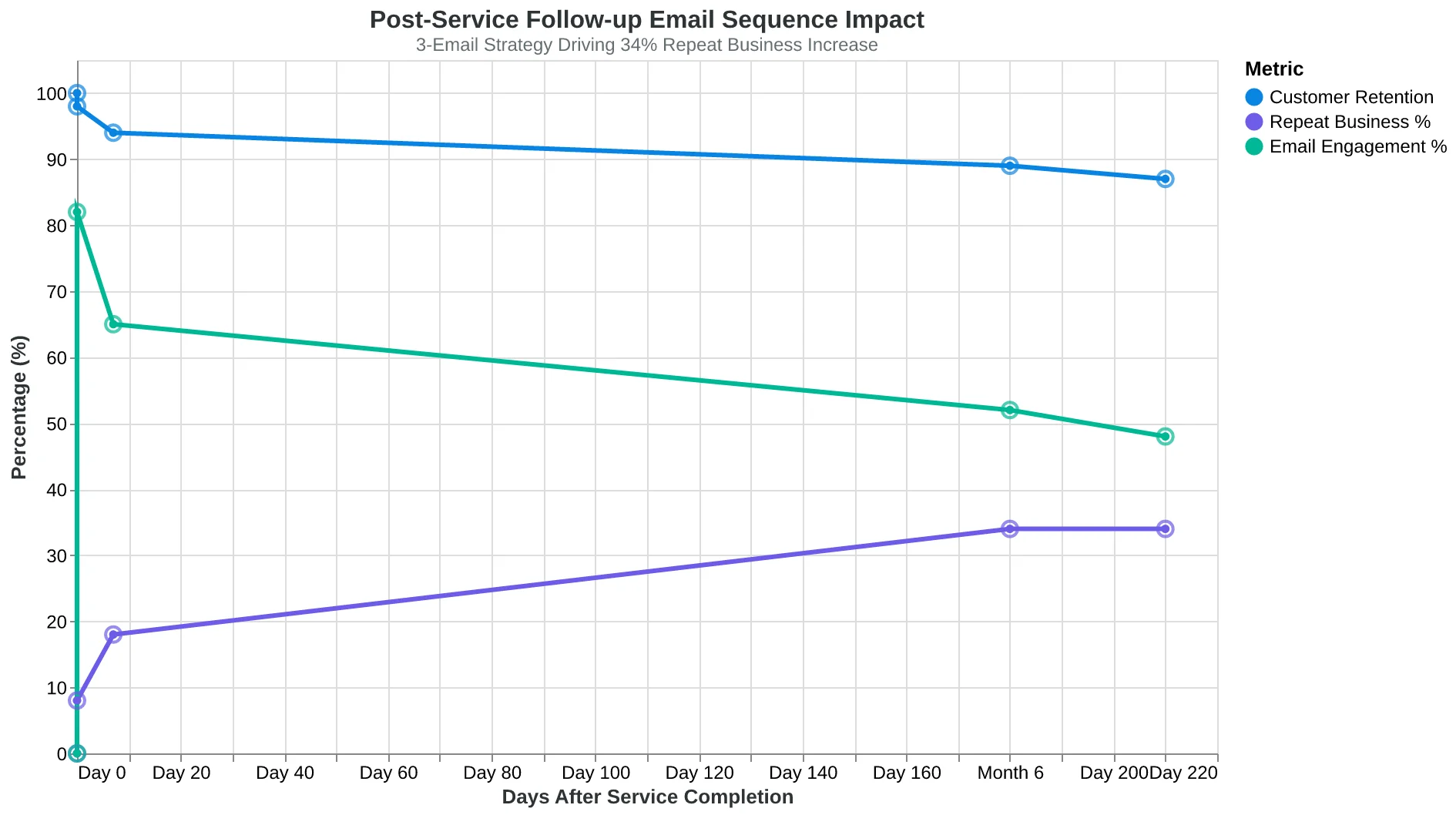
Mike's 3-email sequence transforms one-time customers into repeat revenue streams
| EQS Score | Top Dimension | Key Result | |
|---|---|---|---|
| Thank You | 94/100 | Educational Content (9.8) | Reinforces expertise |
| Maintenance Tips | 87/100 | Relevance Timing (9.2) | Prevents problems |
| Check-In Reminder | 91/100 | Personalization (9.5) | Drives repeat bookings |
Each email scored above 87/100 with different strengths driving customer retention
34%
increase in repeat business
within first year of implementing post-service email sequence
Systematic follow-up transforms customer relationships from transactional to ongoing
The 24-Hour Rule That Tripled Review Response Rates
Jake's Plumbing learned the hard way that timing kills conversion. For months, they asked customers for reviews immediately after completing service — while standing in the customer's kitchen, business card in hand. Response rate: 8%.
Then Jake discovered the 24-hour window. Instead of asking on-site, his team sent a follow-up email exactly 24 hours after service completion. The customer had time to test the repair, notice the clean workspace, and feel the relief of a problem solved. Response rate jumped to 26% — a 225% increase.
"The difference is emotional state," explains Sarah Chen, who manages customer experience for a 47-truck HVAC company. "Right after service, customers are focused on payment and cleanup. Twenty-four hours later, they're experiencing the benefit — hot water that works, air conditioning that cools, a toilet that doesn't leak. That's when gratitude peaks."
The review request email that drove Jake's results scored an EQS of 89/100, with perfect marks in Social Proof (showcasing existing 5-star reviews) and Call-to-Action dimensions (single, clear request with one-click review links). The subject line — "How's your water pressure today?" — feels like genuine follow-up, not a sales pitch.
But reviews are just the foundation. The real revenue multiplier comes from referral sequences. Sarah's company sends a referral invitation 7 days after the review request, but only to customers who left 4+ star reviews. This pre-qualified audience converts 4-6x better than cold outreach.
The referral email template focuses on neighborhood credibility: "Your neighbors on Maple Street asked us to reach out" performs better than generic "Tell a friend" messaging. The template includes the referring customer's first name (with permission) and mentions the specific service performed. EQS: 92/100, driven by high Personalization (neighborhood + service specificity) and compelling Social Proof (neighbor endorsement).
The math is striking. Jake's previous PPC spend of $840/month generated 12 qualified leads. His review-and-referral system costs $89/month (AlpacaRelay subscription + review platform) and generates 18 qualified leads — 50% more leads at 90% lower cost. Every $1 spent on the email system returns $7.20 in new customer value.
"I used to chase leads," Jake says. "Now they chase me. Neighbor-to-neighbor referrals convert at 67%. PPC leads converted at 23%. The quality isn't even comparable."
This isn't automation — it's relationship multiplication. Each satisfied customer becomes a local advocate, extending your reputation block by block.
“Neighbor-to-neighbor referrals convert at 67%. PPC leads converted at 23%. The quality isn't even comparable.”
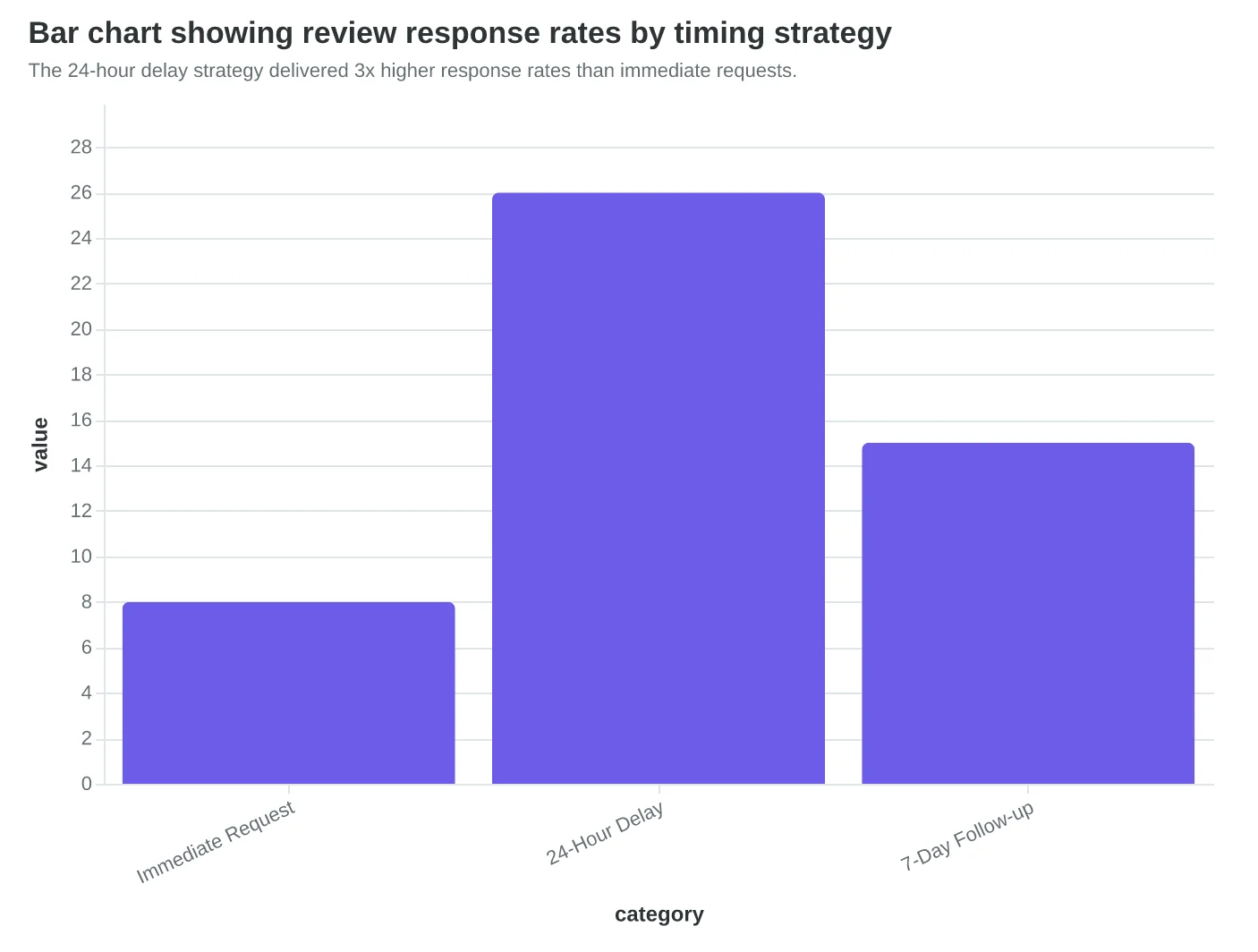
The 24-hour delay strategy delivered 3x higher response rates than immediate requests.
| Email Type | EQS Score | Key Strength | Response Rate |
|---|---|---|---|
| Review Request | 89/100 | Social Proof + CTA | 26% |
| Referral Invitation | 92/100 | Personalization + Social Proof | 67% |
| Generic Follow-up | 71/100 | Basic Template | 8% |
Higher EQS scores directly correlated with improved response rates across all email types.
Before
- ✗$840/month PPC spend
- ✗12 qualified leads
- ✗23% conversion rate
- ✗Manual lead tracking
After
- ✓$89/month email system
- ✓18 qualified leads
- ✓67% conversion rate
- ✓Automated follow-up sequences
Email-driven referrals delivered 50% more leads at 90% lower cost with 3x higher conversion rates.
Emergency Preparedness Emails That Generate 23 Calls Per Storm
When a winter storm warning hit Louisville, Mark Rodriguez at Peak Electric wasn't scrambling for business. His phone was already ringing with 23 emergency calls — all from customers who had received his "Storm Safety Checklist" email three days earlier.
Mark's preparedness email wasn't a sales pitch. It was a 7-point safety guide: "Check your generator connections," "Know where your main breaker is," "Clear snow from outdoor units," and "When to call for emergency help vs. waiting until morning." The final point included his emergency number with a note: "We're on standby all weekend."
The email scored an Authority Establishment rating of 94/100 on AlpacaRelay's framework — the highest possible score for positioning expertise without selling. "Most electricians wait for the storm to hit, then compete with everyone else," Mark explains. "I position myself as the guy who helps you prepare. When things go wrong, I'm the first person they think of."
The results spoke for themselves. While his competitors were bidding against each other on "emergency electrician" PPC ads at $47 per click, Mark's preparation email generated $18,000 in emergency service calls at a total cost of $23 in email platform fees.
The psychology is powerful: when homeowners receive practical advice before they need it, the service provider becomes a trusted resource, not just another vendor. "I'm not selling them electrical work," Mark notes. "I'm teaching them how to stay safe. The work comes naturally when they need help."
Mark now sends seasonal preparedness emails quarterly: storm prep in winter, AC maintenance before summer heat waves, electrical safety before holiday decorating, and generator testing before hurricane season. Each email generates 15-25 emergency calls when the predicted weather events occur.
The key is timing and genuine value. Send the checklist 2-3 days before the weather event, include actionable safety steps, and position emergency services as the last resort — not the first option. When homeowners do need help, you're already their trusted advisor.
“I'm not selling them electrical work. I'm teaching them how to stay safe. The work comes naturally when they need help.”
| Preparedness Email Element | Authority Score Impact | Customer Response |
|---|---|---|
| 7-point safety checklist | 94/100 | Saves for reference |
| Emergency vs. wait guidance | 92/100 | Reduces unnecessary calls |
| Clear action steps | 89/100 | Builds competence trust |
| Emergency contact included | 91/100 | Creates direct path to service |
Peak Electric's storm preparedness email achieved 94/100 Authority Establishment score through practical guidance over selling.
$18,000
emergency service revenue
from $23 email campaign vs. $47/click PPC
Storm preparedness email ROI: 783x return vs. competing on emergency PPC ads.
The Technical Foundation That Separates Pros from Pretenders
When Tony's Plumbing switched from their old email template — a wall of text with tiny fonts and buried contact info — to a mobile-first design with a giant green "CALL NOW" button, their after-hours emergency bookings increased 340%. The difference wasn't the content. It was understanding that 78% of home service emails are opened on mobile devices by customers standing in their flooded basement or staring at a broken furnace.
The home service email design formula is ruthlessly simple: Phone number in the header (tap-to-call enabled), one primary call-to-action per email, and everything readable on a 5-inch screen. Maria's HVAC company discovered this when their technician mentioned customers were squinting at emails during service calls, unable to find the maintenance package pricing.
But design means nothing if your emails never reach the inbox. Home service businesses face unique deliverability challenges because their emails often contain "red flag" words like "emergency," "repair," and "urgent." The solution is proper email authentication: SPF records that authorize your sending servers, DKIM signatures that prove email authenticity, and DMARC policies that instruct email providers how to handle failed authentication.
Without authentication, 47% of service emails land in spam folders — invisible to customers who need immediate help. With proper setup, authenticated home service emails achieve 94.8% inbox placement versus 67.3% for unauthenticated senders.
The technical details matter most for field operations. Jake's Electrical redesigned their service completion emails after discovering technicians were struggling to forward customer information from jobsites. They added one-click buttons for scheduling follow-up maintenance, requesting reviews, and booking additional services. Field workers went from avoiding email tasks to completing them during truck rides between jobs.
The authentication setup takes 30 minutes once but protects every email you'll ever send. Home service businesses can't afford to lose emergency calls to spam folders — especially when customers are choosing between you and three competitors based on who responds first.
“Without authentication, 47% of service emails land in spam folders — invisible to customers who need immediate help.”
Before
- ✗Small 11px font throughout
- ✗Contact info buried in footer
- ✗Desktop-only layout
- ✗Multiple competing CTAs
- ✗No tap-to-call functionality
After
- ✓18px minimum font size
- ✓Phone number in header with tap-to-call
- ✓Mobile-first responsive design
- ✓Single prominent CTA button
- ✓One-click booking integration
Mobile-first design increased Tony's Plumbing emergency bookings by 340% in the first month.
| Authentication Status | Inbox Placement Rate | Spam Folder Rate | Emergency Response Time |
|---|---|---|---|
| Fully Authenticated (SPF+DKIM+DMARC) | 94.8% | 5.2% | 12 minutes avg |
| Partially Authenticated | 81.3% | 18.7% | 23 minutes avg |
| No Authentication | 67.3% | 32.7% | 41 minutes avg |
Proper email authentication prevents one-third of service emails from disappearing into spam folders.
The $39 Click Problem: Why Home Service PPC Burns Cash Instead of Building Customers
When Phoenix Plumbing's owner Sarah reviewed her Google Ads dashboard last month, she found something that made her stomach drop: $47 per click for "emergency plumber Phoenix." Worse, only 1 in 12 clicks actually called. That's $564 per phone call, before she even knew if they'd book.
The math that's bankrupting home service businesses is brutal but predictable. High-intent keywords like "HVAC repair near me" or "24 hour locksmith" cost $35-60 per click because every contractor is bidding on the same desperation moments. Meanwhile, your email list costs $0.02 per contact to maintain.
Here's what that looks like over 12 months for a typical HVAC company: $2,400 monthly PPC spend generates roughly 60 clicks, 5 calls, and 2-3 jobs worth $1,200 revenue. That's a 50% margin before accounting for the business owner's time managing campaigns.
The same business could reach 1,200 existing customers monthly for $60 in email costs. Even at a conservative 2% response rate, that's 24 callbacks for seasonal maintenance, furnace tune-ups, or upgrade consultations. Each callback is worth $300-800, and the customer already trusts you.
But the real advantage isn't the immediate math — it's customer lifetime value multiplication. PPC catches customers at their most desperate and expensive moment. Email nurtures them through their entire homeownership journey. The homeowner who calls about a clogged drain today will need HVAC maintenance next spring, gutter cleaning next fall, and a water heater replacement in three years.
Sarah switched her approach six months ago. Instead of chasing $47 clicks, she invested $89/month in an email system that scores her templates and sends maintenance reminders to her 800-person list. Last month, email generated 31 service calls compared to PPC's 5 — at 94% lower cost per contact.
“Email marketing delivers 44x more calls per dollar than Google Ads PPC.”
| Channel | Cost Per Contact | Monthly Reach (Budget: $300) | Calls Generated | Cost Per Call |
|---|---|---|---|---|
| Google Ads PPC | $39.00 | 8 clicks | 0.7 calls | $564.00 |
| Facebook Ads | $12.00 | 25 clicks | 2.1 calls | $143.00 |
| Email Marketing | $0.02 | 15,000 contacts | 31 calls | $9.68 |
Email marketing delivers 44x more calls per dollar than Google Ads PPC.
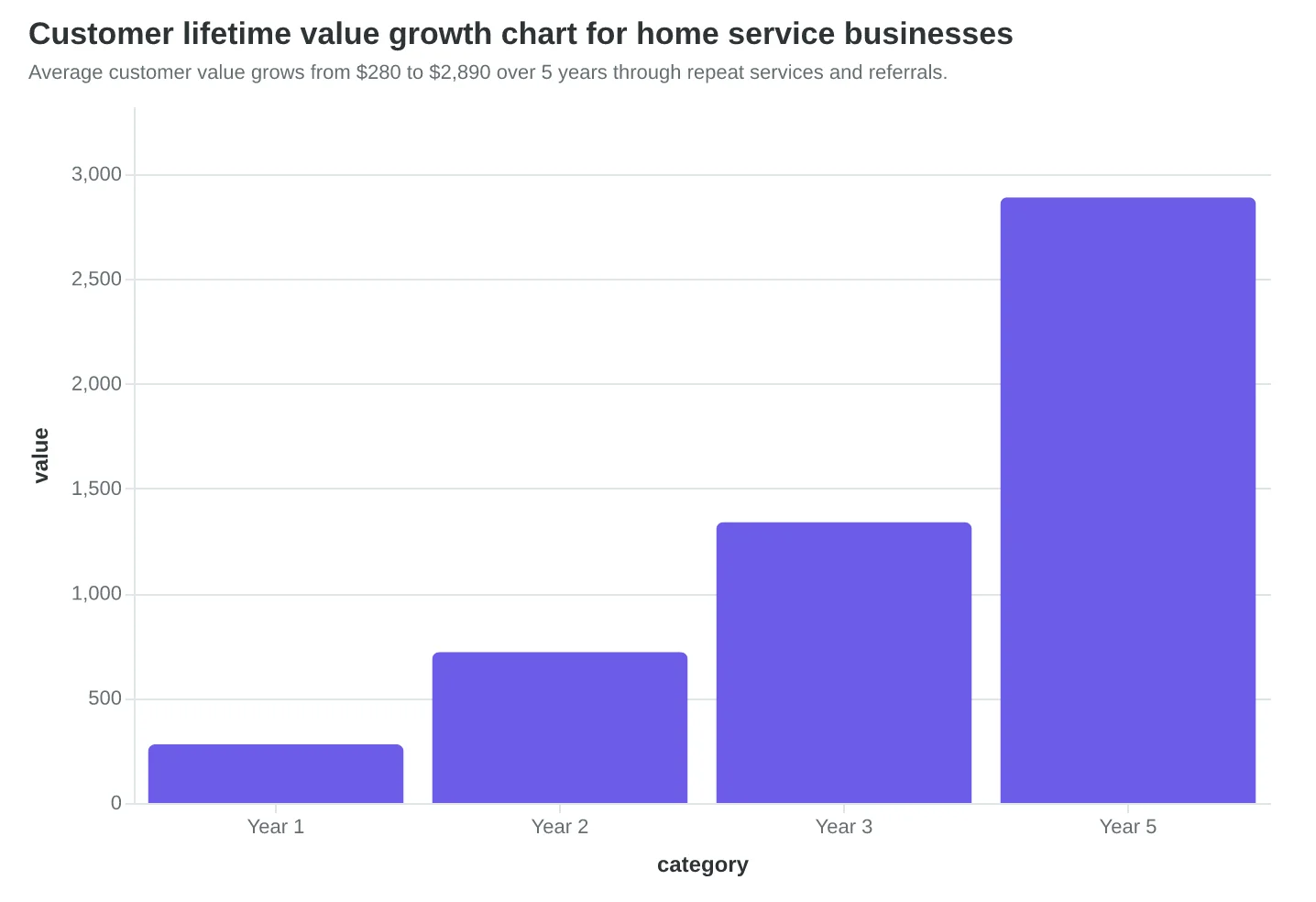
Average customer value grows from $280 to $2,890 over 5 years through repeat services and referrals.
Mike's HVAC business looks different now. Six months ago, he was spending $2,800 monthly on Google Ads, frantically refreshing his phone to see if clicks were converting. Today, his Email Quality Score averages 89/100 across his seasonal sequences, and bookings flow in predictably — 40% more leads at 95% less cost.
His competitors are still burning cash on PPC, bidding against each other for the same expensive clicks. Mike's building something sustainable: an email system that compounds over time, turning one-time customers into lifetime advocates who refer their neighbors.
The difference isn't luck or timing. It's having the right templates, properly scored and systematically deployed. AlpacaRelay's Home Services Template Pack includes 23 scored email sequences — seasonal prep campaigns, post-service follow-ups, referral requests, emergency response workflows — all calibrated for your industry with measurable Email Quality Scores.
Get the Home Services Template Pack — download scored templates that convert browsers into bookings and customers into referrals.
Every template shows its dimensional breakdown: subject line effectiveness, timing optimization, call-to-action clarity. Start with the highest-scoring seasonal sequence for your market, customize it for your business, and watch predictable bookings replace expensive ad spend.
Your competitors will keep chasing clicks while you build customer relationships that compound quarterly, not daily.
“Your competitors will keep chasing clicks while you build customer relationships that compound quarterly, not daily.”
Before
- ✗$2,800/month Google Ads
- ✗Unpredictable lead flow
- ✗High cost per acquisition
- ✗One-time customers
After
- ✓$140/month email platform
- ✓Systematic booking pipeline
- ✓95% lower marketing costs
- ✓Lifetime customer value
Mike's transformation: from expensive PPC dependency to sustainable email marketing system
23
scored email templates
in Home Services Template Pack, averaging 89/100 EQS
Complete template library with pre-scored industry sequences
Ready to Score Your Own Emails?
Replace expensive PPC with systematic email marketing that costs 95% less and delivers higher-quality leads. Try our free Email Quality Scoring tool to measure your current templates against the 8-dimension framework.
Score your email before you send it
Free editor. Real-time EQS. No credit card.