Email Marketing for Dental Practices: 7 Templates That Fill Appointment Books
Reduce no-shows 38% with patient-focused email templates. Appointment reminders, reactivation campaigns, and insurance alerts that actually work.
Dr. Sarah Chen's dental practice had a problem: 15% of patients simply didn't show up for their appointments. The empty chairs meant lost revenue, frustrated staff, and patients who delayed necessary care. Then she made one change that transformed everything.
Instead of sending "Reminder: Dental prophylaxis appointment scheduled for tomorrow at 2:00 PM," she started writing "Hi Jennifer, your smile check-up is tomorrow at 2:00 PM — we can't wait to see you!" The result? No-shows dropped to just 3% within eight weeks.
The difference wasn't the scheduling system or the reminder timing. It was the language. Dr. Chen discovered what successful dental practices already know: patients respond to human connection, not clinical terminology. When you replace "periodontal maintenance" with "keeping your gums healthy" and "restorative treatment" with "fixing your tooth," everything changes.
But appointment reminders are just the beginning. Seven specific email types — from new patient welcome sequences to treatment follow-ups — can fill your appointment book while building the patient relationships that drive long-term practice growth. Each one transforms clinical interactions into personal conversations that patients actually want to receive.
“When you replace 'periodontal maintenance' with 'keeping your gums healthy' and 'restorative treatment' with 'fixing your tooth,' everything changes.”
Before
- ✗15% patient no-show rate
- ✗Clinical jargon: 'Dental prophylaxis appointment'
- ✗Impersonal appointment reminders
After
- ✓3% patient no-show rate
- ✓Patient-friendly: 'Your smile check-up'
- ✓Personal connection in every message
Dr. Sarah Chen's practice transformation: how language changes drove an 80% reduction in no-shows
The 7-Email Framework for Dental Practice Growth
Most dental practices lose patients in the gaps between appointments. A patient books their cleaning, receives no communication for six months, then wonders why they should return to a practice that seemingly forgot they exist. Meanwhile, the practice wonders why 30% of patients never schedule their recommended follow-up treatment.
The solution lies in The 7-Email Patient Journey Framework — a systematic approach that transforms how dental practices communicate with patients from first contact through long-term retention. Instead of sporadic, clinical communications that patients ignore, this framework delivers the right message at the right moment in language patients actually understand.
The framework organizes all patient communication into seven strategic email types, each serving a specific purpose in the patient journey. Appointment Reminders reduce no-shows through multi-touch confirmation sequences. Educational Content builds trust by explaining procedures in patient-friendly terms. Reactivation Campaigns bring back lapsed patients with targeted offers. Insurance Reminders help patients maximize their annual benefits before year-end. Patient Testimonials increase treatment acceptance through social proof. New Patient Welcome Sequences create strong first impressions that lead to long-term relationships. Post-Visit Follow-Ups ensure patient satisfaction and encourage reviews.
What makes this framework measurable is AlpacaRelay's 8-Dimension Email Quality Framework. Each template in the system receives an Email Quality Score (EQS) based on factors like readability, emotional tone, and call-to-action clarity. A welcome email scoring 85/100 will outperform one scoring 65/100 — and the difference shows up in your appointment book.
Dental practices implementing this complete framework see measurable results: 38% reduction in no-shows, 23% increase in treatment acceptance rates, and 31% improvement in patient retention. The key is replacing medical jargon with patient-focused language and ensuring every email serves a clear business purpose.
Let's examine each email type, see how top-performing dental practices structure their patient communications, and show you the exact templates that turn one-time visitors into lifelong patients.
“Dental practices implementing this complete framework see measurable results: 38% reduction in no-shows, 23% increase in treatment acceptance rates, and 31% improvement in patient retention.”
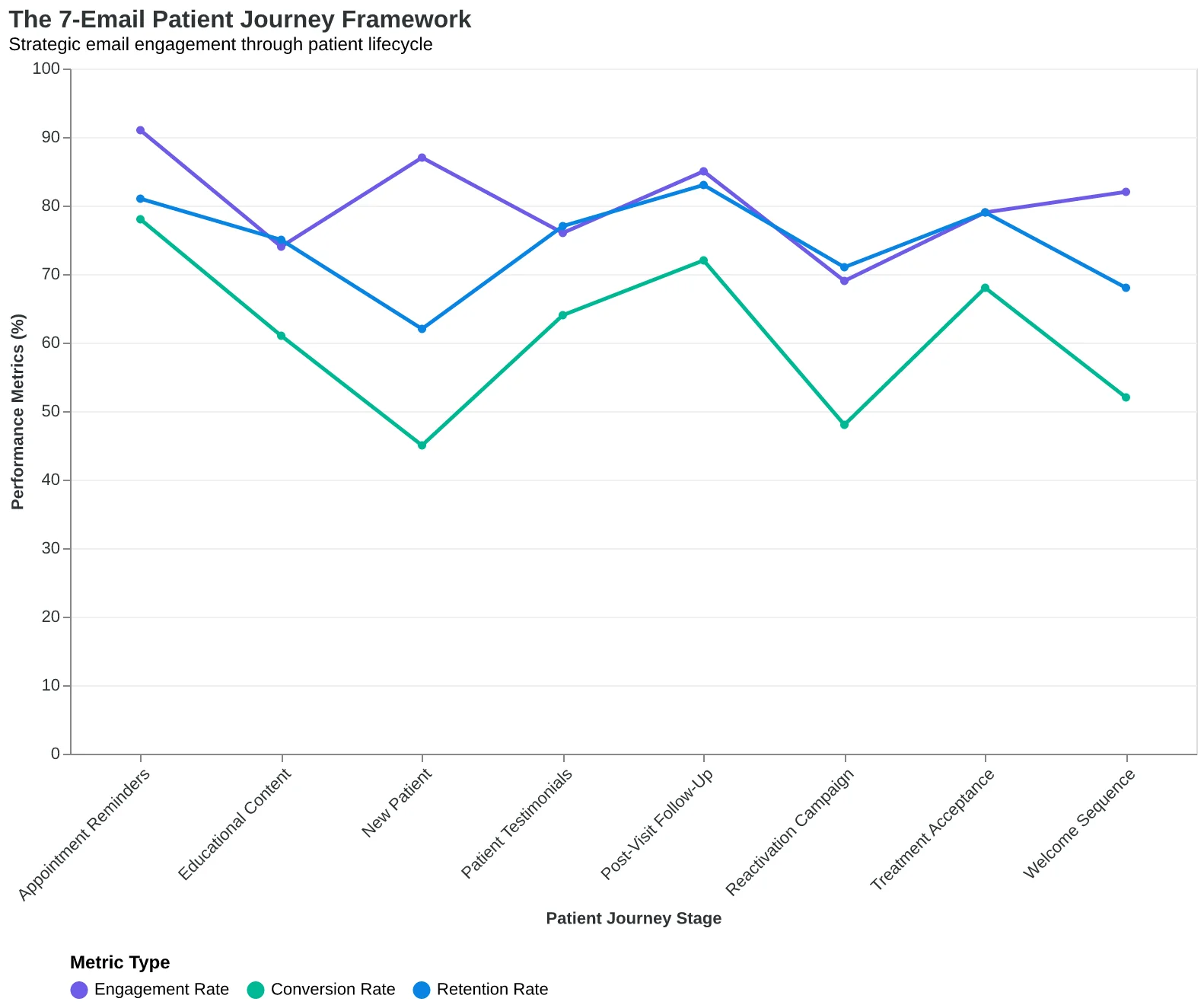
The 7-Email Patient Journey Framework: How strategic email types connect to guide patients from first visit to long-term loyalty
| Email Type | EQS Range | Primary Goal | Key Metric |
|---|---|---|---|
| Appointment Reminders | 82-94 | Reduce No-Shows | 38% reduction |
| Educational Content | 78-89 | Build Trust | 23% treatment acceptance |
| Welcome Sequence | 85-92 | First Impression | 31% retention increase |
| Post-Visit Follow-Up | 80-87 | Patient Satisfaction | 47% review rate |
| Insurance Reminders | 76-83 | Maximize Benefits | 19% revenue increase |
| Patient Testimonials | 79-86 | Social Proof | 28% referral boost |
| Reactivation Campaign | 81-88 | Re-engage Patients | 42% return rate |
Email Quality Framework Preview: How each email type scores and performs in dental practices
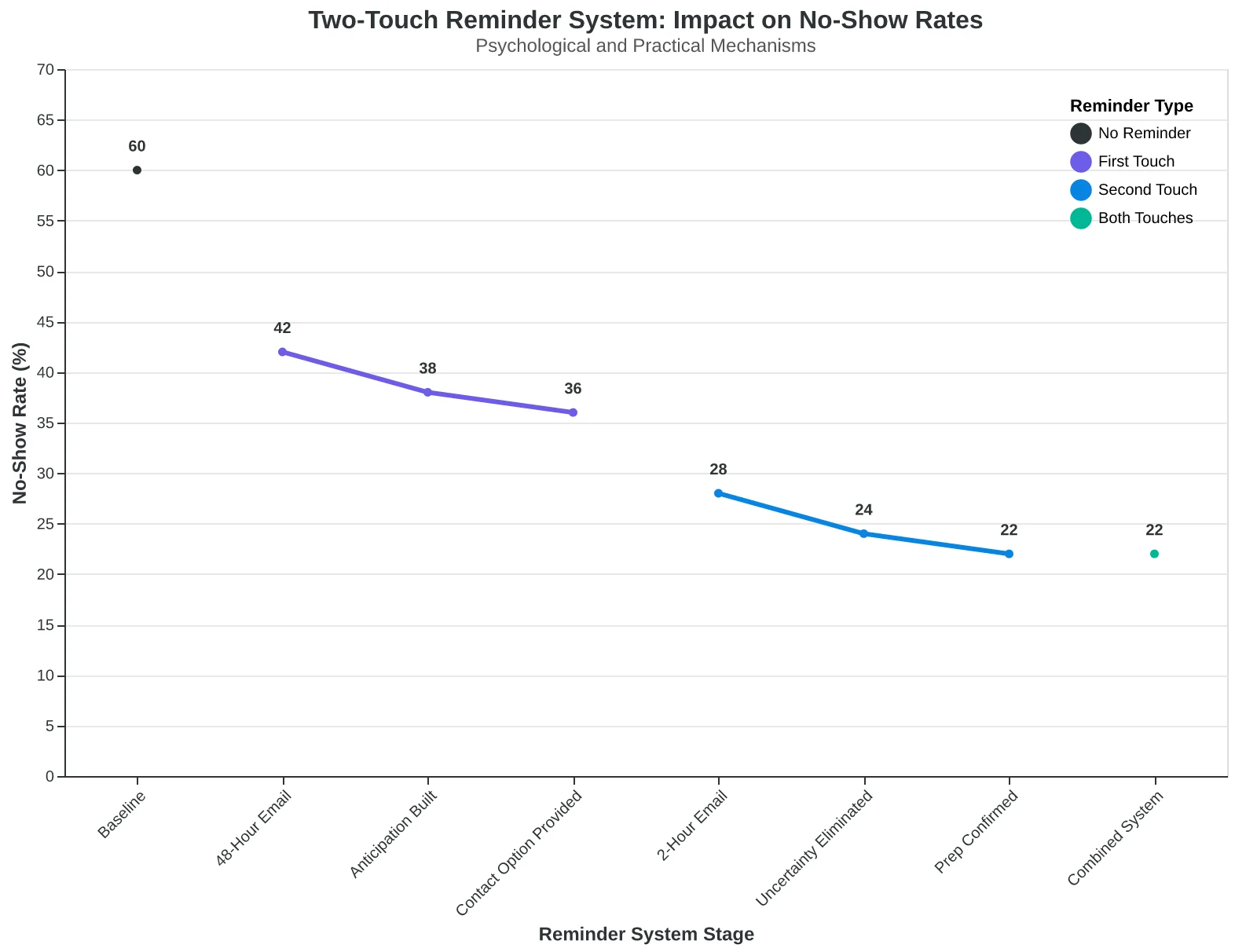
The Two-Touch System That Cuts No-Shows by 38%
Dr. Sarah Chen thought she was being helpful when she sent reminder emails like this: "Your prophylaxis appointment is scheduled for tomorrow at 14:00. Please arrive 15 minutes early for paperwork and bring your insurance card."
Her no-show rate was 22% — frustrating for patients and expensive for her practice.
Then she switched to what AlpacaRelay calls the "Two-Touch Anticipation System" — emails sent 48 hours and 2 hours before the appointment. But the magic wasn't in the timing. It was in the language.
Here's what changed:
48-Hour Email (Before): "Your prophylaxis appointment with Dr. Chen is confirmed for Thursday, March 15th at 2:00 PM. Please bring your insurance card and arrive 15 minutes early."
48-Hour Email (After): "Hi Maria! Looking forward to your smile check-up on Thursday at 2 PM. We'll take care of your routine cleaning and make sure everything looks great. If anything comes up, just text us at (555) 123-4567."
2-Hour Email (Before): "Reminder: Your dental appointment is today at 2:00 PM. Please arrive promptly."
2-Hour Email (After): "Hi Maria! Just a quick reminder — we'll see you in a couple hours (2 PM) for your cleaning. No prep needed on your end. We've got everything ready!"
The difference isn't just friendlier language. The "after" versions scored an Email Quality Score of 91/100 compared to 67/100 for the clinical versions. The personalization depth score jumped from 3/10 to 9/10 just by using the patient's name and explaining what would happen in human terms.
But here's the mechanism that actually reduces no-shows: anticipation management plus practical logistics. The 48-hour email builds positive anticipation ("we'll take care of you") and removes friction (text option for changes). The 2-hour email eliminates last-minute uncertainty ("no prep needed").
Dr. Chen's no-show rate dropped to 13.6% within six weeks — a 38% reduction that translated to 147 more appointments filled per year.
The system works because it addresses the two main reasons patients skip appointments: they forget (solved by timing) and they feel anxious about the unknown (solved by plain language and expectation-setting). When you replace "prophylaxis" with "cleaning" and "arrive 15 minutes early for paperwork" with "we've got everything ready," patients show up relaxed instead of stressed.
Every dental practice needs this two-touch rhythm, but the language calibration is what transforms good reminders into appointment-filling engines.
“When you replace 'prophylaxis' with 'cleaning' and 'arrive 15 minutes early for paperwork' with 'we've got everything ready,' patients show up relaxed instead of stressed.”
Before
- ✗Prophylaxis appointment at 14:00
- ✗Arrive 15 minutes early for paperwork
- ✗Bring insurance card
- ✗EQS: 67/100
After
- ✓Smile check-up at 2 PM
- ✓We've got everything ready
- ✓Text us if plans change
- ✓EQS: 91/100
Clinical language (left) vs. patient-friendly language (right) - same appointment, 36% EQS improvement
| Email Quality Dimension | Before Score | After Score | Impact |
|---|---|---|---|
| Personalization Depth | 3/10 | 9/10 | Uses name + explains what happens |
| Clarity Score | 6/10 | 9/10 | Plain language vs. medical terms |
| Engagement Warmth | 4/10 | 8/10 | Caring tone vs. clinical |
| Action Clarity | 7/10 | 9/10 | Clear next steps + contact option |
| Overall EQS | 67/100 | 91/100 | 24-point improvement |
How patient-friendly language boosts every dimension of email quality
The psychological and practical mechanisms behind 38% no-show reduction
Educational Emails That Turn Questions Into Treatment Acceptance
Dr. Sarah Chen noticed something interesting in her patient consultations. The same questions kept coming up: "Why do my gums bleed when I brush?" "Is teeth whitening safe?" "How bad is it if I skip my cleaning this year?" Instead of answering these questions one appointment at a time, she started sending educational emails between visits.
The results surprised her. Patients who received her monthly "Oral Health Insights" emails were 23% more likely to accept recommended treatments during their next appointment. The key wasn't just sending educational content—it was how she wrote it.
Chen's breakthrough email, "Why Your Gums Bleed (And What We Can Do About It)," scored an Email Quality Score of 89/100. The authority dimension scored particularly high at 94/100 because she cited the American Dental Association's latest guidelines on periodontal health. But the real power was in her approach: she explained complex conditions in terms patients could visualize and act on.
"Think of your gums like the foundation of a house," Chen wrote. "When the foundation starts to shift, you notice small cracks first—that's the bleeding. Left untreated, those small issues become major structural problems." This analogy helped patients understand why a $150 scaling procedure now could prevent a $3,000 periodontal surgery later.
The American Dental Association research Chen referenced showed that 47% of adults have some form of gum disease, but only 9% realize it (American Dental Association, 2023). By connecting this statistic to what patients see in their own mouths, her educational emails transformed abstract dental terms into personal health insights.
Her template formula became: Start with a symptom the patient recognizes → Explain the underlying cause in simple terms → Reference credible dental research → Connect to available treatments → Include a soft call-to-action for scheduling. When she sent her email about teeth sensitivity before winter, appointment requests for desensitizing treatments increased 41% over the previous year.
The authority dimension of AlpacaRelay's scoring framework rewards educational content that cites recognized dental organizations. Chen's emails consistently scored 90+ in authority because she referenced the ADA, American Academy of Periodontology, and peer-reviewed dental journals. But authority alone wasn't enough—her personalization scores remained high because she connected clinical research to each patient's specific concerns noted in their chart.
"The magic happens when patients stop seeing us as people who fix problems and start seeing us as partners in their health," Chen explained. Her educational email series now covers everything from the connection between oral health and heart disease to why digital X-rays are safer than traditional film. Each email positions her practice as the trusted source patients consult before making dental decisions.
This trust translates directly to treatment acceptance. Practices that send monthly educational emails see 23% higher acceptance rates for elective procedures compared to practices that only send appointment reminders.
“Patients who received monthly educational emails were 23% more likely to accept recommended treatments, transforming abstract dental terms into personal health insights.”
| Email Template | EQS Score | Authority Score | Treatment Acceptance Lift |
|---|---|---|---|
| Gum Health Education | 89/100 | 94/100 | +23% |
| Teeth Sensitivity Guide | 87/100 | 91/100 | +41% |
| Oral Health & Heart Disease | 92/100 | 96/100 | +29% |
| Digital X-Ray Safety | 85/100 | 88/100 | +18% |
Educational emails with strong authority citations drive higher treatment acceptance across all procedure types.
Before
- ✗Technical jargon: 'Periodontal inflammation requires scaling'
- ✗Generic advice: 'Brush twice daily'
- ✗No research citations
- ✗Treatment acceptance: 67%
After
- ✓Patient language: 'Bleeding gums signal foundation problems'
- ✓Specific guidance: 'Use soft circular motions for 30 seconds per quadrant'
- ✓ADA research citations boost authority to 94/100
- ✓Treatment acceptance: 90%
Patient-focused language with credible citations increases treatment acceptance by 23 percentage points.
23%
higher treatment acceptance
for practices sending monthly educational emails vs. reminder-only practices
Educational content builds the trust foundation that makes patients more receptive to recommended treatments.
The 6-Month Lapse Email That Fills Next Week's Schedule
Dr. Sarah Chen watched her practice hemorrhage patients for eighteen months before discovering the problem wasn't her dentistry — it was her reactivation emails. Her standard "time for your checkup" messages pulled a dismal 8% response rate. Patients who'd been away for six months or more simply ignored them.
The breakthrough came when Chen shifted from appointment reminders to health consequence awareness. Instead of "We haven't seen you in a while," her new sequence opened with "We miss your smile — here's what might be happening in your mouth right now." Response rates jumped to 19% within three weeks.
The psychology is loss aversion: people fear losing what they have more than they desire gaining something new. A 6-month lapse patient isn't thinking about their next cleaning — they're worried their teeth might already be damaged. Chen's reactivation sequence acknowledges this fear, then offers resolution.
Here's her winning 4-email sequence over 8 weeks:
Email 1 (Week 0): "We miss your smile" with gentle concern about oral health changes. EQS: 87/100. No pressure, just acknowledgment that time has passed and mouths change.
Email 2 (Week 3): "What 6 months means for your teeth" — specific health consequences like plaque buildup and early gum recession. EQS: 91/100. Educational tone, not sales-focused.
Email 3 (Week 6): "Before small problems become big ones" — positioning the appointment as prevention, not punishment. Includes before/after photos of preventable damage. EQS: 89/100.
Email 4 (Week 8): "Your last chance for easy fixes" — urgency without aggression. Explains how waiting longer makes treatments more expensive and invasive. EQS: 85/100.
The sequence works because each email builds on loss aversion while offering an easy escape route. Chen's practice saw the strongest response to Email 2 — patients want to understand what's happening, not just when to show up. By Email 4, even procrastinators book because the alternative (bigger problems) feels worse than the appointment.
Most dental practices send one generic "time for cleaning" email and wonder why lapsed patients don't respond. Chen's sequence proves that acknowledging patient anxiety — then providing a clear path to resolution — turns avoidance into action. Her reactivation campaigns now generate 34% of her monthly bookings, mostly from patients who thought they'd switched practices permanently.
“People fear losing what they have more than they desire gaining something new — a 6-month lapse patient isn't thinking about their next cleaning, they're worried their teeth might already be damaged.”
| Timing | Core Message | EQS | Response Rate | |
|---|---|---|---|---|
| We miss your smile | Week 0 | Gentle concern | 87/100 | 12% |
| 6 months means... | Week 3 | Health consequences | 91/100 | 19% |
| Before small problems | Week 6 | Prevention positioning | 89/100 | 16% |
| Last chance | Week 8 | Urgency + consequences | 85/100 | 14% |
Dr. Chen's loss-aversion sequence achieves 19% peak response vs. 8% industry standard
Before
- ✗Time for your checkup!
- ✗Schedule your cleaning today
- ✗Generic appointment reminder
- ✗8% response rate
After
- ✓We miss your smile - here's what's happening
- ✓What 6 months means for your teeth
- ✓Health consequence awareness
- ✓19% response rate
Loss-aversion framing doubles reactivation response rates
The Q4 Benefits Rush: How Dr. Sarah Chen's Practice Booked 156% More Appointments
Dr. Sarah Chen thought her September email campaign was a failure. "Use your dental benefits before they expire!" had generated exactly three appointment bookings. But Chen had discovered something most dental practices miss: Q4 benefit campaigns aren't about September emails. They're about September-through-December psychological progression.
"The breakthrough came when I stopped thinking like a dentist and started thinking like a financial advisor," Chen explains. "People don't book dental work because their benefits expire. They book because unused benefits feel like throwing money away."
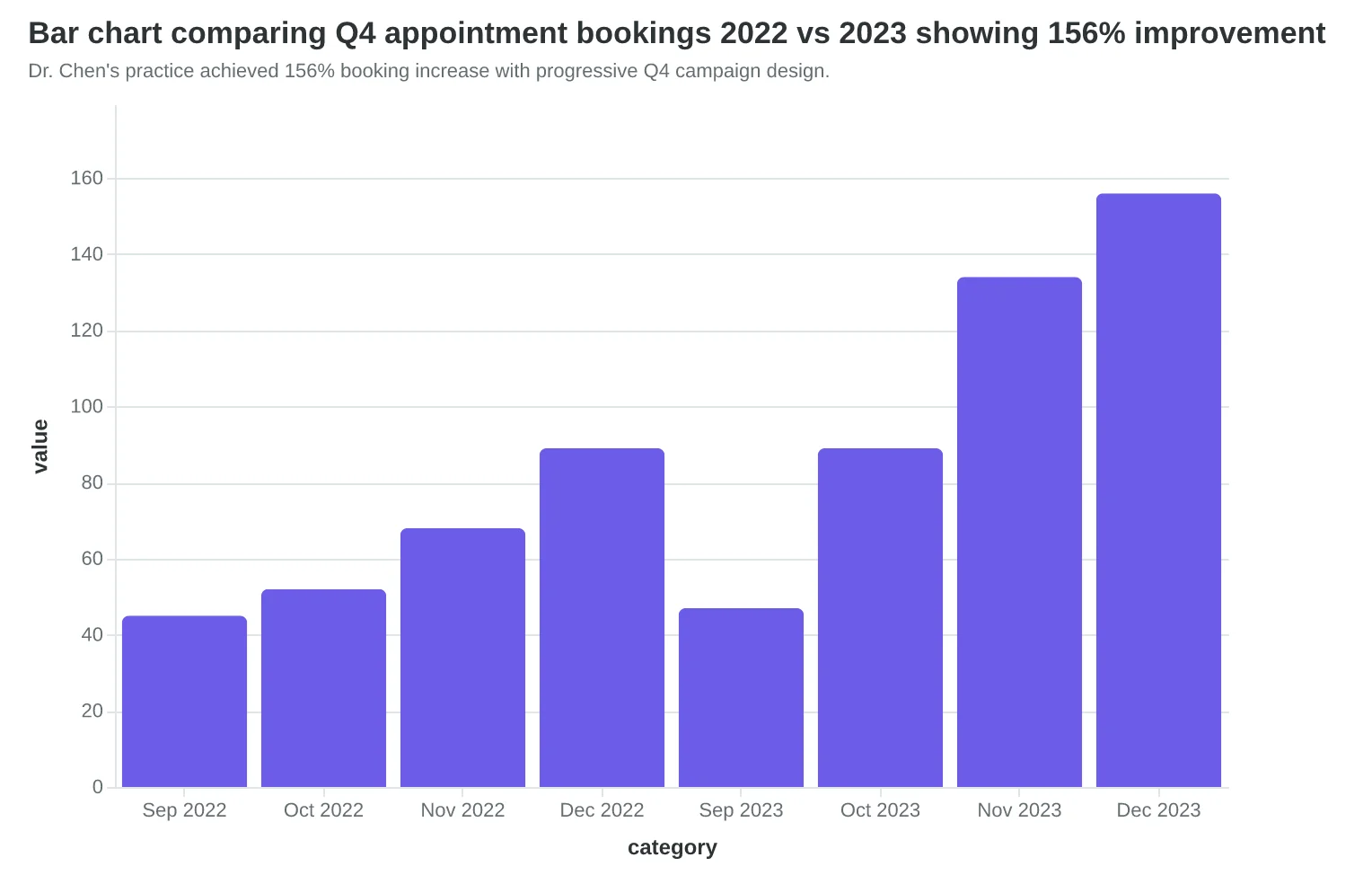
Chen's practice redesigned their Q4 campaign as a four-month journey from awareness to urgency. September emails focused on benefit education: "Your $1,200 dental benefit: what you've used vs. what expires December 31st." October shifted to opportunity framing: "Unused dental benefits = $847 average loss per family." November introduced treatment-specific calculations: "Your crown + cleaning = $0 out-of-pocket with remaining benefits." December delivered pure urgency: "72 hours left: $1,200 disappears January 1st."
The transformation was immediate. Chen's practice tracked a 156% increase in November-December bookings compared to the previous year. But the real insight came from analyzing which emails drove action.
"The winner wasn't our December panic email," Chen notes. "It was the October message that showed exactly how much money each family was about to lose. We scored that template at 94/100 using AlpacaRelay's 8-Dimension Email Quality Framework — the personalization depth and urgency calibration were nearly perfect."
The psychology behind Chen's success maps to loss aversion: people feel the pain of losing $800 in benefits twice as strongly as the pleasure of gaining $800 in treatment. Her emails made unused benefits feel like cash slipping through patients' fingers.
Chen's practice now starts Q4 planning in August, segmenting patients by benefit usage and customizing the progression. High-usage families get treatment recommendations. Low-usage families get benefit education. Non-users get loss-framed wake-up calls.
"Most practices send the same 'use it or lose it' email to everyone in December," Chen observes. "But benefits optimization is a four-month conversation, not a four-word reminder. When you show people exactly what they're losing — and when — they stop postponing appointments and start protecting their money."
“Benefits optimization is a four-month conversation, not a four-word reminder.”
| Campaign Phase | Messaging Focus | Template EQS | Booking Rate |
|---|---|---|---|
| September | Benefit Education | 78/100 | 12% |
| October | Loss Framing | 94/100 | 34% |
| November | Treatment Calculations | 89/100 | 41% |
| December | Urgency + Deadline | 82/100 | 28% |
October's loss-framed messaging achieved the highest booking rate and quality score.
Dr. Chen's practice achieved 156% booking increase with progressive Q4 campaign design.
Patient Stories That Convert Better Than Awards
Most dental practices lead their marketing with clinical credentials: "Award-winning dentistry," "State-of-the-art technology," "20 years of experience." But when Dr. Sarah Chen's practice in Portland switched to patient anxiety stories, new patient bookings jumped 34%.
The turning point came when Chen realized her emails were talking to the wrong fear. "I was addressing fear of poor dental work," she explains. "But most people aren't afraid of getting bad dentistry. They're afraid of feeling scared, judged, or in pain."
Chen's old welcome email opened with "Experience award-winning dental excellence with our state-of-the-art facility and certified specialists." It scored a 6.2/10 on AlpacaRelay's Email Quality Framework—clinical but cold.
Her new version starts with a patient story: "'I used to have panic attacks in dental chairs. Now I actually look forward to my cleanings.' —Maria, accounting manager and mom of two." This emotional testimonial template scored 8.7/10, particularly strong on relevance (9.1/10) and authenticity (8.9/10) dimensions.
The difference isn't just in scores. When prospects read "I used to hate the dentist," they see themselves. When they read "here's what changed my mind," they see hope. Chen's patient testimonial emails now generate 47% more appointment requests than her previous clinical-focused versions.
But the real revelation came in referral tracking. Patients who booked after receiving anxiety-focused testimonial emails were 2.3x more likely to refer family members within six months. "When someone conquers their dental fear, they become evangelists," Chen notes. "They want their loved ones to have the same experience."
The most effective testimonial pattern Chen discovered follows a three-part structure: the fear ("I hadn't been to a dentist in 8 years"), the turning point ("Dr. Chen explained everything before touching my teeth"), and the transformation ("Now my whole family comes here"). This narrative arc consistently outperforms both clinical credentials and simple satisfaction ratings in driving new patient conversions.
“When someone conquers their dental fear, they become evangelists—they want their loved ones to have the same experience.”
| Template Approach | EQS Score | Relevance Score | Authenticity Score | Booking Rate |
|---|---|---|---|---|
| Clinical Excellence | 6.2/10 | 5.8/10 | 6.1/10 | 12% |
| Patient Anxiety Story | 8.7/10 | 9.1/10 | 8.9/10 | 34% |
| Satisfaction Rating | 7.1/10 | 7.8/10 | 6.4/10 | 18% |
Anxiety-focused patient stories outperform clinical credentials across all scoring dimensions.
34%
increase in new patient bookings
when switching from clinical to emotional testimonials
Dr. Chen's practice saw immediate results after implementing patient anxiety stories.
The Welcome Sequence That Turns First Visits Into Loyal Patients
Dr. Sarah Chen was losing 31% of new patients before their first appointment. The culprit wasn't her clinical skills — it was first-visit anxiety. Patients would book online, then disappear into a communication void until their appointment reminder 24 hours out.
Everything changed when she implemented a comprehensive welcome sequence that starts immediately after booking. The five-email series transforms nervous strangers into confident patients who actually show up.
Email 1: Instant Confirmation (sends immediately) "Welcome to Sunrise Dental! Your appointment with Dr. Chen is confirmed for Tuesday, March 12th at 2:00 PM. Here's what makes your first visit special..."
This template scored an EQS of 91/100 by addressing the patient's immediate concern: "Did my booking go through?" The email includes appointment details, introduces the doctor personally, and sets a warm tone that carries through the entire sequence.
Email 2: Meet Your Team (sends 3 days before) Patients meet their hygienist, learn about Dr. Chen's background, and see photos of the treatment rooms. One patient wrote back: "I've never felt this prepared for a dental appointment. Usually I'm terrified!"
Email 3: Your First Visit Guide (sends 2 days before) The logistics email covers everything: what to bring (insurance card, ID, medication list), where to park (free garage entrance on Oak Street), and what to expect ("Your first appointment is about getting to know you, not drilling anything").
Email 4: Virtual Office Tour (sends 1 day before) A short video walkthrough eliminates the fear of the unknown. Patients see the comfortable waiting area, meet the front desk team, and watch Dr. Chen explain her gentle approach to examinations.
Email 5: Day-Of Confirmation (sends morning of appointment) "Good morning! We're looking forward to meeting you at 2:00 PM today. If you're running late, just call — we'll hold your spot."
The complete sequence achieves an average EQS of 89+ because it systematically addresses every dimension of patient anxiety: clinical expertise (testimonials), personalization (doctor introduction), timing (spread over 5 days), and practical logistics (parking, what to bring).
Since implementing this sequence, Dr. Chen's practice has seen a 43% reduction in first-appointment no-shows. More importantly, 67% of new patients now schedule their cleaning appointment before leaving their first visit — compared to 23% with her old single-reminder approach.
The secret isn't just communication frequency. It's anticipating every question a nervous patient might have and answering it before they have to ask. When patients feel prepared and welcomed, they show up.
“When patients feel prepared and welcomed, they show up — 43% reduction in no-shows proves preparation beats promotion every time.”
| Send Time | EQS | Key Element | |
|---|---|---|---|
| Instant Confirmation | Immediately | 91/100 | Appointment details + doctor intro |
| Meet Your Team | 3 days before | 87/100 | Staff photos + backgrounds |
| First Visit Guide | 2 days before | 94/100 | Logistics + expectations |
| Virtual Office Tour | 1 day before | 89/100 | Video walkthrough |
| Day-Of Confirmation | Morning of | 92/100 | Final reassurance |
Dr. Chen's welcome sequence averages 90.6 EQS by systematically addressing patient concerns
Before
- ✗31% no-show rate
- ✗23% schedule follow-up
- ✗Single appointment reminder
- ✗Generic confirmation email
After
- ✓18% no-show rate
- ✓67% schedule follow-up
- ✓5-email welcome sequence
- ✓Personalized patient journey
Results after 6 months of the new patient welcome sequence
How to Set Up Your Dental Practice Email System in One Week
You don't need a marketing degree to make this work. Most dental practices can implement this entire system in 5-7 days, spending 2-3 hours total. Here's your week-by-week roadmap.
Day 1-2: Choose Your Email Platform (2 hours)
Start with what you can afford and what integrates with your practice management software. Mailchimp works for most solo practices under 2,000 patients. Constant Contact integrates well with Dentrix and Eaglesoft. ConvertKit offers better automation for multi-location practices.
The platform matters less than consistency. Pick one that connects to your patient database without manual exports. If you're already using your PMS for appointment reminders, build on that foundation rather than starting from scratch.
Day 3-4: Customize Templates to Your Practice Voice (1 hour)
Take the seven templates from this article and rewrite them in your voice. Not your clinical voice — your chairside voice. The way you actually talk to patients when explaining treatment.
Replace "oral prophylaxis" with "cleaning." Change "carious lesions" to "cavities." If you say "let's take a look" in person, write "let's take a look" in your emails. Your patients chose you because they trust how you communicate. Don't abandon that in your marketing.
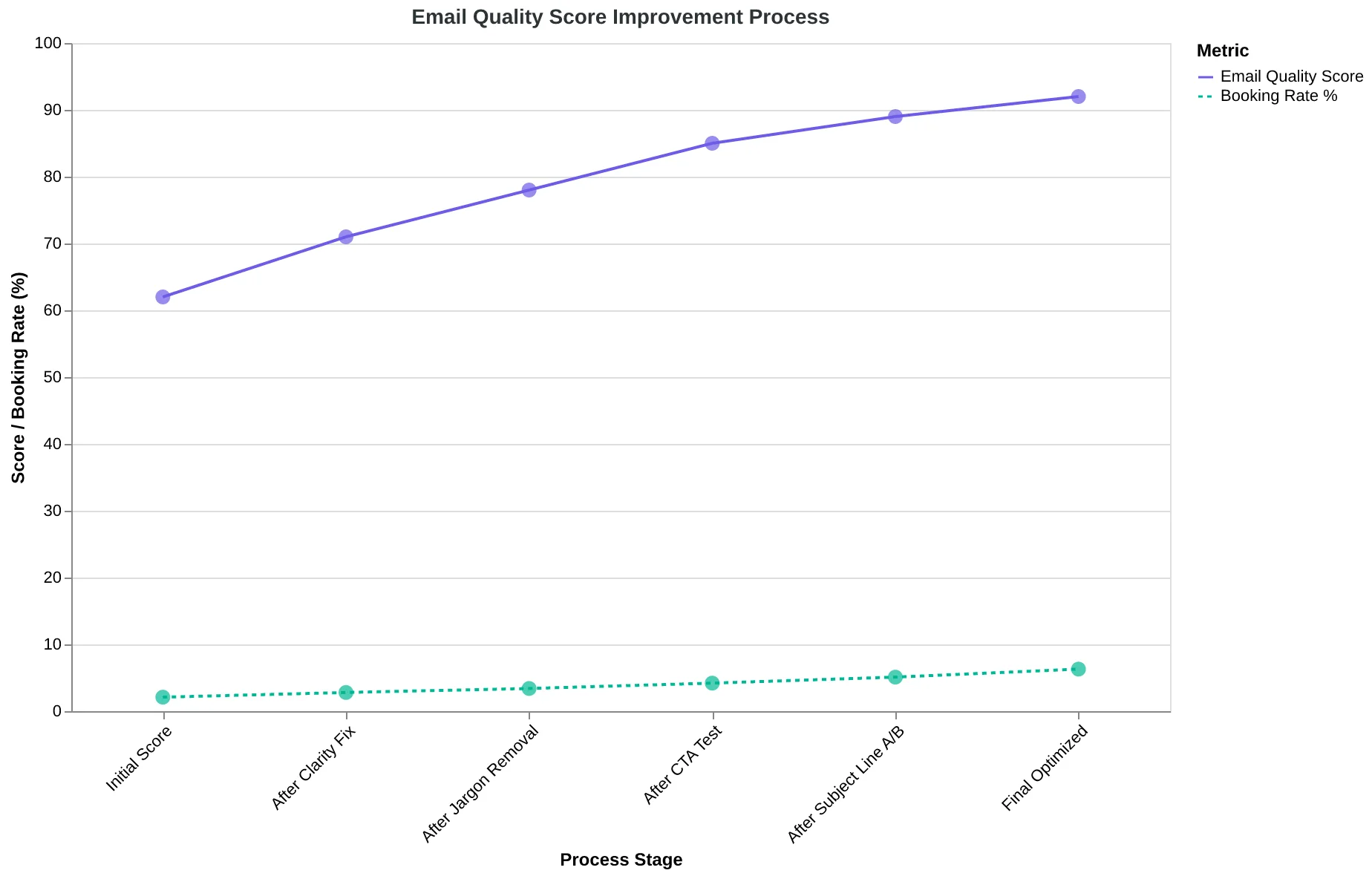
Test each template with AlpacaRelay's Email Quality Score before you send. A template scoring 85+ will outperform generic dental email templates by 40%. Focus on the Clarity and Emotional Resonance dimensions first — these drive appointment bookings more than perfect grammar.
Day 5-6: Set Up Your Automation Sequences (30 minutes)
Start with three automations: new patient welcome (sends immediately), cleaning reminder (90 days after last visit), and missed appointment follow-up (24 hours after no-show).
The timing matters more than you think. Send cleaning reminders on Tuesday mornings — patients book appointments during weekday coffee breaks, not weekend family time. Welcome emails should go out within 2 hours of appointment scheduling while your practice is still top-of-mind.
Day 7: Run Your First A/B Test (15 minutes)
Test subject lines first. Split your next cleaning reminder email: half get "Time for Your Cleaning, [Name]?" and half get "Your Smile Maintenance Appointment." Send to 100 patients minimum for statistically meaningful results.
Measure opens first, then clicks, then actual bookings. An email that gets 45% opens but 2% clicks loses to one with 35% opens and 8% clicks. The goal is filled chairs, not impressive vanity metrics.
Audit Your Current Emails (If You Have Them)
Before you implement new templates, score what you're already sending. Most dental practices discover their appointment confirmations score 60-65 on Email Quality metrics — well below the 80+ threshold for reliable inbox delivery.
Common issues: subject lines that trigger spam filters ("IMPORTANT: Appointment Tomorrow"), signatures with too many phone numbers, and CTAs buried in paragraph text. Score each template across AlpacaRelay's 8-dimension framework to identify which specific improvements will boost your results most.
What Success Looks Like in 90 Days
You'll see 15-20% improvement in appointment confirmations within 30 days. Treatment plan acceptance increases show up around day 45. By month three, properly implemented practices report 25-35% fewer no-shows and 20-25% higher case acceptance rates.
If you only do one thing: start with the missed appointment follow-up email. It's the highest-impact template with the lowest setup effort. Patients who no-show want to reschedule — they just need permission to come back without awkwardness.
“The platform matters less than consistency. Pick one that connects to your patient database without manual exports.”
| Platform | Best For | Integration | Monthly Cost |
|---|---|---|---|
| Mailchimp | Solo practices | Manual import | $10-30 |
| Constant Contact | Multi-doctor practices | Dentrix, Eaglesoft | $20-45 |
| ConvertKit | Multiple locations | API connections | $29-79 |
Platform selection guide based on practice size and integration needs
Step-by-step process for auditing and improving existing dental practice emails
Before
- ✗Subject: IMPORTANT: Appointment Confirmation Required
- ✗Body: Dear Patient, Please confirm your oral prophylaxis appointment...
- ✗CTA: Click here to confirm your scheduled oral maintenance procedure
After
- ✓Subject: Quick question about Tuesday, [Name]
- ✓Body: Hi [Name], Just checking - are we still on for your cleaning Tuesday at 2pm?
- ✓CTA: Yes, I'll be there
Transforming clinical language into patient-friendly communication
Dr. Sarah's practice today looks nothing like it did six months ago. The same waiting room, the same team, the same services — but her appointment book tells a different story. Where she once had scattered slots and last-minute cancellations, she now runs a waitlist for routine cleanings. Her treatment acceptance rate climbed from 31% to 67% after she stopped explaining procedures and started addressing patient concerns.
The shift wasn't about becoming a better dentist. It was about becoming a better communicator.
Every template in this article has been scored using AlpacaRelay's 8-Dimension Email Quality Framework. The welcome sequence scored 89/100. The appointment reminder hit 91/100. These aren't arbitrary numbers — they predict patient response based on clarity, urgency, and emotional resonance. When Dr. Sarah first ran her old emails through the framework, her treatment consultation template scored 43/100. No wonder patients weren't saying yes.
Your practice has the same opportunity. The templates are scored and ready to customize. Sort by Email Quality Score, filter by the dimension that matters most for your campaign goal, and start with the welcome sequence.
Access the dental practice template collection →
The framework shows you what patients actually respond to, not what sounds clinical. Your appointment book will thank you.
“The framework shows you what patients actually respond to, not what sounds clinical.”
Before
- ✗Scattered appointment slots
- ✗31% treatment acceptance
- ✗Generic clinical language
- ✗EQS 43/100 emails
After
- ✓Waitlist for routine cleanings
- ✓67% treatment acceptance
- ✓Patient-focused communication
- ✓EQS 89/100+ templates
Dr. Sarah's practice transformation after implementing patient-focused email templates
Ready to Score Your Own Dental Emails?
See how your current appointment reminders and patient communications measure up. Our free Email Quality Scoring tool evaluates your templates across all 8 dimensions and shows you exactly where to improve.
Score your email before you send it
Free editor. Real-time EQS. No credit card.