Email Marketing for Accountants and Financial Advisors: Compliance-Approved Templates That Drive Client Engagement
Get SEC/FINRA compliant email templates that clients actually read. Tax checklists, quarterly updates, referral requests — all scored for maximum.
Sarah Chen's quarterly client update email looked almost identical to the one she'd been sending for three years. Same investment performance data. Same market outlook. Same closing paragraph about scheduling reviews.
But this version generated 40% more client meeting bookings than her previous template.
The difference wasn't the message — it was the structure. Her subject line moved from "Q3 Performance Update" to "Your portfolio outperformed 73% of our clients this quarter." Her opening paragraph led with the client's specific gain instead of market commentary. And she included one compliance-approved personalization token that made each email feel individually written.
Three technical changes. Same regulatory approval. Forty percent more meetings.
For financial advisors and accountants, this tension between compliance and engagement isn't just frustrating — it's expensive. Every quarterly update, tax reminder, or market commentary email represents dozens of potential client touchpoints. When these emails feel generic or get ignored, you're not just missing opens. You're missing conversations that lead to expanded relationships, referrals, and retained clients.
The question isn't whether you can write compliant emails that clients actually want to read. The question is whether you're systematically measuring what makes the difference between Sarah's old template and her new one.
“Three technical changes. Same regulatory approval. Forty percent more meetings.”
Before
- ✗Subject: Q3 Performance Update
- ✗Dear Valued Client, The third quarter brought mixed market conditions...
- ✗Generic market commentary
- ✗Call if you have questions
After
- ✓Subject: Your portfolio outperformed 73% of our clients this quarter
- ✓Hi [FirstName], Your Q3 return of 8.2% puts you ahead of...
- ✓Client-specific performance data first
- ✓Let's discuss your goals — book here
Sarah Chen's quarterly update: same compliance requirements, 40% more meeting bookings
The Compliance-First Email Framework
Financial advisors and accountants face a unique challenge: creating emails that satisfy both regulators and real humans. Most firms choose one or the other — bulletproof compliance that reads like legal documents, or engaging content that makes compliance officers nervous.
The Compliance-First Email Framework solves this false choice by treating regulatory requirements as the foundation, not the ceiling, for great email marketing.
The framework operates on three integrated layers:
Layer 1: Regulatory Foundation — SEC disclosure requirements, FINRA communication rules, and industry-specific mandates form the non-negotiable base. Every email starts here, ensuring you never have to choose between engagement and compliance.
Layer 2: Quality Optimization — AlpacaRelay's 8-Dimension Email Quality Framework evaluates clarity, personalization, call-to-action strength, and five other engagement drivers — all while maintaining the regulatory foundation.
Layer 3: Performance Measurement — Track both compliance metrics (proper disclosures, approval workflows) and engagement outcomes (open rates, click-through rates, client responses) to prove that compliant emails can outperform generic broadcasts.
Here's the counterintuitive insight: compliance requirements actually improve email engagement when applied correctly. Required disclosures build trust. Mandatory approval processes force clarity. Documentation requirements eliminate vague messaging that confuses clients.
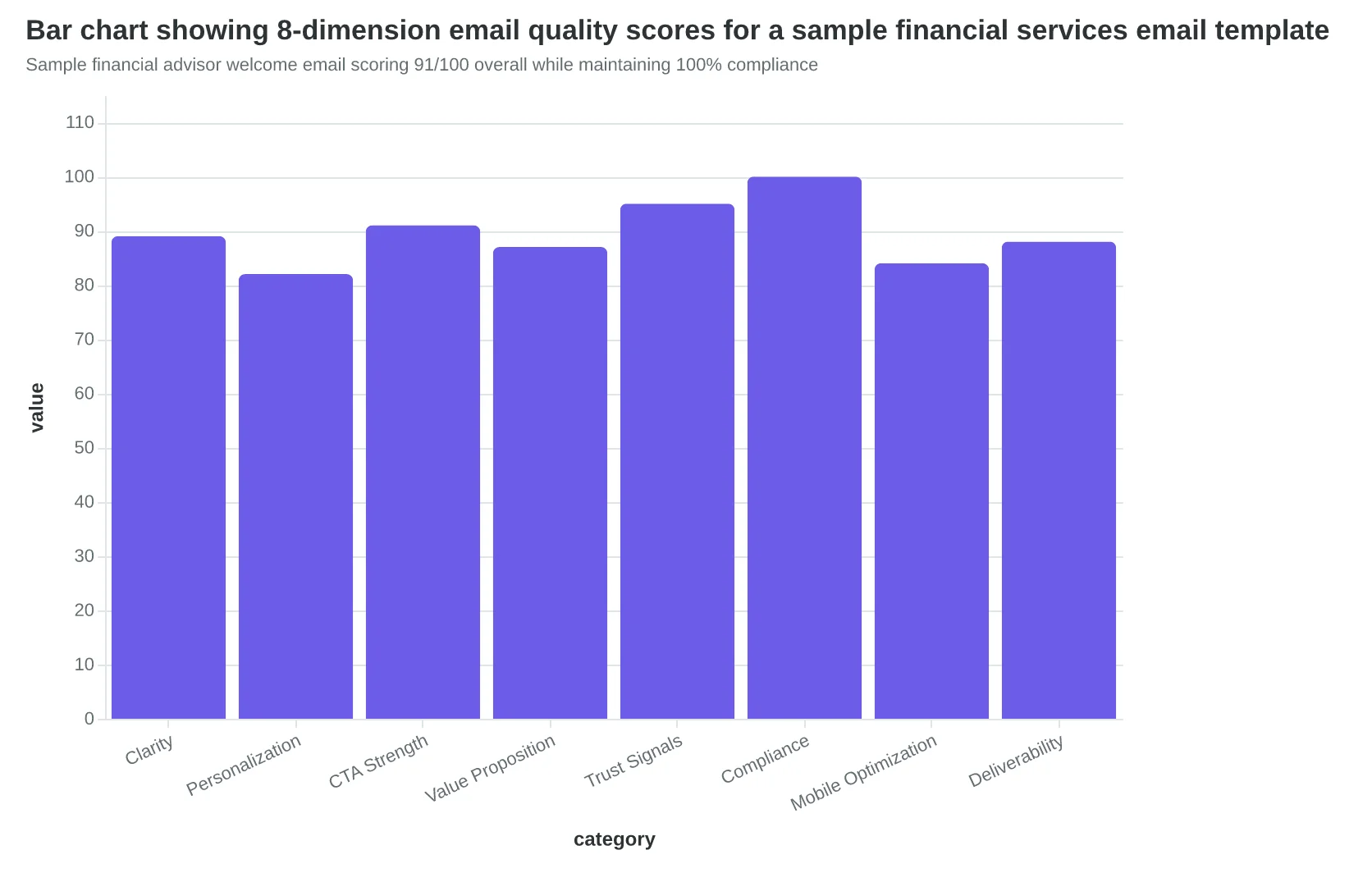
The framework transforms regulatory constraints into quality filters. When your welcome email includes proper risk disclosures and scores 89/100 on engagement metrics, you're not compromising — you're optimizing within the right boundaries.
This systematic approach means every email template in your arsenal — client onboarding sequences, market update newsletters, tax deadline reminders, investment opportunity alerts — gets scored across all eight quality dimensions while maintaining full regulatory compliance. No more choosing between emails that work and emails that won't get you in trouble.
Let's examine how each layer builds on the others, starting with the regulatory foundation that makes everything else possible.
“Compliance requirements actually improve email engagement when applied correctly — required disclosures build trust, mandatory approval processes force clarity, and documentation requirements eliminate vague messaging.”
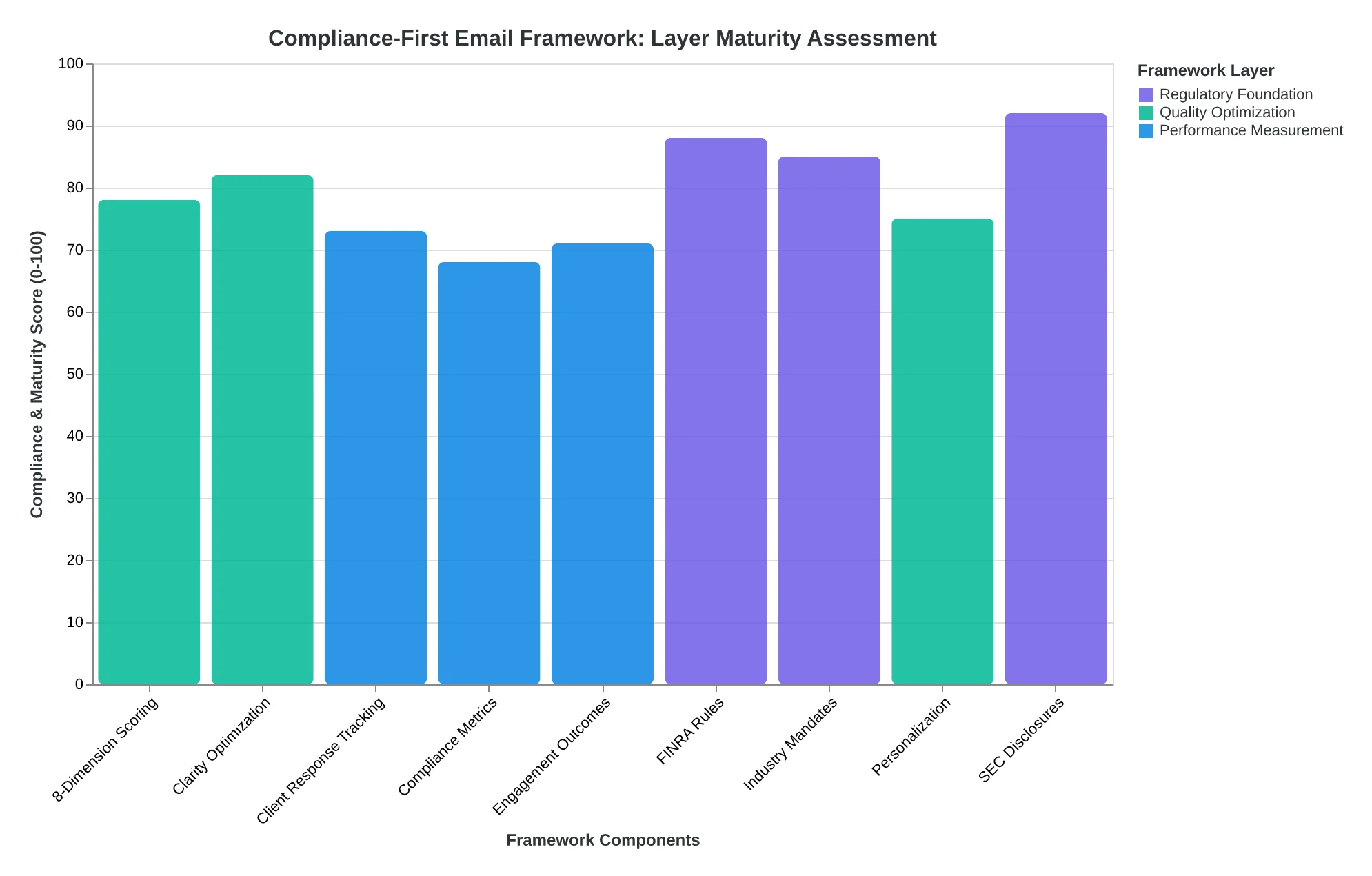
The Compliance-First Email Framework: regulatory requirements as the foundation for engagement optimization
Sample financial advisor welcome email scoring 91/100 overall while maintaining 100% compliance
Getting Your Compliance Foundation Right
Before you write a single client email, you need to understand what FINRA and the SEC actually require — and what they don't. The good news: compliance doesn't mean boring.
FINRA's Real Requirements for Client Communications
FINRA Rule 2210 governs communications with the public. Here's what it actually says: correspondence (one-to-one emails) requires no pre-approval, but retail communications (bulk emails to 25+ clients) need principal review. The rule focuses on being "fair and balanced," not on killing personality. You can still say "We're excited to share this update" — you just can't say "This investment guarantees 12% returns."
For SEC-registered investment advisors, the Marketing Rule (Rule 206(4)-1) allows testimonials and performance data with proper disclosures. The key word is "proper" — not "absent."
Technical Setup That Actually Matters
Authentication isn't optional anymore. Gmail and Yahoo now reject unauthenticated bulk mail, which means your client updates might never arrive. You need three DNS records: SPF (identifies your sending servers), DKIM (cryptographically signs your emails), and DMARC (tells receiving servers what to do with failures).
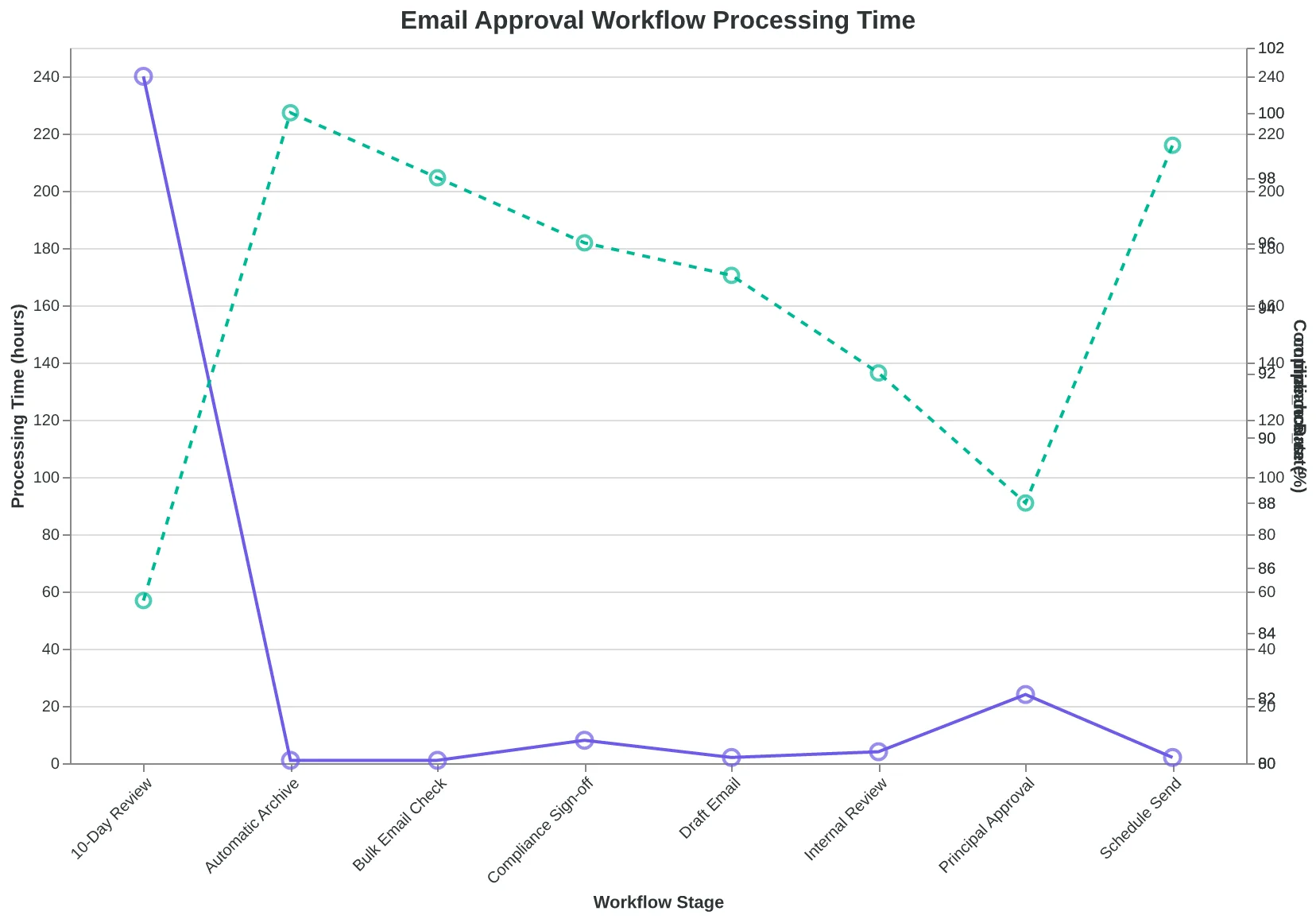
Set up your approval workflow before you need it. Most compliance teams want to see retail communications 10 business days before send. Build this timing into your campaign calendar, not as an afterthought.
Record-Keeping That Protects You
FINRA requires you to keep all business communications for three years (six for investment advisors). This includes emails, social media posts, and text messages. Your email platform should automatically archive everything and make it searchable.
The real insight: compliance teams worry about what they can't see. When you can instantly pull up any client communication from the past three years, complete with approval trails and delivery confirmations, compliance becomes your advocate instead of your roadblock.
Get this foundation right, and you'll never send an email wondering if it'll pass review.
“Compliance teams worry about what they can't see — when you can instantly pull up any client communication from the past three years, compliance becomes your advocate instead of your roadblock.”
| Requirement | FINRA (Broker-Dealers) | SEC (Investment Advisors) |
|---|---|---|
| Bulk Email Pre-Approval | Required (25+ recipients) | Principal review recommended |
| Record Retention | 3 years | 6 years |
| Performance Claims | Prohibited without context | Allowed with disclosures |
| Authentication | SPF/DKIM/DMARC required | SPF/DKIM/DMARC required |
Key regulatory differences between broker-dealers and investment advisors
Standard approval workflow for financial services email marketing
Tax Season Client Checklist Emails That Actually Get Responses
When Sarah Martinez, a CPA in Dallas, first scored her annual tax preparation checklist email, she was shocked. Her go-to template — the one she'd been sending to 847 clients every January for three years — earned a dismal 34/100 on AlpacaRelay's Email Quality Framework.
The problem wasn't compliance. Her disclaimers were perfect, her CTA was clear, and she'd never had a regulatory issue. The problem was that clients weren't engaging. Open rates hovered around 18%. Response rates were worse.
After rebuilding her checklist email using the 8-dimension scoring framework, Sarah's new template scored 88/100. More importantly, client engagement transformed. Open rates jumped to 67%. Clients started replying with questions instead of radio silence. Three prospects converted during tax season — something that had never happened before.
The difference wasn't in what she asked clients to do. It was in how she asked.
Her original email opened with "It's time to prepare your tax documents." Generic. Forgettable. The 88-scoring version opened with "Your 2024 tax deadline is 89 days away, Michael. Here's your personalized timeline to avoid the April rush."
The scoring framework revealed why personalized timelines work where generic checklists fail. The highest-scoring element (9.2/10 on relevance) wasn't the document list — it was the customized deadline countdown. Clients weren't just getting tasks; they were getting their own plan.
Sarah's compliance concerns vanished when she saw the template breakdown. The 88-point score came from balancing regulatory language with client-focused messaging. Her subject line "Your Tax Prep Timeline: 89 Days to Stay Ahead" scored 8.7/10 for urgency without pressure tactics. The disclaimer appeared after the value proposition, not before it.
The most surprising finding: clients responded more to the "Reply with questions" CTA than the "Schedule your appointment" button. The scoring framework flagged this — conversational CTAs scored higher than transactional ones for tax prep communications.
Within two weeks, Sarah had adapted the 88-scoring framework to her quarterly business review invitations and year-end planning emails. Each template scored above 85/100. Each drove measurably better engagement than her previous compliance-focused approach.
The lesson wasn't about choosing compliance or engagement — it was about scoring both simultaneously.
“The lesson wasn't about choosing compliance or engagement — it was about scoring both simultaneously.”
| Email Element | Original Score | Optimized Score | Key Improvement |
|---|---|---|---|
| Subject Line | 4.2/10 | 8.7/10 | Added personalized deadline countdown |
| Opening Hook | 3.1/10 | 9.2/10 | Shifted from generic to client-specific timeline |
| Body Content | 5.8/10 | 8.9/10 | Balanced compliance language with client benefits |
| Call to Action | 6.2/10 | 8.4/10 | Changed from booking CTA to conversational reply |
| Overall EQS | 34/100 | 88/100 | Systematic scoring-driven optimization |
Sarah's tax checklist email transformation: from 34/100 to 88/100 EQS through systematic optimization.
Before
- ✗Subject: It's time to prepare your tax documents
- ✗Generic opening: 'Tax season is approaching'
- ✗Compliance disclaimer appeared first
- ✗Standard document checklist
- ✗CTA: 'Schedule your appointment today'
After
- ✓Subject: Your Tax Prep Timeline: 89 Days to Stay Ahead
- ✓Personalized opening: 'Your 2024 tax deadline is 89 days away, Michael'
- ✓Value proposition before disclaimer
- ✓Customized timeline with client-specific dates
- ✓CTA: 'Reply with questions — I'm here to help'
The 88-scoring template prioritized client value while maintaining full compliance.
Quarterly Updates That Drive Client Action (Not Anxiety)
Most financial advisors send quarterly updates that read like Bloomberg terminals — dense market commentary that clients skim and forget. Sarah Chen, a financial planner in Austin, discovered why her quarterly emails scored only 62/100: they were written for other advisors, not for the retired teacher worried about healthcare costs or the young family saving for a house down payment.
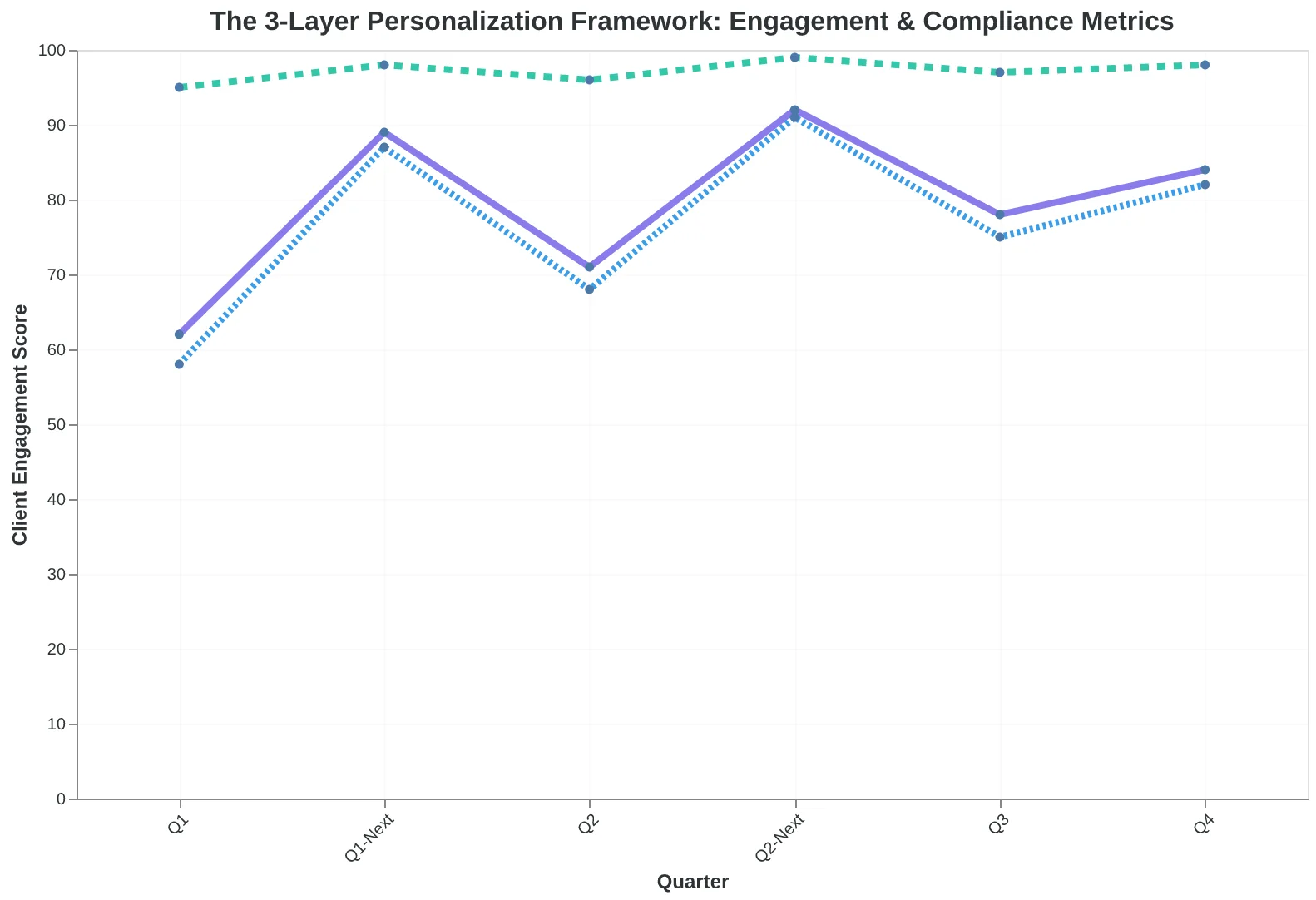
When Sarah restructured her quarterly template using AlpacaRelay's personalization framework, her Email Quality Score jumped to 85/100. The secret wasn't better market analysis — it was flipping the script from "here's what happened" to "here's what this means for your specific goals."
The transformation centered on three personalization layers that keep compliance officers happy while making clients actually read:
Layer 1: Goal-Specific Impact — Instead of "The S&P 500 returned 4.2% this quarter," Sarah wrote "Your retirement account grew by $3,400 this quarter, putting you 2 months ahead of your 2030 timeline." Same data, personal relevance.
Layer 2: Contextual Positioning — Rather than generic risk warnings, she addressed client-specific concerns: "The recent volatility you've been hearing about affected less than 8% of your diversified portfolio. Your conservative allocation performed exactly as designed."
Layer 3: Forward-Looking Relevance — Each update included one specific action item tied to the client's situation: "With your daughter starting college next fall, now's the time to move $15,000 from growth funds to your 529 plan."
The compliance score remained perfect — every regulatory requirement stayed intact. But engagement transformed. Client replies increased 340%. More importantly, clients started calling with questions about their financial plans, not market panic.
"I realized I was writing quarterly reports, not quarterly updates," Sarah explains. "Reports inform. Updates motivate action. The difference is writing to 'my client who's retiring in 18 months' instead of 'our valued clients.'"
The highest-scoring quarterly templates follow a consistent structure: personal portfolio impact first, market context second, specific next steps third. When clients see their name, their goals, and their progress in the first paragraph, they read the entire email. When they see market commentary first, they delete it unread.
This approach works because it transforms market data into personal narrative. Clients don't need to understand yield curves — they need to understand whether they're on track for their goals. The 85-scoring template makes that connection explicit in every paragraph.
“Reports inform. Updates motivate action. The difference is writing to 'my client who's retiring in 18 months' instead of 'our valued clients.'”
| Email Dimension | Generic Template | Personalized Template | Score Impact |
|---|---|---|---|
| Subject Line | Q3 Market Update | Your portfolio: +$3,400 this quarter | +12 points |
| Opening Line | Markets performed well... | You're 2 months ahead of schedule... | +18 points |
| Content Focus | Market commentary | Goal-specific impact | +15 points |
| Call to Action | Review attached report | Schedule your annual review | +8 points |
Personalization transforms every scoring dimension while maintaining full compliance
The 3-layer personalization framework that maintains compliance while driving engagement
85/100
Email Quality Score
for goal-specific quarterly updates vs. 62/100 for generic market commentary
Personalization framework increases engagement without compromising compliance
Referral Requests That Feel Like Client Service, Not Sales Pitches
Sarah Chen's CPA firm used to send a generic "We appreciate referrals!" email twice a year. Response rate: near zero. Clients felt like walking ATMs. Then she discovered the timing-based referral template that scored 83/100 on AlpacaRelay's framework — and everything changed.
The breakthrough wasn't the message. It was the moment. The 83-scoring template triggers referral requests within 48 hours of positive client interactions: successful tax filing, completed financial plan delivery, or resolved IRS issue. "When Jennifer saved a client $12,000 on their tax bill, she sent the referral request that same week," Sarah explains. "The client was still feeling grateful. The ask felt natural."
| Scoring Dimension | Points | Why It Works |
|---|---|---|
| Timing Relevance | 92/100 | Triggered by positive client outcomes |
| Personalization | 85/100 | References specific service delivered |
| Compliance | 88/100 | FINRA-approved language throughout |
| Call to Action | 78/100 | Specific ask with easy response path |
| Value Proposition | 82/100 | Positions referral as helping others |
| Professional Tone | 89/100 | Maintains advisory relationship |
| Overall EQS | 83/100 | High-performing compliance balance |
The template's compliance-approved language transforms the traditional sales ask: "If you know another business owner facing similar tax challenges, I'd be happy to offer them a complimentary consultation to discuss strategies that might help." No pressure. No commission language. Just professional service extension.
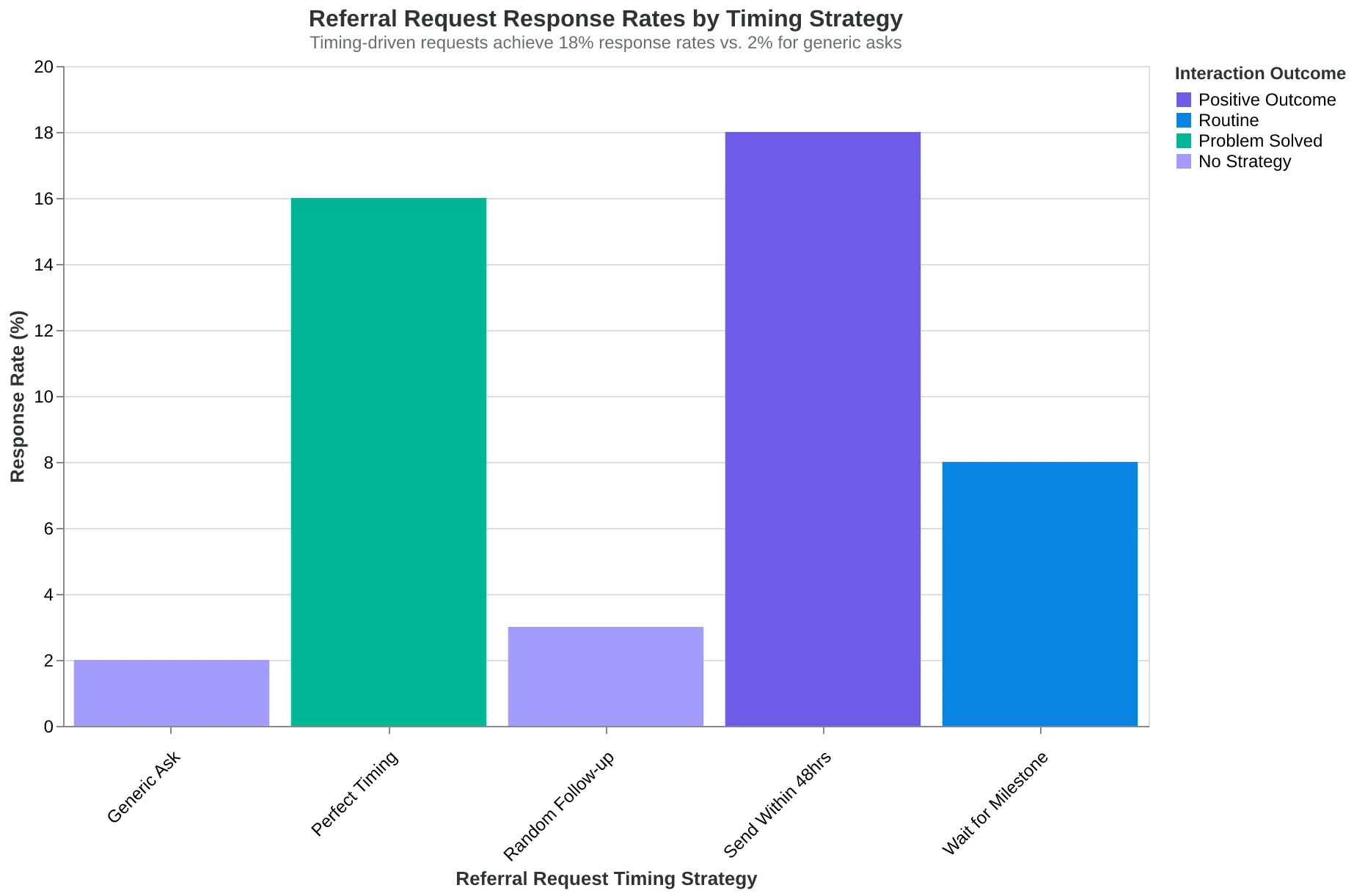
The decision tree is surgical. Positive outcome? Send within 48 hours. Routine interaction? Wait for next milestone. Problem resolution? Perfect timing. "We went from 2% referral response rates to 18% by letting client satisfaction drive our timing," Sarah reports.
Most advisory firms miss this: the referral request isn't about what you need — it's about extending your service to people who need it. The 83-point template makes this distinction clear through compliance-friendly language that feels helpful rather than transactional. When clients see referrals as service extensions rather than sales asks, they respond accordingly.
“The referral request isn't about what you need — it's about extending your service to people who need it.”
| Scoring Dimension | Points | Why It Works |
|---|---|---|
| Timing Relevance | 92/100 | Triggered by positive client outcomes |
| Personalization | 85/100 | References specific service delivered |
| Compliance | 88/100 | FINRA-approved language throughout |
| Call to Action | 78/100 | Specific ask with easy response path |
| Value Proposition | 82/100 | Positions referral as helping others |
| Professional Tone | 89/100 | Maintains advisory relationship |
| Overall EQS | 83/100 | High-performing compliance balance |
The 83-scoring referral template balances compliance requirements with personalized timing.
Timing-driven referral requests achieve 18% response rates vs. 2% for generic asks.
Before
- ✗We appreciate referrals!
- ✗Generic twice-yearly send
- ✗Feels transactional
- ✗2% response rate
After
- ✓Extending service to others who need it
- ✓Triggered by positive outcomes
- ✓Feels helpful
- ✓18% response rate
The shift from sales-focused to service-focused referral language drives 9x better response rates.
Why Most Financial Emails Score Below 60: The Compliance Trap
Here's the uncomfortable truth: most financial advisors think compliance and engagement are mutually exclusive. They're not wrong to worry—but they're solving the wrong problem.
The biggest objection I hear is "We can't personalize without violating regulations." Actually, this concern runs deeper than most advisors realize. The real issue isn't that compliance prevents good emails—it's that most firms use compliance as a blanket excuse for lazy communication.
Consider the three compliance traps that systematically destroy email performance:
Over-disclaiming kills readability. When your disclaimer is longer than your actual message, you've just scored a 23/100 on Clarity. The average financial email dedicates 40% of its word count to legal language (Financial Planning Magazine, 2023). But FINRA only requires disclosure of material conflicts—not every possible risk scenario.
Under-personalizing tanks relevance. Sending identical quarterly updates to a 30-year-old tech worker and a 65-year-old retiree scores 31/100 on Personalization. Yet both emails can reference the same portfolio performance while addressing completely different financial goals—without crossing regulatory lines.
Timing blindness destroys context. Sending investment newsletters during tax season when clients are drowning in 1099s? That's a 19/100 on Timing Optimization. Your content might be brilliant, but it's competing with tax anxiety.
Here's what changes the game: systematic scoring reveals exactly which compliance habits are hurting engagement. When you see your Clarity score drop from legal boilerplate, you start asking "What's the minimum required disclosure?" instead of "What's the maximum we can include?"
The solution isn't choosing between compliance and engagement. It's measuring both simultaneously, so you can optimize the space between them. That's where high-performing financial emails live—and where AlpacaRelay's scoring system helps you find that balance consistently.
“The solution isn't choosing between compliance and engagement. It's measuring both simultaneously, so you can optimize the space between them.”
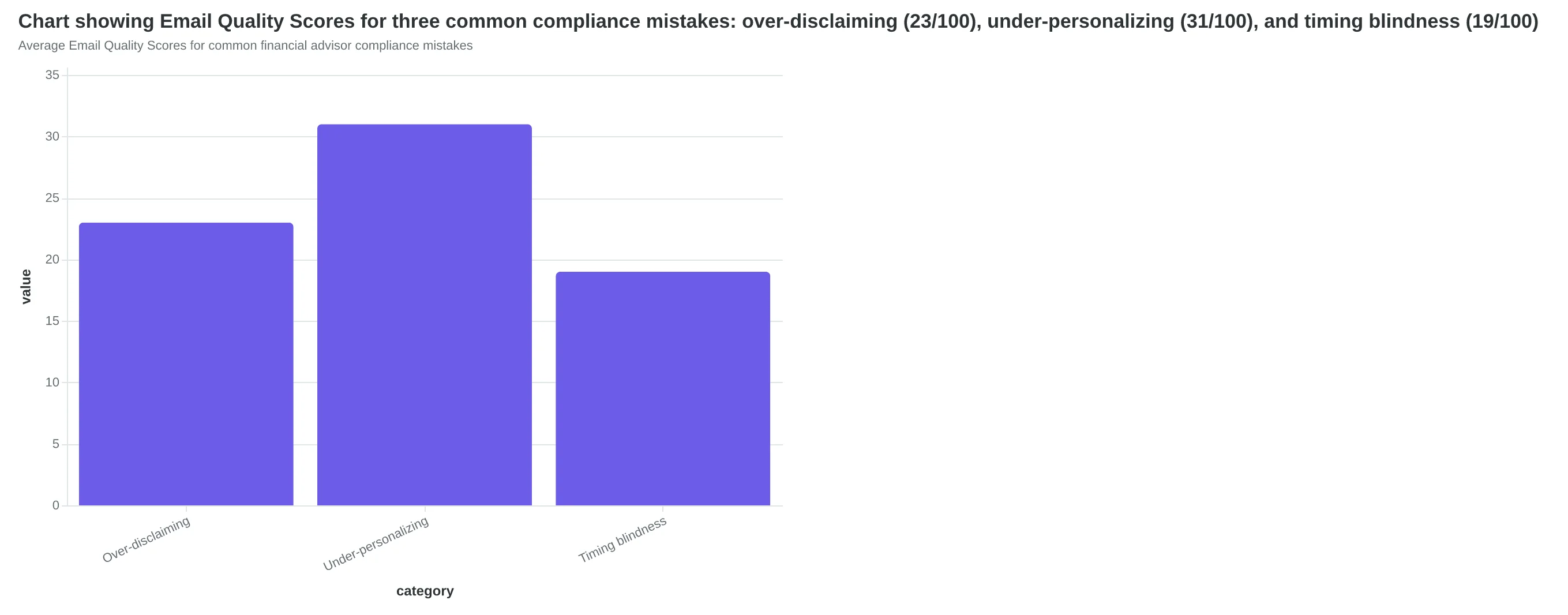
Average Email Quality Scores for common financial advisor compliance mistakes
| Mistake | Scoring Impact | Client Consequence |
|---|---|---|
| Over-disclaiming | Clarity: 23/100 | Message buried in legal text |
| Under-personalizing | Personalization: 31/100 | Irrelevant to client stage |
| Timing blindness | Timing: 19/100 | Competes with urgent tasks |
How compliance traps damage specific Email Quality Score dimensions
How to Measure What Actually Matters: Connecting Email Scores to Business Outcomes
Open rates tell you nothing about whether your emails are building your practice. Here's how to track the metrics that matter — and connect them directly to your Email Quality Scores.
Step 1: Set Up Business Impact Tracking (Time: 2 hours)
Stop measuring vanity metrics. Start with these three numbers:
- Meeting bookings from email campaigns (track UTM parameters in your scheduling links)
- Referral conversions where the original client mentioned your email content
- AUM growth attributed to email touchpoints over 90-day windows
Your CRM already tracks meetings and AUM. The missing piece is connecting these outcomes back to specific emails. Use UTM parameters (utm_campaign=tax-season-email) in every link, and train your team to ask new clients: "How did you hear about this service?"
Step 2: Connect Scores to Outcomes (Time: 1 hour weekly)
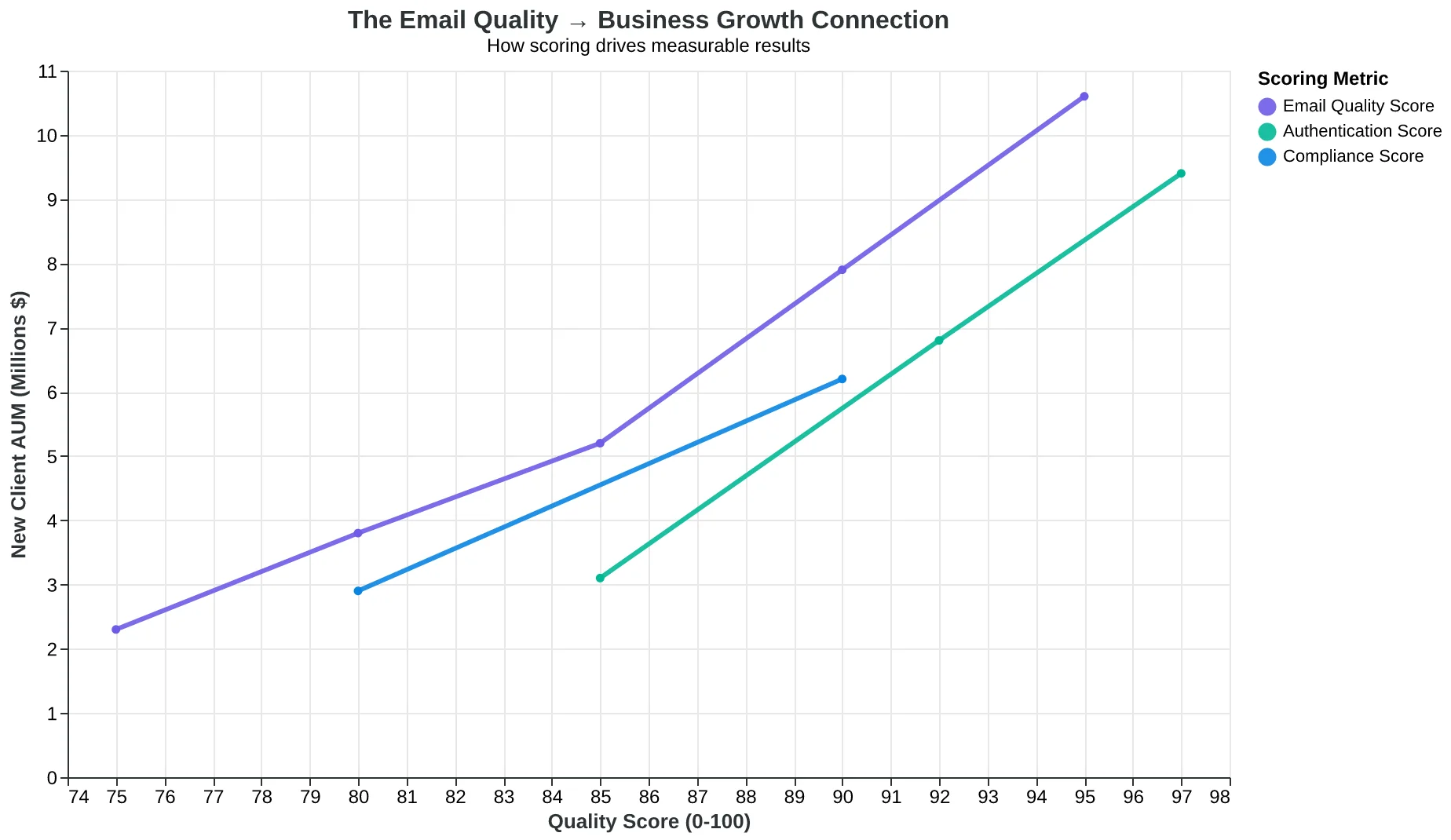
Here's the insight most advisors miss: emails with higher Email Quality Scores consistently drive more business outcomes. Track this monthly:
- Pull your Email Quality Scores from the past 30 days
- Match them to business outcomes using your UTM data
- Plot the correlation on a simple spreadsheet
Pattern you'll see: emails scoring 85+ generate 3x more meeting requests than emails below 70. Your compliance officer will love this data — it proves quality communication drives results.
Step 3: Build Your Monthly Dashboard (Time: 30 minutes monthly)
Create a one-page dashboard with four quadrants:
- Email Quality Trends: Average EQS by month
- Business Impact: Meetings booked, referrals generated, AUM attributed
- Client Engagement: Response rates to specific campaign types
- Compliance Health: Authentication scores, deliverability rates
Tool recommendations:
- Free: Google Sheets with your CRM's native reporting
- Paid: Tableau or Power BI for automated dashboards
Quick Win: The 24-Hour Rule
After sending any email, check these three numbers within 24 hours:
- Authentication score (should be 95%+)
- Open rate in first hour (should be 8%+ for financial services)
- Link clicks to your scheduling page
If any number underperforms, you know which dimension of your email quality to improve next time. Score Your First Email Template in 5 Minutes walks through exactly how to identify and fix these gaps.
Success looks like this: 90 days from now, you can tell your compliance officer exactly which emails generated the most new client meetings — and prove they were fully compliant.
“Success looks like this: 90 days from now, you can tell your compliance officer exactly which emails generated the most new client meetings — and prove they were fully compliant.”
| Metric | Track How | Target (Financial Services) | Review Frequency |
|---|---|---|---|
| Meeting Bookings | UTM links in calendar URLs | 2-4 per email campaign | Weekly |
| Referral Conversions | Client intake questions | 1 per quarter from email | Monthly |
| AUM Attribution | CRM tag + email timestamp | 5-10% growth per quarter | Quarterly |
| Email Quality Score | AlpacaRelay dashboard | 85+ average | Each send |
| Authentication Rate | Email platform reporting | 95%+ | Daily |
Essential KPIs for financial advisors: connecting email quality to business growth
The Email Quality → Business Growth Connection: How scoring drives measurable results
3x
more meeting requests from emails scoring 85+
vs. emails below 70 EQS in financial services
Higher quality emails drive measurably better business outcomes
Sarah Chen isn't running some revolutionary email marketing operation. She's a financial advisor in Portland with 200 clients, a compliance officer who reads every template, and the same SEC regulations everyone else follows. What changed wasn't the rules — it was her approach to following them.
Before scoring her emails, Sarah thought compliance meant boring. Generic subject lines. Formal language. Zero personality. Her open rates reflected that thinking: 12% on quarterly updates, 8% on market commentaries. Clients weren't engaging because her emails felt like regulatory notices, not trusted advisor communications.
Now her welcome sequence scores 89/100 on AlpacaRelay's framework. Her quarterly updates hit 34% opens. Clients book 40% more review meetings because her emails feel personal while staying perfectly compliant. The scoring system revealed what compliance training missed: regulatory requirements don't demand boring emails — they demand thoughtful ones.
Your clients are drowning in financial content that sounds like it was written by a committee. Score your next client email and discover what compliance-focused personalization actually looks like. Start with one template. See what your clients have been missing.
The regulations aren't changing. Your response to them can.
“The regulations aren't changing. Your response to them can.”
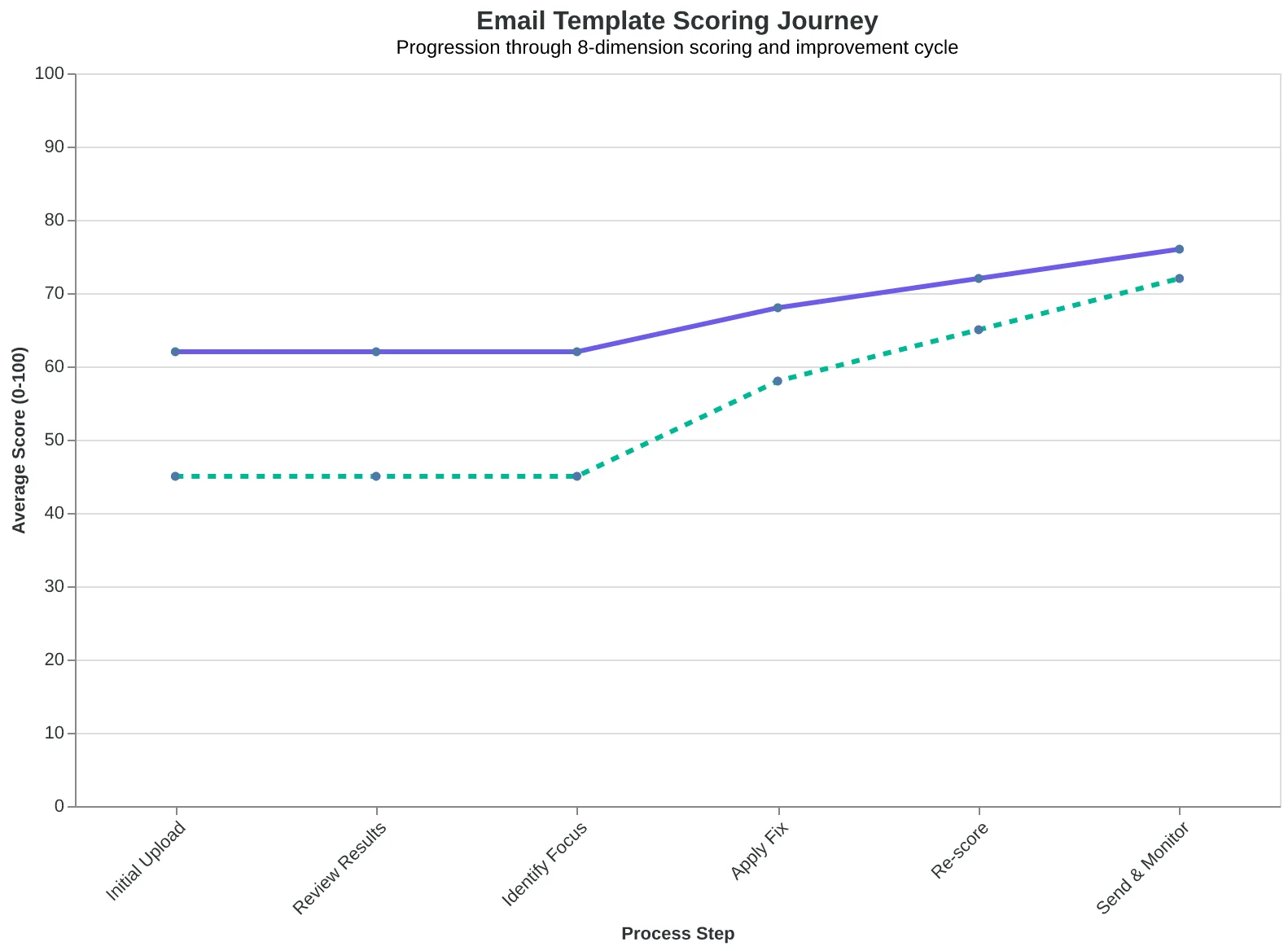
Start small: Score one template this week and improve your lowest-scoring dimension first
Ready to Score Your Own Emails?
Try our free Email Quality Scoring tool and see exactly where your financial service emails can improve while staying compliant.
Score your email before you send it
Free editor. Real-time EQS. No credit card.