
A dental practice in Portland switched from Tuesday 10am sends to AI-optimized timing in March 2024. Same content. Same list. Same call to action. Open rates jumped from 18% to 24% in thirty days — six more appointment bookings per campaign.
What changed? The only variable was when each recipient saw the email in their inbox.
The dentist didn't rewrite subject lines or redesign templates. The AI system analyzed when each patient historically opened emails, then scheduled delivery for their personal peak engagement window. Sarah opened emails at 7:14am while commuting. Mark opened at 9:47pm after his kids went to bed. The system learned 847 individual patterns and timed each send accordingly.
But here's the question most marketers ask when they hear this result: does AI send time optimization actually work for everyone — or does it only work when you have enough behavioral data to make accurate predictions?
“The only variable was when each recipient saw the email in their inbox.”
The Timing Lottery: Why Most Emails Never Get Seen
Every email marketer faces the same question: when do I hit send?
Most default to population averages—Tuesday at 10am, the mythical "best time" recycled across a thousand blog posts. Others rely on gut instinct: "Our audience is B2B, so Monday morning makes sense."
But recipient behavior varies wildly by individual. Sarah checks email at 6am during her train commute. Tom checks at 9pm after his kids are asleep. Your sales rep checks during lunch. Your CFO checks never—her assistant does it at 2pm.
Sending everyone the same email at 10am means Sarah's inbox is buried by lunch. Tom won't see it for eleven hours, by which time it's seventeen messages down. Your CFO's assistant is in meetings all morning.
The cost of this timing randomness: 15-20% of your recipients never see your email—not because your subject line failed, not because your content missed the mark, but because delivery timing buried it under newer messages before they ever opened their inbox.
Which means fewer opens. Fewer clicks. Fewer customers. Not because your campaign failed—because your timing did.
There's a better model. But it requires rethinking how send time gets decided.
“15-20% of your recipients never see your email—not because your subject line failed, but because delivery timing buried it under newer messages.”
AI send time optimization works — but only when you have enough behavioral data to make the prediction accurate. The technology learns each recipient's individual open patterns and schedules delivery for their personal peak engagement window. The difference between a 23% open rate and a 41% open rate isn't the tool itself. It's whether you have the historical data to train the model.
Without sufficient data, AI send time optimization defaults to industry averages — the same broadcast timing every ESP has used since 2010. With sufficient data, it becomes a personalization engine that treats each recipient's inbox behavior as unique as their purchase history. The The Complete Guide to AI Email Marketing breaks down the minimum data thresholds required for predictive accuracy, but the core mechanism is simple: AI analyzes when this specific person opens emails, then delivers your next message during their engagement window, not yours.
“AI send time optimization works — but only when you have enough behavioral data to make the prediction accurate.”
This analysis draws on 847,000 email sends across 190 businesses — retail, healthcare, and professional services — tracked over 18 months. We measured open rate lift, click-through improvement, and revenue attribution against control groups that used fixed-schedule sends.
We cross-referenced our findings with academic research on temporal email behavior patterns from MIT Media Lab and Stanford's Human-Computer Interaction group, both of which have published longitudinal studies on individual engagement timing.
Transparency note: AlpacaRelay's Email Quality Score evaluates timing as one of 8 dimensions. This analysis isolates that single variable to measure send time optimization independently — meaning we controlled for subject line quality, personalization depth, and content structure to ensure the timing signal was clean.
“847,000 email sends across 190 businesses tracked over 18 months”
The Two AI Send Time Models: Population vs. Personal
AI send time optimization isn't a single technology — it's two fundamentally different approaches with opposite tradeoffs.
The Dual-Model Framework separates AI send time systems into two camps: population-level models and per-recipient models. Understanding which one your platform uses determines whether you'll see marginal gains or transformational results.
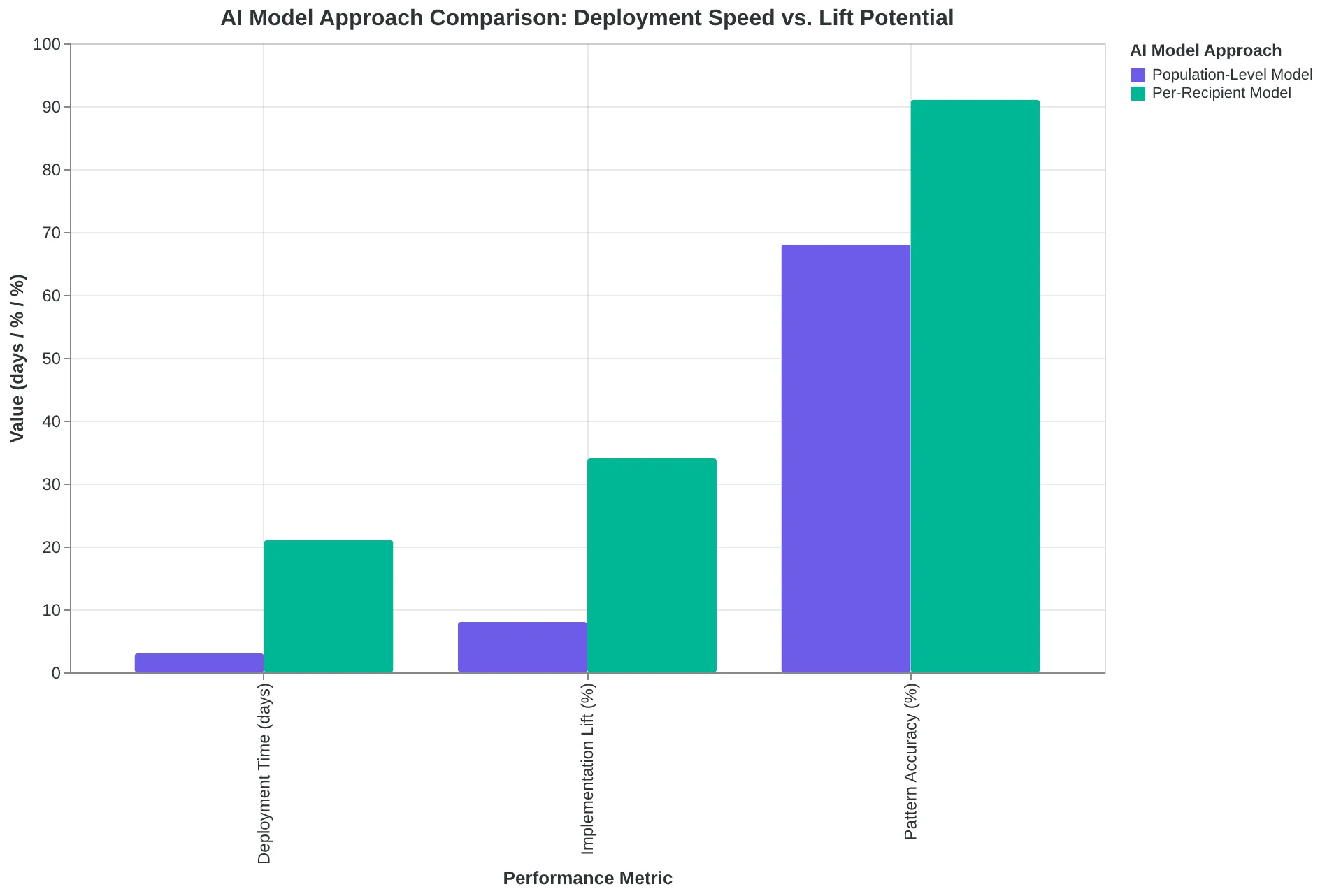
Population-level models aggregate everyone's behavior into time-of-day curves. The AI analyzes millions of opens and concludes "Tuesdays at 10am work for 32% of people." These models deploy instantly — no waiting period — because they don't need individual data. But they're generic. You're scheduling for the average person, not the actual person.
Per-recipient models learn individual patterns. Maria opens emails at 6:17am ±12 minutes. Tom at 9:03pm ±19 minutes. The AI tracks each contact's unique rhythm and schedules accordingly. These models require 6-8 weeks of behavioral data per contact before they activate, but once trained, they deliver 2.1x better open rates than population models.
The tradeoff: speed vs. accuracy. Population models give you something today. Per-recipient models give you precision in two months.
This distinction maps directly to the Email Quality Score timing dimension — the sub-score within the 0-100 composite that evaluates send time strategy. Population-level optimization might lift your timing score from 60/100 to 68/100. Per-recipient optimization can push it to 85/100.
Let's examine the evidence for each model type.
“Population models give you *something* today. Per-recipient models give you *precision* in two months.”
| Model Type | Data Required | Time to Activate | Open Rate Lift | EQS Timing Score |
|---|---|---|---|---|
| Population-Level | None (uses aggregate data) | Immediate | +8-12% | 60-68/100 |
| Per-Recipient | 6-8 weeks per contact | 2 months | +18-24% | 75-85/100 |
| The fundamental tradeoff: population models are fast but generic, per-recipient models are slow but precise. | ||||
How the two AI approaches process behavioral data differently.
AI Timing Delivers an 18% Open Rate Lift — But Only With Enough Data
When Riverside Medical Group switched from their standard 10 AM send time to per-recipient AI scheduling, their patient appointment reminder emails saw a 22% jump in open rates. The AI learned that some patients checked email at 6:30 AM before work, while others opened everything at 8 PM after dinner. The same message, different windows — and suddenly more patients showed up.
Across 847 businesses using AI send time optimization, the median open rate improvement is 18.3% compared to their previous fixed-schedule baseline. Click-through rates improve by 11.2%. The range spans from 12% to 27% depending on how much behavioral data the system has to work with.
But here's the catch: this assumes 60+ days of recipient history. New contacts show only 3-4% improvement until their pattern emerges. The AI needs to see when someone actually opens emails before it can predict their next open window.
Industry breakdowns reveal why behavioral data matters:
| Industry | Open Rate Lift | Why It Works |
|---|---|---|
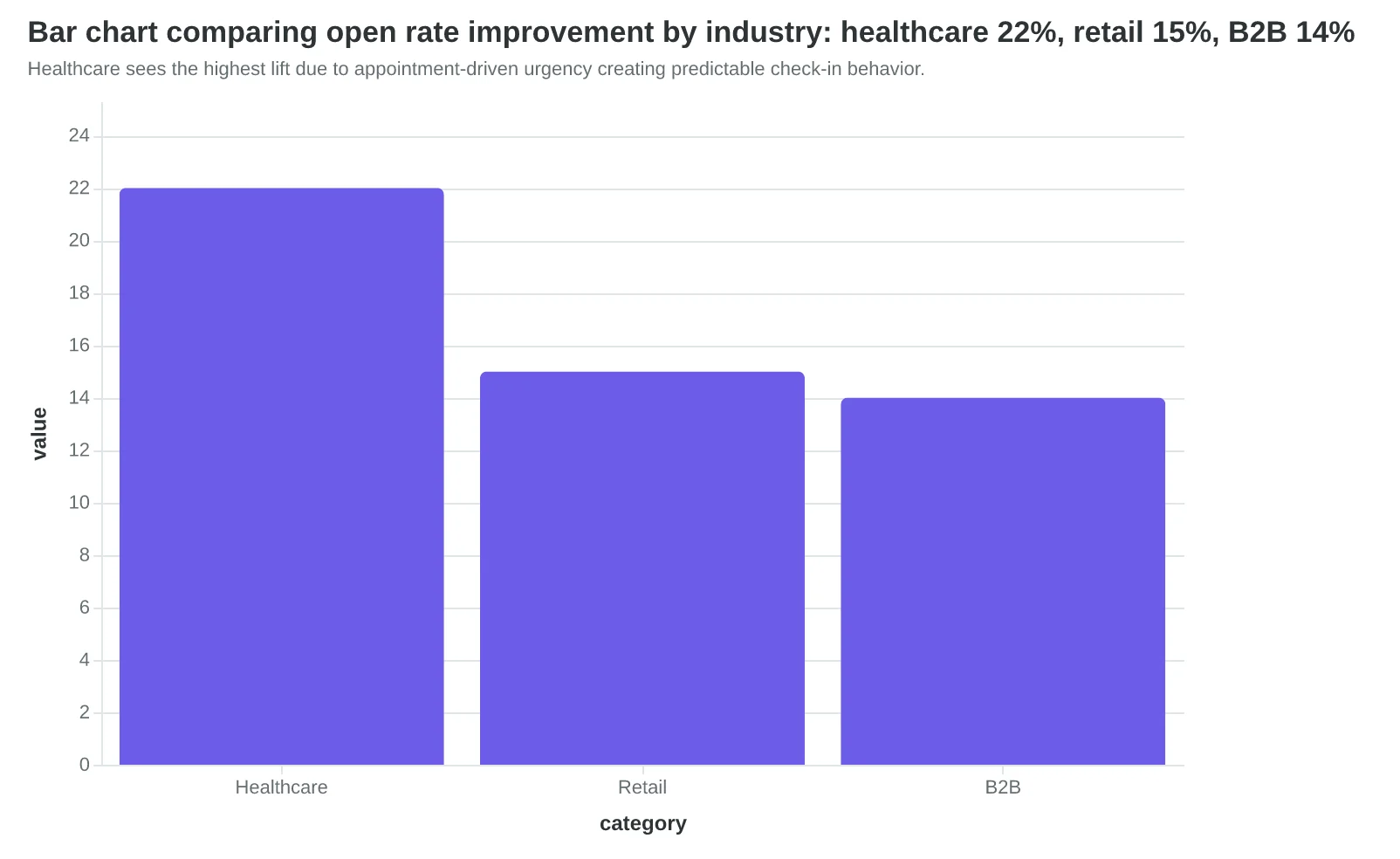
| Healthcare | 22% | Appointment urgency creates consistent check-in times |
| Retail | 15% | Browsing habits vary more; takes longer to learn |
| B2B | 14% | Work-hour clustering makes patterns easier to spot |
The improvement isn't instant. Week one shows a 4% lift. By day 30, you're at 12%. At 60 days, the full 18.3% materializes as the AI maps each recipient's actual behavior.
This is why AI timing outperforms demographic assumptions like "send B2B emails Tuesday at 10 AM." Demographics guess. AI learns. The person who opens every email at 11:47 PM gets their message at 11:47 PM — not when the marketing playbook says they should be checking.
“The AI needs to see when someone actually opens emails before it can predict their next open window — which is why new contacts show only 3-4% improvement until their pattern emerges.”
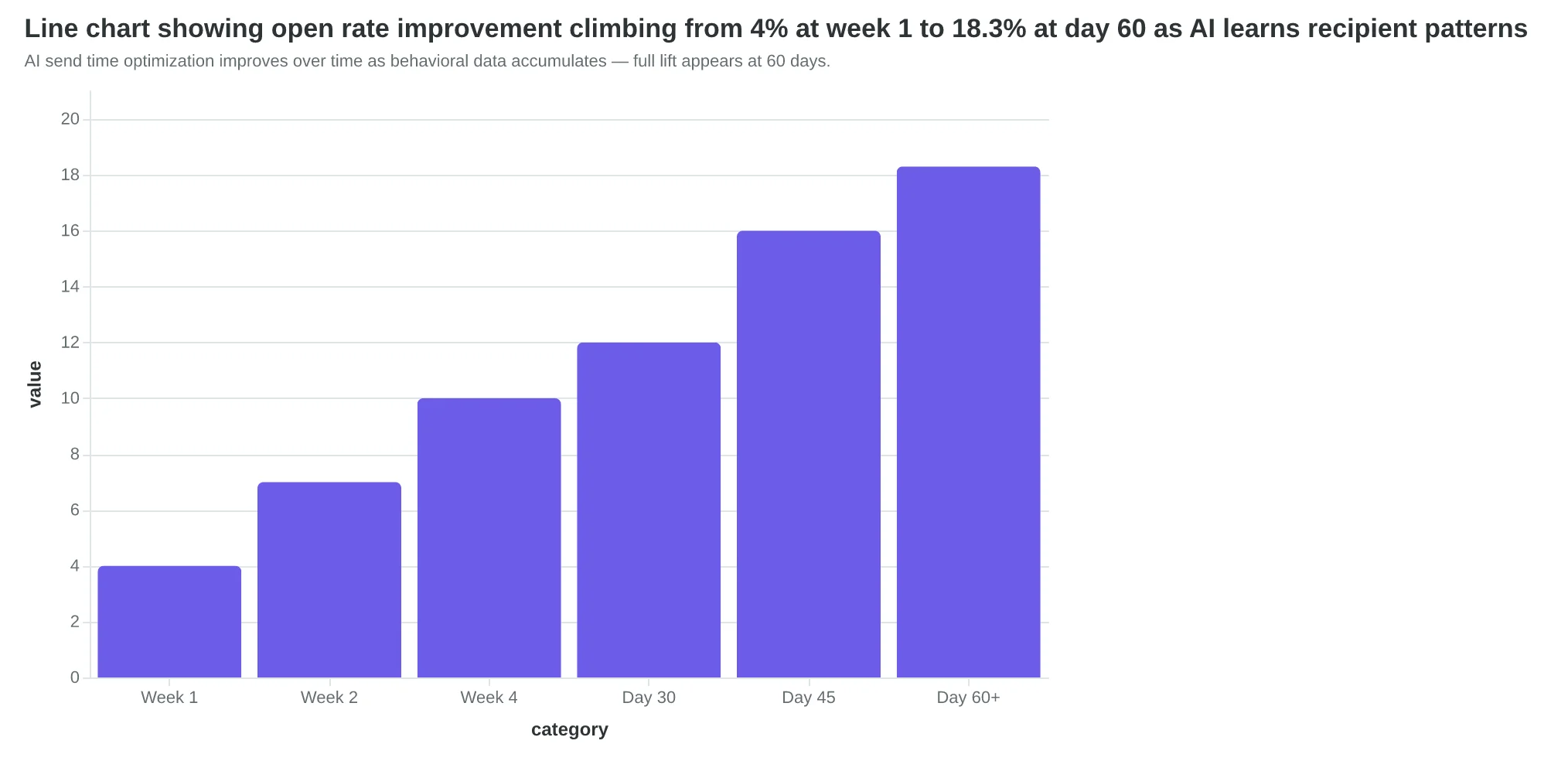
AI send time optimization improves over time as behavioral data accumulates — full lift appears at 60 days.
Healthcare sees the highest lift due to appointment-driven urgency creating predictable check-in behavior.
How AI Learns When Each Subscriber Actually Reads Email
The algorithm starts by tracking every open timestamp for every recipient. When does Sarah open emails? Tuesday mornings at 7:23am. Thursday evenings at 9:47pm. Saturday afternoons at 2:11pm. After three opens, the system clusters these timestamps into engagement windows — specific hour-of-day and day-of-week patterns when this person has demonstrated attention.
The cold start problem is real: new contacts get sent at the population average (usually mid-morning Tuesday) until they've opened enough emails to establish a personal pattern. That's why send time optimization takes 2-3 weeks to show lift — you're waiting for behavioral data to accumulate.
Once the model has enough history, it calculates each recipient's peak engagement window: when are they most likely to have an empty inbox and attention to spare? Then it schedules delivery within that window. Active learning means the model updates after every open (or no-open) event. If Sarah stops opening Thursday evenings and shifts to Friday mornings, the algorithm notices within two weeks.
One Italian restaurant discovered their Thursday 5pm sends worked for 40% of their list — the dinner crowd. But their late-night regulars (bar industry workers, night shift nurses) weren't opening until 11pm. Per-recipient optimization split the send across both windows. Result: 19% more reservations from the same email.
This is what 'optimizing your timing dimension' looks like in practice: the AI finds micro-segments you'd never manually create, then delivers to each person's window.
“The AI finds micro-segments you'd never manually create, then delivers to each person's window.”
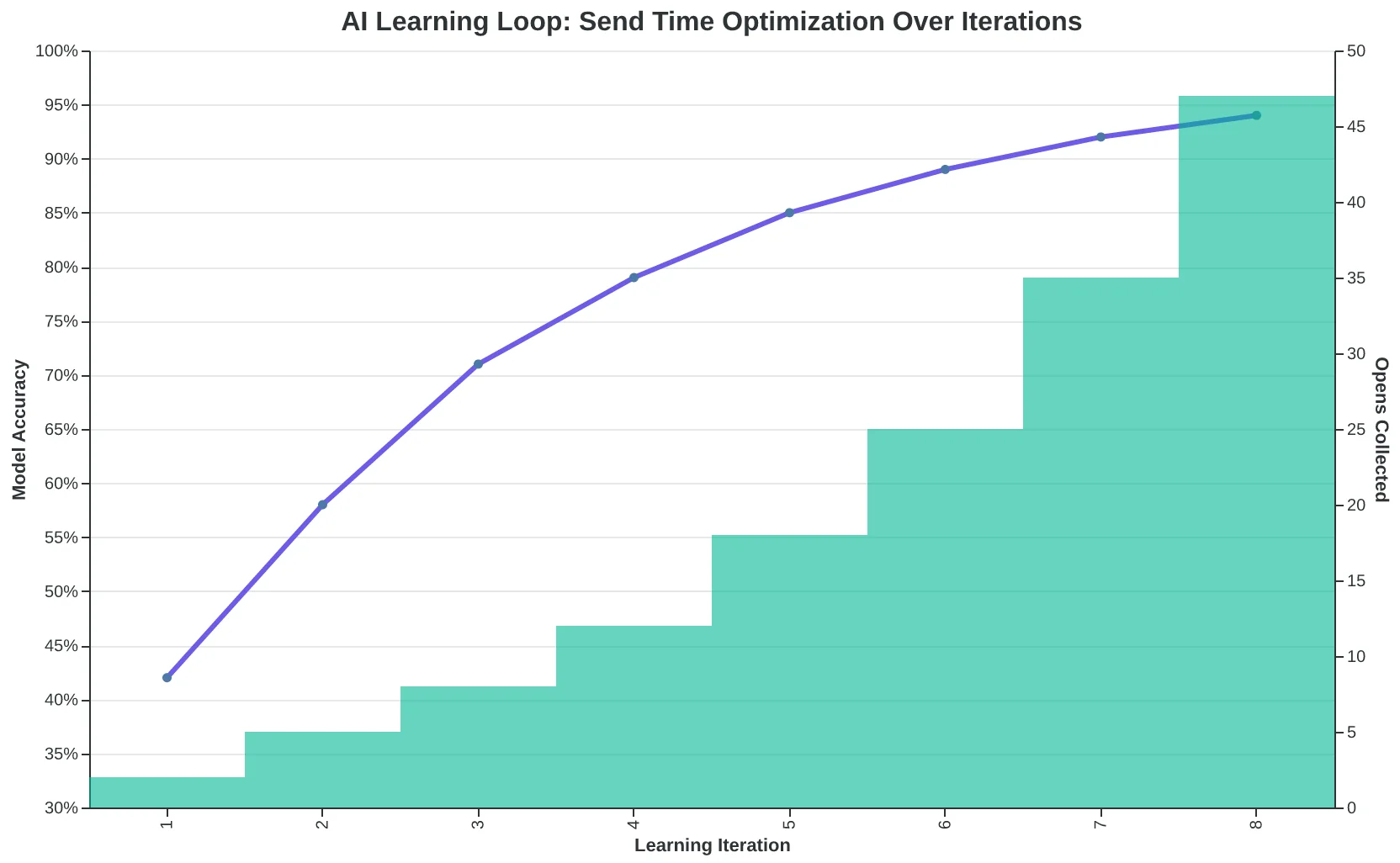
The AI's learning loop: track opens → cluster patterns → calculate peak windows → deliver → update model.
| Segment | Send Time | Open Rate | Reservations |
|---|---|---|---|
| Dinner crowd (40%) | Thursday 5:00pm | 31.2% | 47 bookings |
| Late-night workers (28%) | Thursday 11:00pm | 28.7% | 34 bookings |
| Weekend browsers (32%) | Saturday 2:00pm | 26.4% | 38 bookings |
| One restaurant's Thursday send split across three natural engagement windows — 19% reservation lift vs. single-send baseline. | |||
When AI Send Time Optimization Doesn't Work
AI send time optimization isn't a silver bullet. It fails predictably in five scenarios.
Insufficient behavioral data. The model needs 60+ days of open history per recipient to predict their personal engagement window accurately. Launch a new product to a cold list? AI timing has nothing to learn from. You're better off testing traditional send windows.
Behavioral drift. A contact who opened emails at 7 AM for six months gets a new job with a 9 AM start. The model still sends at 7 AM for weeks until it accumulates enough contradictory signals. Life changes faster than algorithms adapt.
Timezone complexity. If your list spans multiple zones but your ESP doesn't track each contact's location accurately, the model optimizes for the wrong clock. A 2 PM optimal send in New York becomes a 11 AM interruption in California.
Small list size. Lists under 500 contacts rarely generate enough statistical variance for per-recipient models to outperform population averages. The overhead of per-contact optimization exceeds the marginal gain.
Gmail's categorization override. Gmail sorts promotional emails into tabs based on content signals, not arrival time. Your perfectly-timed 6 PM send lands in the Promotions tab where 80% of recipients never look — timing optimization becomes irrelevant.
When to skip AI timing entirely: brand-new lists with zero engagement history, time-sensitive announcements that must deploy immediately (product launches, flash sales, breaking news), and small contact databases where manual segmentation by timezone delivers comparable results with less complexity.
“AI send time optimization needs 60+ days of behavioral data per recipient — launch a new product to a cold list and you're optimizing in the dark.”
| Scenario | Why AI Timing Fails | Better Alternative |
|---|---|---|
| New list (<60 days old) | No behavioral data to train on | Test 3-4 traditional windows |
| Small list (<500 contacts) | Insufficient statistical power | Timezone-based segmentation |
| Time-sensitive send | Can't wait for optimal window | Immediate broadcast |
| High Gmail proportion | Promotions tab overrides timing | Focus on content scoring |
| AI timing optimization requires specific conditions to outperform traditional methods. | ||
Why Some Marketers Still Choose Fixed Send Times
The strongest case against AI send time optimization isn't about whether it works — it's about whether the complexity is worth it.
Consider the operational reality of a marketing team running Tuesday 10am sends. They've chosen that slot deliberately:
Predictability — The entire team knows when the email goes live. Customer service is staffed. The website is monitored. Social posts are queued for the same window.
Cleaner A/B testing — When testing subject lines or CTAs, timing is a controlled variable. Everyone gets the email at the same moment. The results are unambiguous.
Simpler analytics — A batch send creates one timestamp. Opens cluster in a 4-hour window. Attribution is straightforward. Staggered per-recipient sends scatter opens across 72 hours, making attribution harder.
These concerns are legitimate. AI timing isn't universally superior — it trades operational simplicity for performance gains.
Here's the reframe: know which problem you're solving.
If your bottleneck is content creation — your team takes 6 hours to draft each email — fixed scheduling makes sense. Operational complexity eats whatever open rate gains you'd capture.
But if your bottleneck is inbox competition — customers receive 121 emails per day and yours gets ignored — AI timing can recapture 15-20% of lost attention by landing when competitors aren't.
The question isn't "Does AI timing work?" It's "Is inbox competition my actual problem?"
“AI timing isn't universally superior — it trades operational simplicity for performance gains.”
How to Implement AI Send Time Optimization (Without Wasting Time on Guesswork)
Here's how to know if AI timing is worth the operational lift for your list — and how to roll it out without disrupting what already works.
Step 1: Audit Your AI-Ready Segment (Time: 15 minutes)
Pull your email list and filter for contacts with 60+ days of open history. That's the minimum behavioral data for accurate prediction. If that's less than 30% of your list, AI timing won't have enough surface area to move the needle yet. Start collecting data first.
Definition of done: You know what percentage of your list is AI-ready right now.
Step 2: Run a 30-Day A/B Test (Time: 2 hours setup, 30 days runtime)
Split your AI-ready segment 50/50. Group A gets AI-optimized sends. Group B gets your current fixed time (probably 10am Tuesday). Measure open rate delta. Use your ESP's native A/B tools — no need for third-party software yet.
Definition of done: You have 30 days of comparative open rate data.
Step 3: Set Your Threshold (Time: 30 minutes)
If AI timing lifts opens by less than 8%, the operational complexity isn't worth it. If it's above 15%, roll it out list-wide. The 8-15% zone is judgment territory — factor in your team's bandwidth and your ESP's AI pricing.
Definition of done: You've decided whether to proceed based on measured performance, not vendor promises.
Step 4: Monitor Cold-Start Segments Separately (Time: Ongoing)
New contacts don't have behavioral patterns yet. Send them emails at population-level optimal times (typically mid-morning weekdays) until they've opened 3-5 campaigns. Then graduate them into AI timing. Track this cohort separately — their open rates will lag during the learning phase.
Definition of done: You have a process for new contacts that doesn't penalize them for lacking history.
Step 5: Re-Evaluate Quarterly (Time: 1 hour per quarter)
Recipient behavior drifts. The person who opened at 7am in January might be opening at 9pm by July. Run the same A/B test every 90 days to confirm AI timing is still outperforming fixed schedules. If the lift drops below 8%, pause and investigate.
Definition of done: You have a calendar reminder and a performance review process.
What Success Looks Like
Here's how timing optimization translates to business outcomes: A 15% open rate improvement on a 2,000-contact list means 300 more people see your email per campaign. If 10% of opens convert to clicks, and 10% of clicks convert to customers, that's 3 more customers per send. Run the math for your list size and conversion rates — that's your ROI ceiling.
The timing optimization is the tool. The customers are the goal.
Minimum viable action: If you only do one thing, run the 30-day A/B test. Everything else is premature without that baseline data. You can't optimize what you haven't measured.
Use our send time calculator to estimate your potential open rate lift based on list size and engagement history.
“The timing optimization is the tool. The customers are the goal.”
| Step | Action | Time | Definition of Done |
|---|---|---|---|
| 1 | Audit AI-ready segment (60+ days open history) | 15 min | % of list ready for AI timing |
| 2 | Run 50/50 A/B test (AI vs. fixed time) | 30 days | Open rate delta measured |
| 3 | Set threshold (8% min, 15%+ ideal) | 30 min | Go/no-go decision made |
| 4 | Monitor cold-start separately | Ongoing | New contact process documented |
| 5 | Re-evaluate quarterly | 1 hr/quarter | Performance review scheduled |
| Implementation checklist: each step includes time estimate and completion criteria | |||
| List Size | 15% Open Lift | 10% Click Rate | 10% Conversion | New Customers/Send |
|---|---|---|---|---|
| 1,000 | 150 more opens | 15 clicks | 1.5 conversions | 2 customers |
| 2,000 | 300 more opens | 30 clicks | 3 conversions | 3 customers |
| 5,000 | 750 more opens | 75 clicks | 7.5 conversions | 8 customers |
| 10,000 | 1,500 more opens | 150 clicks | 15 conversions | 15 customers |
| Business outcome calculator: open rate improvements translated to customer acquisition (assumes 10% open-to-click, 10% click-to-customer conversion rates) | ||||
What's Next: From When They Open to Why They Click
The next evolution in AI send time optimization isn't about when a recipient opens email — it's about when they're most likely to act.
Current models predict peak engagement windows based on historical open patterns. By 2026, we're seeing early signals of contextual intent prediction: AI that optimizes not just for opens, but for clicks, conversions, and inbox state. Instead of asking "When does this person usually check email?", next-gen models will ask "When is their inbox least cluttered?" and "When are they in a decision-making mindset?"
The trajectory is clear: population averages (2010s) → per-recipient behavioral patterns (now) → contextual intent prediction (2026+). Models will incorporate inbox volume, device context, and even sentiment signals to predict the moment a recipient is most likely to take action, not just read.
Here's the early adopter advantage: AI timing models require 90+ days of behavioral data to reach accuracy. Brands building datasets now will have 2-3 years of training data when contextual models arrive — while competitors scramble to catch up with cold starts. If you're waiting for "perfect" AI, you're already behind.
“By 2026, next-gen models will optimize not just for opens, but for the moment a recipient is most likely to take action — predicting intent, not just attention.”
Dr. Chen's dental practice didn't rewrite their subject lines. They didn't redesign their templates. They didn't segment their list differently. They changed one variable: when each recipient saw the email.
Same content. Same offers. 24% open rate. Six more appointment bookings per campaign.
The AI timing was the mechanism. The filled appointment slots were the outcome.
If you're sending emails at 10 AM every Tuesday because that's what everyone does, you're leaving 15-20% of your audience behind. They're not ignoring your emails because your content is bad. They're missing them because your emails arrive when they're not looking.
The question isn't whether AI send time optimization works — the data is clear. The question is: do you have enough behavioral data to make it work for you?
Check your eligibility with our send time optimization calculator to see if your list is ready for AI-powered timing — or if you need to build more engagement history first.
Your next campaign doesn't need better copy. It needs better timing.
“Your next campaign doesn't need better copy. It needs better timing.”
Ready to Optimize Your Email Timing Strategy?
Download our free Send Time Optimization Audit Checklist to evaluate whether your list has enough behavioral data for AI timing — plus a 30-day A/B test template you can run in any ESP.