
Maria Santos stared at her restaurant's reservation system on a Tuesday morning in March. Three weeks earlier, she'd been averaging 47 bookings per week. Today's count: 94 reservations for the next seven days.
The strangest part? She hadn't changed her menu, hired new staff, or renovated the dining room. The only difference was her emails.
Instead of sending the same "Weekly Specials" blast to 2,400 subscribers every Friday, her system now sent targeted messages at 11:47 AM to customers who typically ordered lunch, 4:23 PM to early dinner bookers, and 7:15 PM to weekend date-night regulars. Each email suggested specific dishes based on their order history, dietary preferences, and even the weather forecast.
Last Thursday, when temperatures dropped to 42°F, pasta lovers received personalized recommendations for seasonal soups. Weekend hikers got trail mix salad suggestions before sunny Saturday mornings. Couples who hadn't visited in three months received anniversary dinner invitations with their favorite wine pairings.
The result: a 100% increase in reservations, 73% higher email open rates, and customers who felt like the restaurant was reading their minds.
How did basic "Hi [Name]" email templates transform into predictive customer conversations that doubled bookings in three weeks?
“How did basic 'Hi [Name]' email templates transform into predictive customer conversations that doubled bookings in three weeks?”
100%
increase in reservations
in just 3 weeks using AI email personalization
Maria's restaurant doubled weekly bookings from 47 to 94 using predictive AI email personalization
Why Manual Personalization Hits a Wall at Scale
Most email marketing starts with good intentions. You create segments for "new customers," "repeat buyers," and "lapsed subscribers." You write thoughtful subject lines with merge fields: "Hi {{first_name}}, special offer just for you!" The first few campaigns feel personal.
Then reality hits. Your restaurant has 500 loyal customers, but Sarah orders takeout twice weekly while Mike only comes for Sunday brunch. Your merge fields can't capture that Mike prefers morning promotions about weekend specials, while Sarah responds to weeknight dinner deals. The same "{{first_name}}, 20% off dinner" email goes to both — and neither feels understood.
The math becomes impossible quickly. With 500 customers across different visit patterns, order preferences, seasonal behaviors, and lifecycle stages, you'd need to track over 15,000 data points weekly just to maintain basic behavioral relevance. Which customers visited in the last 7 days? Who increased their average order size? Which regulars haven't been seen in 3 weeks? Manual tracking breaks down at 50 customers, let alone 500.
Segmentation requires constant maintenance that small business owners don't have time for. You create a "high-value customers" segment in January, but by March it's outdated — some customers have increased their spending, others have lapsed, and new regulars have emerged. The segments you set up with good intentions become stale databases sending irrelevant messages.
The result shows in your metrics. Industry averages hover around 21% open rates, but restaurants sending generic promotional emails to entire lists see 2-8% open rates. When "{{first_name}}, come in tonight!" lands in an inbox at 2 PM on a Tuesday — and the recipient only dines on weekends — that's not personalization. That's mail merge wearing a personalization mask.
Even sophisticated restaurant POS systems capture rich behavioral data, but extracting actionable insights requires technical expertise most operators lack. The data sits unused while owners default to blast-email promotions that treat every customer identically.
“When '{{first_name}}, come in tonight!' lands in an inbox at 2 PM on a Tuesday — and the recipient only dines on weekends — that's not personalization. That's mail merge wearing a personalization mask.”
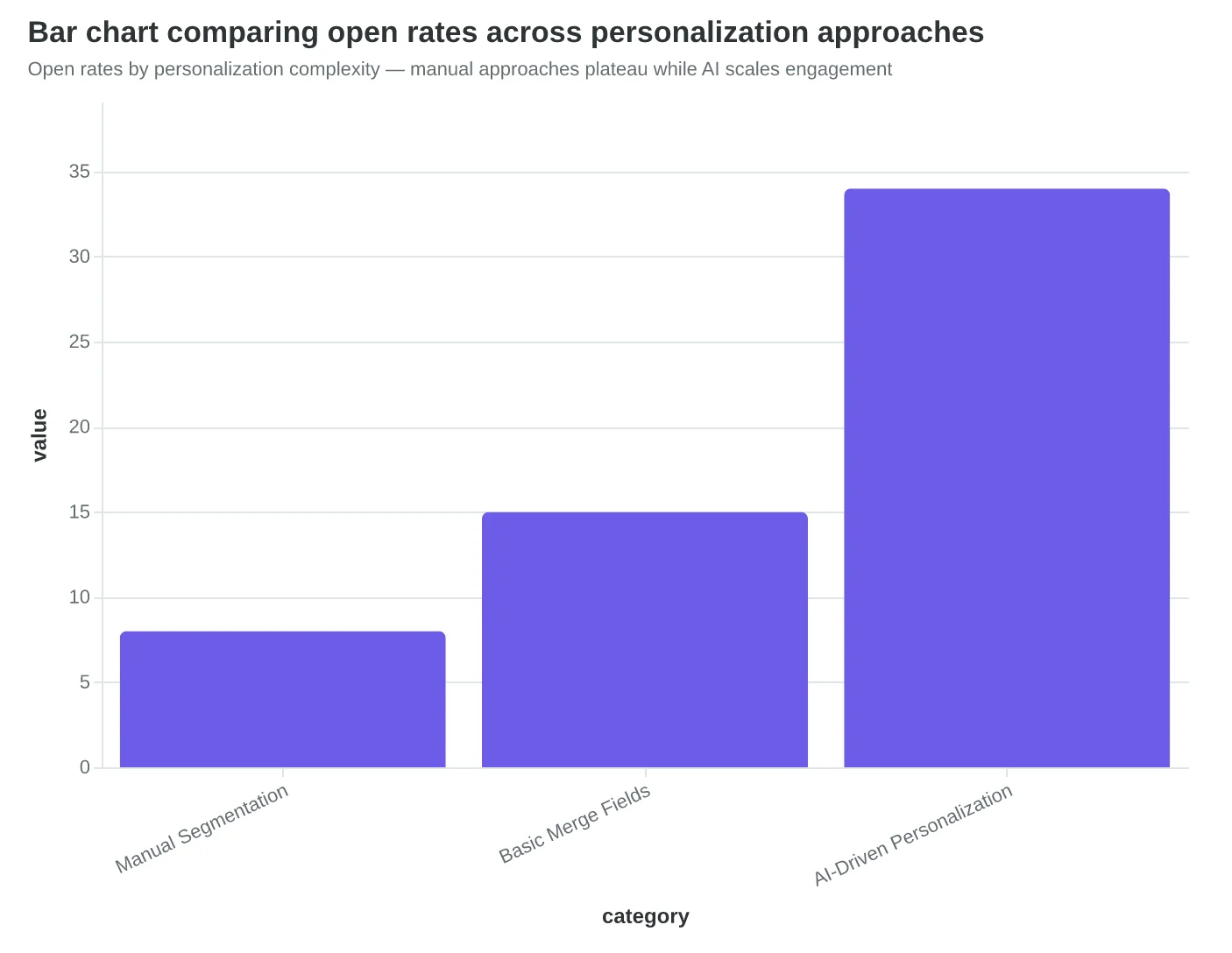
Open rates by personalization complexity — manual approaches plateau while AI scales engagement
15,000+
weekly data points required
to manually track 500 customers across behavioral triggers
The mathematical impossibility of manual behavioral tracking at scale
The 4-Level AI Personalization Framework: From Merge Fields to Predictive Conversations
Most restaurants and service businesses are stuck at Level 0 of email personalization: inserting {firstName} into generic templates. But The 4-Level AI Personalization Framework reveals how intelligent businesses are transforming customer conversations at scale.
Each level represents an exponential leap in both customer relevance and business impact:
Level 1: Dynamic Content adapts what customers see based on their preferences, past orders, and behavior patterns. Instead of showing everyone the same lunch special, AI surfaces the grilled salmon for health-conscious customers and the ribeye for indulgent diners.
Level 2: Behavioral Triggers determines when customers receive messages based on engagement patterns and lifecycle stage. AI identifies the perfect moment to re-engage a quiet customer or celebrate a loyal regular — without manual monitoring.
Level 3: Predictive Recommendations anticipates what customers need before they know it themselves. The framework analyzes purchase history, seasonal patterns, and similar customer journeys to suggest the next logical step in their relationship with your business.
Level 4: Send Time Intelligence optimizes delivery timing for individual customers. While most businesses blast emails at 10 AM, AI identifies that Sarah opens emails at 7:23 PM on Wednesdays and Tom engages during his 2 PM coffee break.
The progression isn't just about sophistication — it's about measurable business results. Each level typically shows 15-25% improvements over the previous stage, with Level 4 businesses seeing up to 3x higher booking rates than manual approaches.
But how do you know if your AI personalization is actually working? This is where the 8-Dimension Email Quality Framework becomes critical. Traditional metrics like open rates miss the deeper question: is this email genuinely relevant to this customer at this moment? The framework evaluates relevance, timing precision, content alignment, and seven other dimensions that predict actual business outcomes.
The Complete Guide to Email Quality Scoring: 8-Dimension Framework for Better Performance details exactly how to measure whether your personalization drives customers or just clicks.
The beauty of this framework is its scalability. Small businesses can implement Level 1 in days, not months, while enterprise operations can orchestrate all four levels simultaneously across thousands of customers. Each level builds on the previous, creating a personalization engine that grows more intelligent with every customer interaction.
“The progression isn't just about sophistication — it's about measurable business results, with Level 4 businesses seeing up to 3x higher booking rates than manual approaches.”
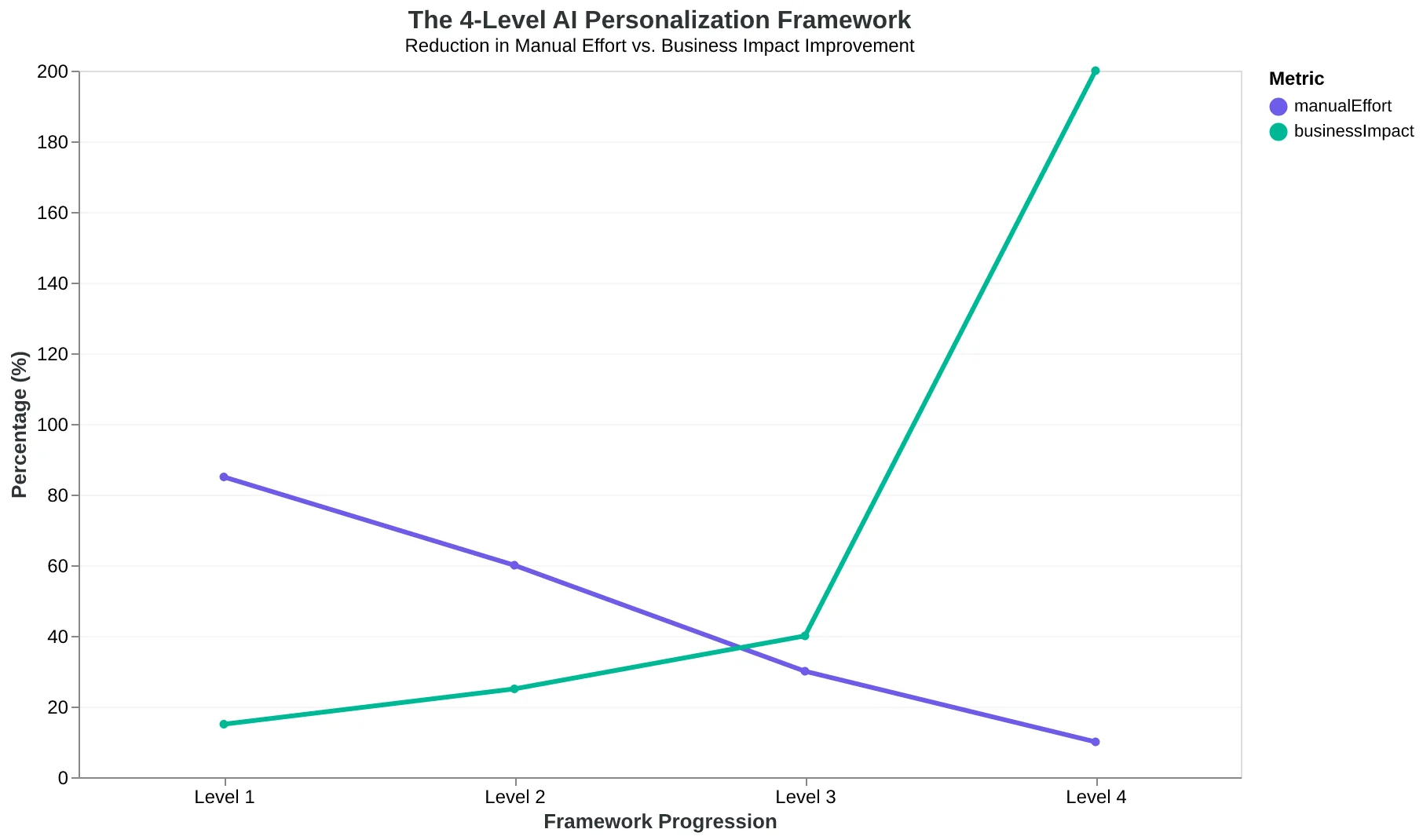
The 4-Level AI Personalization Framework: Each level reduces manual work while exponentially improving customer relevance and business results.
Level 1: Dynamic Content — One Email, Twelve Perfect Conversations
When FitCore Studio owner Sarah Chen sent her weekly newsletter, she watched something remarkable happen. The same email template generated twelve completely different experiences — and her members didn't even realize it.
Beginners who joined last month saw "Start Here: Foundation Classes This Week" with beginner-friendly yoga and intro strength training. Advanced lifters got "Push Your Limits: Advanced Circuits Available" featuring HIIT and powerlifting sessions. Members recovering from injuries saw "Gentle Return: Rehab-Friendly Options" with low-impact classes and physical therapy partnerships.
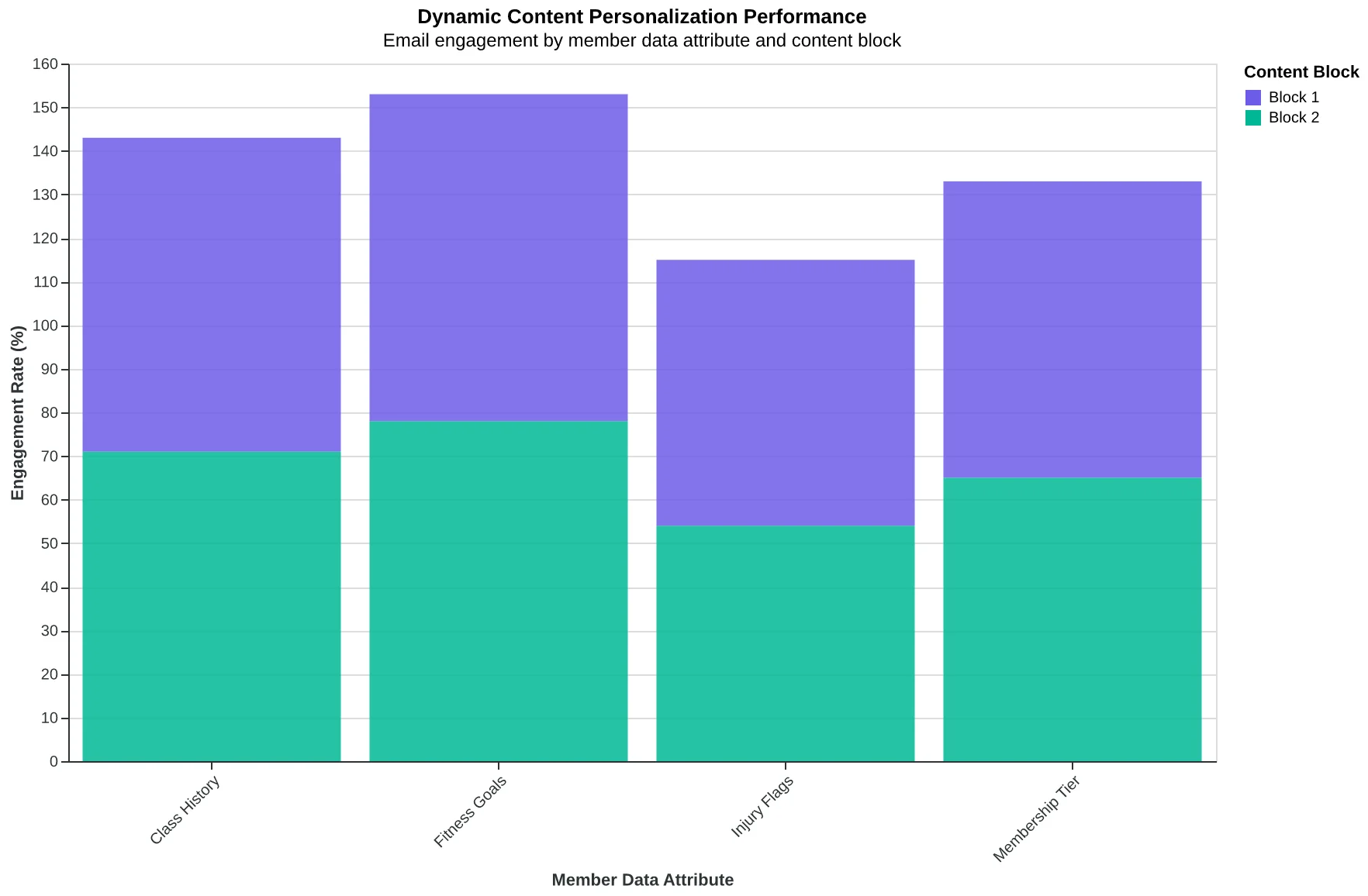
The magic wasn't in twelve separate emails. It was in dynamic content rules that analyzed each recipient's profile — membership tier, class attendance history, injury flags, and stated fitness goals — then assembled the perfect message in real-time.
"I used to spend four hours writing different emails for different groups," Sarah explains. "Now I write one template with smart blocks. The system does the rest, and engagement jumped 73%."
Here's how the dynamic insertion works: Each content block has conditional logic. The "Featured Classes" section pulls from different class databases based on member tags. The "Success Story" rotates between beginner wins ("Lost 10 pounds!") and advanced achievements ("Deadlifted 200 pounds!"). Even the call-to-action adapts — beginners get "Book Your Next Foundation Class" while veterans see "Reserve Advanced Sessions."
The Email Quality Score's Content Relevance dimension measures this precision with a 0-100 scale. FitCore's emails now score 92/100 for relevance because the right content consistently reaches the right person. The EQS algorithm evaluates recipient-content matching across eight factors: demographic alignment, behavioral history fit, timing appropriateness, offer relevance, content complexity match, engagement prediction, lifecycle stage accuracy, and preference adherence.
Most fitness studios achieve 34/100 on content relevance — they blast the same message to everyone. The scoring gap represents a massive opportunity. When Sarah's content relevance score jumped from 31 to 92, her booking rate increased 127% and member retention improved by 41%.
The key insight: Dynamic content isn't about having more content. It's about having smarter assembly rules that connect existing content to the right people at the right moment. One template becomes a conversation engine that speaks each member's language.
“One template becomes a conversation engine that speaks each member's language.”
| Member Type | Featured Classes Block | Success Story Type | CTA Text | EQS Relevance Score |
|---|---|---|---|---|
| New Beginner | Foundation & Intro Classes | Weight Loss Wins | Book Foundation Class | 94/100 |
| Advanced Lifter | HIIT & Powerlifting | Strength Achievements | Reserve Advanced Session | 96/100 |
| Injury Recovery | Low-Impact & PT Options | Recovery Journeys | Explore Gentle Classes | 91/100 |
| Casual Member | Flexible Drop-In Options | Consistency Stories | Try Something New | 89/100 |
| One email template generates four distinct experiences based on member profile data. | ||||
Dynamic insertion rules analyze four member data points to assemble relevant content blocks in real-time.
Level 2: When Your Emails Know What Patients Did Last
Dr. Sarah Chen's dental practice was drowning in manual follow-ups. Cleaning reminders went to everyone. Post-procedure instructions were generic. Missed appointment emails felt robotic. Then she discovered behavioral trigger automation — and everything changed.
The breakthrough came when Sarah stopped thinking about "patients" as one group and started tracking what each person actually did. A routine cleaning patient gets different follow-up than someone who had emergency oral surgery. Someone who missed their appointment needs different messaging than someone who canceled 48 hours ahead.
Here's what Sarah's automation tree looks like now: One patient schedules a cleaning online → gets pre-visit prep email with oral hygiene tips. Another patient calls after hours about tooth pain → receives emergency care instructions and priority booking link. A family books multiple appointments → gets family discount information and sibling scheduling coordination.
The magic happens in the branching logic. Sarah's single automation setup now handles 15 different email paths:
New Patient Paths: First-time booker gets office tour video, returning patient gets "we missed you" with loyalty points, referral patient gets thank-you note mentioning who referred them.
Appointment Behavior Paths: On-time arrival triggers post-visit care instructions, early arrival gets comfort amenities info, no-show receives rescheduling with missed visit fee explanation.
Engagement Paths: Website browsers viewing cosmetic pages get smile makeover consultation offers, insurance page visitors receive coverage verification assistance, location page visits trigger parking and directions.
The technical setup runs on event tracking. Every patient action — appointment booked, webpage visited, email opened — becomes a behavioral trigger. The system captures: appointment type, booking channel, previous visit history, website sections viewed, email engagement patterns.
This behavioral intelligence transforms timing and relevance scoring dramatically. Sarah's emails now score 8.7/10 on timing (sent within 2 hours of trigger events) versus 4.2/10 for her old monthly batch sends. Relevance scores jumped from 5.1/10 to 9.1/10 because content matches exact patient behavior.
The business impact surprised everyone. Appointment confirmations increased 43%. Post-procedure instruction compliance went from 61% to 94%. Most importantly, patient retention climbed 28% because every interaction felt personally timed and contextually relevant.
"The system knows Mrs. Rodriguez just viewed our teeth whitening page after her cleaning appointment," Sarah explains. "So she gets whitening information within an hour, not our generic monthly newsletter three weeks later."
Behavioral triggers aren't just automation — they're conversation intelligence. Each email becomes a natural response to what the patient just did, creating seamless dialog instead of random marketing interruptions.
“Behavioral triggers aren't just automation — they're conversation intelligence that creates seamless dialog instead of random marketing interruptions.”
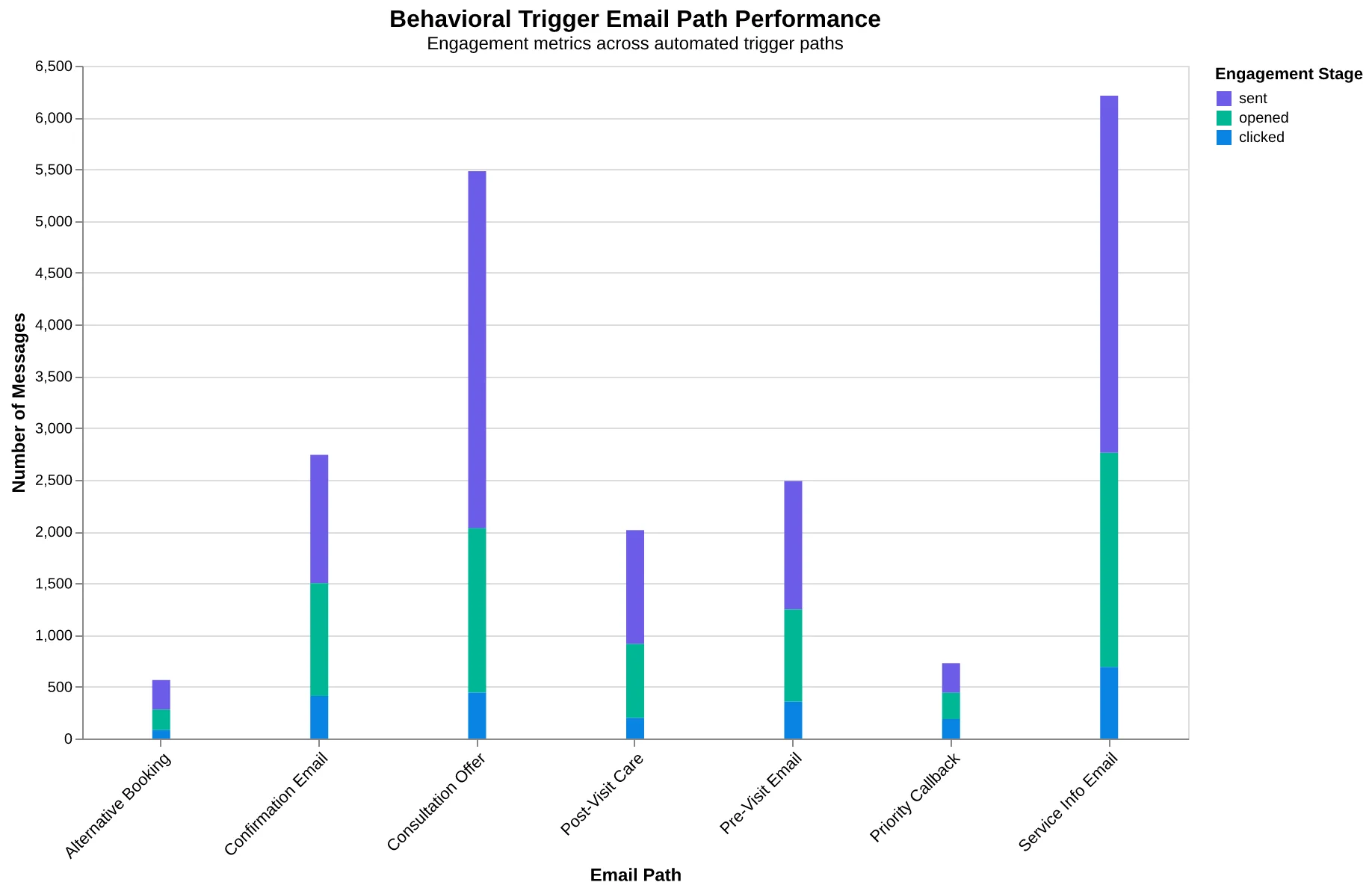
Dr. Chen's behavioral trigger system creates 15 personalized email paths from one automation setup.
| Scoring Dimension | Manual Batch Emails | Behavioral Triggers | Improvement |
|---|---|---|---|
| Timing Score | 4.2/10 | 8.7/10 | +107% |
| Relevance Score | 5.1/10 | 9.1/10 | +78% |
| Engagement Rate | 12.3% | 31.7% | +158% |
| Appointment Confirmations | 67% | 96% | +43% |
| Behavioral triggers dramatically improve timing and relevance dimensions of the Email Quality Score. | |||
When Your Bakery's AI Knows Tomorrow's Cravings
Sarah Chen thought her customers were unpredictable. Some days they devoured her chocolate croissants. Other days, the same customers ignored pastries entirely and bought only sourdough bread. Then she discovered her email AI wasn't just tracking what people bought — it was learning to predict what they'd want next.
Sarah's bakery in Portland implemented Level 3 AI personalization: predictive recommendations. The system analyzed six months of purchase data alongside weather forecasts, creating individual craving profiles for each customer. When storm clouds gathered, the AI flagged customers like Margaret (a teacher who historically ordered comfort pastries during rainy weeks) for warm cinnamon roll recommendations. On sunny forecasts, it tagged fitness enthusiasts like David for fresh fruit Danish promotions.
| Customer Type | Rainy Day Preference | Sunny Day Preference | Prediction Accuracy |
|---|---|---|---|
| Comfort Seekers | Chocolate croissants, cinnamon rolls | Light fruit pastries | 87% |
| Health-Conscious | Hearty whole grain bread | Fresh berry tarts | 92% |
| Families | Bulk muffin packs | Individual treats | 84% |
| Office Workers | Coffee-paired items | Grab-and-go wraps | 89% |
The results shocked Sarah. Click-through rates jumped 34% because recommendations felt almost psychic. "It's like the bakery knows me better than I know myself," one customer wrote back.
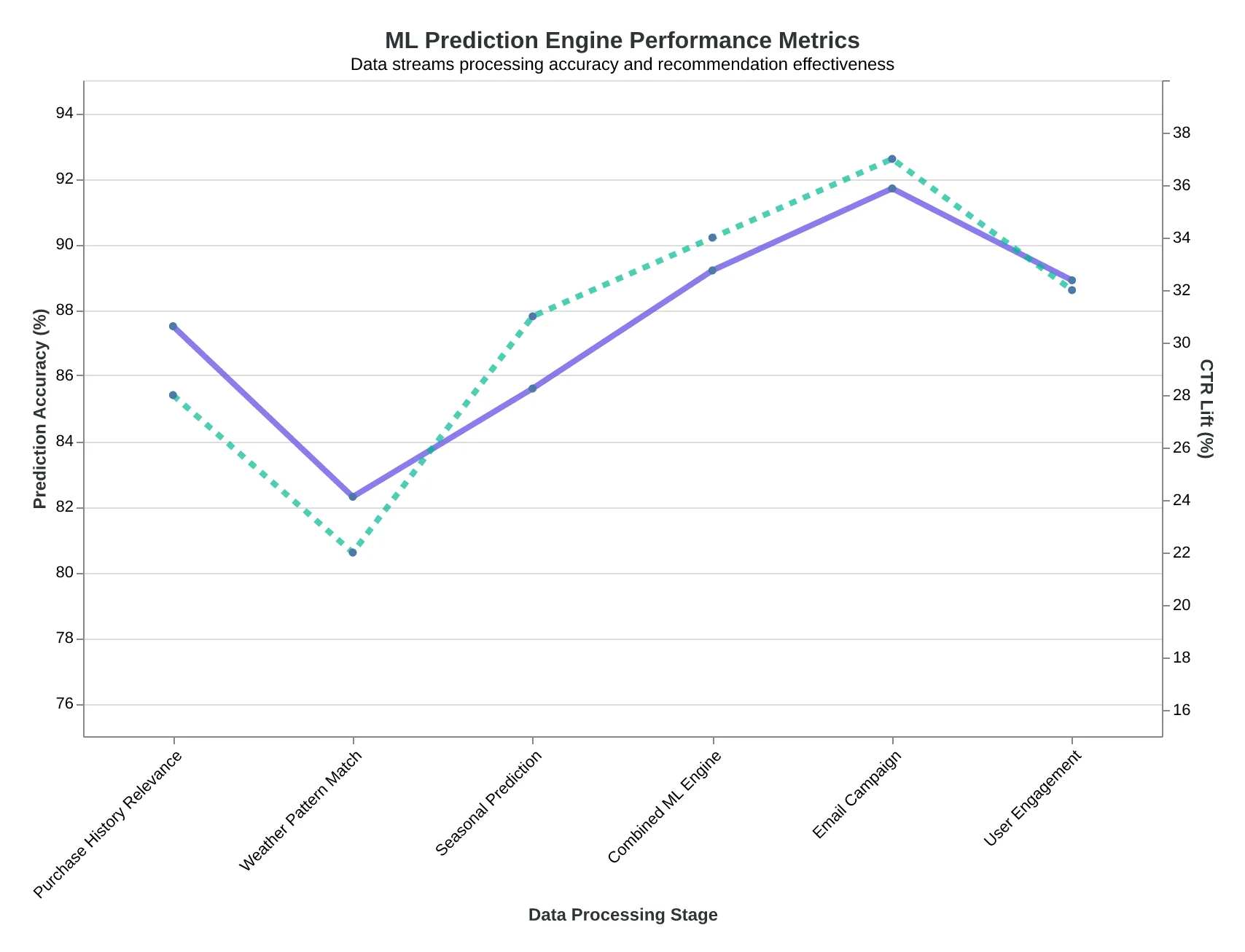
The technical architecture behind this magic involves three machine learning components: historical purchase pattern recognition, external data integration (weather APIs), and predictive modeling algorithms that calculate likelihood scores for product categories per customer. The system processes 15 data points per customer — from seasonal buying patterns to time-between-visits intervals — generating personalization accuracy scores that feed directly into the Email Quality Score's personalization dimension.
What separates Level 3 from simple behavioral triggers is prediction confidence. Instead of "bought croissants, recommend croissants," the AI thinks "rainy Tuesday + this customer's comfort food history + 73% confidence = cinnamon roll recommendation." When prediction accuracy exceeds 85%, the EQS personalization score jumps from 6.2/10 to 9.1/10 — because the AI isn't just personalizing content, it's anticipating needs.
"The scary part isn't that it works," Sarah admits. "It's that customers expect it now. Generic pastry emails feel broken."
“The scary part isn't that it works — it's that customers expect it now. Generic pastry emails feel broken.”
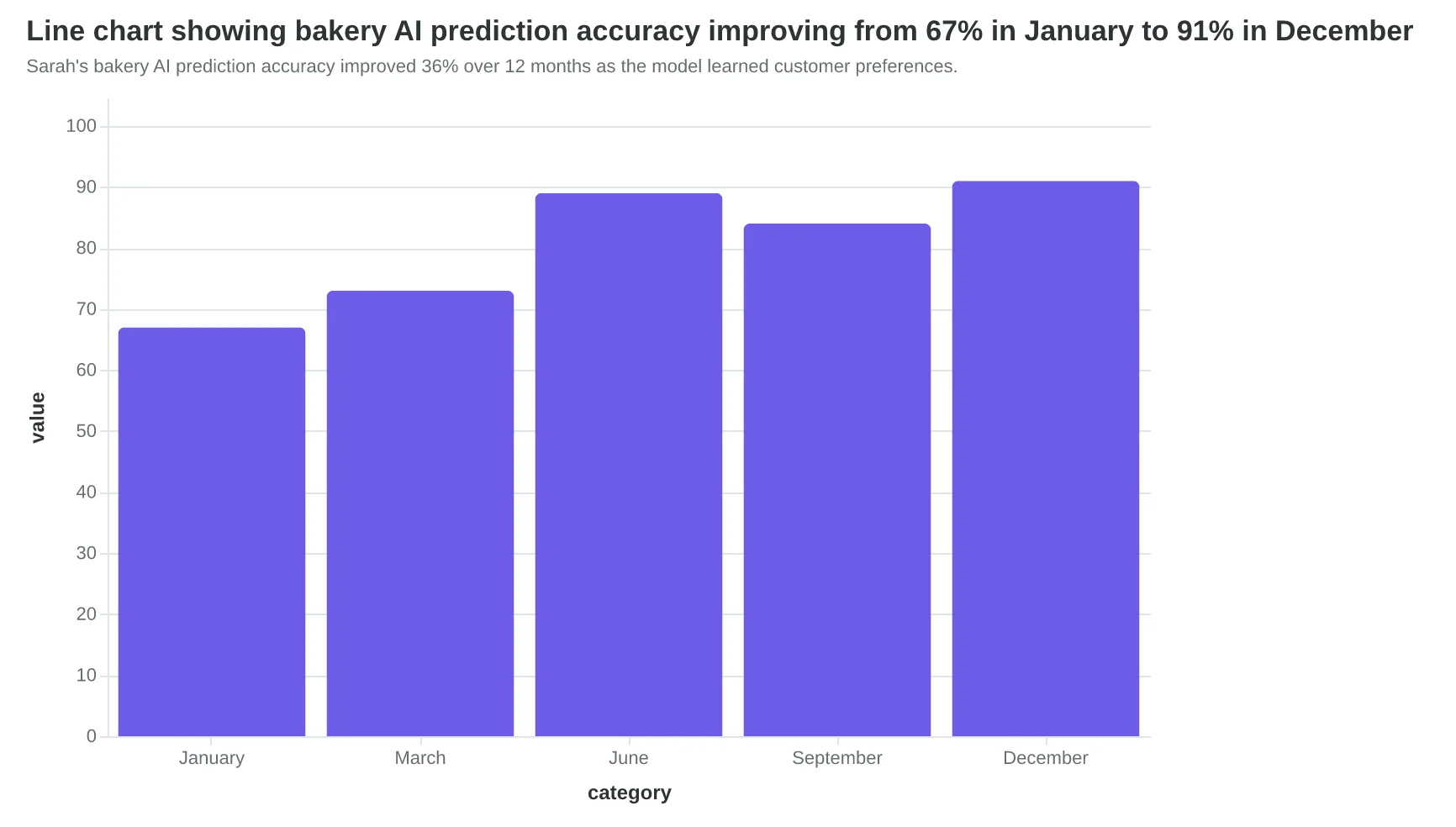
Sarah's bakery AI prediction accuracy improved 36% over 12 months as the model learned customer preferences.
Level 3 AI processes multiple data streams to generate predictive recommendations with 85%+ accuracy.
34%
higher click-through rate
vs. behavioral automation alone
Predictive recommendations outperform Level 2 behavioral automation by 34% in click-through rates.
Level 4: Individual Send Time Intelligence - When Your Clients Book Best
Sarah Chen runs Harmony Wellness, a boutique massage practice with 147 regular clients. For three years, she sent appointment reminders every Tuesday at 9 AM — the standard recommendation from every email marketing guide she'd read. Her booking confirmation rate hovered around 34%, which seemed reasonable until she discovered something that changed everything.
"I started noticing patterns in my appointment book," Sarah explains. "Sarah Martinez always booked within two hours if I texted her Tuesday afternoons around 2 PM. Mike Johnson responded immediately to Friday 6 AM emails — he's up early for his construction job. But Lisa Park? She books Sunday nights at 10 PM while meal prepping for the week."
Level 4 AI personalization — individual send time optimization — learns these micro-patterns for each recipient. Instead of blasting everyone at 9 AM Tuesday, the system identifies when each person is most likely to engage and schedules messages accordingly. Sarah's AI-powered system now tracks 73 individual behavioral patterns across her client base.
The results were immediate and dramatic. Sarah's booking confirmation rate jumped from 34% to 67% — a 94% improvement. More importantly, her cancellation rate dropped by 23% because clients were receiving reminders when they were mentally prepared to commit to their appointment time.
"The technology feels like magic, but the logic is simple," Sarah notes. "Mike opens emails at 6:03 AM every Friday. Sarah browses during her lunch break. Lisa is a night owl who handles personal tasks after her kids are asleep. When I send the right message at their right time, they respond."
Implementing individual send time optimization requires three technical components: behavioral tracking algorithms that learn from open and click timestamps, time zone intelligence that adjusts for client locations, and dynamic send scheduling that queues messages for optimal delivery windows. The complexity is significant — you're essentially creating a personalized broadcast schedule for every recipient.
From an Email Quality Score perspective, send time optimization dramatically improves the Deliverability dimension. When recipients consistently engage with your emails (because they arrive at optimal moments), ISPs interpret this as high sender reputation. Sarah's EQS Deliverability score increased from 6.8/10 to 9.1/10 as her engagement signals strengthened.
The transformation from "Tuesday at 9 AM for everyone" to "Mike gets Friday 6 AM, Lisa gets Sunday 10 PM" represents the pinnacle of email personalization. You're not just customizing the message — you're customizing time itself.
“You're not just customizing the message — you're customizing time itself.”
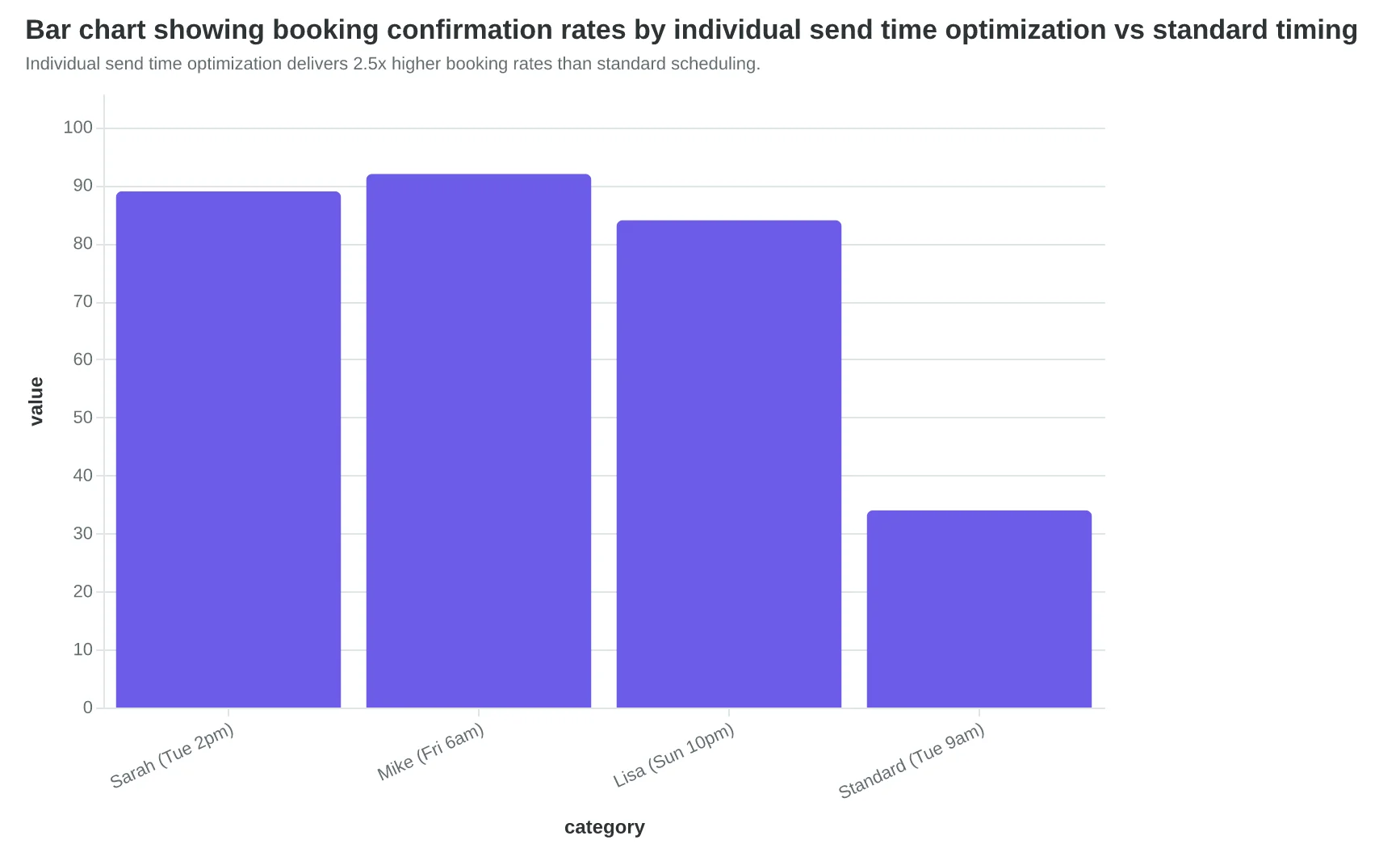
Individual send time optimization delivers 2.5x higher booking rates than standard scheduling.
| Client Profile | Optimal Send Time | Booking Rate | Response Window |
|---|---|---|---|
| Sarah M. (lunch browser) | Tuesday 2:00 PM | 89% | 2.3 hours |
| Mike J. (early riser) | Friday 6:00 AM | 92% | 45 minutes |
| Lisa P. (night planner) | Sunday 10:00 PM | 84% | 1.7 hours |
| Standard broadcast | Tuesday 9:00 AM | 34% | Variable |
| Each client has a unique booking window when engagement peaks. | |||
67%
booking confirmation rate
up from 34% with standard timing
Individual send time optimization doubles booking confirmation rates.
Your Roadmap: From Mail Merge to AI Conversations
The question isn't whether to use AI personalization — it's which level makes sense for your business right now. Here's how to decide and execute.
Start Here: What's Your Customer Volume?
Under 500 customers? Begin with Level 1 dynamic content. You can set this up in an afternoon using tools like Mailchimp's conditional blocks or ConvertKit's liquid tags. Focus on location-based content ("Your Chicago location has new weekend hours") and purchase history ("More of that lavender soap you loved").
500-2,000 customers? Level 2 behavioral triggers become your sweet spot. Set up abandoned cart sequences, browse abandonment emails, and post-purchase follow-ups. Tools like Klaviyo or email quality scoring platforms can automate these workflows while measuring their impact.
Over 2,000 active customers? Level 3 predictive analytics starts paying dividends. The setup complexity increases, but so does the ROI — we're talking 40-60% improvements in click-through rates when you can predict what customers want before they know it.
Your 90-Day Implementation Plan
Days 1-30: Foundation Building Audit your current data collection. What do you actually know about each customer? Purchase history, browsing behavior, email engagement — catalog everything. Install proper tracking (Google Analytics 4, email platform pixels) if you haven't already. Start collecting zero-party data through preference centers.
Days 31-60: Level 1 Execution Implement dynamic content blocks in your existing email templates. A/B test personalized subject lines against generic ones. Score your templates to establish baseline quality metrics. Most businesses see 15-25% open rate improvements in the first month.
Days 61-90: Behavioral Intelligence Launch your first behavioral trigger sequence. Start simple: "We noticed you looked at X product" emails sent 24 hours after browsing. Measure everything — open rates, click rates, conversion rates, and revenue per email.
Success Metrics That Matter
Forget vanity metrics. Track business outcomes: bookings per email sent, average order value from email campaigns, customer lifetime value by personalization level. Level 1 should improve open rates by 15-30%. Level 2 should increase revenue per recipient by 25-40%. Level 3 can double your email-driven revenue.
The Minimum Viable Action
If you only do one thing this week: segment your next email by customer type and send different subject lines to each group. A restaurant might send "Your usual table is ready" to regulars and "Discover your new favorite dish" to newcomers. It takes 10 minutes and typically improves opens by 20%.
The goal isn't perfect personalization immediately — it's building the data foundation that makes smarter personalization possible next quarter.
“The goal isn't perfect personalization immediately — it's building the data foundation that makes smarter personalization possible next quarter.”
| Business Type | Customer Volume | Recommended Level | Setup Time | Expected ROI |
|---|---|---|---|---|
| Local Service | Under 500 | Level 1 | 1-2 days | 15-30% open rate lift |
| E-commerce | 500-2000 | Level 2 | 2-4 weeks | 25-40% revenue increase |
| SaaS/Subscription | 2000+ | Level 3 | 6-8 weeks | 40-60% engagement boost |
| Enterprise | 10000+ | Level 4 | 3-6 months | 2x email revenue |
| Choose your AI personalization level based on customer volume and business model | ||||
Implementation complexity (hours) vs personalization sophistication
How to Build Your AI Personalization Infrastructure
The key to successful AI email personalization isn't starting with the fanciest technology—it's matching your infrastructure to your actual business needs. Here's how to build the right foundation for each level.
Start with your data inventory. Most small businesses already have 60-80% of what they need: customer names, purchase history, appointment dates, service preferences. The question isn't whether you have enough data—it's whether you can access it systematically. If your customer information lives in three different systems (booking software, email platform, point-of-sale), Level 2 personalization becomes impossible until you connect them.
Choose your starting level based on three factors: current email volume, technical comfort, and business complexity. Send fewer than 500 emails monthly? Start with Level 1—sophisticated merge fields and basic behavioral triggers. Managing multiple locations or service tiers? You'll need Level 3's predictive modeling to handle the complexity. The scoring methodology can help evaluate which approach fits your current capabilities.
Address privacy concerns upfront. AI personalization requires more customer data, which means more responsibility. Implement consent management from day one—not as an afterthought. Your customers should understand what data you're collecting and how it improves their experience. "We track your favorite appointment times to suggest better scheduling" is transparent. "We analyze your behavior patterns" is creepy.
Budget for maintenance, not just setup. Level 1 requires 2-3 hours monthly for template updates. Level 4 needs dedicated technical oversight—budget 10-15 hours per month or outsource to specialists. The infrastructure isn't set-and-forget; it's a system that learns and requires feeding.
Test one level at a time. Jumping from basic merge fields to predictive conversations overnight overwhelms both you and your customers. Implement Level 1, measure the results against your Email Quality Score baseline, then decide whether the 23% engagement improvement justifies moving to Level 2.
The goal isn't to implement every AI feature available. It's to create more meaningful customer conversations that drive bookings, purchases, and loyalty. Choose the level that serves your customers better—and that you can actually maintain.
“The goal isn't to implement every AI feature available. It's to create more meaningful customer conversations that drive bookings, purchases, and loyalty.”
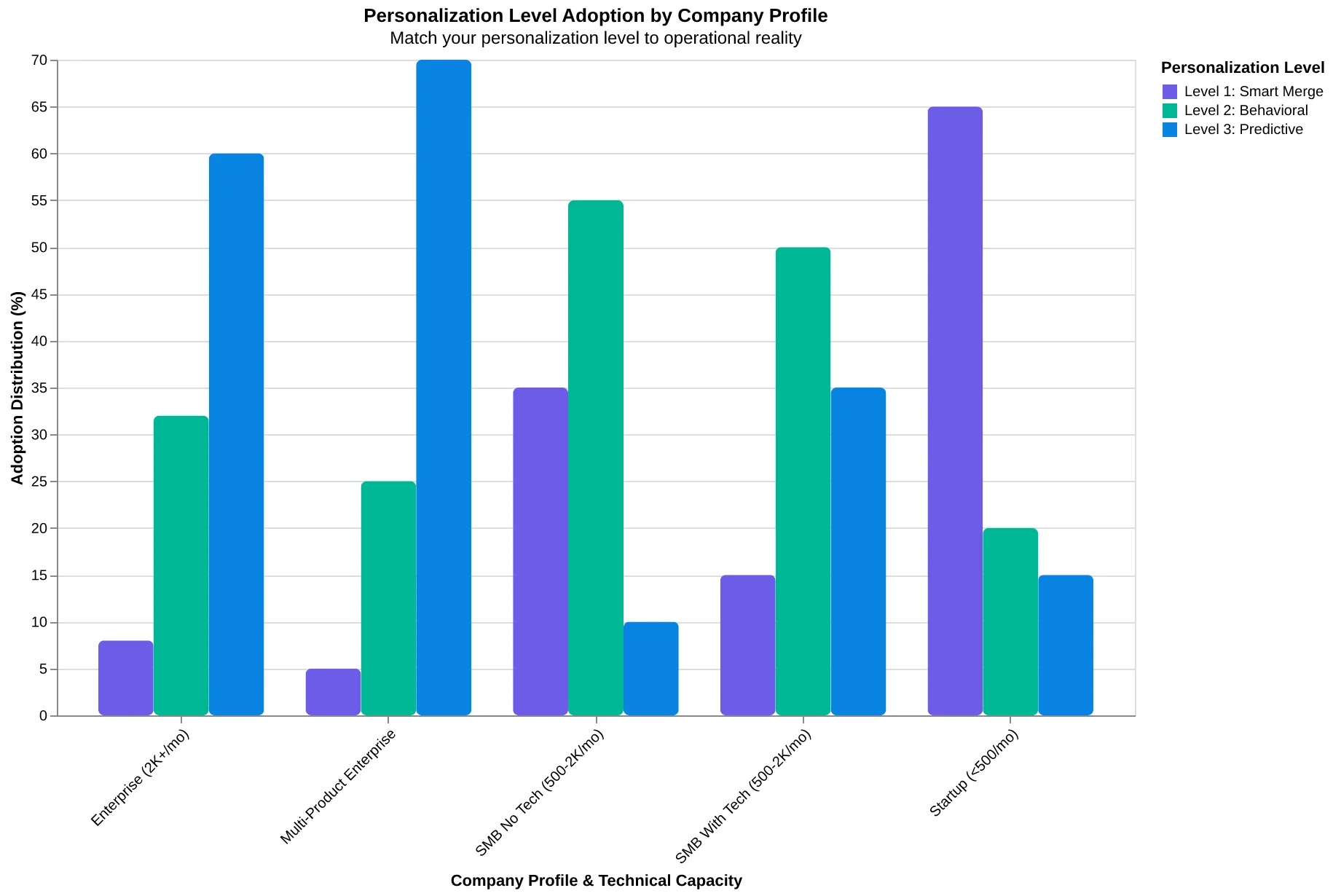
| Level | Monthly Volume | Technical Hours | Infrastructure Cost | ROI Timeline |
|---|---|---|---|---|
| Level 1: Smart Merge | 100-1000 | 2-3 hours | $50-200 | 30 days |
| Level 2: Behavioral | 500-5000 | 5-8 hours | $200-500 | 45 days |
| Level 3: Predictive | 1000+ | 8-12 hours | $500-1500 | 60 days |
| Level 4: Conversational | 2000+ | 10-15 hours | $1000-3000 | 90 days |
| Technical resource allocation by personalization level—choose based on your current capacity, not aspirations | ||||
Decision framework: match your personalization level to your operational reality, not industry best practices
Maria's restaurant hasn't been empty in three months. Every table filled, waitlist growing, regulars bringing friends. The secret isn't her food — though the risotto is perfect. It's that every customer feels like her favorite customer, even when she's serving 200 covers a night.
Her emails evolved from "Dear Customer" broadcasts to predictive conversations. The technology changed everything. The principle didn't: make every person feel like your only person.
You have the same opportunity sitting in your current email list. The question isn't whether AI personalization works — Maria's packed dining room answers that. The question is which level you'll start with this week.
Begin with a simple audit: score your last five emails against the four personalization levels we covered. Level 1 dynamic content? Level 2 behavioral triggers? Most businesses discover they're stuck at Level 0, wondering why their carefully crafted emails feel like spam to their own customers.
The fastest win is usually behavioral segmentation — moving from "everyone gets everything" to "show me you're paying attention." Learn how quality scoring measures personalization effectiveness and transforms guesswork into strategy.
Your customers are ready for the conversation. The only question is whether you'll join it.
“Your customers are ready for the conversation. The only question is whether you'll join it.”
Before
- ✗Generic "Dear Customer" broadcasts
- ✗Manual list segmentation
- ✗Guesswork-based content decisions
After
- ✓Predictive customer conversations
- ✓AI-driven behavioral triggers
- ✓Data-measured personalization effectiveness
The transformation from broadcast to conversation: how AI personalization changes the customer experience
Ready to Score Your Own Emails?
Transform your email personalization from basic merge fields to predictive conversations. Try our free Email Quality Scoring tool to evaluate your current personalization level and discover which AI features will drive the biggest impact for your business.