


Most 'AI email tools' are electric drivetrains bolted onto horse carriages. They make the old way slightly faster, but they miss the revolution entirely.
The real divide in email marketing isn't AI versus no-AI. It's AI-first versus AI-added.
When Tesla designed the Model S, they didn't start with a gasoline car and add batteries. They reimagined what a vehicle could be when electricity was the foundation — the skateboard chassis, the software-defined drivetrain, the over-the-air updates that made the car better after you bought it. Legacy automakers are still bolting electric motors onto platforms designed for internal combustion engines, wondering why their EVs feel like compromises.
Email platforms are at that exact inflection point right now.
AI-added platforms take the email creation workflow you already know — the blank template, the subject line test, the send-and-hope — and sprinkle AI on top. Write faster. Generate three subject lines instead of one. Get a tone suggestion. But you're still guessing whether it'll work until after you hit send.
AI-first platforms eliminate the workflow. They score email quality before you send, using the same 8 dimensions that determine inbox placement and conversions. The Complete Guide to Email Quality Scoring: 8-Dimension Framework for Better Performance breaks down what those dimensions are — and why measuring them in advance changes everything.
The difference isn't features. It's architecture. And architecture determines whether AI makes you faster at guessing or eliminates the guessing entirely.
“Most 'AI email tools' are electric drivetrains bolted onto horse carriages — they make the old way slightly faster, but they miss the revolution entirely.”
Before
- ✗Start with gasoline car platform
- ✗Add electric motor to existing chassis
- ✗Compromise on weight distribution
- ✗Limited battery placement options
- ✗Same old driving experience, slightly quieter
After
- ✓Design from first principles with electricity as foundation
- ✓Skateboard chassis with batteries in floor
- ✓Perfect weight distribution (50/50)
- ✓Software-defined performance updates
- ✓Reimagined driving experience: instant torque, one-pedal driving, autonomous capability
AI-added vs. AI-first: The Tesla analogy. Legacy platforms bolt AI onto workflows designed for manual creation. AI-first platforms eliminate the workflow by scoring quality before you send.
The False Promise of AI-Added Features
Mailchimp's AI will write your subject lines in seconds. Klaviyo's Smart Sending will optimize delivery times. Constant Contact's generative templates will fill in your content blanks. The pitch sounds transformative: AI is coming to save your email marketing.
But here's what actually happens.
You still open the campaign builder. You still drag modules into place. You still write the body copy, choose the CTA, pick the audience segment. The AI speeds up one step — maybe two — but the workflow stays identical. You're still the architect, the copywriter, the QA team, and the strategist. The AI is just a faster pencil.
And when you're done? You still have no idea if the email is any good.
Mailchimp doesn't tell you if your subject line will get flagged as spam. Klaviyo's automation doesn't score whether your flow actually converts. Constant Contact's template doesn't warn you that mobile rendering will break your CTA. You built the email faster, sure. But you're still hitting send blind, hoping this one performs better than the last one that got a 1.2% click rate.
This is the core problem with AI-added platforms: they optimize the process without transforming the outcome. You create mediocre emails faster. You guess at quality faster. You cross your fingers faster.
For a restaurant owner sending a weekend special, this means another email that maybe drives reservations, maybe doesn't. For a spa booking weekend slots, it means another campaign that fills some appointments but leaves money on the table. The expertise gap — knowing WHAT makes an email convert and WHY — remains untouched. The AI helped you work faster. It didn't make you better.
And the cost compounds. Every mediocre email trains your subscribers that your emails are skippable. Every blind send risks a spam complaint that damages deliverability for months. Every campaign that underperforms is an opportunity cost: those subscribers could have opened, clicked, and booked if the email had been built to convert.
AI-added platforms promise transformation but deliver iteration. They bolt intelligence onto legacy workflows designed for the manual era — workflows that assume you know what you're doing, that you have time to test and optimize, that you can interpret analytics and adjust strategy.
Small business marketers don't have that time. They don't have that expertise. And they can't afford to keep sending emails that "might" work.
The question isn't whether your platform HAS AI features. The question is whether the AI actually eliminates the guesswork — or just makes you guess faster.
“AI-added platforms optimize the process without transforming the outcome — you create mediocre emails faster, guess at quality faster, cross your fingers faster.”
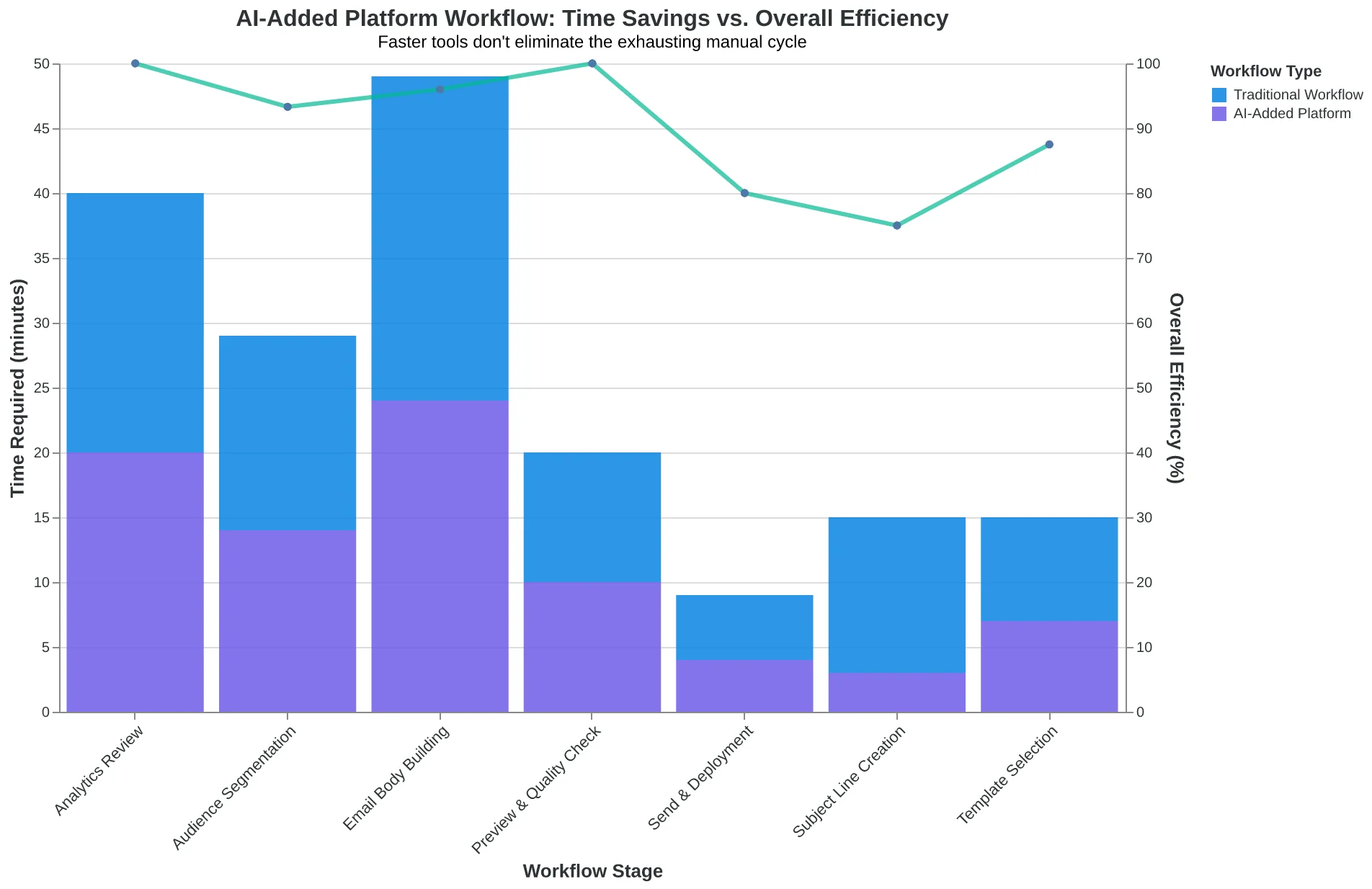
AI-added platforms: faster tools, same exhausting workflow
AI-first platforms eliminate the email creation workflow entirely by scoring quality before you send, while AI-added platforms just speed up the guessing. The difference isn't features — it's architecture.
Most email tools bolted AI onto a system designed for manual creation. They generate subject lines faster and suggest better copy, but you still build, preview, second-guess, and hope. AI-first platforms work differently: they measure email quality across 8 dimensions before you hit send, turning every campaign into a scored, optimized asset. One approach makes you faster at guessing. The other eliminates the guessing.
“AI-first platforms eliminate the email creation workflow entirely by scoring quality before you send, while AI-added platforms just speed up the guessing.”
This analysis comes from building an email platform from scratch in 2024 — not by adding AI features to an existing template library, but by asking: if you could design email marketing from zero today, knowing AI exists, what would you actually build?
The answer wasn't faster template editors. It was a system that knows whether an email will work before the customer sees it.
That insight led to developing an 8-dimension quality framework by studying what actually drives email performance across thousands of campaigns. Not what gets clicks in a demo. What converts in the real world.
The fundamentals haven't changed: 47% of recipients decide to open based on subject line alone. 69% report email as spam based on subject line alone. Segmented campaigns drive 760% increases in email revenue. These statistics have been true for years.
What's changed is that AI-first architecture finally makes them actionable for small businesses without agencies. The gap isn't features — every platform can generate subject lines now. The gap is whether the system understands quality before you hit send.
Traditional platforms added AI to speed up creation. That's solving the wrong problem. Creation was never the bottleneck. Confidence was. Small business marketers don't need faster ways to guess. They need to know their email will work.
That distinction — between AI that generates faster and AI that evaluates quality — is architectural. It can't be bolted on. You either designed for it from the beginning, or you're retrofitting speed into a workflow that still ends with the user wondering if their email is good enough.
“The gap isn't features — every platform can generate subject lines now. The gap is whether the system understands quality before you hit send.”
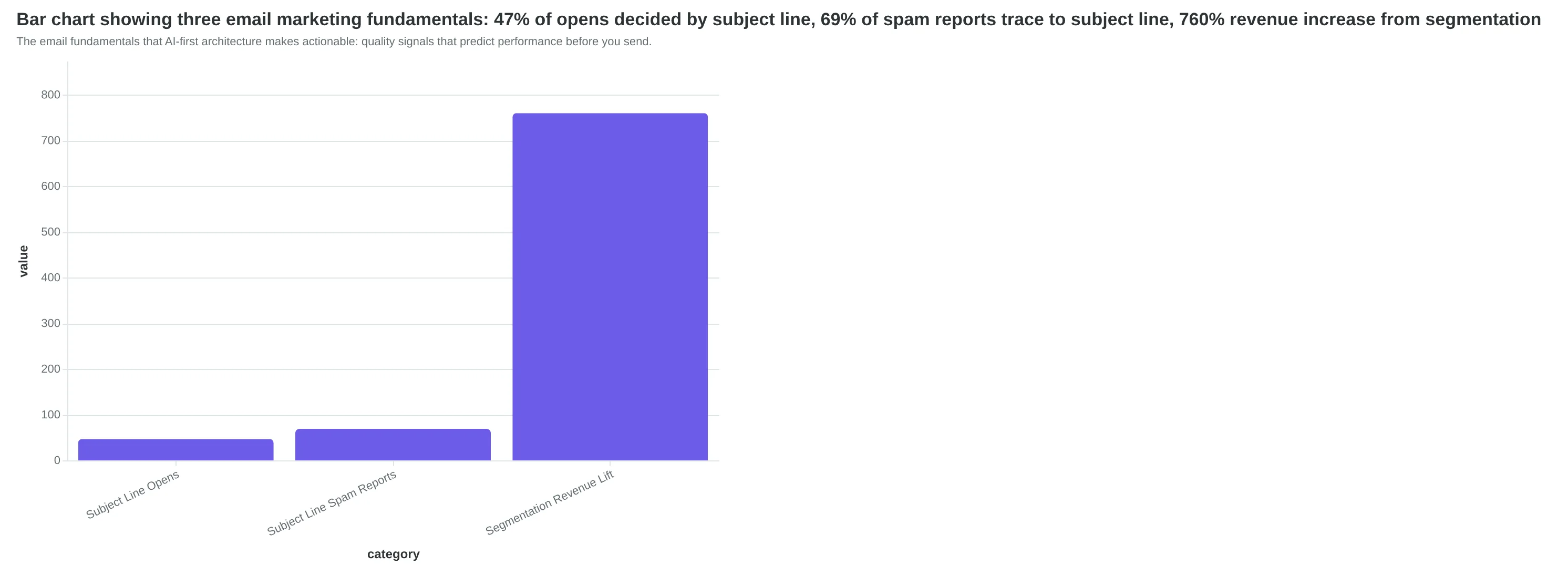
The email fundamentals that AI-first architecture makes actionable: quality signals that predict performance before you send.
The AI-First vs. AI-Added Framework: Where AI Sits Changes Everything
Tesla didn't become the leader in autonomous driving by adding cruise control to a Honda. They built the entire car around self-driving architecture from the ground up — sensors, processors, software stack, everything. The difference between AI-first and AI-added email platforms follows the same logic.
Most platforms today follow the AI-added workflow: start with the traditional email builder that's existed for 15 years, then bolt on AI features one at a time. A subject line generator here. A send time optimizer there. Maybe a template recommender. The user still assembles the email piece by piece, still guesses whether it'll work, still hits send hoping for the best. AI becomes a productivity tool — you create faster, but you're still steering blind. Measurement happens after the fact, when it's too late to fix what didn't land.
The AI-first workflow inverts this completely. Instead of starting with a blank canvas and hoping AI speeds up your guessing, the platform starts with a quality scoring architecture — an 8-dimension framework that evaluates emails before they're even created. AI doesn't just suggest a subject line. It evaluates what will actually drive customers through the door, then assembles the entire email based on that evaluation. The user's role shifts from creator to approver: you review a finished, pre-scored email that's already been validated against the same criteria your audience will judge it by. When you send, you're not hoping — you're deploying a 92/100 email with confidence baked in.
The architectural difference is WHERE AI sits in the workflow:
- AI-added platforms: User creates → AI assists → User assembles → Send → Measure outcomes
- AI-first platforms: AI evaluates quality criteria → AI creates based on what works → User approves → Send with score → Outcomes validate the score
Think of it like navigation systems. AI-added is cruise control — it maintains your speed, but you're still reading the map and choosing the turns. AI-first is a self-driving system that knows the destination and calculates the optimal route before the wheels turn. One makes the journey easier. The other gets you where you're going.
This matters because email marketing isn't measured by how fast you can hit send. It's measured by whether the email brings customers through the door. Email Marketing Isn't About Opens — It's About Customers, and AI-added platforms optimize for speed while AI-first platforms optimize for the outcome that actually pays the bills.
The framework has three comparison layers:
- Workflow Architecture — Where does AI enter the process, and what role does the user play?
- Quality Infrastructure — Does the platform evaluate emails against outcome-predictive criteria before sending, or only measure performance after?
- User Mental Model — Does the user think "I need to build an email" or "I need an email that scores 90+"?
Over the next three sections, we'll examine each layer with evidence from real platform workflows, technical architecture analysis, and the business outcomes that separate productivity from performance. Because if you're still assembling emails from scratch in 2025, you're not behind on features — you're running the wrong operating system.
“AI-added platforms help you create faster. AI-first platforms create what will work.”
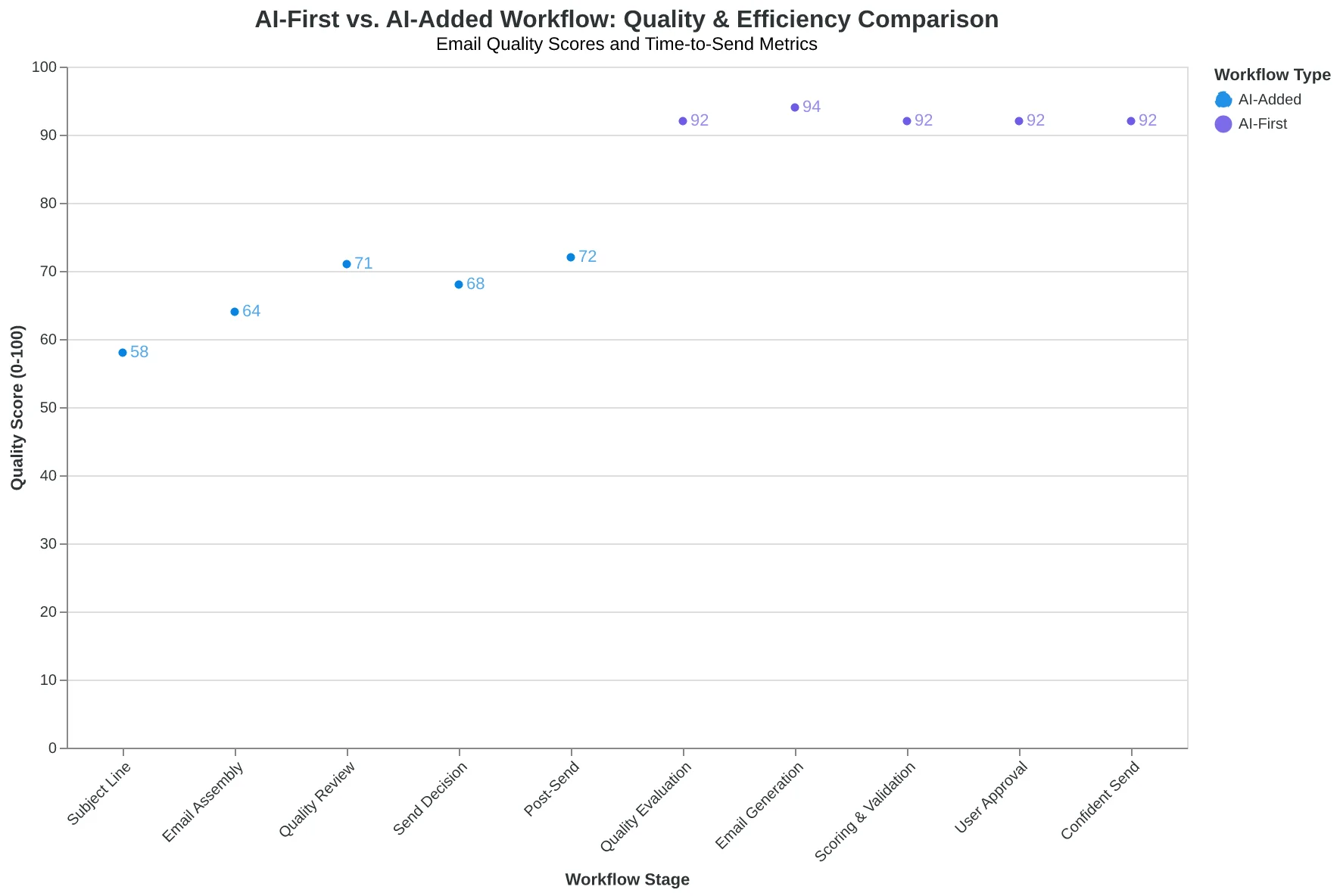
The AI-First vs. AI-Added Framework: AI-added platforms help you create faster. AI-first platforms create what will work.
Before
- ✗Cruise control maintains speed
- ✗Driver still steers and navigates
- ✗Human reads map and chooses route
- ✗Technology assists but doesn't decide
After
- ✓Self-driving knows destination
- ✓System calculates optimal route
- ✓AI navigates based on real-time data
- ✓Human approves, doesn't steer
The Tesla Analogy: AI-added is cruise control. AI-first is self-driving architecture.
The AI-Added Workflow: Speed Without Direction
Walk through a typical Tuesday morning email campaign in Mailchimp. You log in. You choose a template from their gallery — usually the same newsletter format you've used for months. You write your copy in the text boxes, tweaking headline phrasing three or four times because you're not sure what works. You upload images. You adjust spacing. You preview on mobile. Ninety minutes gone.
Then you click the AI subject line generator. Five options appear in seconds. "🎉 Don't Miss This Week's Special" or "Your Exclusive Offer Inside" or "Sarah, We Have Something For You." They look professional. You pick the one with the emoji because someone once told you emojis increase opens. You have no data on whether that's true for YOUR audience. You're guessing.
You schedule the send. Wednesday morning, you check the results. 18% open rate. Is that good? You're not sure. You have no benchmark for your industry, no breakdown of what worked and what didn't, no way to know if the subject line was the problem or the send time or the preview text you forgot to customize. You'll try something different next week. Maybe fewer emojis.
This is the AI-added paradigm. The platform gave you five subject lines in 10 seconds instead of spending 15 minutes writing them yourself. That's the AI contribution. But the 90 minutes of template selection, copywriting, and image placement? Still entirely manual. The decision about which subject line is actually good? Still a guess. The understanding of whether your 2-hour investment produced a quality email? Deferred until after 10,000 people see it.
AI shaved 5 minutes off a 2-hour process and called it transformation. The fundamental workflow didn't change. You're still:
- Building the email manually
- Making quality decisions without quality data
- Learning what worked only after it's too late to fix it
The subject line generator isn't connected to deliverability scoring. The Smart Recommendations for send time don't evaluate whether your email will render correctly on mobile. The campaign assistant doesn't tell you your preview text is truncated or your CTA is buried below the fold. Each AI feature exists in isolation — a faster way to execute the same guessing game.
Forty-seven percent of recipients decide whether to open based on subject line alone (OptinMonster / Zippia, 2023). Mailchimp's AI helps you generate those subject lines faster. But it doesn't tell you if the one you picked is in the winning 47% or the ignored 53%. Speed without direction is just faster failure.
“Speed without direction is just faster failure.”
AI-added platforms insert automation at step 5 of a 10-step process. Steps 1-4 and 6-10 remain unchanged — including the critical quality decisions.
The Expertise Dependency Trap: When AI Automates Everything Except the Hard Part
Klaviyo's K:AI represents the most sophisticated AI implementation in the AI-added category. It automates abandoned cart sequences, post-purchase flows, and win-back campaigns with impressive technical precision. The AI handles segmentation logic, trigger timing, and message variation at scale.
But here's what K:AI doesn't do: it doesn't tell you that you need a win-back flow. It doesn't explain when to trigger it (45 days of inactivity? 90 days?). It doesn't decide whether to offer a discount or tell a story. Those decisions require email marketing expertise.
The workflow K:AI automates looks like this: (1) learn email marketing strategy from courses or agencies, (2) design a flow architecture that maps to your customer journey, (3) write multiple message variations for each flow stage, (4) configure segmentation rules and trigger conditions, (5) let K:AI automate the execution, (6) analyze performance across segments, (7) optimize based on engagement patterns.
K:AI handles step 5 brilliantly. But steps 1 through 4 assume you already know what effective email marketing looks like. For enterprise brands with dedicated email teams, this is perfect — the AI multiplies their expertise. For the restaurant owner who just wants to send a good email to last week's customers, it's paralyzing.
The barrier to effective email marketing isn't execution speed — it's strategic knowledge. A small business owner doesn't need to send 47 automated flows. They need to know which ONE email to send right now that will bring customers back through the door.
AI-added platforms assume this knowledge exists. They automate the mechanics while leaving the strategy to you. The result: sophisticated tools that require sophisticated users. The gap between feature capability and business outcome remains wide.
AI-first platforms invert this model. Instead of automating workflow steps, they embed the strategic decisions. The system knows that a 30-day inactive customer needs a different message than a 90-day inactive customer. It understands that a discount erodes brand value while a story builds it. The expertise isn't required from the user because it's baked into the architecture.
This isn't about making email marketing "easier" in the sense of fewer clicks. It's about eliminating the dependency on knowledge most small businesses don't have time to acquire. The email gets created, scored, and sent because the system knows what good looks like — not because the user figured it out first.
“The barrier to effective email marketing isn't execution speed — it's strategic knowledge.”
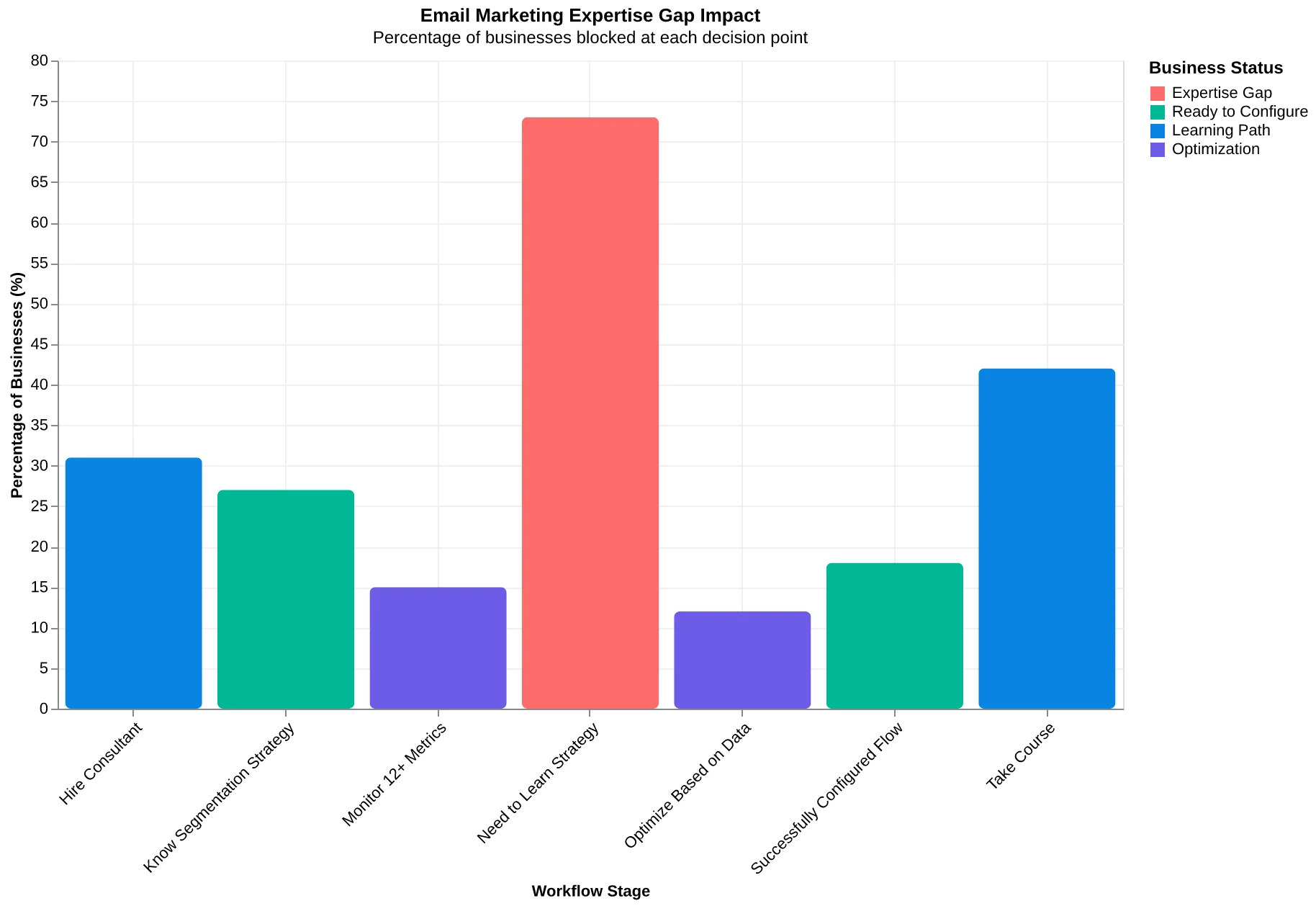
K:AI automates execution (green) but requires strategic expertise (red) before you can begin. The expertise gap blocks 73% of small businesses from effective email marketing.
| Decision Point | What K:AI Automates | What You Must Know |
|---|---|---|
| Flow Selection | Sends the flow you built | Which flows your business needs |
| Trigger Timing | Executes on your schedule | When to trigger (30d? 60d? 90d?) |
| Message Strategy | Personalizes your copy | Whether to discount or tell a story |
| Segment Logic | Applies your rules | How to segment your audience |
| Success Criteria | Tracks all metrics | Which metrics matter for your goal |
| AI-added platforms automate execution while assuming strategic expertise. The knowledge gap remains the primary barrier to effective email marketing. | ||
The Template Speed Trap: Why Fast Creation Without Quality Feedback Solves the Wrong Problem
Constant Contact's AI template generator represents the promise and the trap of AI-added email platforms. Describe your business in a few sentences, and the system generates a visually polished email template in under 30 seconds. Colors match your brand. Layout looks professional. The email exists.
But here's what the system doesn't tell you: whether the email will actually work.
The workflow is elegant in its simplicity: (1) describe your business, (2) AI generates a template, (3) add your content, (4) send. A small business owner who used to spend two hours wrestling with drag-and-drop builders now creates an email in 20 minutes. The time savings are real. The problem is that speed and effectiveness aren't the same metric.
The template might be beautiful. It might also have a subject line that triggers spam filters, a mobile layout that breaks on half of devices, and zero personalization depth. The business owner has no way to know. They've traded two hours of manual work for 20 minutes of faster guessing.
This is the quality blindness problem: AI-added platforms optimize for creation speed without providing any mechanism to evaluate if what you've created will drive results. The bottleneck for most small businesses isn't "I can't make an email fast enough." It's "I don't know if this email is good enough to bring customers through the door."
Consider the gap between template generation and business outcomes. Research shows segmented email campaigns drive 760% revenue increases compared to non-segmented sends (DMA / Campaign Monitor, 2015). But a fast template doesn't teach you how to segment, when to segment, or what segmentation strategy matches your business model. It gives you speed without strategy.
The difference between AI-added and AI-first platforms becomes stark here. AI-added platforms answer the question: "How can I make email creation faster?" AI-first platforms answer: "How can I make email creation result in more customers?" One optimizes the process. The other optimizes the outcome.
| Metric | Manual Creation | AI-Added Template | AI-First Approach |
|---|---|---|---|
| Time to Create | 120 min | 20 min | 25 min |
| Quality Feedback | None | None | Before Send |
| Deliverability Score | Unknown | Unknown | 8.7/10 |
| Business Outcome | Unknown | Unknown | Projected |
A template generator solves a symptom while leaving the disease untreated. The small business owner still sends emails into the void, hoping for replies that may never come — just faster than before.
“The bottleneck for most small businesses isn't 'I can't make an email fast enough.' It's 'I don't know if this email is good enough to bring customers through the door.'”
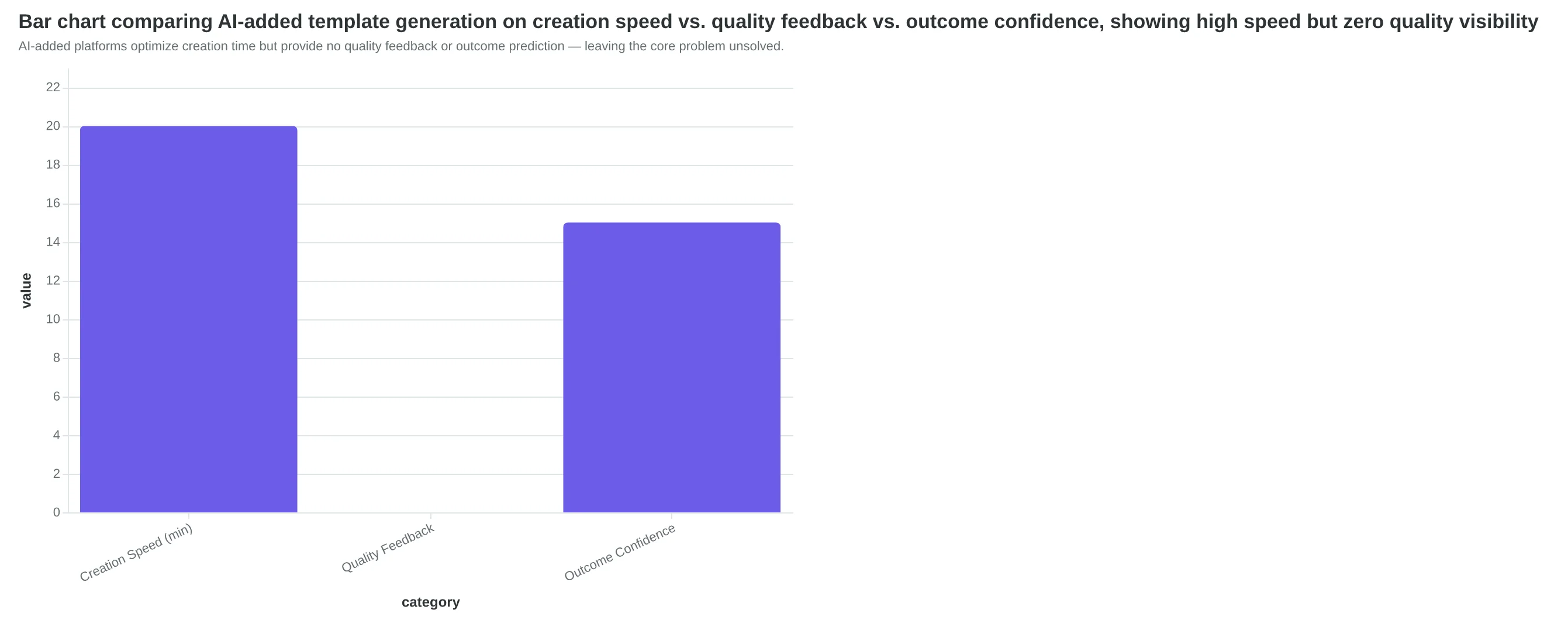
AI-added platforms optimize creation time but provide no quality feedback or outcome prediction — leaving the core problem unsolved.
But What If You Actually Want Control?
The strongest objection to AI-first platforms is legitimate: some businesses genuinely want manual control over every word. Their brand voice is so specific that templates feel generic. Their audience is so unique that pre-scored formulas miss nuance. Their offers change weekly, sometimes daily, and they need the flexibility to iterate without waiting for AI to catch up.
For these businesses — especially those with dedicated email strategists on staff — AI-added platforms are genuinely valuable. The strategist already knows what high-quality email looks like. They've A/B tested subject lines for years. They understand their open rates, their click patterns, their conversion paths. They don't need AI to teach them email marketing. They just want to execute faster. AI-added features give them speed without removing agency. That's worth paying for.
The objection is even stronger than it first appears: forcing AI on a team that doesn't trust it creates resistance. If your brand manager spent three years developing voice guidelines, they're not going to let an algorithm override them. Control isn't just preference — it's brand protection.
But here's the reframe: AI-first doesn't remove control. It removes guessing.
You can still review every subject line. You can still edit every sentence. You can still reject the AI's recommendation entirely and write from scratch. The difference is that you don't start from a blank screen, and you don't send blind. The small business owner who wants control still wants confidence. The question isn't "Do you want AI to do everything?" It's "Do you want to know if your email is good before you send it?"
AI-added platforms speed up creation. They can't answer whether what you created will work.
AI-first platforms score quality before you send. That's not control removal — that's decision support. And in an environment where SPF, DKIM, and DMARC authentication are now mandatory (Google (Gmail Bulk Sender Guidelines), 2024), where unauthenticated bulk mail is rejected by Gmail, Yahoo, and Microsoft, and where properly authenticated emails achieve 95%+ inbox placement compared to the 83.1% average (EmailToolTester, 2024) — control without knowledge isn't strategic. It's just guessing with extra steps.
The businesses that want control don't want less information. They want more. AI-first architecture gives them both.
“AI-first doesn't remove control. It removes guessing.”
How to Evaluate Email Platforms Through the AI-First Lens
You're comparing platforms. The demos look similar. Everyone promises "AI-powered email marketing." Here's how to tell who's actually built differently.
Ask these four questions:
1. Does the AI score quality BEFORE you send, or just analyze performance AFTER?
AI-added platforms show you open rates three days later. AI-first platforms show you a quality score before you hit send. The difference: one tells you what happened, the other prevents the mistake.
Look for platforms that surface a numerical quality assessment during creation — not in a post-send report. If you can't see the score until after your customers see the email, you're still guessing.
2. Does the AI require you to already know email marketing strategy, or does it embed best practices?
AI-added platforms assume you know what "good personalization" means. They'll help you write faster, but they won't tell you if what you wrote will work. AI-first platforms evaluate your content against deliverability standards, subject line psychology, mobile readability — the expertise you'd hire an agency for.
Test this: draft an email with a 70-character subject line and no personalization tokens. Does the platform flag it, or let you send it? AI-first systems catch problems. AI-added systems speed up problems.
3. Does the AI eliminate steps in your workflow, or just speed up existing steps?
AI-added platforms make step 4 (writing copy) faster. AI-first platforms eliminate steps 5-7 (guessing if it's good, A/B testing to find out, analyzing why it failed).
The restaurant owner who used to spend four hours per email — an hour writing, two hours second-guessing, another hour formatting for mobile — now spends 30 minutes. The system checked the numbers across deliverability, subject line effectiveness, content quality, mobile design. Score came back high. She sent it with confidence. That's not faster guessing. That's transformation.
4. Can you see a quality score, or do you have to guess if the email is good?
This is the simplest test. Open the platform. Create a draft email. Before you send, can you see a number that represents quality? Not engagement predictions. Not subscriber count. Quality.
If the answer is no, you're looking at AI-added. The architecture wasn't built to evaluate quality — it was built to generate content. Those are different problems requiring different solutions.
What AI-first looks like in practice:
You write your email. The system runs it through the scoring framework — checking authentication setup, subject line structure, personalization depth, content clarity, mobile optimization, link placement, CTA effectiveness. You see: 73/100.
The breakdown shows why: subject line is strong (18/20), but deliverability has authentication gaps (12/20) and your content is too text-heavy for mobile (14/20). You fix the SPF record, break up the paragraph, rescore. Now 89/100. You send knowing it'll work.
That visibility — seeing the score, understanding the gaps, fixing them before customers see the email — is what AI-first architecture enables. AI-added platforms can't do this because the AI was bolted onto a workflow designed for manual execution.
The business outcome:
You stop hoping your emails will work and start knowing they will. You stop paying agencies to tell you what went wrong and start preventing problems before they happen. You stop spending four hours per email and start spending 30 minutes.
The gap between these architectures isn't features. It's time, confidence, and revenue.
“The gap between these architectures isn't features. It's time, confidence, and revenue.”
| Question | AI-Added Answer | AI-First Answer |
|---|---|---|
| When do you see quality metrics? | After send (3-5 days) | Before send (during draft) |
| What does the AI evaluate? | Engagement predictions | 8-dimension quality score |
| Who needs to know email strategy? | You do | The system does |
| What workflow steps are eliminated? | None (just faster execution) | Guessing, A/B testing, post-failure analysis |
| Can you fix problems before sending? | No — you find out later | Yes — score shows gaps in real-time |
| Platform evaluation checklist: AI-added vs. AI-first architectural differences | ||
The Tesla Moment: What Happens When an Entire Category Rebuilds
We're watching the same transformation in email marketing that Tesla triggered in automotive. In 2012, most automakers bolted electric batteries onto existing gasoline platforms — "electric-added" cars that compromised on range, performance, and design. Tesla reimagined the entire vehicle from the ground up. The skateboard battery platform. The software-first interface. The over-the-air updates. Within a decade, every major manufacturer abandoned hybrid approaches and committed to native electric architectures.
Email marketing is at that exact inflection point right now.
AI-added platforms will incrementally improve their features. Better subject line suggestions. Faster template assembly. Smarter send-time optimization. These are real improvements — the equivalent of better gas mileage. But they're still building on a foundation designed for manual workflows. The user still creates, still guesses, still waits for open rates to know if they succeeded.
AI-first platforms are redefining what "email marketing" means. Not faster guessing — zero guessing. Not better tools — no tools to learn. The 8-dimension quality framework scores your email before you send, eliminating the trial-and-error cycle that keeps small businesses stuck. Authentication, segmentation, mobile optimization, deliverability — handled by architecture, not checklists.
The businesses adopting AI-first systems today will spend the next five years filling tables, booking appointments, and growing. Their competitors will still be learning Mailchimp.
This isn't about technology. It's about outcomes. AI-first platforms make professional-grade email marketing accessible to businesses that couldn't afford agencies or didn't have time to become experts. That democratization — turning guesswork into certainty — is the revolution. And it's already here.
“AI-first platforms make professional-grade email marketing accessible to businesses that couldn't afford agencies or didn't have time to become experts. That democratization — turning guesswork into certainty — is the revolution.”
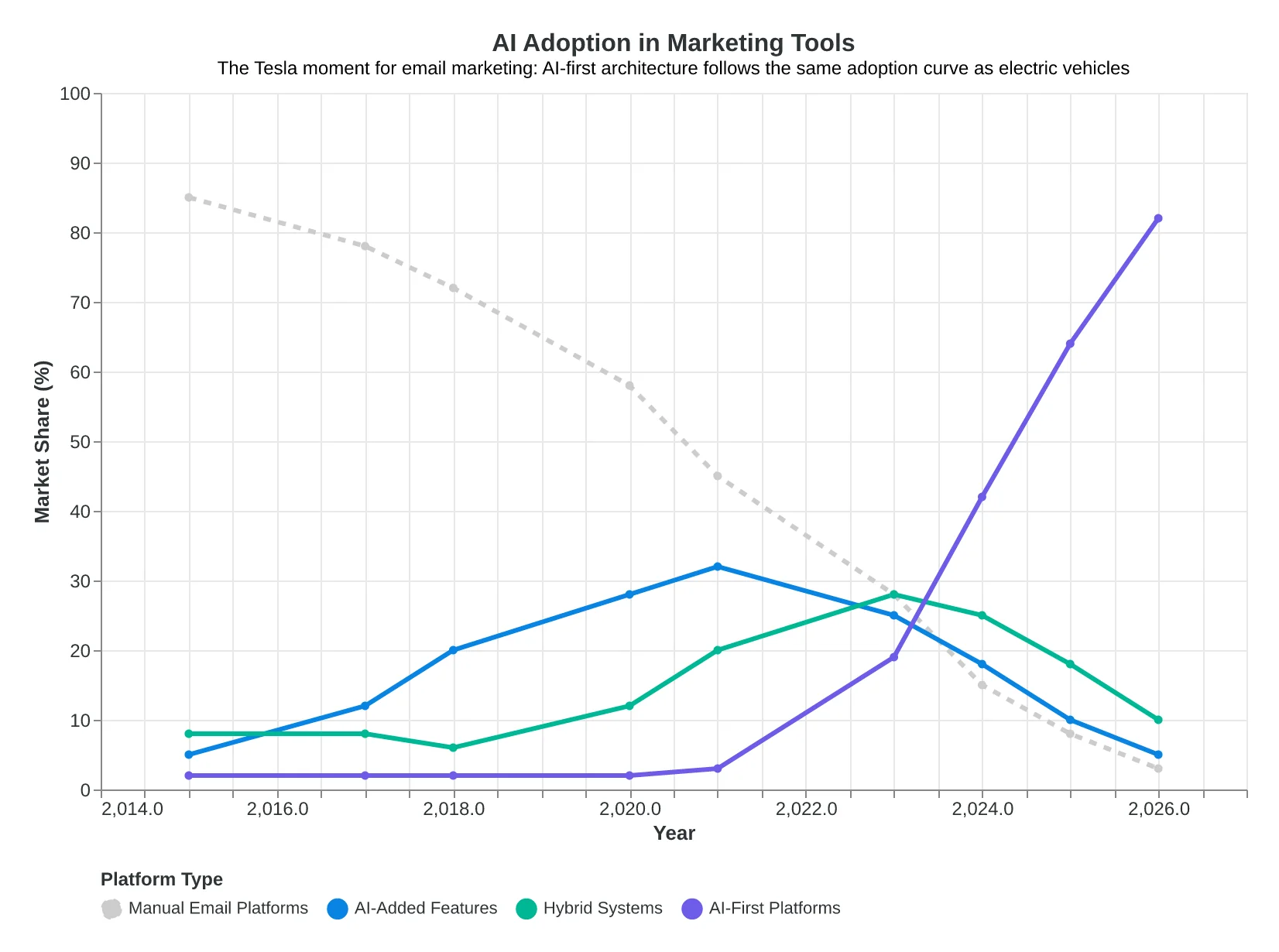
The Tesla moment for email marketing: AI-first architecture follows the same adoption curve as electric vehicles — optional feature to industry standard in under a decade
When Tesla started building cars, they didn't add electric motors to existing chassis. They redesigned everything from the ground up — battery placement, weight distribution, software integration. That's the difference between retrofitting and rethinking.
Email platforms work the same way. AI-added gives you a faster horse. AI-first gives you a car. Both will get you to your destination, but one requires you to know how to ride, and the other just requires you to approve the route.
The businesses winning at email aren't the ones with the most features. They're the ones who eliminated the guessing. They stopped asking "Will this subject line work?" and started asking "What score does this email need to hit before I send it?"
That shift — from creation workflow to quality workflow — is what The Complete Guide to Email Quality Scoring: 8-Dimension Framework for Better Performance explores in depth. It's the difference between hoping your emails work and knowing they will.
The next time you evaluate an email tool, ask one question: Does it help me create faster, or does it help me create better?
That's the difference between AI-added and AI-first. And that's the difference between sending emails and sending emails that work.
“The next time you evaluate an email tool, ask one question: Does it help me create faster, or does it help me create better?”
Ready to Score Your Own Emails?
See the difference between AI-added speed and AI-first quality. Try our free Email Quality Scoring tool — get your 8-dimension score before you send.